Memecoins Explained: What They Are and the Real Risks
A memecoin is a cryptocurrency whose value comes almost entirely from attention: a joke, an animal mascot, an internet trend, or a famous name. There is usually no product, no revenue, and no plan beyond getting more people to buy. Some have made early holders rich. Far more have gone to zero within days, and a meaningful share were built specifically to take your money. This page explains what memecoins actually are, why the pump-and-dump pattern repeats, how rug pulls and liquidity work, what the realistic odds look like, and a step-by-step way to research one before you risk a cent.
None of this is financial advice. The goal is to help a normal person understand what they are buying and lose less money to the obvious traps. If you only take one thing away: with memecoins you are not investing in a business, you are betting on whether more people show up after you, and the people who created the token usually know far more than you do.
What a memecoin actually is
Most cryptocurrencies at least claim to do something. Bitcoin aims to be a scarce digital money; Ethereum runs programs called smart contracts. A memecoin typically does neither. It is a token created as a joke or around a trend, and its price is driven by hype, social media, and speculation rather than by any underlying use. The first famous one, Dogecoin, started in 2013 as a parody of crypto itself.
The mechanics are simple, which is part of the problem. On a chain like Ethereum, BNB Chain, or Solana, anyone can create a new token in minutes, often for a few dollars and with no coding. Free launch tools and "token generator" sites mean the supply of new memecoins is effectively unlimited. So the scarce thing is never the token. The scarce thing is attention, and attention is exactly what marketing and bots can manufacture.
- No intrinsic value: there is rarely a product, cash flow, or asset behind it. Price is pure supply and demand for the token itself.
- Created cheaply and quickly: tens of thousands of new tokens can launch in a single day across chains.
- Driven by narrative: a tweet, a celebrity, or a trending animal can move the price far more than anything technical.
To understand the machinery underneath, it helps to read blockchain basics and crypto explained. A memecoin is just a token sitting on top of those systems, with the substance removed.
Why memecoins pump and dump
The pump-and-dump pattern is not a bug in memecoins, it is closer to the default behavior. It works because of who holds the supply and what they want.
At launch, a small group, often the creator and a handful of insiders, holds most of the tokens. The trading pool that lets ordinary people buy is small. So a little real buying, plus coordinated hype, makes the price jump fast. The early chart looks like a rocket. That chart is the marketing. New buyers see green candles and a flood of excited posts and rush in so they do not "miss out."
The dump is the other half. The insiders who hold most of the supply sell into all that fresh demand. Because they own so much and the pool is thin, their selling crashes the price. The people who bought near the top are left holding tokens worth a fraction of what they paid, and often nobody is buying at all.
- Concentrated supply: a few wallets own most of the tokens and can flood the market whenever they choose.
- Thin liquidity: small pools mean prices move violently in both directions.
- Manufactured urgency: "100x," "last chance," and countdowns exist to switch off your patience.
- Bots and coordination: identical hype replies and fake trading volume make demand look real.
The uncomfortable summary: in a pure memecoin, your profit can only come from someone buying after you at a higher price. When the new buyers stop arriving, the price has nowhere to go but down.
Rug pulls and liquidity, in plain terms
To trade a memecoin on a swap site, there has to be a pool holding both the token and something real, like ETH, BNB, SOL, or a stablecoin. That pool is the liquidity. It is what your buy and sell actually trade against, and it is the single most important thing to understand about scam tokens.
A rug pull is when the team removes that liquidity and disappears. If the creators control the pool, they can withdraw the real money inside it in one transaction, leaving holders with a token that can no longer be sold for anything. The price goes to near zero instantly. This is the classic memecoin scam, and it is depressingly common because it is so easy to set up.
The defense people rely on is locked liquidity. "Locked" means the pool tokens are held by a separate locker service or sent to a dead address for a set time, so the team cannot pull them. But read the details, not the word:
- Check the lock release date. Liquidity locked for two more weeks is a countdown, not protection. A multi-month or multi-year lock is a stronger signal.
- No lock at all on a brand-new token is one of the clearest rug-pull setups there is.
- Watch for a honeypot: a contract that lets you buy but quietly blocks selling, or charges a 90 to 100 percent fee on sells. The chart only goes up because almost nobody can get out.
- Watch for a contract that can still mint new tokens, which lets the team dilute you to nothing, or on Solana a freeze authority that can lock your wallet.
For the broader anatomy of these schemes, see crypto scams and fraud and the pre-purchase routine in how to spot a crypto scam before buying.
The realistic odds
It is worth being honest about what usually happens, because the marketing only ever shows the winners. The handful of memecoins that turned a small bet into a life-changing sum are real, and that is exactly why they get talked about constantly. Survivorship bias is the whole business model: you hear about the one lottery winner, never the millions of losing tickets.
The base rates are harsh. The vast majority of memecoins launched on automated platforms never gain meaningful traction, lose almost all their value quickly, or are abandoned soon after launch. Many are honeypots or rug pulls from the start. Even the tokens that pump can collapse just as fast once insiders sell, so a paper gain is not money until you have actually sold it and the funds are in a wallet you control.
A few framing points that keep expectations sane:
- Most go to zero or near it. Treat "this will be the next big one" as the least likely outcome, not the expected one.
- The chart is not demand, it can be theater. Fake volume and bots make dead tokens look alive.
- Timing is not skill. Getting out before the dump is mostly luck, and insiders have a head start you cannot match.
- The house has more information. The creator knows the supply split, the unlock dates, and when they plan to sell. You do not.
If you choose to participate anyway, the only sane mental model is that you are spending money you can fully afford to lose, the way you would treat a ticket to a show, not money you are counting on getting back.
How to research a memecoin before you buy
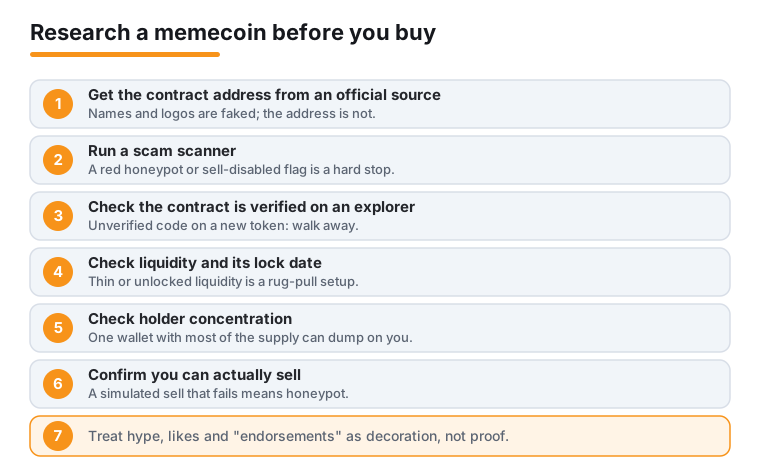
You cannot make a memecoin safe, but you can screen out the worst traps in about ten minutes with free tools and your own eyes. Do these checks in order and stop the moment one fails badly.
- Get the contract address from an official source. Names and logos are faked constantly. The contract address is the only thing that cannot be copied. Take it from the project's own site or a major data site, never from a reply in a comment section.
- Run it through a scam scanner. On Ethereum and BNB Chain, Token Sniffer gives a score plus a simulated buy-and-sell badge. On Solana, RugCheck flags unlocked liquidity, risky authorities, and concentrated holders. A red honeypot or "sell disabled" flag is a hard stop.
- Check the contract on a block explorer. Paste the address into Etherscan (or BscScan, or Solscan for Solana) and confirm the code is verified. Unverified code on a token asking for your money is a reason to walk away.
- Look at liquidity. How much real money is in the pool, and is it locked? Read the actual unlock date. Thin or unlocked liquidity is a major warning.
- Look at holders. On the explorer's Holders tab, ignore the pool and locker addresses, then add up the top wallets. If one wallet or a small cluster holds 30, 50, or 80 percent, they can dump on you at will.
- Confirm you can actually sell. Honeypot detectors and the scanner's swap badge simulate a sell before you risk money. If the simulated sell fails or the fee is near 100 percent, stop.
- Sanity-check the hype. Follower counts, likes, celebrity "endorsements," and screenshots of gains are all cheap to fake, increasingly with AI. Treat them as decoration, not evidence.
One caveat that matters: a clean check is a snapshot of the code right now, not a promise. Teams can wait, then raise the sell fee or mint new supply later. Passing these checks lowers your risk, it does not remove it.
Basic risk management
If you decide to participate anyway, the difference between a painful lesson and a wiped-out account is almost entirely about position size and habits, not about picking winners.
- Only spend money you can fully afford to lose. Assume any single memecoin can go to zero, because most do. Never use rent, savings, or borrowed money.
- Size the bet like entertainment. A small, fixed amount you have mentally written off already, not a position you are counting on to grow.
- Take a test buy first. Buy a tiny amount, then immediately try to sell part of it. If the sell works at a normal fee, the basic mechanics are real. If it fails, you learned the truth for a few dollars.
- Decide your exit before you enter. Pick in advance what would make you sell, in profit or in loss, and follow it. Greed and "it will come back" are how paper gains turn into total losses.
- Use a self-custody wallet you control and keep your main holdings separate from the wallet you use for risky tokens. See how to set up a self-custody wallet and crypto security.
- Manage token approvals. Never approve a spend you did not initiate, and revoke old approvals you no longer use, since a malicious approval can drain a wallet long after the fact. See revoke token approvals.
Remember that gains and losses can have tax consequences depending on where you live. Selling or swapping a token is often a taxable event. Keep records and check the rules; in the United States that means the IRS, and more generally your local crypto regulation and crypto taxes pages.
Memecoins vs real projects
Not everything that gets called a memecoin is a pure gamble, and not everything with a serious-sounding name is a real project. The useful question is not "is it a meme" but "is there anything here besides attention."
- Pure memecoin: no product, no revenue, no roadmap that matters. Value is entirely narrative and momentum. This is the highest-risk category and the one most likely to be a scam.
- Memecoin with a community: still speculative, but with a large, durable base of holders and some staying power. The older, well-known names sit here. Risk is high but the token is less likely to vanish overnight.
- Utility token or established asset: backed by an actual network, application, or use, with public teams and audited code. Different risk profile entirely, though still volatile.
A few honest distinctions to hold onto. A clever name and a big following do not create value; they create attention, which can evaporate. Real adoption is dull and slow: a working product, paying users, code you can verify, and time. The flashier and more urgent the pitch, the more skeptical you should be. Regulators including the SEC repeatedly warn that promises of guaranteed or risk-free high returns, pressure to act now, and fake claims of government endorsement are hallmarks of fraud. No real regulator endorses any token.
If you want to see what a project with actual fundamentals looks like for comparison, the crypto comparisons page is a more grounded starting point than any trending ticker.
Bottom line
Memecoins are entertainment dressed up as investing. They can move fast in both directions, and the people who created them almost always know more than you do about when the music stops. A small minority make money; most lose, many to outright scams.
If you stay away entirely, that is a perfectly rational choice and you have missed nothing you could reliably have captured. If you choose to play, do it with money you have already written off, do the ten-minute research routine every single time, size positions like a night out rather than a retirement plan, and keep your real savings in a wallet and assets you actually understand. Above all, treat any token whose entire case is a chart and a hashtag as the lottery ticket it is.
This article is educational only and is not financial advice. Do your own research and consider speaking to a licensed professional before making decisions about your money.
Frequently asked questions
What is the difference between a memecoin and a regular cryptocurrency?
A regular cryptocurrency usually claims some function: a payment network, a smart-contract platform, or another use. A memecoin generally has no product, revenue, or plan, and its price comes almost entirely from attention, hype, and speculation around a joke, trend, or name. That makes memecoins far more volatile and far more likely to be abandoned or to be an outright scam.
Why do most memecoins go to zero?
At launch a small group of insiders usually holds most of the supply, and the trading pool is thin. Hype draws in new buyers, the insiders sell into that demand, and because they own so much the price collapses. Many tokens are also rug pulls or honeypots from the start. Since your profit can only come from someone buying after you at a higher price, once new buyers stop arriving the price has nowhere to go but down.
How can I tell if a memecoin is a scam before buying?
Run the contract address through a scam scanner and check whether a simulated sell passes. On a block explorer like Etherscan or Solscan, confirm the code is verified, look at how much liquidity is in the pool and whether it is locked with a real future unlock date, and check whether one or a few wallets hold most of the supply. A failed sell, unlocked liquidity, or extreme holder concentration each ends the decision. Always copy the address from an official source, since fake tokens reuse real names.
What is a rug pull?
A rug pull is when the team behind a token removes the liquidity pool, the real money that backs trading, and disappears. Holders are left with a token that can no longer be sold for anything, and the price drops to near zero instantly. Locked liquidity, held by a separate locker or burned for a set time, is the main defense, but you must read the unlock date: a lock expiring in a couple of weeks is a countdown, not protection.
Can you actually make money on memecoins?
Some people have, which is exactly why those stories get repeated. But that is survivorship bias: you hear about the rare winners, not the many losing bets. The base rates are harsh, most memecoins lose nearly all their value quickly, and a paper gain is not real until you have sold and the funds are in a wallet you control. If you play, treat it as money you can fully afford to lose, not an investment you are counting on.
Is buying memecoins financial advice or a safe investment?
No. This page is educational only and not financial advice, and memecoins are among the highest-risk things in crypto. They are closer to a lottery ticket than an investment, with a real chance the token goes to zero or turns out to be a scam. Selling or swapping can also trigger taxes depending on where you live. Do your own research, keep amounts small, and consider speaking to a licensed professional before risking money you cannot afford to lose.
Last updated: 2026.