Blockchain Basics: How It Works
A blockchain is a shared digital record that many independent computers keep in sync, so that no single company, bank, or government has to be trusted to hold the official copy. It is the technology that made Bitcoin possible in 2009, and it now underpins thousands of cryptocurrencies as well as experiments in finance, supply chains, and digital identity. The core idea is deceptively simple: instead of one organization maintaining the master database, a network of participants all hold the same continuously updated ledger and follow the same rules for adding to it.
This guide explains what a blockchain actually is, how new entries get added and agreed upon, the difference between open public networks and closed private ones, and where the technology genuinely helps versus where it falls short. It is educational only and is not financial, legal, or tax advice. Crypto and blockchain regulation vary widely by country and continue to change, so verify anything that affects your money or your business with an official or professional source before acting.
What is a blockchain?
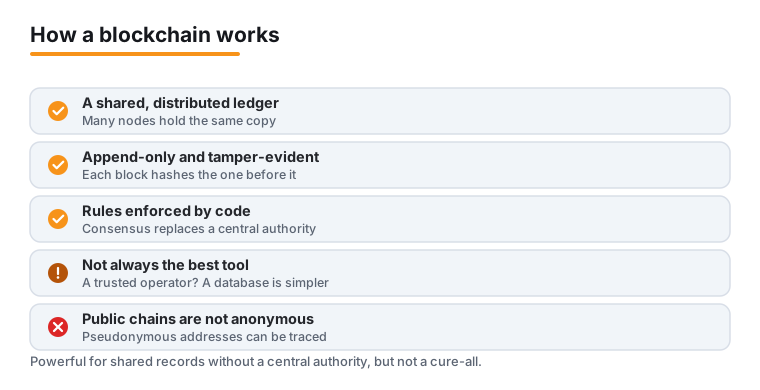
At its simplest, a blockchain is a database structured as a chain of blocks. Each block holds a batch of records, usually transactions, along with a timestamp and a cryptographic reference to the block before it. Linking blocks in this way creates an ordered, append-only history: new entries are added to the end, but old entries are not edited or deleted. The result is often described as a ledger, because for cryptocurrencies it records who sent what to whom.
Three properties make a blockchain different from an ordinary database run by one company:
- It is distributed. Many computers, often called nodes, each keep a full copy of the ledger. There is no single master server everyone depends on, and so no single point of failure or control.
- It is append-only and tamper-evident. Because each block is cryptographically tied to the one before it, changing an old record breaks the chain in a way every participant can detect; rewriting history would mean redoing the work for that block and every block after it, across the whole network at once.
- It is rule-based rather than authority-based. Participants agree in advance on what counts as a valid transaction and block, and software enforces those rules automatically. Trust sits in transparent code and a network majority rather than in any one institution.
The cryptography that ties it together relies on hashing. A hash function turns any data into a short, fixed-length fingerprint, and changing even one character of the input changes the fingerprint completely. Because each block stores the hash of the previous block, tampering with a buried transaction changes its block's fingerprint so it no longer matches the reference stored in the next block, making the alteration immediately obvious to everyone running the software.
A common point of confusion is the relationship between blockchain and Bitcoin. Bitcoin was the first application to combine these ideas into a working, decentralized digital currency, but the underlying blockchain concept is more general and now supports many other networks and uses.
How blocks & consensus work
The hardest problem a blockchain solves is agreement. If thousands of computers each keep a copy of the ledger and anyone can broadcast a transaction, how does the whole network settle on a single, correct history without a central referee? The answer is a consensus mechanism: rules and incentives that let independent participants converge on the same version of events. Here is the life of a transaction on a public network like Bitcoin.
From transaction to confirmed block
- Broadcast. You sign a transaction with your private cryptographic key, proving you own the funds, and your wallet announces it to the network. Anyone can check the signature without learning the secret key.
- Validation and queuing. Nodes independently check the transaction against the rules, for example that the coins exist and have not already been spent, and place valid ones in a waiting pool.
- Block creation. Participants gather pending transactions into a candidate block and compete for the right to add it to the chain.
- Confirmation. Once a block is accepted, it is appended to every copy of the ledger. Your transaction now has one confirmation; each later block deepens it and makes reversal exponentially harder.
Proof of work and Nakamoto consensus
Bitcoin secures this process with proof of work, the heart of what is often called Nakamoto consensus after Bitcoin's pseudonymous creator, Satoshi Nakamoto. Participants known as miners race to solve a hard mathematical puzzle that has no shortcut: finding a solution takes enormous trial-and-error computation, but verifying one is instant. The first to solve it earns the right to add the next block and collects newly issued coins plus the transaction fees inside that block.
This makes cheating expensive rather than impossible: to rewrite confirmed history, an attacker would have to redo the proof-of-work for the target block and outpace the combined power of every honest miner. When two valid blocks appear at almost the same time, the network treats the longest chain, the one with the most accumulated work, as the truth and discards the shorter branch. This is the practical meaning of "the majority rules" in Bitcoin: not a vote of people, but a contest of computational effort.
Mining rewards and the halving
Mining does two jobs at once: it secures the ledger and introduces new coins on a fixed, predictable schedule. Bitcoin's block reward is cut in half roughly every four years, an event called the halving. It began at 50 BTC per block in 2009 and has stepped down repeatedly; following the April 2024 halving it stands at 3.125 BTC per block, and the next halving is expected around 2028. This shrinking issuance is what enforces Bitcoin's hard cap of 21 million coins over time.
Other consensus mechanisms
Proof of work is secure but energy-intensive, so many newer networks use alternatives. The most common is proof of stake, where participants called validators lock up ("stake") their own coins for the right to propose and check blocks; dishonest behavior can cost them that stake. Ethereum, the second-largest blockchain, switched from proof of work to proof of stake in an upgrade known as The Merge in September 2022, which the project reports cut its energy use by roughly 99.95 percent. Different mechanisms balance security, decentralization, speed, and energy use differently, a set of trade-offs developers often call the "blockchain trilemma."
Public vs private
Not all blockchains are open to the world. A major design choice is who is allowed to read the ledger, submit transactions, and help reach consensus. This splits the technology into two broad families, with several variations in between.
Public (permissionless) blockchains
Public blockchains such as Bitcoin and Ethereum are open to anyone. You do not need permission to download the software, hold an address, send a transaction, or run a node that verifies the rules. The ledger is fully visible: every transaction is recorded in what is essentially a giant open book that anyone can audit. Crucially, this transparency does not mean your name is attached. Identities are represented by alphanumeric addresses rather than personal details, so the network is pseudonymous rather than anonymous: outsiders can see that an address sent funds, much as one might see that a spaceship landed without knowing who the astronaut is, but they do not automatically know who controls it. With enough analysis, and especially where regulated exchanges have verified a user's identity, activity can often still be traced.
Private (permissioned) blockchains
A private or permissioned blockchain restricts participation. A known group, often companies in a shared industry, controls who can join, view records, and validate transactions. These networks trade some decentralization for speed, privacy, and control, which can suit a business that wants a blockchain's tamper-evidence without exposing data publicly or relying on anonymous validators. The cost is that participants must trust the gatekeepers, moving a permissioned ledger closer to a conventional shared database than to Bitcoin's open model.
| Aspect | Public (permissionless) | Private (permissioned) |
|---|---|---|
| Who can participate | Anyone, without approval | Only approved members |
| Transparency | Ledger is open to all | Visible only to permitted parties |
| Decentralization | High; no central operator | Lower; controlled by an organization or consortium |
| Speed and cost | Can be slower and fee-driven when busy | Typically faster and cheaper |
| Typical use | Cryptocurrencies, open applications | Enterprise record-keeping, inter-company workflows |
Between these poles sit consortium blockchains, jointly governed by several organizations, and hybrid designs that keep some data private while anchoring proofs to a public chain. The right choice depends on whether openness or privacy and control matter more for the task.
Use cases & limits
Blockchain's first and still most proven use is digital money: sending value directly between people, across borders and at any hour, without a bank approving the transfer. This can lower the cost and time of remittances and give people in places with unstable currencies or limited banking a way to hold and move value with only a phone and an internet connection. That describes what the technology enables; it is not a recommendation to buy any asset.
Smart contracts
A pivotal step beyond simple payments was the smart contract, popularized by Ethereum. A smart contract is code stored on the blockchain that runs automatically when agreed conditions are met, for example releasing a payment only once a delivery is confirmed. Because the logic executes on the network rather than through a middleman, smart contracts power decentralized finance applications, automated marketplaces, and digital collectibles. They are powerful but unforgiving: a flaw in the code can be exploited, and once deployed it generally behaves exactly as written.
Beyond cryptocurrency
Organizations are exploring blockchains wherever a shared, tamper-evident record among parties who do not fully trust each other would help:
- Supply chains: tracking a product from origin to shelf, making it easier to verify authenticity and trace recalls.
- Healthcare records: an auditable trail of who accessed or changed sensitive patient data.
- Voting: recording ballots transparently and tamper-resistantly, though secure elections involve many challenges beyond the ledger itself.
- Digital identity: proving credentials without handing a copy of every document to each service.
Many of these remain pilots rather than mainstream systems, and a blockchain is not always the best tool; where a single trusted operator is acceptable, an ordinary database is usually simpler, faster, and cheaper.
Real limitations
The same features that make blockchains trustworthy also create genuine constraints:
- Scalability: requiring every node to process and store every transaction limits how many a network can handle, which can mean slower confirmations and higher fees when demand spikes. Bitcoin's Lightning Network and other "layer-two" systems ease this by settling many small payments off-chain and recording the net result on the main chain.
- Energy use: proof-of-work networks consume substantial electricity. Proof of stake reduces this sharply for many newer chains, but it remains a real criticism of proof-of-work systems.
- Privacy trade-offs: on public chains, openness is the point, so transactions are permanently visible, which can conflict with the desire for financial privacy.
- Irreversibility and user risk: a confirmed transaction generally cannot be undone, and whoever holds the private keys controls the funds. Most losses come from scams, mistakes, and lost keys rather than from flaws in the blockchain itself.
- Complexity and regulation: the technology is hard for newcomers, and laws governing crypto, lending, and trading vary by country and keep evolving.
The takeaway is balanced: blockchains are a powerful way to coordinate a shared record without a central authority, and they shine where transparency and tamper-resistance matter most, but they are not a cure-all. This overview is educational and not financial, legal, or tax advice; for anything affecting your money or compliance obligations, confirm the current rules with an official source or a qualified professional.
Frequently asked questions
What is the difference between Bitcoin and blockchain?
Blockchain is the underlying technology: a shared, tamper-evident ledger maintained by a network of computers. Bitcoin is one application built on a blockchain, specifically the first decentralized digital currency. All Bitcoin runs on a blockchain, but blockchains can also support other cryptocurrencies and uses such as smart contracts, supply-chain tracking, and digital identity.
Can data on a blockchain be changed or deleted?
In practice, no. Records are append-only, and each block is cryptographically linked to the one before it, so altering an old entry would break the chain in a way the whole network detects. On a proof-of-work network, rewriting confirmed history would require redoing the computational work for that block and every later block faster than the rest of the network combined, which is prohibitively expensive.
Is a blockchain anonymous?
Public blockchains are pseudonymous rather than anonymous. Activity is tied to alphanumeric addresses, not your legal name, but every transaction is permanently visible to anyone, and regulated exchanges usually verify identity when you buy or sell. With analysis, addresses can often be linked to real-world identities.
What is a consensus mechanism?
It is the set of rules and incentives a network uses to agree on a single, correct version of the ledger without a central authority. Bitcoin uses proof of work, where miners expend computing power to add blocks and the longest valid chain is treated as the truth. Many newer networks use proof of stake, where validators lock up their own coins and can lose them for cheating; Ethereum switched to proof of stake in 2022.
Do all blockchains use mining and consume a lot of energy?
No. Mining and high energy use are specific to proof-of-work networks such as Bitcoin. Proof-of-stake networks replace mining with validators who stake coins instead of solving puzzles, which dramatically lowers electricity use; Ethereum reported a roughly 99.95 percent reduction after moving to proof of stake. Energy consumption depends on which consensus mechanism a given blockchain uses.
Last updated: 2026-06.