Bitcoin Mining: How It Works
Bitcoin mining is the process that keeps the Bitcoin network running without any central authority. Miners use specialized computers to validate transactions, bundle them into blocks, and secure the shared ledger, and in return they compete for newly issued bitcoin and transaction fees. It is the mechanism that turns electricity and computing power into network security.
This guide explains what mining actually does, how the underlying proof-of-work system works, the hardware that dominates today (and why), and how mining pools let smaller participants earn steadily. We also touch on profitability, energy use, and security, because those are the questions most newcomers run into first. This article is educational and is not financial, legal, or tax advice; mining economics and regulations vary widely by location, so verify specifics with official and up-to-date sources before committing money or hardware.
What is Bitcoin mining?
Bitcoin mining is how new transactions are confirmed and how new bitcoin enters circulation. Rather than a bank deciding which payments are valid, the network relies on thousands of independent computers (miners) that compete to add the next block of transactions to the blockchain. The blockchain is simply an ordered, public record of every confirmed transaction since Bitcoin launched in 2009.
Mining serves three jobs at once:
- Transaction validation. Miners check that each transaction is legitimate, the sender actually owns the coins, and the same coins are not being spent twice (preventing "double-spending").
- Ordering and timestamping. By packaging transactions into a sequence of blocks, miners establish an agreed order of events that everyone can verify independently.
- Issuance. Each new block creates a fixed amount of new bitcoin, called the block subsidy, which is paid to whichever miner produced that block.
When a miner successfully adds a block, it collects two things: the block subsidy plus the transaction fees attached to the transactions in that block. As of 2026 the subsidy is 3.125 BTC per block, following the April 2024 "halving" that cut it from 6.25 BTC. Roughly every four years (about every 210,000 blocks) the subsidy halves again; the next reduction is expected around 2028. A new block is found roughly every ten minutes on average, which works out to about 144 blocks per day. Over time, as the subsidy shrinks, transaction fees are expected to make up a growing share of miner income.
The often-used "digital gold mining" metaphor is loose. Miners are not digging up hidden coins; they are running computations that secure the ledger, and the new coins are a reward for doing that work honestly. That reward is what makes attacking the network far more expensive than simply participating in it.
Proof of work explained
Proof of work (PoW) is the rule that decides who gets to add the next block. The core idea: producing a valid block must be computationally hard and costly, but checking that block must be trivially easy for everyone else. That asymmetry is what makes the network secure.
Here is the mechanism in plain terms. To create a block, a miner takes the block's data (the transactions, a reference to the previous block, a timestamp, and a changeable number called a nonce) and runs it through the SHA-256 hash function. A hash is a fixed-length string of characters that looks random and changes completely if the input changes even slightly. The network requires the resulting hash to fall below a certain target value, which in practice means it must start with a specific number of leading zeros.
There is no shortcut to find an input that produces such a hash. Miners simply change the nonce and re-hash, over and over, billions of times per second, until one of them stumbles onto a valid result. This guessing race is why mining consumes so much electricity. The first miner to find a valid hash broadcasts the block; every other node can verify it with a single hash computation and, if it checks out, accepts it and moves on.
Two related concepts matter:
- Difficulty adjustment. Roughly every two weeks (every 2,016 blocks), the network automatically raises or lowers the difficulty so that blocks keep arriving about every ten minutes, regardless of how much total mining power has joined or left. More miners means higher difficulty, not faster blocks.
- Hashrate. This is the total number of hash attempts the whole network performs per second. A higher hashrate means more security, because an attacker would need to out-compute the entire honest network to rewrite history. Bitcoin's network hashrate reached new highs in early 2026, surpassing roughly 800 exahashes per second (EH/s).
Because rewriting a past block would require redoing its proof of work and out-pacing everyone else simultaneously, tampering becomes economically irrational. That is the security guarantee PoW provides: honesty is cheaper than cheating.
Mining hardware (ASIC)
In Bitcoin's earliest days people mined with ordinary CPUs, then graphics cards (GPUs), then field-programmable chips. Today, serious Bitcoin mining is done almost entirely with ASICs (Application-Specific Integrated Circuits): chips built to do one thing, SHA-256 hashing, as fast and efficiently as physically possible.
ASIC vs GPU: why ASICs won for Bitcoin
GPUs are versatile and can mine many different cryptocurrencies or be repurposed for gaming, AI workloads, or rendering. ASICs are the opposite: they are locked to a single algorithm and cannot adapt if you want to mine something else. For Bitcoin specifically, that specialization is exactly the point. An ASIC can be thousands of times more efficient at SHA-256 than a high-end GPU, which means a GPU mining Bitcoin today earns essentially nothing after electricity costs. GPUs remain relevant for other proof-of-work coins, but for Bitcoin the practical answer is ASIC.
| Factor | ASIC | GPU |
|---|---|---|
| Bitcoin efficiency | Extremely high | Very low (uncompetitive) |
| Flexibility | Bitcoin/SHA-256 only | Many coins and other uses |
| Upfront cost | High per unit | Moderate per card |
| Resale / repurposing | Limited | Broad |
Reading the key specs
Two numbers dominate ASIC shopping:
- Hashrate (TH/s). How many trillions of hashes per second the unit produces. More is better, but only relative to power use.
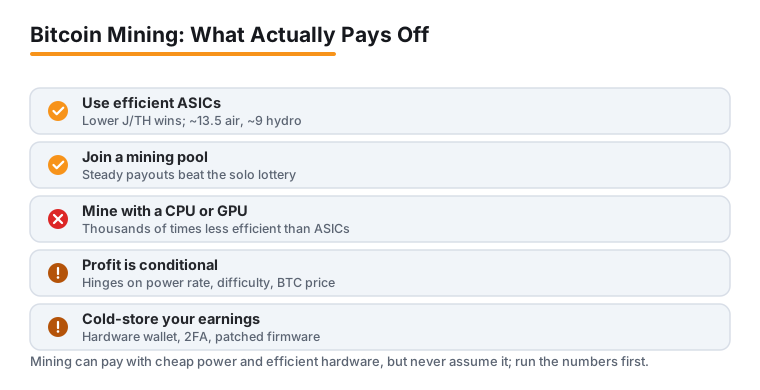
- Efficiency (J/TH). Joules consumed per terahash, the single most important figure. Lower is better. In 2026 the most efficient air-cooled units are around 13.5 J/TH, while top hydro-cooled models reach into the single digits (roughly 9 to 10 J/TH). Older machines above about 25 J/TH struggle to be profitable at typical electricity prices.
Beyond the headline specs, real-world mining requires planning for heavy, continuous power draw, substantial heat output and cooling (fans, immersion, or hydro), noise, and access to firmware and replacement parts. ASICs also have a limited competitive lifespan: as newer, more efficient models launch and difficulty rises, older units are pushed toward retirement, which is a real cost and a source of electronic waste to factor in.
Mining pools
Because the network hashrate is so enormous, a single small miner could go years between finding a block on their own. The odds of solo success scale with your share of the total hashrate, and for most participants that share is tiny. Mining pools solve this by letting many miners combine their hashrate and share rewards proportionally.
How a pool works
Members point their machines at the pool's server and work on the same block together. The pool tracks each member's contribution using "shares" (proofs that a miner is doing valid work at a lower difficulty). When the pool as a whole finds a block, the reward is split among members according to how many shares each contributed, minus a small pool fee. The result is smaller but far more frequent and predictable payouts, instead of the all-or-nothing lottery of solo mining.
Reward methods
- PPS (Pay-Per-Share). The pool pays a fixed amount for each valid share you submit, regardless of whether the pool finds a block. This gives steady, low-variance income, but pools usually charge a higher fee to absorb the risk.
- PPLNS (Pay Per Last N Shares). You are paid only when the pool actually finds a block, based on your shares over a recent window. Rewards are more variable and tend to favor consistent, longer-term participation, but fees are often lower and payouts can be higher over time.
- Variations. Many pools offer hybrids (such as FPPS, which adds transaction fees into a PPS-style payout). Always read how a specific pool defines its method before joining.
Choosing a pool
Weigh fee structure, payout method and minimum payout threshold, the pool's size and reliability, payout frequency, supported regions, and its security and uptime track record. A profitability calculator can help you estimate net earnings for your specific hardware and electricity rate before committing.
The centralization trade-off
Pools make mining accessible, but they concentrate decision-making power. If a few large pools control most of the network hashrate, that raises theoretical centralization and censorship concerns, even though the individual miners within those pools can usually switch elsewhere at any time. Spreading hashrate across multiple independent pools is widely seen as healthier for the network, and some newer protocols aim to give individual miners more control over the transactions they help confirm.
Frequently asked questions
Is Bitcoin mining still profitable in 2026?
It can be, but profitability is highly conditional and not guaranteed. The main variables are your electricity rate, the efficiency of your hardware (measured in J/TH), the bitcoin price, network difficulty, and pool fees. In 2026, efficient modern ASICs paired with cheap power can be viable, while older or inefficient machines often lose money at typical electricity prices. Run the numbers with a current profitability calculator using your real electricity cost before buying anything. This is not financial advice.
Can I mine Bitcoin with a regular PC or graphics card?
Technically you can run mining software, but for Bitcoin specifically it is not worthwhile. CPUs and GPUs are thousands of times less efficient at SHA-256 hashing than ASICs, so you would spend far more on electricity than you could ever earn. GPUs can still be used for some other proof-of-work cryptocurrencies, but competitive Bitcoin mining effectively requires purpose-built ASIC hardware.
How much does mining harm the environment?
Mining is energy-intensive by design, and its environmental impact depends heavily on the energy source. A growing share of mining uses renewables (hydro, wind, solar), geothermal power, or otherwise-wasted energy such as flared natural gas, which can reduce emissions and even capture methane that would have escaped anyway. Critics point to overall electricity demand, grid strain, and electronic waste from retired hardware. The honest answer is that the footprint varies enormously by operation and region. Industry-reported sustainability figures should be checked against independent sources.
How do I keep a mining operation secure?
Treat it as both a financial and a cybersecurity exercise. Store earned bitcoin in a hardware (cold) wallet rather than leaving it on an exchange or a connected device, and consider multi-signature setups for larger holdings. Protect your accounts with strong, unique passwords and two-factor authentication, stay alert to phishing, and keep mining firmware and software patched. On the physical side, manage heat with adequate cooling, ensure safe electrical wiring suitable for sustained high load, and set up monitoring and alerts so you notice failures or intrusions quickly.
What is the difference between the block subsidy and transaction fees?
The block subsidy is the new bitcoin created with each block (3.125 BTC as of 2026), and it halves roughly every four years until issuance eventually ends. Transaction fees are paid by users to have their transactions included in a block, and they go to the miner on top of the subsidy. As the subsidy continues to shrink with each halving, fees are expected to become an increasingly important part of miner revenue.
Last updated: 2026-06.