Bitcoin Mining: Energy Use & Profitability
Bitcoin mining sits at the intersection of two questions that rarely get answered together: can it make money, and what does it do to the grid and the climate? Both matter, and both have shifted as the network has matured. Mining is now an industrial business dominated by large data centres chasing cheap power, not a hobby you run from a spare bedroom. This guide explains how mining economics actually work, how much electricity the network uses and where that figure comes from, the real state of the renewables-versus-carbon debate, and what it takes to start. The aim is to give you a clear, current picture so you can judge claims for yourself rather than relying on headlines. Figures here are estimates from third-party research and change constantly, so treat them as orientation and verify specifics against primary sources before acting on them. None of this is financial, tax, or legal advice.
Mining profitability
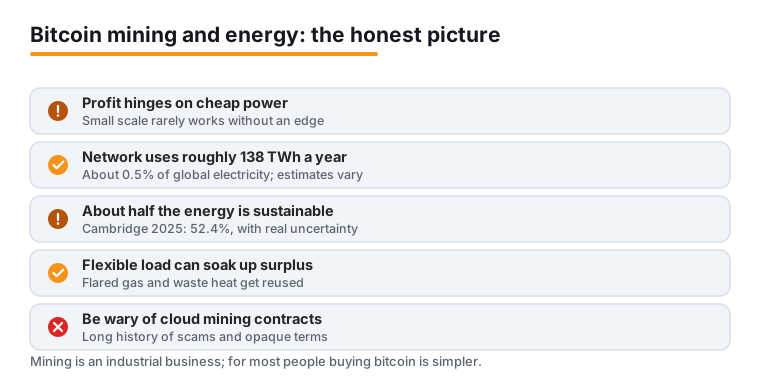
Mining profitability comes down to a single comparison: the value of the coins (and transaction fees) you earn versus the cost of the electricity and hardware needed to earn them. Miners compete to add the next block to the Bitcoin blockchain. Whoever finds a valid block first collects the block subsidy plus the fees from the transactions in that block. Following the April 2024 halving, the subsidy is 3.125 BTC per block, and it is scheduled to halve again to 1.5625 BTC around the spring of 2028. Each halving cuts the largest part of miner revenue in half overnight, so the long-term trend is that miners must run more efficiently just to stand still.
Your individual share of those rewards is proportional to your share of the network's total computing power, known as the hashrate. Because the network automatically adjusts mining difficulty roughly every two weeks to keep blocks coming about every ten minutes, more competitors joining the network means your fixed amount of hardware earns less over time, even if nothing else changes. This is why mining is a treadmill: efficiency gains across the industry are quickly absorbed by rising difficulty.
The variables that decide whether you are in profit are:
- Electricity price - usually the single biggest operating cost. The difference between, say, a few US cents per kilowatt-hour and the retail rate most households pay is often the difference between profit and loss.
- Hardware efficiency - measured in joules per terahash (J/TH). Modern application-specific machines (ASICs) are far more efficient than older units, and inefficient hardware is the first to become unprofitable when rewards fall or difficulty rises.
- Bitcoin's price - rewards are paid in BTC but most costs are paid in local currency, so a falling price squeezes margins quickly.
- Network difficulty and total hashrate - both have trended upward for most of Bitcoin's history.
- Uptime, cooling, and pool fees - downtime, heat throttling, and the cut taken by a mining pool all erode returns.
Most small operators join a mining pool, which combines many participants' hashrate and shares rewards in proportion to contribution, smoothing out the otherwise lottery-like odds of finding a block solo. A useful rule of thumb: if you cannot secure genuinely cheap, reliable power and reasonably current hardware, the economics are unlikely to work at small scale. Online profitability calculators can model your specific numbers, but they assume today's difficulty and price, both of which can move sharply.
Energy consumption
Bitcoin's energy use is real and large, but the headline numbers deserve context. The most widely cited research, the Cambridge Centre for Alternative Finance, estimated the network's annual electricity consumption at roughly 138 terawatt-hours (TWh) in its 2025 study, which it framed as around 0.5% of global electricity use. Other trackers, notably Digiconomist, publish higher figures (in the range of 150 TWh or more in early 2026). The gap is not a contradiction so much as a difference in method: estimates rely on assumptions about which mining hardware is actually running and how efficient it is, and reasonable assumptions produce a fairly wide range. Treat any single number as a best guess within a band, not a precise meter reading.
Why does mining use so much power? Bitcoin secures itself through proof of work, a deliberate design in which adding blocks requires real computational effort and therefore real electricity. That energy expenditure is what makes the ledger expensive to attack. Critics see this as waste; supporters see it as the cost of a decentralised settlement network with no central operator. Either way, the energy use is a feature of the protocol, not an accident, and it will not fall simply because hardware gets more efficient, because difficulty rises to absorb those gains.
For perspective, comparisons are often drawn to the consumption of a mid-sized country, or to other large electricity users such as global data centres, residential air conditioning, or always-on home electronics. These comparisons can be framed to support almost any narrative, so the more useful questions are where the electricity comes from and whether it would otherwise have gone to waste, which the next section addresses.
Renewables & carbon debate
The environmental argument over Bitcoin is really an argument about its energy mix and its carbon emissions, not its raw kilowatt-hours. The Cambridge 2025 study estimated that about 52.4% of the energy used for mining came from sustainable sources, split between roughly 42.6% renewables and 9.8% nuclear, up from a lower baseline a few years earlier. The same research put associated emissions at around 39.8 megatons of CO2 equivalent. As with consumption, these are estimates with meaningful uncertainty, and different studies reach different conclusions.
Several renewable sources are genuinely used by miners, and the source material this page consolidates covered each:
- Hydroelectric power - historically a major source, especially in regions with abundant rivers and seasonal surplus. It offers low marginal cost and near-zero direct emissions, but output can vary seasonally and is tied to specific geography.
- Geothermal energy - valued because it provides steady, around-the-clock output rather than the intermittency of wind and solar. Iceland is the long-standing example, and El Salvador has publicised volcano-powered mining, though the scale of such projects should be checked against current reporting rather than assumed.
- Wind - increasingly cost-competitive, but variable. Output depends on weather, so it pairs best with storage or with flexible mining that can ramp down when the wind drops.
- Solar - cheap once installed but only generates during daylight, which suits operations that can run intermittently or combine solar with batteries.
Two arguments are central to the case that mining can be environmentally constructive. First, miners are uniquely flexible buyers of electricity: they can switch off in seconds and relocate to wherever power is cheapest. That lets them soak up surplus renewable generation that would otherwise be curtailed, and some operations capture flared natural gas from oil fields, burning methane that would otherwise be released or wasted. Second, mining hardware produces large amounts of low-grade waste heat, which a handful of projects redirect into district heating, greenhouses, or industrial processes, improving overall energy use.
The counterarguments are equally real. Mining still draws on fossil generation in many regions, and a flexible load that chases the cheapest electricity will sometimes find that the cheapest electricity is coal. Renewable-only operations face intermittency and high upfront capital costs for panels, turbines, and batteries, which complicates the steady, high-uptime profile that mining profitability rewards. Hardware also becomes electronic waste as it is retired. A fair summary is that mining's energy mix is improving and that the network can support grid balancing and renewable build-out, but claims that it is broadly green should be checked against specific, sourced data rather than taken on faith.
Costs to start
The cost of starting depends entirely on scale, and the gap between hobbyist and industrial mining has widened to the point where they are almost different activities. At any scale, the main cost categories are the same:
- Mining hardware (ASICs) - purpose-built machines are the only competitive option for Bitcoin today. They are the largest upfront expense, prices move with Bitcoin's price and chip supply, and units lose value as more efficient models arrive.
- Electricity - the dominant ongoing cost. Because rates vary enormously by region and contract, this single number usually determines whether an operation is viable. Securing a low, stable industrial rate is the core challenge for serious miners.
- Infrastructure - adequate electrical capacity and wiring, cooling (air or immersion), ventilation, racking, and a suitable space. Heat and noise make home mining impractical beyond a unit or two.
- Networking and software - a stable internet connection, mining software, a wallet, and usually a mining-pool account.
- Maintenance and replacement - fans and machines fail, and hardware must eventually be replaced to stay competitive.
Before buying anything, weigh the alternatives. Cloud mining contracts let you rent hashrate without owning hardware, but the sector has a long history of scams and opaque terms, so it warrants heavy scrutiny. Simply buying and holding bitcoin gives direct exposure to its price without electricity bills, hardware depreciation, or operational risk, and for many people that is the more sensible route. Mining makes the most sense when you have a genuine structural edge, such as access to cheap or stranded power, a use for the waste heat, or the scale to negotiate industrial rates.
Finally, check the rules where you live. Some jurisdictions regulate or restrict mining, energy use, or related business activity, and mining income and disposals of mined coins commonly carry tax obligations. The specifics vary widely and change, so confirm your position with official government and tax-authority sources, and consult a qualified professional. This page is general information, not financial, tax, or legal advice.
Frequently asked questions
How much electricity does the Bitcoin network use?
Estimates vary by methodology. The Cambridge Centre for Alternative Finance put it at roughly 138 TWh per year in its 2025 study, about 0.5% of global electricity use, while other trackers such as Digiconomist have estimated higher figures around 150 TWh or more in early 2026. No source measures it directly, so the true value sits within a range. Check current figures from Cambridge or Digiconomist for the latest estimates.
Is Bitcoin mining still profitable?
It can be, but mainly for operations with very cheap, reliable electricity and efficient, current hardware. Profitability depends on your power price, hardware efficiency, Bitcoin's price, and network difficulty, all of which change constantly. The April 2024 halving cut the block subsidy to 3.125 BTC, raising the bar further. Run your own numbers through a profitability calculator with today's difficulty and price before committing.
What share of Bitcoin mining uses renewable energy?
The Cambridge 2025 study estimated about 52.4% of mining energy came from sustainable sources, roughly 42.6% renewables plus 9.8% nuclear, with the rest from fossil fuels. This is an estimate with meaningful uncertainty, and other studies reach different conclusions. The mix has trended toward cleaner sources over recent years but is not uniform across regions.
Can mining run entirely on renewable energy?
Some operations come close, using hydroelectric, geothermal, wind, or solar power, sometimes paired with battery storage or captured flared gas. The main obstacles are the intermittency of wind and solar and the high upfront cost of renewable infrastructure, which sit awkwardly with mining's preference for steady, high uptime. Geothermal and hydro provide more consistent output, which is why places like Iceland are cited as examples.
Is mining worth it compared with just buying bitcoin?
For most individuals, buying and holding bitcoin gives direct price exposure without electricity bills, hardware depreciation, noise, heat, or operational risk. Mining tends to make sense only when you have a structural advantage such as cheap or stranded power, a use for the waste heat, or industrial scale. This is general information, not financial advice; consider your own situation and consult a professional.
Last updated: 2026-06.