Bitcoin (BTC): the Complete Guide
Bitcoin is digital money that no company, bank, or government controls. It launched in January 2009, created by a person or group writing under the name Satoshi Nakamoto, and it has run without interruption ever since. You can send it to anyone on the internet, hold it yourself the way you hold cash, and nobody can print more of it: the supply is permanently capped at 21 million coins.
This page explains bitcoin the way a friend would: what it is, how it works, how to buy and store it, what it really costs, where the risks hide, and how the scams operate. It assumes you start from zero. To be clear up front: this is educational content, not financial advice. Bitcoin's price swings hard, plenty of people lose money on it, and nothing here tells you what to do with yours.
What bitcoin is, in plain words
Bitcoin is money that lives on the internet and belongs to whoever holds its keys, with no bank in the middle. There is no Bitcoin company, no CEO, and no headquarters. Instead, thousands of computers around the world each keep an identical copy of one big public record, called the blockchain, which lists every bitcoin transaction ever made. When you own bitcoin, what you really own is an entry in that record plus the secret code that can move it.
The system was designed by Satoshi Nakamoto, who published a nine page plan in 2008 (you can read the original whitepaper at bitcoin.org), launched the network in early 2009, and vanished about two years later. Nobody is in charge today. Volunteer programmers maintain the software, miners process the transactions, and everyone checks everyone else's work.
Three things make bitcoin different from the money in your bank account:
- Nobody can print more. The supply is capped at 21 million coins, and about 95 percent of them have already been created.
- Nobody can freeze it or block a payment, as long as you hold the coins yourself.
- It works the same everywhere. Paying a neighbor and paying someone on another continent is the same action, any hour, any day.
You never need to buy a whole coin. Each bitcoin divides into 100 million pieces called satoshis, so buying 20 dollars worth is as normal as buying 20,000. For an even gentler start, see our bitcoin basics guide.
How it works: a simple mental model
You need zero math to understand bitcoin. Picture a shared notebook.
Thousands of strangers each keep an identical copy of one notebook. When you want to pay someone, you announce it to the whole room: this much from my account to yours. Everyone checks their own copy to confirm you really have the money, and if you do, they all write the new line in. Nobody has to trust anybody, because everybody verifies everything.
The real vocabulary maps neatly onto that picture:
- An address is an account number in the notebook: a string of letters and digits you share to get paid. You can create as many as you like, free.
- A private key is the secret code that proves an address is yours; your wallet app guards it for you. Whoever knows the key owns the coins.
- Miners do the writing. Roughly every ten minutes, one of them bundles the waiting transactions into a block, one new page of the notebook. Each page is mathematically locked to the page before it, so changing an old entry would mean redoing every page since. That is why nobody can quietly rewrite history.
Once your payment is written into a block, it has one confirmation. Every later block adds another, and after a handful, the payment is about as final as money gets. There is no undo button and no customer service line, which is both the point and the danger.
None of this is hidden. Anyone can watch blocks arrive in real time on a block explorer, a website that displays the blockchain's contents, such as mempool.space. And note: transactions are public forever, tied to addresses rather than names, so bitcoin is not anonymous.
How to buy bitcoin, step by step
For most people the practical route is an exchange, an app where buyers and sellers meet and the company handles the matching. The whole process looks like this:
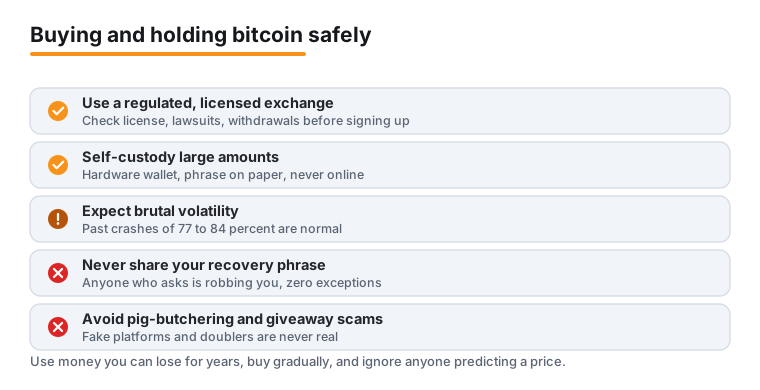
- Pick a regulated exchange. Favor a large platform licensed in your country, and search its name alongside words like license, lawsuit, and withdrawals before signing up. Boring and established beats new and exciting here.
- Verify your identity. Legitimate exchanges must know who their customers are, so expect to photograph your ID and possibly your face. This is normal. A platform that asks for no ID at all is the actual red flag.
- Add money. A bank transfer is usually free or close to it but may take a day or two. A debit card is instant but typically costs 2 to 4 percent, so a 100 dollar card purchase can burn 3 or 4 dollars before you own anything.
- Place the order. Type in a dollar amount; 25 dollars is fine. The instant buy button is simplest. A limit order (you name your price and wait) usually beats a market order (you take the current price).
- Decide where the coins should live, which the next section covers.
Two habits are worth forming on day one. First, most exchanges can repeat a purchase automatically, say 25 dollars every Friday. Second, save your purchase records from the start, because selling later usually has tax consequences; our crypto tax guide covers what to track. For a fuller walkthrough, see how to buy and sell crypto.
One thing to skip as a beginner: bitcoin ATMs. They commonly charge 10 to 20 percent, and scammers love marching victims to them.
Storing it: the exchange or your own wallet
After buying, your coins sit in your exchange account. You can leave them there or withdraw them to a wallet you control. This choice deserves two minutes.
Leaving coins on the exchange is called custodial storage: the company holds the private keys and you hold a claim, like money at a bank but without government deposit insurance. The upside is comfort. You cannot lose the keys, you can reset a forgotten password, and selling takes one tap. The risk is the company itself. Exchanges get hacked, freeze withdrawals, and sometimes collapse. When the FTX exchange failed in 2022, customers waited years through bankruptcy and were repaid based on old, far lower prices.
Holding coins yourself is called self custody. A wallet is an app on your phone or, better for larger amounts, a hardware wallet: a small offline device, around 60 to 150 dollars, that keeps your keys away from the internet. During setup it shows you a recovery phrase, a list of 12 or 24 ordinary words that can rebuild your wallet on any device. That phrase is everything:
- Anyone who reads it can take all your coins, from anywhere on earth, in minutes.
- If you lose it and your device breaks, the coins are gone forever. There is no reset, no support ticket, no exception. By some estimates a few million bitcoin are already stranded this way.
Write the phrase on paper, never in a screenshot or a cloud note. Keep it safe from fire and curious visitors. And never type it into any website, app, or chat, no matter who asks; no legitimate person ever will.
A sensible rule of thumb: an amount you would carry in your pocket can stay on a reputable exchange. An amount that would hurt to lose belongs in a hardware wallet. Our bitcoin wallet guide compares the popular options.
The fees you actually pay
Bitcoin fees confuse people because there are several, charged by different parties. Here is the complete list.
Trading fee. The exchange takes a cut of every buy and sell, usually 0.1 to 1.5 percent. Buy 50 dollars of bitcoin at a 1.5 percent fee and you pay 75 cents. Small, but it hits again when you sell.
The spread. Many apps also sell to you slightly above the real market price and buy back slightly below it. This markup never shows up as a line item. Instant buy buttons and payment apps tend to have the widest spreads; the true cost of a small purchase there can reach 2 to 3 percent even when the advertised fee looks tiny.
Payment method fee. Bank transfers: usually free. Cards: typically 2 to 4 percent. Bitcoin ATMs: often 10 to 20 percent.
Network fee. Moving coins on the blockchain itself, for example from an exchange to your own wallet, pays a fee to miners. The surprise: it depends on network traffic and the data size of the transaction, not on the amount. Sending a million dollars costs the same as sending fifty. In quiet weeks the fee is often well under a dollar; during rushes it can jump past ten. Current rates are public on any block explorer.
Withdrawal fee. Some exchanges add their own fixed charge when you move coins out, so withdraw in one batch rather than in dribbles.
A companion network called Lightning makes small bitcoin payments nearly instant and nearly free; as a buy and hold beginner you may never need it.
Put together: fund by bank transfer, prefer exchanges with clear percentage fees over wide spread apps, and batch withdrawals. Done wrong, a 100 dollar buy can lose 8 dollars to fees. Done right, under one.
Mining and the halving, in short
Someone has to write each new page of the notebook, and bitcoin picks that someone with a contest. Mining machines race to find a winning lottery number for the next block, making astronomical numbers of guesses per second. The winner writes the block and collects the prize: newly created bitcoin plus the fees from the transactions inside. The contest is called proof of work, and it doubles as security, because rewriting history would mean out-guessing the entire network, which by 2026 makes on the order of a sextillion guesses every second.
Mining stopped being a hobby years ago. Today it is an industrial business: warehouses of purpose built machines parked next to cheap electricity, consuming roughly as much power worldwide as a midsize country. That energy bill is bitcoin's most criticized feature; miners increasingly chase surplus and renewable power because it is cheapest. Either way, a home computer has effectively zero chance of earning anything today.
The halving is bitcoin's built in supply schedule. Every 210,000 blocks, roughly every four years, the new coin prize is cut in half. It started at 50 bitcoin per block in 2009. The April 2024 halving cut it from 6.25 to 3.125, and the next one, expected around April 2028, cuts it to 1.5625. The series continues until about the year 2140, when issuance ends just short of 21 million total coins.
Why you will hear about it: each halving slows the flow of new coins, and the year or two after past halvings brought big price runs. That pattern has occurred exactly four times, a tiny sample, and some analysts argue it is already fading. Treat the halving as supply mechanics, not a guaranteed rally. Our halving guide walks through the dates and the evidence.
Price history and volatility, honestly
The live price sits at the top of this page, so this section is about behavior, not today's number. Bitcoin's history is extreme growth interrupted by extreme crashes, and both halves of that sentence deserve equal weight.
The growth: bitcoin traded for under a dollar in 2010, the year someone famously paid 10,000 coins for two pizzas. It first crossed 1,000 dollars in 2013, 20,000 in 2017, 69,000 in 2021, and set its most recent record above 126,000 in October 2025. No mainstream asset has compounded like that over the same fifteen years.
The crashes are just as reliable. After the 2017 peak, the price fell about 84 percent. After the 2021 peak, about 77 percent, to under 16,000 by late 2022. After the October 2025 record, it again gave back a large share of those gains within months. Drops of 30 percent in a few weeks, and 50 percent or worse across a cycle, are normal bitcoin weather, not a malfunction.
Real people lose real money in those storms, usually the same way: buying near a euphoric top, watching the fall, and selling near the bottom. At the depth of the 2022 crash, blockchain records showed roughly half of all coins were worth less than their owners had paid for them. And bitcoin pays you nothing while you wait: no interest, no dividend, no rent. The price is simply whatever the next person will pay.
If you still want some, the boring playbook is the defensible one. Use only money you will not need for several years. Keep it a small slice of your savings, not the foundation. Buy gradually on a schedule instead of all at once. And ignore anyone confidently predicting a specific price; nobody knows, and the honest ones admit it.
Bitcoin ETFs vs owning coins
Since January 2024, Americans have had a second door in: spot bitcoin ETFs, funds that hold real bitcoin and trade on the stock exchange like any share. (Canada, much of Europe, and Hong Kong have similar products.) You buy them through an ordinary brokerage account, including retirement accounts, and by early 2026 the U.S. funds collectively held over 100 billion dollars of bitcoin. The SEC's investor.gov explains how ETFs work in plain language.
What the ETF buys you: no wallets, no keys, no exchange accounts to vet, tax forms generated by your broker, and a way to hold bitcoin exposure inside an IRA or 401(k). For someone who already owns index funds, it feels like adding one more ticker.
What it costs you: a yearly management fee, typically around 0.2 to 0.25 percent, which is about 2 to 2.50 dollars per year on a 1,000 dollar position. It trades only during market hours while bitcoin moves around the clock, so weekend news lands all at once on Monday morning. And you cannot withdraw, spend, or send the coins; you own a wrapper around bitcoin, not bitcoin itself.
A fair way to decide: if you want price exposure in a portfolio and nothing else, the ETF is simpler and much harder to mess up. If part of the appeal is money that no institution holds for you, only real coins in your own wallet provide that, and the ETF misses the point. Product and tax rules differ by country and keep shifting, so check our regulation section for where things stand.
Scams, mistakes, and whether bitcoin is for you
Here is the section that saves readers the most money. Bitcoin payments are irreversible and borderless, which makes them the favorite collection method of modern fraud. Americans reported more than 11 billion dollars in crypto related fraud losses for 2025 to the FBI's Internet Crime Complaint Center, and many victims never report. Four patterns cover nearly everything:
- The fake investment platform. A friendly stranger arrives via a wrong number text, a dating app, or social media, builds trust for weeks, then shares a trading site showing amazing returns. The profits on screen are fake. Deposits go in; withdrawals never come out. This scheme, often called pig butchering, produces the largest losses by far.
- The impersonator. A celebrity giveaway promising to double whatever you send, a fake exchange support agent, a fake government official demanding payment in bitcoin. None of these are ever real. Real agencies do not take bitcoin, and real support staff never contact you first.
- The phrase thief. Any site, app, pop up, or person asking for your recovery phrase is robbing you. Zero exceptions exist.
- The recovery scam. After a loss, someone offers to retrieve your money for an upfront fee. That is round two of the same scam.
Plain mistakes cost nearly as much as fraud: sending coins to a mistyped address (send a small test amount first), photographing a recovery phrase into a cloud photo library, parking life savings on a tiny exchange, buying a euphoric top with next month's rent, or forgetting that selling is usually a taxable event.
So, is bitcoin for you? The honest case for it: a strictly limited asset nobody can print more of, savings you can hold yourself and carry across any border, a fifteen year record of surviving every obituary, and now easy access through mainstream funds. The honest case against: brutal volatility, no income while you hold, irreversible mistakes, a fraud heavy environment, unsettled regulation, and the genuine possibility of deep losses lasting years. Both lists are true at once.
If you have no emergency fund or you carry expensive debt, fix that first; bitcoin will still be here afterward. If your finances are stable and you stay curious, a small position you fully understand beats a big one you do not. Once more, because it matters: this page is education, not financial advice.
Frequently asked questions
How much money do I need to start?
Almost none. A bitcoin divides into 100 million units called satoshis, and most major exchanges let you buy from about 1 to 10 dollars. Just mind the fees: a fixed minimum charge can eat several percent of a 5 dollar buy, so 25 to 50 dollars at a time is more efficient.
Can I lose more money than I put in?
Not by simply buying and holding bitcoin; the worst case is the price falling to zero. Losing more than you invested only happens with borrowed money products such as margin and futures trading, which amplify every move in both directions and are best avoided by beginners.
Is bitcoin legal?
In most of the world, yes. Owning and trading it is legal, and taxed, across the United States, the European Union, the United Kingdom, Japan, and most other countries. A few governments, China being the largest, ban trading. Rules change often, so check current local law before buying.
What happens if I lose my recovery phrase?
If your wallet device still works, move your coins to a brand new wallet right away and back up the new phrase correctly. If the device is also lost or broken, the coins are gone permanently. No company, government, or recovery service can restore them, and anyone who claims otherwise for a fee is a scammer.
Should I buy bitcoin itself or a bitcoin ETF?
Choose the ETF if you want price exposure inside a brokerage or retirement account with no extra homework. Choose real coins if you might ever want to hold, move, or spend them yourself, or you value money outside the banking system. Costs are close: ETFs charge roughly 0.2 to 0.25 percent per year, while exchanges charge per trade.
Do I owe taxes on bitcoin?
Usually only when you act. In the United States and many other countries, buying and holding triggers nothing, while selling, spending, or swapping bitcoin is a taxable event on any gain. Exchanges increasingly report customer activity to tax authorities, so record the date, amount, and price of every purchase.
Last updated: 2026-06.