Home › Crypto Regulation › Canada
Bitcoin & Cryptocurrency Regulation in Canada
Quick answer — Canada, 2026
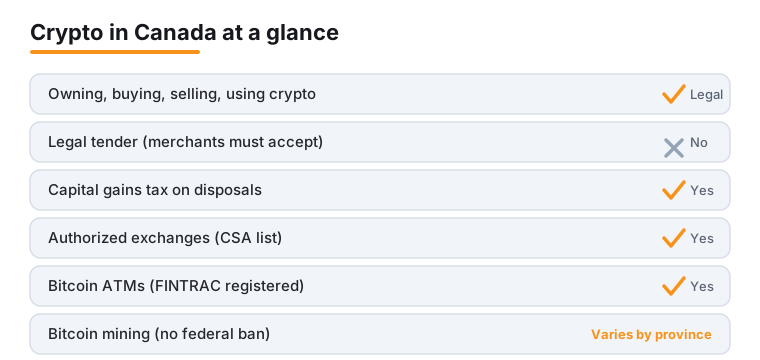
- Yes, owning, buying and selling crypto is legal in Canada, though it is not legal tender.
- It is taxed: the CRA treats crypto as a commodity, so disposing of it can trigger a capital gain or business income.
- Residents buy through platforms on the CSA's authorized list that are also registered with FINTRAC.
Canada was an early mover on digital assets and remains one of the more clearly regulated crypto markets in the world. Owning, buying, selling and using Bitcoin and other crypto assets is legal across the country, and Canada hosts a mature exchange market, a large network of crypto ATMs, significant industrial mining and a deep professional-services industry around blockchain. What defines the Canadian approach in 2026 is a multi-track model: provincial and territorial securities regulators (coordinated through the Canadian Securities Administrators) decide how trading platforms may operate, FINTRAC enforces anti-money-laundering rules on any business that deals in virtual currency, the Canada Revenue Agency handles tax, and a new federal stablecoin framework places fiat-backed stablecoin issuers under the Bank of Canada.
This guide explains the current legal status of crypto in Canada, who the regulators are, how crypto is taxed, the rules around exchanges, ATMs, mining and remittances, and the main risks to weigh before investing. It is general information as of 2026 and is NOT legal, tax or financial advice. Canadian crypto rules are changing quickly: new OECD-based tax reporting starts to bite for the 2026 year, and a federal stablecoin framework received Royal Assent in 2026 with detailed rules still being built. Always confirm specifics with the official regulators named below (the CSA, your provincial regulator, FINTRAC, the CRA and the Bank of Canada) or with a licensed adviser before acting. You can also read our general crypto regulation explainer and browse other country guides in our regulation hub.
On this page: Legal status · Who regulates it · Taxes · How to buy · Mining
Is Bitcoin and crypto legal in Canada?
Yes. Buying, holding, selling and using Bitcoin and other crypto assets is legal in Canada for individuals and businesses. There is no ban on personal ownership or trading, and the country hosts numerous registered exchanges, custodians and ATM operators, as well as publicly listed crypto investment products.
Crypto is not legal tender in Canada. The Canadian dollar, issued by the Bank of Canada, remains the only legal tender, and no merchant is obliged to accept Bitcoin. Regulators instead treat crypto as a commodity, a security or a derivative depending on how it is offered and used, which has significant tax and compliance consequences (covered below). Businesses may choose to accept crypto as payment, but that is a commercial decision rather than a legal requirement.
Because crypto is legal but regulated, the practical question for most people is not whether they can use it, but which obligations apply: in particular, identity verification when dealing with a registered provider, and tax reporting when disposing of holdings.
Who regulates crypto in Canada?
Canada does not have one single crypto regulator. Oversight is shared across several bodies, and more than one usually applies to the same business at once:
- Canadian Securities Administrators (CSA) and the provincial and territorial securities regulators. Canada has no single federal securities regulator; oversight sits with each province and territory (for example the Ontario Securities Commission, the Autorite des marches financiers in Quebec and the British Columbia Securities Commission), coordinated through the CSA. These regulators decide how crypto trading platforms may operate. The CSA publishes a public list of platforms authorized to do business with Canadians.
- Canadian Investment Regulatory Organization (CIRO). The national self-regulatory organisation; many custodial crypto platforms are being directed toward investment-dealer registration and CIRO membership.
- FINTRAC (Financial Transactions and Reports Analysis Centre of Canada). Canada's financial-intelligence unit, which administers anti-money-laundering and anti-terrorist-financing rules. Businesses that exchange or transfer virtual currency are treated as money services businesses and must register with FINTRAC.
- Canada Revenue Agency (CRA). Administers the tax treatment of crypto.
- Bank of Canada. The central bank, which issues the Canadian dollar and, under the 2026 stablecoin framework, is mandated to supervise issuers of fiat-backed stablecoins.
Official source links for each of these bodies appear in the final section so you can verify the current position yourself.
Crypto laws and frameworks in Canada
Canadian crypto rules are built from existing laws applied to digital assets, plus newer dedicated measures. The main pillars in 2026 are:
- Securities law. Provincial and territorial securities legislation, applied through CSA guidance, takes the view that many crypto trading platforms deal in instruments that are securities or derivatives. On 6 August 2024 the CSA and CIRO said they did not intend to continue the earlier interim, time-limited restricted-dealer approach, pushing platforms toward full investment-dealer registration and CIRO membership, with capital, custody, insurance and proficiency requirements.
- Anti-money-laundering law. The Proceeds of Crime (Money Laundering) and Terrorist Financing Act treats businesses dealing in virtual currency as money services businesses, triggering FINTRAC registration, customer verification, record-keeping and reporting (including the international Travel Rule for transfers).
- Tax law. The Income Tax Act, as interpreted by the CRA, governs how crypto gains and income are taxed. Canada is adopting the OECD Crypto-Asset Reporting Framework (CARF), which adds new transaction-level reporting by crypto-asset service providers.
- Stablecoin framework. A federal stablecoin framework was enacted through the Budget Implementation Act, 2025 (Bill C-15), which received Royal Assent on 26 March 2026. It expands the Bank of Canada's mandate to supervise issuers of fiat-backed stablecoins. Detailed regulations are still being developed and the regime is expected to come fully into force later, so treat the specifics as evolving.
The rules are detailed and still moving. Treat the points above as general orientation and confirm the current position with the CSA, your provincial or territorial regulator, CIRO, FINTRAC, the CRA and the Bank of Canada.
Licensing and registration of exchanges
Platforms that want to serve Canadians generally face two layers of authorisation:
- Securities authorisation. Trading platforms that deal in crypto treated as securities or derivatives must be registered with securities regulators. Following the end of the interim restricted-dealer regime, the expected route for custodial platforms is full registration as an investment dealer and membership in CIRO. The CSA maintains a public list of platforms authorized to do business with Canadians, plus lists of platforms that have given undertakings or that Canadians are warned against.
- FINTRAC registration. Any business dealing in or transferring virtual currency must register with FINTRAC as a money services business before operating, and foreign businesses directing services at Canadians must register too. FINTRAC charges no registration fee, and registration is not an endorsement or licence; it only confirms the business met the legal requirement to register.
Authorisation comes with ongoing obligations: identity verification (KYC), conditions that can restrict leverage and margin for retail clients, conditions around certain stablecoins (value-referenced crypto assets), and expectations that client crypto is held with appropriate custody and segregation rather than commingled with the platform's own assets. When choosing a platform, check that it appears on the CSA's authorized list and is registered with FINTRAC.
Crypto and Bitcoin tax in Canada
The Canada Revenue Agency (CRA) generally treats cryptocurrency as a commodity, not as money or foreign currency. That means using or disposing of crypto is usually a taxable event, and how it is taxed depends on whether the CRA sees your activity as an investment or a business. You can find more general background in our crypto taxes guide.
Key principles to understand:
- Disposals are taxable. A taxable disposition can include selling crypto for Canadian dollars, trading one crypto for another, spending crypto on goods or services, or gifting it. Using crypto to pay for goods or services is treated as a barter transaction. Each disposal can create a gain or loss measured in CAD against your cost base.
- Capital gains vs. business income. If you hold crypto as an investment, gains are typically treated as capital gains, and section 38(a) of the Income Tax Act includes exactly one-half of the gain in taxable income. That half is added to your income and taxed at your marginal rate, and the other half is not taxed. One-half of a capital loss is an allowable capital loss. If you trade frequently or at scale, or mine commercially, the CRA may treat the activity as a business, in which case the full profit can be taxable as business income. Classification turns on factors such as frequency, intention and how the activity is conducted.
- Adjusted cost base (ACB). Where you buy the same crypto at different times and prices, the CRA generally expects you to track an average cost base to calculate gains and losses.
- Income events. Crypto received as payment for work, certain rewards, and mining or staking carried on as a business can be taxed as income at fair market value when received.
- Records. Keep detailed records (dates, CAD values, amounts, wallet addresses, exchange statements and the purpose of each transaction) and retain them for the period the CRA requires.
Note that a widely discussed proposal to raise the capital-gains inclusion rate (to two-thirds on larger gains) was cancelled by the federal government in March 2025 (after first being deferred in January 2025), so the one-half inclusion rate that has applied for years is still the rate written into the statute today, at section 38(a) of the Income Tax Act. Confirm your position with the CRA or a qualified Canadian tax professional. This section is general information, not tax advice.
AML, KYC and CARF reporting
Anti-money-laundering (AML) rules are a core part of Canadian crypto compliance and are administered by FINTRAC. Any business dealing in or transferring virtual currency is a money services business and must:
- Register with FINTRAC before operating and keep its registration current.
- Verify customers (KYC). Expect to provide government ID and personal details before trading, transferring or withdrawing. This is a legal requirement, not optional.
- Keep records and monitor transactions, and report suspicious transactions, prescribed transactions, and large virtual-currency transactions.
- Apply the Travel Rule, so that originator and beneficiary information accompanies in-scope transfers.
On the tax-transparency side, Canada is implementing the OECD Crypto-Asset Reporting Framework (CARF). Crypto-asset service providers will collect transaction-level data and customer details and report them to the CRA. Under the draft legislative proposals, due-diligence and data-collection duties for reporting providers start on 1 January 2026, with the first annual reports to the CRA expected in 2027 covering the 2026 calendar year, followed by cross-border exchange through the OECD network. As of 3 August 2026 those proposals are still proposals. The enacting vehicle is Bill C-31, the Budget 2025 Implementation Act, No. 2, which had first reading on 6 May 2026 and was referred to the Standing Committee on Finance after second reading on 3 June 2026, where it remained on 3 August 2026. The consolidated Income Tax Act still ends at Part XX, so the crypto reporting Part XXI is not yet law, and on the current draft the first information return would be due before 2 May 2027. AML enforcement has also intensified, with reported revocations of crypto-linked FINTRAC registrations in 2026 and higher maximum penalties for violations. Because timelines and thresholds can shift, confirm the current requirements directly with FINTRAC and the CRA.
Buying and using crypto in practice
Canadians can buy crypto through registered exchanges and brokers, paying with methods such as Interac e-Transfer, bank transfers and cards, depending on the platform. The platforms most appropriate for Canadian residents are those authorized by securities regulators and registered with FINTRAC. A careful, typical path looks like this:
- 1. Choose a provider. Pick a platform that is on the CSA's authorized list and registered with FINTRAC. Compare fees, security, supported funding methods and reputation.
- 2. Create and verify your account. Complete KYC by submitting your ID and details. Enable two-factor authentication, preferably an authenticator app rather than SMS.
- 3. Fund your account. Deposit via Interac e-Transfer, bank transfer or another supported method, allowing for any bank limits or delays; some banks add friction to crypto transfers as a scam-prevention measure.
- 4. Place an order. Buy with a market or limit order, and start small while you learn the interface.
- 5. Secure your holdings. For meaningful amounts, consider withdrawing to a wallet you control. A hardware (cold) wallet with an offline backup of your recovery phrase offers strong protection; never store the phrase online or share it with anyone.
- 6. Keep records. Save transaction details and CAD values for tax time.
Crypto can also be used for cross-border value transfer, and some people in Canada use Bitcoin or stablecoins to send remittances. Businesses providing crypto remittance or value-transfer services are money services businesses subject to FINTRAC and the Travel Rule. Mind volatility, confirm addresses carefully because transactions are generally irreversible, use registered providers where possible, and remember that the recipient's country has its own rules.
Bitcoin ATMs in Canada
Canada has one of the world's largest crypto-ATM networks. These machines let users buy crypto with cash and, in some cases, sell crypto for cash. Operators of virtual-currency ATMs are treated as money services businesses and must register with FINTRAC and meet AML obligations, including customer identification, record-keeping, transaction monitoring and reporting.
Regulators and law enforcement have repeatedly flagged crypto ATMs as a channel exploited in fraud and money-laundering. In practice you should expect:
- Identity verification, especially above certain transaction sizes.
- Prominent scam warnings on or around many machines.
- Higher fees and less favourable exchange rates than typical online exchanges.
If anyone instructs you to deposit cash into a Bitcoin ATM, particularly a stranger contacting you by phone or message, a supposed official, or an "investment manager" promising returns, treat it as a major red flag and stop. ATM transactions are generally irreversible. Confirm current registration and rules via FINTRAC, as requirements continue to tighten.
Bitcoin mining in Canada
Bitcoin mining is legal in Canada and there is no federal ban. Canada has historically been an attractive mining location thanks to a cool climate and abundant hydroelectric and other low-cost power in parts of the country. The main constraints are provincial energy policy, electricity costs and tax treatment rather than questions of legality.
Energy access varies sharply by province, and several have moved to limit new mining load on their grids:
- British Columbia has made the bar permanent. A temporary suspension of new mining connections began in December 2022, the Utilities Commission Act was amended in spring 2024 to give Cabinet regulation-making authority over the provision of electricity service for cryptocurrency mining, the suspension was extended from an initial 18-month period to 36 months, and in fall 2025 the province permanently relieved BC Hydro of its obligation to serve certain new cryptocurrency mining operations.
- Manitoba has legislated. Bill 39, The Manitoba Hydro Amendment and Tax Administration and Miscellaneous Taxes Amendment Act, was heard by the Standing Committee on Social and Economic Development on 22 April 2026 and is now enacted as SM 2026, c. 32. It imposes a levy on power supplied to cryptocurrency operations and large data centres, defaulting under section 110.2(1)(b) to 100 percent of the monthly energy charge per kWh plus 100 percent of the monthly demand charge per kVA where no rate is set by regulation. Section 8 provides that the Act comes into force on a day fixed by proclamation, and no proclamation had been issued as of 3 August 2026. The companion Bill 20, SM 2026, c. 17, addresses curtailment at peak times.
- Quebec has used price signals and capped allocations, with Hydro-Quebec limiting available capacity for mining.
- New Brunswick moved to block new mining connections through its provincial utility.
- Alberta, with a deregulated electricity market, has been comparatively open, letting operators buy power on the open market.
On tax, mining can be treated as a hobby or as a business depending on scale and intent, with different consequences; commercial miners are commonly treated as running a business, with profits taxed as income. For most individuals, small-scale home mining of Bitcoin is rarely profitable after electricity and hardware costs, and policies differ enough by province that current local rules should be confirmed before committing capital.
Recent developments (2025-2026)
Several changes have reshaped the Canadian landscape heading into and through 2026:
- Federal stablecoin framework enacted. The Budget Implementation Act, 2025 (Bill C-15) received Royal Assent on 26 March 2026 and expanded the Bank of Canada's mandate to supervise issuers of fiat-backed stablecoins. The framework points to registration with the Bank of Canada, a 1:1 reserve of high-quality liquid assets in the reference currency, at-par redemption for holders, and policies for corporate governance, risk management, data security, and recovery and resolution. The Act is on the statute book as S.C. 2026, c. 3, s. 600, but section 97 provides that its provisions come into force on a day or days fixed by order of the Governor in Council, and no such order had been made as of 3 August 2026. The Justice Laws consolidation still flags the Act's operative sections as not in force. The Bank of Canada says the Department of Finance Canada is leading the development of the regulations, so no issuer is registered yet and no stablecoin is yet supervised under the Act. The Act itself already fixes the shape of the regime: section 15 bars issuing a stablecoin unless the issuer's name is on the list of issuers, which section 16 requires the Bank of Canada to keep in a public registry; section 35 requires redemption in the reference currency at par value; and section 37(1) requires a reserve worth at least the par value of stablecoins outstanding. Sections 11 to 13 exclude closed-loop stablecoins, financial institution issuers and central banks. What the regulations still have to fix is the detail, the penalty amounts under section 79, and the start date.
- CARF tax reporting. Canada's adoption of the OECD Crypto-Asset Reporting Framework adds new third-party reporting by crypto-asset service providers, with reporting expected to start in 2027 for the 2026 calendar year.
- End of interim securities accommodations. The CSA wound down its earlier restricted-dealer and pre-registration arrangements, pushing platforms toward full investment-dealer registration and CIRO membership.
- Tougher AML enforcement. On 17 March 2026 FINTRAC revoked the registrations of 23 crypto-linked money services businesses in a single action, two of them operating from outside Canada. Separately, the penalty ceilings enacted by Bill C-12, the Strengthening Canada's Immigration System and Borders Act, took effect on 26 March 2026: maximum administrative monetary penalties for prescribed violations rose to $4,000,000 for an individual and $20,000,000 for an entity, and contravening a compliance order can cost an entity the greater of $30,000,000 or 3 percent of gross revenue.
- Capital-gains rate increase cancelled. The proposed increase to the capital-gains inclusion rate was cancelled by the federal government in 2025, leaving the prior approach in place.
Because the framework is still evolving, treat dates, thresholds and registration requirements as moving targets and verify the current position with the official regulators.
Consumer risks and protection
Crypto can fall sharply and quickly, and it is not covered by deposit protection such as CDIC insurance, which applies to eligible bank deposits, not crypto holdings. Beyond price volatility, the main risks for Canadian users are:
- Scams and fraud, which regulators and police have repeatedly flagged, especially involving ATMs, impersonation, romance scams, fake apps and "guaranteed return" schemes. Anyone who contacts you first with an investment opportunity, or pressures you to act urgently or move cash, is a warning sign.
- Platform failure or insolvency. Crypto held on a platform is not an insured deposit, so a platform collapse can mean loss.
- Loss or theft of private keys. Self-custody removes counterparty risk but shifts full responsibility for security onto you, and lost keys generally mean permanent loss.
- Irreversible transactions. A wrong address or a scam payment usually cannot be reversed.
- Tax and compliance burden, which grows with active use and the new reporting rules.
Protections are strengthening over time through securities registration, custody and segregation expectations, FINTRAC oversight and the coming stablecoin regime, but none of this removes market risk. Before investing, consider speaking with a licensed Canadian financial adviser and reviewing investor resources from your provincial securities regulator and the Financial Consumer Agency of Canada. This is general information, not financial advice.
Official sources and how to verify
This article is general information as of 2026 and is NOT legal, tax or financial advice. Canadian crypto rules are detailed and changing, so verify the current position directly with the named official regulators before you act. The primary official sources are:
- Canadian Securities Administrators (CSA) - list of crypto platforms authorized to do business with Canadians: securities-administrators.ca.
- FINTRAC - money services businesses and virtual-currency obligations: fintrac-canafe.canada.ca.
- Canada Revenue Agency (CRA) - information for crypto-asset users and tax professionals: canada.ca CRA crypto guide.
- Department of Finance Canada - Canada's stablecoin framework: canada.ca stablecoin framework.
- Financial Consumer Agency of Canada (FCAC) - consumer guidance on crypto assets: canada.ca crypto assets.
For more background, see our guide to crypto regulation. When in doubt, contact your provincial or territorial securities regulator, CIRO, FINTRAC, the CRA or a licensed professional.
Status check: what is actually true in August 2026
Three federal measures reached Royal Assent on 26 March 2026 and none of them is fully operational. Bill C-15, the Budget 2025 Implementation Act, No. 1, became S.C. 2026, c. 3, and at Division 45 of Part 5, section 600, it enacted the Stablecoin Act. The same day, the rebuilt anti-money-laundering penalty regime took effect. Neither event changed anything for a person buying Bitcoin on a registered Canadian platform.
The Stablecoin Act is law but is not in force. The Justice Laws consolidation of the Stablecoin Act carries a notice above its operative sections stating that the provision is not in force, and section 97 provides that the Act comes into force on a day or days to be fixed by order of the Governor in Council. No such order had been made as of 3 August 2026. The Bank of Canada describes its future role as registering stablecoin issuers, supervising compliance, monitoring risks and taking enforcement action, and states that the Department of Finance Canada is leading the development of regulations with support from the Bank. There is no live Bank of Canada registry of stablecoin issuers, so no stablecoin is currently supervised under the Act.
The OECD crypto tax reporting rules are also not yet law. The consolidated Income Tax Act still ends at Part XX, Reporting Rules for Digital Platform Operators. The Part XXI that would create crypto reporting is inside Bill C-31, the Budget 2025 Implementation Act, No. 2, whose summary lists implementing the Crypto-Asset Reporting Framework among its measures. It had first reading on 6 May 2026, was referred to the Standing Committee on Finance after second reading on 3 June 2026, and was still at that committee on 3 August 2026. Senate committees were authorised on 10 June 2026 to pre-study parts of the bill.
What is in force and applies to you now: registration duties for any business dealing in virtual currency, securities registration and CIRO membership for trading platforms, and the ordinary tax treatment of disposals. Section 38(a) of the Income Tax Act makes one-half of a capital gain a taxable capital gain and one-half of a capital loss an allowable capital loss. That is the 50 percent inclusion rate, and it did not change.
Named laws and where each one stands
Canada does not have a single crypto act. It has one new federal statute, one bill in committee, and several regimes that already apply. This is the pipeline with stages and timing as at 3 August 2026.
| Measure | Stage on 3 August 2026 | What it actually does | Timing |
|---|---|---|---|
| Stablecoin Act, S.C. 2026, c. 3, s. 600 | Adopted, not in force | Section 15 bars issuing a stablecoin unless the issuer is on the list of issuers in paragraph 16(a). Section 16 requires the Bank of Canada to maintain a public registry containing that list. Section 35 requires redemption in the reference currency at par. Section 37(1) requires reserves worth at least the par value outstanding. Sections 11 to 13 exclude closed-loop stablecoins, financial institutions and central banks. | In force by Governor in Council order under section 97. No order made. Finance Canada is drafting regulations; law firm commentary anticipates 2027. |
| Crypto-Asset Reporting Framework, proposed Part XXI of the Income Tax Act, in Bill C-31 | In Parliament, at committee | Crypto-asset service providers would identify customers and file annual returns to the CRA on exchanges, transfers and gross amounts. | First reading 6 May 2026, referred to the Finance Committee 3 June 2026, still there. Applies to 2026 and later calendar years; returns due before May 2 each year, so first filing before 2 May 2027. |
| PCMLTFA penalty overhaul, enacted by Bill C-12 | In force | Maximum penalties for prescribed violations rise to $4,000,000 for an individual and $20,000,000 for an entity, from $100,000 and $500,000. Breaching a compliance order can cost an entity the greater of $30,000,000 or 3 percent of gross revenue. | In force 26 March 2026. |
| FINTRAC enrolment regime, and stablecoin issuers deemed to deal in virtual currency | Adopted, not in force | Every reporting entity must enrol with FINTRAC, with renewals and a publicly accessible roll. Stablecoin issuers must register as money services businesses. | On a day fixed by Governor in Council order. No date announced. |
| CIRO Digital Asset Custody Framework | In force | Custody and segregation expectations for Dealer Members running crypto trading platforms, with a tiered, risk-based custodian structure. | Published 3 February 2026, effective immediately, applied through membership terms and conditions. |
| Large virtual currency transaction reporting, SOR/2002-184 | In force | Receipt of $10,000 or more in virtual currency in a single transaction must be reported. Records are required for virtual currency transfers of $1,000 or more. | Already applies. |
| Manitoba Bill 39, SM 2026, c. 32 | Adopted, not in force | Levy on power supplied to cryptocurrency operations and large data centres, defaulting under section 110.2(1)(b) to 100 percent of the monthly energy and demand charges where no rate is prescribed. | Comes into force on a day fixed by proclamation under section 8. No proclamation issued. |
What CARF would mean for you, and when
The Crypto-Asset Reporting Framework is the change most likely to affect an ordinary Canadian holder, and it is the one the page should be clearest about. It is not a new tax. It changes what the CRA knows.
- Who reports: crypto-asset service providers resident in Canada or carrying on business in Canada, which covers exchanges, brokers and certain intermediaries, including some non-resident entities.
- What is reported: customer identity, and for exchanges between crypto and fiat, crypto-to-crypto exchanges and transfers, the aggregate gross amounts paid and received.
- When it is filed: draft section 300(1) requires an information return before May 2 of each calendar year, and the proposals apply to the 2026 and subsequent calendar years. On the current draft, the first return is due before 2 May 2027.
- Your own obligation: draft section 303(3) sets a $500 penalty for each failure by a reportable person to give a tax identification number on request, with an exception where an application for the number is made not later than 90 days after the request.
- What it does not do: it does not change how much tax you owe. Your gain is still calculated the same way and one-half of it is still the taxable portion.
The practical takeaway: if you have been trading through a Canadian platform and not reporting disposals, the enforcement gap closes with the first filing, not with the law's passage. Reconstructing an adjusted cost base is far easier now than after a CRA query.
Stablecoins in Canada while the Act waits
Because the Stablecoin Act is not in force, stablecoins sold to Canadians are still handled under securities law rather than by the Bank of Canada. Provincial and territorial securities regulators treat them as value-referenced crypto assets, and CSA Staff Notice 21-333, published on 5 October 2023, sets out terms and conditions on which the CSA would consent to a platform continuing to allow exposure to them. That notice is the reason your Canadian exchange lists some stablecoins and not others.
One Canadian dollar stablecoin has gone further and used the prospectus route. On 24 November 2025 Stablecorp announced that its QCAD Digital Trust had received a final receipt for a prospectus qualifying the distribution of QCAD tokens under the framework in force at the time.
Separately, there is no Canadian central bank digital currency coming. The Bank of Canada states on its Digital Canadian Dollar page that it is scaling down its work on a retail central bank digital currency and shifting its focus to broader payments system research and policy development. Supervising privately issued fiat-backed stablecoins is the job it took on instead.
Frequently asked questions
Is Bitcoin legal in Canada?
Yes. Owning, buying, selling and using Bitcoin and other crypto assets is legal in Canada. However, crypto is not legal tender, so no business is required to accept it, and regulators treat it as a commodity, security or derivative depending on how it is used.
Who regulates cryptocurrency in Canada?
Oversight is shared. Crypto trading platforms are regulated by provincial and territorial securities regulators, coordinated through the Canadian Securities Administrators (CSA), with self-regulatory oversight through CIRO. FINTRAC enforces anti-money-laundering rules on businesses that deal in virtual currency, the Canada Revenue Agency (CRA) handles tax, and under the 2026 federal stablecoin framework the Bank of Canada supervises fiat-backed stablecoin issuers.
Do I have to pay tax on crypto in Canada?
Generally yes. The CRA treats crypto as a commodity, so disposing of it (selling, swapping, spending or gifting) can create a taxable gain or loss. Investment gains are usually treated as capital gains, while frequent trading or commercial mining can be taxed as business income. New CARF reporting by service providers is expected to start in 2027 for the 2026 year. Rules can change between tax years, so confirm your situation with the CRA or a qualified tax professional. This is not tax advice.
Do crypto exchanges need to be registered in Canada?
Yes. Platforms that deal in crypto treated as securities or derivatives must be registered with securities regulators, and the expected route for custodial platforms is full investment-dealer registration plus CIRO membership. Separately, any business dealing in or transferring virtual currency must register with FINTRAC as a money services business. You can check whether a platform is authorized on the CSA's public list before using it.
Are Bitcoin ATMs legal in Canada?
Yes, but operators must register with FINTRAC as money services businesses and meet anti-money-laundering obligations, including identity verification and reporting. Regulators have flagged crypto ATMs as a common fraud channel, so expect scam warnings, identity checks and higher fees. Never deposit cash into an ATM at the request of a stranger, a supposed official or an "investment" contact.
Is Bitcoin mining allowed in Canada?
There is no federal ban on Bitcoin mining in Canada. However, several provinces, including British Columbia, Manitoba, Quebec and New Brunswick, have restricted new mining connections or capped and repriced electricity for miners, while Alberta has been comparatively open. Commercial mining is generally taxed as a business. Check current rules with your provincial utility and regulator before starting.
When does Canada's crypto stablecoin law take effect?
The federal stablecoin framework was enacted in the Budget Implementation Act, 2025 (Bill C-15), which received Royal Assent on 26 March 2026. It gives the Bank of Canada a mandate to supervise issuers of fiat-backed stablecoins, with requirements such as registration, a 1:1 reserve of high-quality liquid assets and at-par redemption. The Bank of Canada began preparatory work after Royal Assent, and detailed regulations are still being developed, so the regime is expected to come fully into force later. Confirm the current status with the Department of Finance and the Bank of Canada.
Will Canadian exchanges report my crypto to the CRA?
They are being required to. Canada is adopting the OECD Crypto-Asset Reporting Framework (CARF). Under the draft rules, crypto-asset service providers begin due-diligence and data collection on 1 January 2026, with the first reports to the Canada Revenue Agency expected in 2027 covering the 2026 year, followed by international exchange of that data. This does not change what tax you owe, but it means the CRA will receive more information about your activity, so keeping accurate records matters. Confirm the current requirements with the CRA.
Is Canada's stablecoin law in force yet?
No. The Stablecoin Act received Royal Assent on 26 March 2026 and is cited as S.C. 2026, c. 3, s. 600, but section 97 says its provisions come into force only on a day or days fixed by order of the Governor in Council. No such order had been made as of 3 August 2026, the Justice Laws consolidation still flags the operative sections as not in force, and the Bank of Canada registry of issuers does not exist yet. Until it is proclaimed, stablecoins offered to Canadians are handled under provincial securities rules as value-referenced crypto assets, not under the new Act.
Will my exchange report my trades to the Canada Revenue Agency?
Not yet, and not under a finished law. The Crypto-Asset Reporting Framework would add Part XXI to the Income Tax Act, and it sits in Bill C-31, the Budget 2025 Implementation Act, No. 2, which was referred to the House of Commons finance committee on 3 June 2026 and was still there on 3 August 2026. The consolidated Income Tax Act still ends at Part XX. As drafted it applies to the 2026 and later calendar years, with providers filing an information return before May 2 each year, so the first filing would be due before 2 May 2027. It creates no new tax; it gives the CRA transaction data it did not previously receive.
How much of a crypto gain is actually taxed in Canada?
One-half. Section 38(a) of the Income Tax Act makes a taxable capital gain one-half of the capital gain, and that half is added to your income and taxed at your marginal rate. The proposed increase to a two-thirds inclusion rate was cancelled and never became law. If the CRA treats your activity as a business rather than investing, for example frequent high-volume trading or commercial mining, the full profit is business income instead of a half-taxed capital gain.
Can I still mine crypto in Canada in 2026?
Mining is legal federally, but the binding constraint is provincial electricity policy. British Columbia has permanently relieved BC Hydro of any obligation to serve certain new cryptocurrency mining operations, so new grid connections there are effectively closed. Manitoba has passed Bill 39, now SM 2026, c. 32, which would charge cryptocurrency operations and large data centres a levy on their power, defaulting to 100 percent of the monthly energy and demand charges where no rate is prescribed; it comes into force on a day fixed by proclamation and had not been proclaimed as of 3 August 2026. Check the province and the utility before you cost out hardware.
Is Canada launching a digital dollar?
No. The Bank of Canada states that it is scaling down its work on a retail central bank digital currency and shifting its focus to broader payments system research and policy development. The digital-money job it has actually taken on is supervising privately issued fiat-backed stablecoins under the Stablecoin Act once that Act is brought into force.
Facts reviewed: 3 August 2026. Page updated: 3 August 2026.
Related guides
More countries in the region
Practical guides