How to Buy & Sell Crypto: Step-by-Step
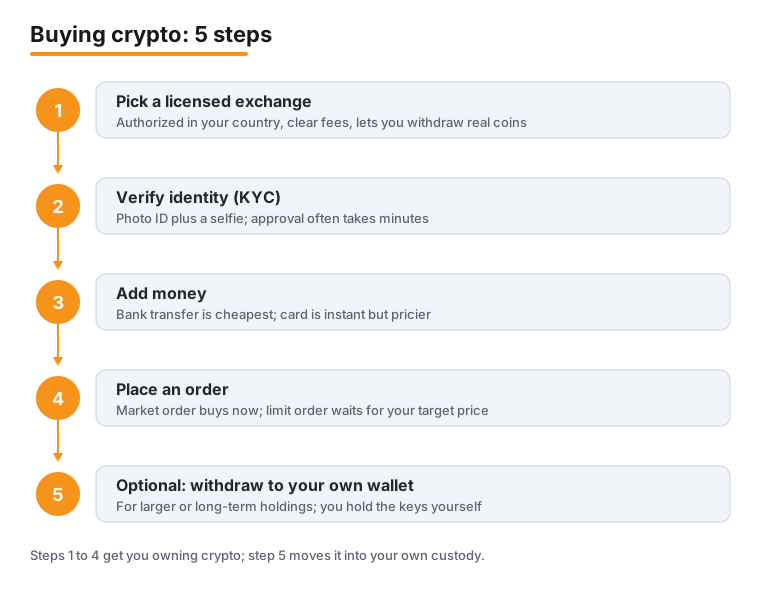
Buying crypto for the first time looks more complicated than it is. The whole journey has four steps: pick a platform, prove who you are, add money, place an order. Selling runs the same road in reverse. What trips people up is everything around those steps: the quiet fees that eat 3 percent before you own a coin, why an exchange wants your passport photo, and the questions your bank may ask when the money comes back. This guide walks through each stage with real numbers, the honest trade-offs between payment methods, and the habits that keep your money safe.
This guide is educational only, not financial advice, and crypto prices can fall as fast as they rise, so never commit money you cannot afford to lose.
Step 1: Choose where you will buy
Where you buy matters more than which coin you buy first. Most people start with a centralized exchange or a broker app, and the good ones all do the same basic job: they take your dollars, euros, or pounds and hand you crypto. The real differences hide in four places.
- Licensing. Check that the platform is authorized or registered in your country before you send it a cent. In the EU, exchanges now operate under the MiCA licensing regime; in the UK, crypto firms must be registered with the Financial Conduct Authority; in the US, the SEC's Investor.gov crypto pages explain which protections apply and, just as important, which do not. Our regulation section breaks the rules down by region. If a platform is not allowed to operate where you live, nothing else on its website matters.
- Fees. Look up two numbers before signing up: the trading fee on the standard trade screen (typically 0.1 to 0.6 percent) and the all-in cost of the one-tap instant buy button (often 1.5 to 4 percent). Platforms tend to bury the second number, which tells you something.
- Coin withdrawals. Some apps sell you price exposure but never let you move the coins to a wallet you control. That quietly locks you in. Confirm you can withdraw actual crypto before you deposit anything.
- Custody and track record. You are trusting this company to hold your money. Prefer platforms that have operated for years, publish proof of reserves or audited financials, and keep most customer coins in offline storage.
Spend twenty minutes comparing two or three platforms on these four points. It is the most valuable twenty minutes in this entire guide.
Step 2: Verify your identity (KYC)
Before you can buy anything, every regulated platform will run you through identity verification, usually called KYC, short for 'know your customer'. This is not the company being nosy. Anti money laundering laws require it wherever serious regulation exists, which means a platform that asks for nothing is a warning sign, not a convenience.
Expect to provide:
- Basic details: your full legal name, date of birth, home address, and often your tax residency.
- A government photo ID: passport, driving licence, or national ID card, photographed clearly.
- A live selfie or short video, so the platform can match your face to the document.
- Sometimes a proof of address: a recent utility bill or bank statement, most often requested when you want higher limits.
- Occasionally questions about your source of funds, normally only once larger amounts start moving.
With automated checks, approval often takes minutes. Allow up to a day in normal conditions, and a few days if a photo is blurry, your name is spelled differently across documents, or the platform is swamped during a market rush. Three habits prevent most rejections: photograph documents in good light with all four corners visible, avoid glare on the plastic, and use exactly the same name and address you will later use for your bank account.
Step 3: Add money to your account
How you fund the account decides how much of your money actually becomes crypto. The honest summary: bank transfers are slow but nearly free, cards are instant but expensive.
| Method | Speed | Typical cost | Best for |
|---|---|---|---|
| Bank transfer (ACH, SEPA, Faster Payments) | Minutes to 3 business days | Usually free, occasionally a small flat fee | Most purchases |
| Debit card | Instant | About 1.5% to 4% | Small, urgent buys |
| Credit card | Instant | Card fee, plus possible cash advance charges from your bank | Best avoided |
| PayPal, Apple Pay, Google Pay | Instant | Varies, often similar to cards | Convenience where supported |
| Peer-to-peer (P2P) | Varies | The seller's markup | Regions with limited banking options |
The card premium is real money. On a $200 purchase, a 3 percent card fee takes $6 before you own a single coin, and some banks treat crypto bought on a credit card as a cash advance, stacking interest and another fee on top. The same $200 sent by bank transfer usually arrives whole. One more quiet catch: many platforms lock coins bought with a card or instant payment for several days before you can withdraw them, as fraud protection.
A simple rule serves most people well: use a bank transfer for anything you planned more than a day in advance, and pay the card fee only when speed genuinely matters.
Step 4: Place your first order
Money in. Now the part that takes thirty seconds. Most platforms give you two ways to buy, and the cost difference between them is bigger than beginners expect.
The instant buy button is the friendly screen with a coin logo and an amount box. It is simple, and you pay for the simplicity: the markups and convenience fees on these widgets commonly total 0.5 to 3 percent. The standard trading screen looks scarier, with a chart and an order form, but fees there typically run 0.1 to 0.6 percent. It is the same coin either way.
On the trading screen you will pick an order type:
- A market order buys immediately at the best available price. For small amounts of a liquid coin like Bitcoin, it is the simple, sensible default.
- A limit order executes only if the price reaches a level you set, so you control the price but not the timing. It might fill in seconds, in days, or never.
There is one cost no fee table shows: the spread, the gap between the buying price and the selling price at the same moment. Say the spread is 1 percent and you put in $100. You receive about $99 worth of coin measured at the true middle price, and if you sold it straight back you would be left with roughly $98. On major exchanges the spread on bitcoin is tiny, hundredths of a percent, but it widens sharply on small coins and inside instant buy widgets.
And no, you do not need a whole coin. $25 buys a fraction of Bitcoin exactly as well as $25,000 does.
After buying: keep it on the exchange or withdraw it?
The moment you own crypto, you face a decision most apps never mention: who actually holds it. Coins sitting on an exchange are controlled by that company. If it is hacked, freezes withdrawals, or goes under, your coins are caught in the middle.
Leaving coins on the exchange is reasonable when the amount is small, you plan to sell or trade again soon, or you are still learning and honestly more likely to lose a recovery phrase than a regulated exchange is to fail this month.
Withdrawing to your own wallet makes sense when the amount has grown into real savings or your horizon is years. With a self-custody wallet you hold the keys yourself, so no platform failure can touch the coins. The trade is responsibility: lose your recovery phrase and nobody on earth can restore it. Our guide to bitcoin wallets walks through the options, from free phone apps to hardware devices.
Withdrawing crypto costs a network fee, paid partly to the blockchain rather than the platform. It is a flat amount per withdrawal, not a percentage: commonly a dollar or two on Bitcoin, sometimes $10 to $20 when networks are congested, and under $1 on newer low-cost ones. Check it before withdrawing small amounts, because a $10 fee on a $50 withdrawal is 20 percent of your money gone.
Two habits make withdrawals boring, which is exactly the goal: always send a small test amount to any new address first, and always confirm the network matches at both ends, because coins sent over the wrong network can be lost for good.
Selling: the same road in reverse
Selling has the same shape as buying, run backwards. Three steps.
- Get the coins where you will sell them. If they already sit on the exchange, skip ahead. If they are in your own wallet, copy the exchange's deposit address for that exact coin and network, send a small test amount, confirm it arrives, then send the rest.
- Place the sell order. A market order sells right now; a limit order waits for your target price. The proceeds land in your account as a cash balance, or as a stablecoin you then convert to cash.
- Withdraw to your bank. The bank account normally has to be in your own name. Confirm the withdrawal, approve it with two-factor authentication, and wait.
The waiting is the part to plan around. The sale itself takes seconds; the bank leg takes anywhere from minutes on instant rails (SEPA Instant, UK Faster Payments) to one to three business days for a US ACH transfer, and weekends do not count as business days anywhere. If you need the money in your account by Friday, sell on Monday or Tuesday, not Thursday night. A first withdrawal to a newly linked bank account often triggers extra checks, so do one small practice run long before you need money quickly.
Cashing out: the surprises nobody mentions
The selling mechanics are easy. These are the things that actually catch people the first time.
- Your bank may ask questions. Banks monitor incoming transfers for money laundering, and crypto platforms sit on their watchlists. A call or a form asking where the money came from is routine, not an accusation. Answer plainly and keep simple records of your buys and sells; an exchange statement usually settles it in one reply. A few banks are openly crypto-unfriendly and may delay or return such transfers, so it pays to know yours before the money lands.
- Weekend math. Crypto trades around the clock, banks do not. Sell on Friday evening and a standard transfer may not move until Monday, arriving Tuesday or Wednesday.
- Minimums and limits. Platforms set minimum cash withdrawals, often somewhere around $10 to $50, plus daily or monthly caps that start low until you finish higher verification tiers. Cashing out a large sum the same week you opened the account rarely works.
- Holds on fresh money. Coins bought with a card, and sometimes recent deposits, can be locked from withdrawal for several days as fraud protection. The lock is on withdrawal, not on selling, but it still delays your cash.
- Everything must match your name. You generally cannot withdraw to someone else's bank account or receive a deposit from one. Mismatched names are one of the most common reasons withdrawals bounce.
The fees you will actually pay
Here is the whole cost picture in one place. Exact numbers differ by platform and country, so treat these as honest ranges rather than quotes.
| Fee | Honest range | When it hits |
|---|---|---|
| Deposit fee | Free by bank transfer; about 1.5% to 4% by card | When money goes in |
| Trading fee | Roughly 0.1% to 0.6% per trade on a standard trading screen | Every buy and every sell |
| Instant-buy markup | Roughly 0.5% to 3% in spread and convenience fees | One-tap buy and sell buttons |
| Crypto withdrawal (network) fee | Flat per withdrawal: often a dollar or two on Bitcoin, up to $10 or $20 on busy networks, under $1 on cheap ones | Moving coins to your own wallet |
| Cash withdrawal fee | Free to a few dollars | Sending proceeds to your bank |
A worked example makes it concrete. Take $1,000 on a full round trip, the cheap way: free bank deposit, a 0.4 percent trading fee to buy ($4), 0.4 percent to sell ($4), free bank withdrawal. Total: about $8, under 1 percent. Now the expensive way: a 3.5 percent card fee ($35), an instant buy markup of about 2 percent ($19), and the same again on the way out ($19). Total: roughly $73 on the same coins in the same market, nine times the cost. The cheap path asks nothing of you except a day of patience and one slightly uglier screen.
The 10-point safety checklist
Crypto payments cannot be reversed and there is no fraud department to call afterwards, so prevention is the whole game. Run through this list once and most of the common disasters simply cannot happen to you.
- Turn on two-factor authentication today, using an authenticator app rather than SMS, since phone numbers can be hijacked through SIM swaps.
- Use a long, unique password for your exchange account, ideally generated and stored by a password manager.
- Never share your recovery phrase or private keys with anyone, for any reason. No legitimate support team will ever ask for them.
- Send a test amount first every time you use a new address. A dollar of extra network fees buys a lot of peace of mind.
- Type the exchange's web address yourself and bookmark it. Fake lookalike sites buy search ads and harvest logins.
- Treat anyone who contacts you first as a scammer, especially 'support staff' messaging you on Telegram, X, or Discord. Real support never starts the conversation.
- Ignore guaranteed returns and friendly strangers offering to teach you trading. That script has a name, pig butchering, and our guide to crypto scams and fraud shows exactly how it unfolds.
- Check the coin, the address, and the network before every single transfer, because mistakes cannot be undone.
- Move long-term savings to a wallet you control, and store the recovery phrase offline, on paper or metal, in two separate places.
- Slow down whenever anything feels urgent. Pressure is the one ingredient every scam shares. The FTC's plain-English page on crypto scams is a good ten-minute read.
A word about taxes
Two facts surprise almost everyone. First, in most countries, selling crypto for cash is a taxable event: if the price rose between buying and selling, the gain is usually taxable. Second, swapping one coin for another typically counts as a sale too, even though no money ever touched your bank account, and spending crypto on goods often counts as well. Simply buying and holding is generally not taxed until you dispose of the coins.
Keep records from day one: the date, amount, and price of every buy, sell, and swap. Many exchanges now report customer activity directly to tax authorities, so assuming the tax office will never know is a poor plan. Our guide to crypto taxes explains the common rules and record-keeping basics; for your personal situation, your local tax authority's guidance or a qualified professional beats anything a website can tell you.
Frequently asked questions
How much money do I need to start buying crypto?
Less than you might think. Most platforms let you start with around $10, and every major coin can be bought in fractions, so $25 of Bitcoin is a perfectly normal purchase. Starting small is genuinely smart: do one tiny buy, one tiny withdrawal, and one tiny sell to learn the full loop before real money is involved.
What is the cheapest way to buy crypto?
Fund your account by bank transfer, which is usually free, then buy on the standard trading screen instead of the instant buy button. That combination typically costs well under 1 percent all in. Paying by card through one-tap buy buttons can push the same purchase toward 5 percent or more once spreads are counted.
How long does it take to get money into my bank after selling?
The sale itself takes seconds. The bank withdrawal is the slow part: minutes on instant rails like SEPA Instant or UK Faster Payments, one to three business days for a US ACH transfer, and weekends do not count. A first withdrawal to a newly linked bank account can take longer because of extra security checks.
Is it safe to leave my crypto on the exchange?
For small amounts, or coins you plan to trade soon, it is a reasonable convenience on a reputable, regulated platform. For larger or long-term holdings, most experienced holders withdraw to a wallet they control, because coins on an exchange depend on that company staying solvent and secure. Our bitcoin wallets guide compares the options.
Why is my bank asking where my money came from?
Banks are required to monitor transfers for money laundering, and payments from crypto platforms get flagged routinely. It is a standard check, not an accusation, and you are not in trouble. Answer honestly and keep simple records of your purchases and sales; a statement or screenshot from the exchange usually resolves it in one reply.
Do I have to pay tax when I sell or swap crypto?
In most countries, yes. Selling at a profit is usually a taxable gain, and swapping one coin for another typically counts as a sale even though no cash reached your bank. Buying and holding is generally not taxed until you sell. Keep records of every transaction, and see our crypto taxes guide for the basics.
Last updated: 2026-06.
Related guides
- How to Choose the Right Network When Sending Crypto (ERC-20 vs TRC-20 vs BEP-20)
- Getting Paid in Crypto: How Stablecoin Salaries Actually Work
- How to Back Up Your Seed Phrase (and Test That It Works)
- How to Lower Crypto Transaction Fees
- How to Move Crypto Between Exchanges (Without Losing It)
- How to Set Up a Self-Custody Wallet
- Crypto Scams and Fraud: How to Stay Safe