Getting Paid in Crypto: How Stablecoin Salaries Actually Work
For years, getting paid in crypto meant a startup offering its own token instead of money. In 2026 it mostly means something duller and more practical: your employer or client routes pay through a platform like Deel or Rise, and a slice of it lands as USDC or USDT minutes after payday. Rise projects that 35 to 40 percent of global businesses will use stablecoin payroll by the end of 2026, up from roughly 25 percent a year earlier, so the odds you get this offer are rising. This guide is written from your side of the table, the worker's side: how payouts actually work, which coin to pick, what the IRS expects, how to reach your bank, and when to say no.
What a stablecoin salary actually is (and is not)
The thing almost nobody tells you first: on the major platforms you do not get your whole salary in crypto. Legitimate setups run gross pay through normal payroll, deduct income tax and social contributions in fiat, and only then convert a slice of net pay into stablecoins. On Deel, employees can allocate between 10 and 25 percent of net salary to stablecoin payouts, only if the employer has enabled the feature, and only on USD or EUR contracts. Your W-2 or payslip looks the same as before.
Three different animals get lumped under 'crypto salary':
- Employee payout option: a percentage of net wages converted to USDC, USDT or EURC after taxes. Low risk, low paperwork.
- Contractor payout: you invoice in dollars and withdraw the whole amount in stablecoins. More control, more tax homework.
- Token compensation: the employer pays you in its own volatile token. That is not a stablecoin salary, and it belongs in the red flag section.
How a Deel-style employee payout works, step by step
Deel's process is publicly documented, and competitors follow a similar shape.
- Your employer enables stablecoin payouts for your contract. You cannot switch this on yourself.
- You get a confirmation email. This does not enroll you. You must log in and set your salary split before the payroll cutoff, or nothing changes.
- You pick the percentage (10 to 25 percent of net) and the coin: USDC, EURC or USDT. The payout wallet only activates once the split is saved.
- On payday, taxes and deductions come out first, then your chosen slice arrives as stablecoins. Deel charges employees no provider, transaction or gas fees on these payouts.
Edge cases: a split set after the cutoff applies to the next cycle, and a mid-cycle exit follows whatever split was active. Deel's newer DLUSD (June 2026) is different again: a closed-loop USD balance redeemable only inside Deel, not a token you can move to your own wallet.
Freelancers get more control and more homework
Contractors are where stablecoin pay really lives. On Rise, contractors pick their withdrawal method every cycle, fiat, USDC, USDT or a mix, on networks like Ethereum and Arbitrum; the client cannot dictate that choice. Rise bills the client a flat monthly fee per contractor rather than skimming your payout, and it is a FinCEN-registered money services business.
Deel handles contractors differently: its digital currency withdrawal costs 2 percent of the amount plus a 1 dollar network fee, with USDC supported on Ethereum, Base, Polygon, BNB Chain and Solana. On a 3,000 dollar invoice that is 61 dollars, every month, and the method is not available in every country. A plain bank withdrawal is often cheaper; compare per cycle, not on vibes.
The homework: a US contractor owes income tax and self-employment tax on each payment's fair market value, clients report on a 1099-NEC (threshold 2,000 dollars for payments made in 2026), and nobody withholds for you. Set aside 25 to 35 percent and pay quarterly estimates.
USDC or USDT: which one do you take wages in?
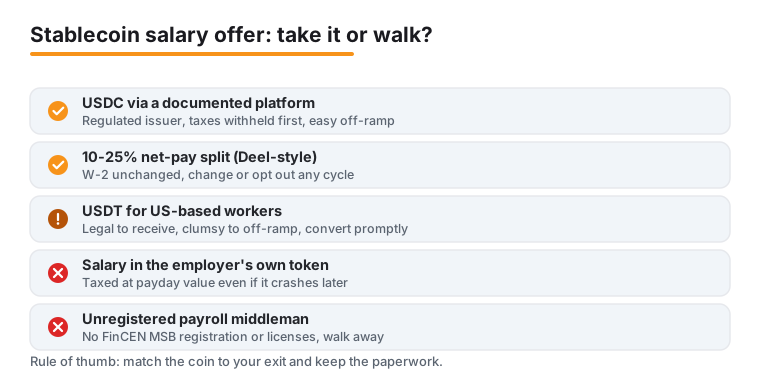
Tax-wise they are identical, dollar-pegged property. Practically they are not interchangeable.
USDC is issued by Circle, a US-regulated company operating inside the GENIUS Act framework, the 2025 federal stablecoin law. It publishes reserve attestations, redeems 1:1, and converts to dollars on Coinbase and most US exchanges without friction. For anyone off-ramping through a US exchange it is the boring, correct default.
USDT is the largest stablecoin by circulation, roughly 185 billion dollars in early 2026, but Tether is domiciled in El Salvador and USDT does not operate inside the US framework. Tether instead launched a separate US token, USAT, in January 2026, issued through Anchorage Digital Bank under OCC supervision. USDT remains the liquidity king across much of Latin America, Africa and Asia, often on Tron.
Rule of thumb: match the coin to your exit. US bank account, take USDC. Local peer-to-peer market that trades USDT all day, take USDT and do not hold it longer than needed. For the regulatory background, see our guide to stablecoins under the GENIUS Act.
The tax reality: your paycheck is property
The IRS treats digital assets, stablecoins included, as property, not currency. That single fact drives everything else.
For employees, wages paid in crypto are taxable at fair market value on the date you receive them, reported on your W-2, with normal income and payroll tax withholding. On Deel-style platforms this is painless because taxes come out in fiat before the conversion, so your withholding does not change.
For contractors, you report the fair market value of each payment as self-employment income on the day it lands. With a stablecoin that value is, by design, almost exactly the invoice amount, which is precisely why stablecoins and not bitcoin won the payroll race: 5,000 USDC received is 5,000 dollars of income, with no argument about valuation.
Where people trip up is not the income side but the disposal side, covered next. For how crypto income, gains and losses fit together across the forms, see our crypto tax guide.
The second tax event nobody warns you about
Because stablecoins are property, every conversion, spend or swap is a disposal, and every disposal is reportable, even when the gain is zero point nothing. Get paid 2,000 USDC, off-ramp two days later for 2,000 dollars, and you have a sale with a near-zero gain that still belongs on Form 8949.
This became visible in 2026 because of Form 1099-DA. US exchanges now report your gross proceeds to the IRS for transactions from 2025 onward, and cost basis for assets bought and sold on the same platform from 2026 onward. Cycle a paycheck through an exchange every month and your 1099-DA can show tens of thousands of dollars in proceeds by year end while your actual gain is a few dollars. That mismatch is harmless if you keep records, and audit bait if you ignore the form.
Practical habits: keep payout confirmations (they establish cost basis) and off-ramp promptly; if a peg slips between payday and withdrawal, the difference is a small capital loss you can claim.
Off-ramping: getting stablecoins into your bank
The standard route from wages to checking account:
- Open an account at a licensed exchange in your own name (Coinbase and Kraken are the usual US picks) and finish identity verification before payday, not after.
- Set your payroll payout address to your exchange deposit address, and match the network exactly. If the exchange gives you a USDC address on Base, do not send USDC on Polygon to it. Wrong-network deposits are the number one way people turn a paycheck into a support ticket.
- Convert USDC to USD (1:1 on Coinbase) and withdraw by ACH, typically free and one to two business days.
Two caveats. Banks sometimes flag recurring exchange inflows; a note that this is payroll usually settles it. And do not chase advertised yield on parked salary: the GENIUS Act bars issuers from paying interest to holders, and in February 2026 the OCC proposed rules targeting the pass-through 'rewards' workarounds, so treat any advertised rate as temporary. Full step-by-step detail, including limits and timing, is in our guide to cashing out crypto to a bank account.
Red flags: when to say no
A stablecoin payout option from a documented platform is a reasonable thing to accept. The following are not.
- Pay in the employer's own token. You are taxed on its payday value even if it craters the next week; the drop only counts as a capital loss when you sell. Startups pitch this as upside. It is a pay cut with extra steps.
- An unregistered middleman. If a third party you have never heard of will 'handle the crypto part', check the FinCEN MSB registry and ask which state money transmitter licenses it holds. If the answer is a shrug, walk.
- 100 percent of gross pay in crypto for a US employee. Withholding has to happen, and several state labor codes require wages payable in money, which is why serious platforms only convert a slice of net pay. Skipped withholding is a tax problem with your name on it.
- Pressure to keep salary on-platform for yield. The regulatory ground under those offers is moving, as covered above.
- Payments from a personal wallet with no contract. No payslip, no 1099, no proof of income for a mortgage or visa. Insist on the paperwork.
Before opting in, ask three questions: which licensed entity actually sends the coins, are taxes withheld in fiat before conversion, and can I change my split or opt out every cycle? Good setups answer all three in writing.
Frequently asked questions
Can I take 100 percent of my salary in stablecoins?
As a regular employee on the major platforms, no. Deel caps stablecoin payouts at 25 percent of net salary, after taxes are deducted in fiat. As an independent contractor you can usually withdraw your entire invoice in stablecoins, but then quarterly taxes are entirely your job.
Do I get taxed twice, once on payday and again when I cash out?
Not meaningfully. You owe income tax on the value at the moment you are paid. Converting later is a separate disposal, but with a stablecoin the gain or loss is normally a few cents. You report it; you will not owe real extra tax.
What if the stablecoin depegs between payday and my withdrawal?
Your wage income is locked at the value on the payment date. If you later sell below that, the difference is a capital loss you can claim. This is one more argument for off-ramping wages promptly instead of letting them sit.
Should I use my own wallet or an exchange address for payouts?
Sending straight to your exchange deposit address saves a hop and a fee if you plan to cash out. A self-custody wallet gives control and suits spending or holding, but adds one more transfer and one more chance to pick the wrong network. Most people paid monthly do fine with a direct-to-exchange setup.
My employer offers USDT but I am in the US. Is that a problem?
Receiving USDT is not illegal, but Tether does not operate it inside the US regulatory framework (its separate US token, USAT, launched in January 2026), and off-ramping USDT through US exchanges is clumsier than USDC. If USDC is on the menu, pick it; if not, convert soon after receipt.
Does a stablecoin salary hurt mortgage or loan applications?
Not if the paperwork exists. Lenders want payslips, W-2s or 1099s, and bank statements showing regular deposits; a Deel-style split keeps all of that intact. Crypto from a personal wallet with no contract is what causes problems.
Last updated: 2026-06-30.
Related guides
- How to Lower Crypto Transaction Fees
- How to Move Crypto Between Exchanges (Without Losing It)
- How to Read a Blockchain Explorer and Track Your Transaction
- How to Read a Crypto Whitepaper Before You Buy
- How to Send Crypto Safely: A Step-by-Step Guide
- How to Set Up a Self-Custody Wallet
- Crypto Scams and Fraud: How to Stay Safe