How to Cash Out Crypto to Your Bank Account
You own some crypto and you want real money in your checking account. That is a completely normal thing to want, and the process is not complicated once you see the whole path laid out. The catch is that two things can quietly eat into what you actually receive: fees charged by the platform you use, and the tax bill that the sale itself creates. This guide walks through the full off-ramp, from selling your coins for dollars to seeing the deposit land, and it is honest about which methods are safe and which ones tend to cost you far more than they should.
This is educational content, not financial or tax advice; for decisions about your own situation, talk to a licensed tax professional.
The two-step idea behind every cash-out
Almost every way of turning crypto into bank-account dollars is really two separate steps, even when an app hides the seam between them.
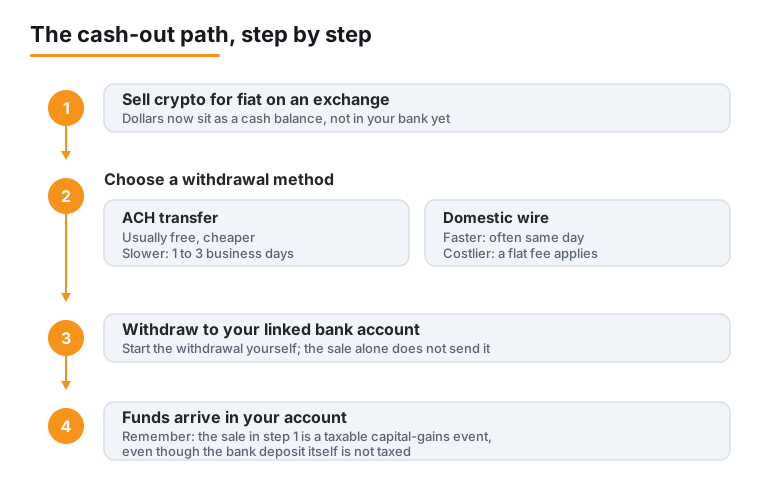
Step one is the sale. You trade your Bitcoin, Ether, or other coin for fiat currency, usually US dollars. After this step the value is sitting as a cash balance inside the exchange or app, not in your bank yet. This step is also the moment a tax event happens, which we cover in detail below.
Step two is the withdrawal. You move that dollar balance from the platform to your linked bank account. This is where you choose between methods like an ACH transfer or a wire, and where withdrawal fees and processing times come in.
Keeping these two steps separate in your head matters, because the fee to sell and the fee to withdraw are charged at different points. A platform can advertise a free withdrawal while still taking a cut on the sale through a spread, and the reverse can also be true. To understand the difference between a quoted price and a spread, the basics of buying and selling crypto are worth a quick read first.
Selling your crypto for dollars, step by step
The exact taps differ by platform, but the shape is the same everywhere. Using a regulated US exchange as the example, here is the typical path.
- Open the trade or sell screen. On Coinbase this is the Buy/Sell button, then the Sell tab. On Kraken you would use the trade screen or the simple Buy/Sell view.
- Pick the coin and the amount. You can usually sell a partial holding. Decide whether you are selling in coin terms (0.1 BTC) or dollar terms ($500 worth), since most apps let you type either.
- Choose what you receive. Sell into your USD cash balance, not into another coin. Selling Bitcoin for a stablecoin or another token is still a taxable disposal and does not actually get you closer to your bank.
- Review the quote. Look for the spread and any stated fee before you confirm. The number you see as "you receive" is the real figure that matters.
- Confirm the sale. Your dollars now sit as a cash balance on the platform, ready to withdraw.
A common mistake here is stopping after the sale and assuming the money is on its way to the bank. It is not. The sale only parks dollars inside the platform. You still have to start the withdrawal yourself.
ACH versus wire: which transfer to choose
Once you hold a dollar balance, the withdrawal method decides both your fee and how long you wait. For US users the two main options are ACH and a domestic wire, with a newer instant option appearing on some platforms.
ACH transfer. This is the standard, low-cost choice and is usually free. Coinbase lists ACH withdrawals as free, and Kraken's own support page shows free ACH withdrawals with a $1 minimum. The tradeoff is speed: ACH typically takes one to three business days to settle, and weekends and bank holidays do not count.
Domestic wire. A wire is faster, often landing the same business day, but it carries a fee. Coinbase charges about $25 for a USD wire withdrawal. Kraken is cheaper, with domestic wire options listed around $4 to $10 depending on the partner bank. A wire only makes sense when the speed is genuinely worth the fee, for example a large amount you need today.
Instant or real-time payments. Some platforms now offer near-instant payouts using the RTP network or instant card rails, landing in your bank in under fifteen minutes. These usually carry a percentage fee, often around 1.5 percent, so they are convenient but not cheap.
A simple rule of thumb: if you can wait a couple of days, use free ACH. If you genuinely need the money today, compare the flat wire fee against the percentage instant fee and pick whichever is smaller for your amount.
The fees that actually reduce your payout
The withdrawal fee is only one of several costs, and often not the largest. Here is where money tends to leak out.
- The spread on the sale. Many simple buy/sell interfaces bake a margin into the price you receive. You will not see it as a separate line item, but it lowers your proceeds.
- The trading fee. Exchanges that show an explicit fee charge a percentage of the trade. Using an exchange's advanced or pro trading view usually carries a much lower fee than the simple one-tap sell button.
- The withdrawal fee. Free for ACH on the major US exchanges, a flat charge for wires, and a percentage for instant payouts.
The platform you choose changes your total cost dramatically. Cash App, for instance, has historically used a tiered Bitcoin fee structure that ran from roughly 3 percent on very small amounts down to about 0.75 percent on amounts over $5,000, on top of a spread, though its current schedule has shifted toward free buys in some cases. The lesson is not about any single app: it is that you should read the fee page of whatever platform you use before you sell, because a convenient app can quietly cost several percent. For more on how trading costs work in general, see our overview of crypto trading.
Selling is a taxable event in the US
This is the part people most often get wrong, and it can turn a smooth cash-out into a surprise bill the following spring. In the United States the IRS treats digital assets as property, not currency. That means selling crypto for dollars is a taxable disposal that creates a capital gain or a capital loss.
The math is straightforward: your gain or loss equals the proceeds from the sale minus your cost basis, which is what you originally paid to acquire the coins, including fees. If you bought 0.5 BTC for $20,000 and later sell it for $30,000, you have a $10,000 capital gain, and that gain is what gets taxed. If you sell for less than you paid, you have a capital loss, which can offset other gains.
Note that you do not need to move anything to your bank for tax to apply. The taxable moment is the sale itself. Even swapping one coin for another counts as a disposal. You can read the official treatment on the IRS Digital Assets page, and our own primer on crypto taxes goes deeper into how to report it.
How much tax you might owe
The rate depends almost entirely on one thing: how long you held the crypto before selling.
Held one year or less (short-term). The gain is taxed as ordinary income, at the same rates as your paycheck. For 2026 those rates run from 10 percent up to 37 percent depending on your total taxable income.
Held more than one year (long-term). You get preferential long-term capital-gains rates of 0 percent, 15 percent, or 20 percent, again depending on your income. Many people fall in the 15 percent band.
High earners may also owe an additional 3.8 percent Net Investment Income Tax if their income crosses certain thresholds. The practical takeaway is real: holding for just over a year before cashing out can move the same gain from the ordinary-income rate down to the long-term rate, which is often a large difference. None of this is a recommendation to time a sale around taxes alone, only an explanation of how the brackets work. The official rate brackets are published by the IRS on Topic 409, Capital Gains and Losses.
New 1099-DA reporting and the records you must keep
Tax reporting for crypto changed recently, and it affects what arrives in your mailbox and what you still have to track yourself.
Starting with 2025 transactions, custodial brokers such as Coinbase, Kraken, and Gemini are required to issue Form 1099-DA, which reports your crypto sales to both you and the IRS. You can expect those first forms in early 2026. However, for 2025 transactions the form reports only the gross proceeds, the dollars you sold for, and generally not your cost basis. Cost-basis reporting becomes required for 2026 transactions, with those forms arriving in early 2027.
What this means in plain terms: for now, the IRS may know what you sold for but not what you paid. If you cannot prove your cost basis, the entire sale amount could be treated as gain, which inflates your tax. So keep your own records. For every purchase, save the date, the amount of crypto, the price, and the fees. A simple spreadsheet or a dedicated crypto tax tool is enough. The details on the form are explained well by the IRS page on understanding your Form 1099-DA.
Safe methods versus risky ones
Not every off-ramp is equally trustworthy. Here is how the common methods stack up.
Safer: regulated exchanges. Cashing out through a licensed exchange like Coinbase, Kraken, or Gemini is generally considered one of the safest routes. They are subject to oversight, they keep records you will need at tax time, and the fees are transparent. The main inconvenience is identity verification and the occasional compliance hold on a withdrawal.
Use with care: peer-to-peer marketplaces. P2P platforms such as Binance P2P or Paxful let you sell directly to another person who pays you by bank transfer. This can offer good rates, but it carries real counterparty risk: chargeback scams and fake payment confirmations are common. Only use the platform's built-in escrow, never release coins before the money has truly cleared in your bank, and be skeptical of anyone rushing you.
Convenient but expensive: crypto debit cards and Bitcoin ATMs. A crypto debit card converts coins to cash at the point of sale, which is handy but not a clean way to fund your bank. Bitcoin ATMs let you walk away with paper cash, but they are the costliest option by a wide margin: sell fees commonly run 5 to 7 percent and total costs including spreads can climb much higher. Our guide to Bitcoin ATMs covers when, if ever, they make sense.
One more safety note for anyone holding their own coins in a self-custody wallet: you control the keys, which is powerful but unforgiving. Sending to the wrong address or mistyping it can mean permanent loss, a theme we cover in not your keys, not your coins and in what happens when you send crypto to the wrong address.
Processing times and what to do when a withdrawal is pending
Timing trips people up because two different clocks are running. The on-chain part, moving coins from a personal wallet onto an exchange, is normally near-instant, though it can sit pending for hours during network congestion until enough confirmations arrive. The fiat part, moving dollars from the exchange to your bank, follows banking timelines: same day for a wire, one to three business days for ACH.
Exchanges also sometimes place a temporary hold. A first-time withdrawal, a large amount, or a recently added bank account can trigger a security or compliance review that delays the payout by a day or two. This is normal and usually clears on its own.
If a withdrawal is still pending after 24 to 48 hours, do not panic and do not try to send it again, which can compound the problem. Instead, gather the details before contacting support: the coin or currency, the destination address or bank account, the network used, the time you requested it, and the transaction ID (TXID) if it was an on-chain transfer. Having those in hand makes support able to trace it quickly. A pending status almost always resolves; it rarely means the funds are lost.
A clean cash-out, start to finish
Putting it together, here is a sensible default for most people cashing out a meaningful amount in the US.
- Use a regulated exchange you already have verified, so there are no surprise holds.
- Sell into your USD balance, ideally through the lower-fee advanced trading view rather than the one-tap button.
- Withdraw by free ACH unless you genuinely need the money the same day, in which case compare a flat wire fee against a percentage instant fee.
- Write down the sale date, proceeds, and your cost basis the moment you sell, while the numbers are in front of you.
- Set aside a portion of any gain for taxes, and treat the 1099-DA you receive as a cross-check against your own records, not as the whole story.
Done this way, cashing out is calm and predictable. The money that surprises people is almost never the withdrawal fee; it is the tax on a gain they did not plan for, or the several percent quietly taken by a convenient but pricey app. Plan for both and you keep what you meant to keep.
Frequently asked questions
Do I owe tax even if I leave the cash in the exchange and never move it to my bank?
What is the cheapest way to cash out to my bank?
How long does it take to get my money?
Will the exchange report my cash-out to the IRS?
Can I lower the tax by holding longer before I sell?
My withdrawal has been pending for a day. What should I do?
Last updated: 2026-06-14.