What happens when you send crypto to the wrong address
Your stomach drops the moment you hit send and notice the address is off by a few characters, or that you picked the wrong network. Take a breath. Panic leads to bad decisions, and bad decisions here usually cost more money. The harder truth: in most cases, crypto sent to a truly wrong address is gone for good, and no customer service line reverses it. But "most cases" is not "all cases," and the difference between a wrong address and a wrong network decides whether you have a real shot at getting your money back.
This guide covers what actually happens, how to check your specific situation in a few minutes, when a company can legitimately help, the scams that prey on people in your position, and how to make sure this never happens again. This is educational content, not financial advice.
Why most transactions cannot be undone
A blockchain is a shared ledger that thousands of computers agree on. When you send funds, your wallet signs the transaction with your private key and broadcasts it. Once validators confirm it, it is permanent, and there is no admin who can flip it back. MetaMask is direct about it: once a transaction is confirmed, the only way to get the funds back is for whoever controls the receiving address to send them back in a new transaction. Ledger and Coinbase say the same in their own help pages.
This is not a bug. The point of these systems is that no single party can edit history, so the responsibility sits with you. A bank can claw back a mistaken wire because it controls the ledger. On a public blockchain, nobody does. Understanding how a blockchain confirms and settles transactions makes the irreversibility easier to accept, even when it stings.
So the honest baseline: if you sent coins to a valid address that is not yours, only whoever controls that address can return them. The rest of this guide is about whether that is really your situation, or one of the narrower cases where recovery is possible.
First, figure out which mistake you actually made
People say "wrong address" to mean very different things, and each has a different outcome. Pin down which applies to you before doing anything else.
- Wrong address, right network. You sent to a valid address on the correct blockchain, but it belongs to someone else (a typo, an old address, the wrong contact). The coins are sitting in that address. Recovery depends entirely on who owns it.
- Right address, wrong network. The address is correct, but you sent over a different blockchain than the receiver expected, for example USDT over Tron (TRC-20) to an exchange that only credits USDT over Ethereum (ERC-20). This case has the best odds, and gets its own section below.
- Invalid or mistyped address the network rejected. Most modern wallets use a checksum that catches a malformed address and refuses to send. If your wallet blocked it, nothing left your account. No action needed.
- Wrong asset to a real address. You sent the wrong coin, or a token a service does not support. Often recoverable through that service's tools, covered later.
To confirm what happened, copy the transaction ID (also called a hash, a long string starting with 0x on Ethereum-style chains) from your wallet and paste it into a block explorer such as Etherscan for Ethereum, or the explorer for whatever chain you used. It shows the exact sending address, receiving address, network, and whether the transaction confirmed. This is your ground truth. Screenshot it now.
The wrong-network case, where you might be in luck
Here is the detail that creates a second chance. Networks like Ethereum, Polygon, Arbitrum, Optimism, Avalanche, and BNB Smart Chain are all "EVM-compatible," meaning they share the same address format and cryptography. Your seed phrase generates the same address across all of them. So if you meant to send on Ethereum but the funds landed on Polygon, the coins are at your own address, just on a different chain.
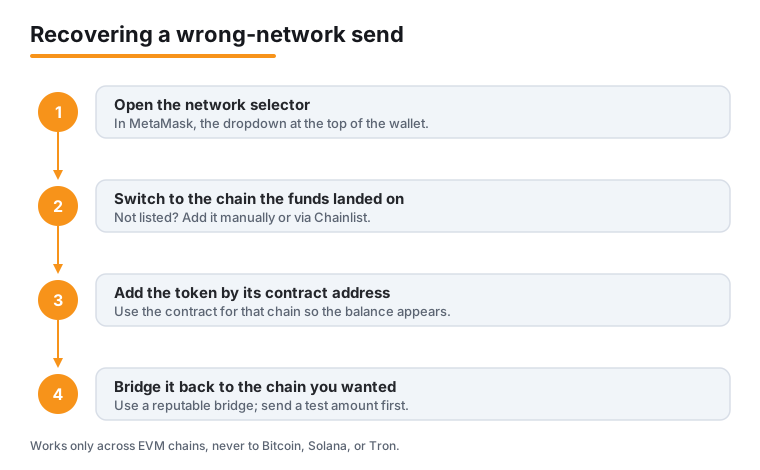
MetaMask describes the fix: if you control the receiving wallet, the tokens "are not lost" and you simply need to switch your wallet to that network. Concrete steps in a self-custody wallet:
- Find the network selector (in MetaMask, the dropdown at the top).
- Switch to the network the funds actually landed on. If it is not listed, add it manually or through a directory like Chainlist.
- The token may not show on its own. Add it using that chain's contract address. The same token has a different contract address on each chain, so copy the one for the chain you are now on.
- Once you see the balance, move it back to the chain you wanted with a reputable bridge.
One important warning: a seed phrase only restores the same address on EVM chains. It will not restore your address on a non-EVM network like Bitcoin, Solana, or Tron. If you sent funds "to" one of those by picking the wrong network, MetaMask is blunt that "it's likely your tokens are gone forever," because they went to an address format your key does not control.
Bridging funds back to the chain you wanted
If your tokens are safe on the wrong EVM chain, a bridge moves them to the right one. A bridge locks your tokens on one chain and releases the equivalent on another. Stick to well-known ones, and reach the site by typing the address yourself, never through a search ad or a link someone sends you.
A small worked example. You wanted 200 USDC on Arbitrum but sent it on Polygon. Confirm the balance on Polygon in your wallet, open a reputable bridge, connect, select USDC from Polygon to Arbitrum, review the quote, and confirm. You pay a small network fee on each side and sometimes a bridge fee, usually a few dollars total, though it varies with congestion. Send a tiny test amount first if the balance is large.
Before bridging, double check you are on the official site and the token contract matches. Fake bridge sites are a common way people lose the funds they just rescued. When in doubt, the slower path through a centralized exchange (next section) is often safer.
When an exchange can actually help
If the funds went to a deposit address at a centralized exchange, you have a real party to talk to, though help is limited and conditional.
Wrong asset or network sent to your own Coinbase account. Coinbase runs an Asset Recovery tool for certain unsupported ERC-20 tokens mistakenly sent to your Coinbase address. As of 2026 it covers select tokens on Ethereum, Polygon, BNB Smart Chain, Base, and Solana. You provide the transaction hash and the token's contract address. The fee is 5% on any amount over the first 100 dollars, plus network fees, and some assets (such as rebase tokens) cannot be recovered. Check Coinbase's own page for current eligibility before counting on it.
Other exchanges. Some large ones can sometimes retrieve wrong-network deposits when the address format matches across chains. It is case by case, often takes weeks, needs a support ticket with the hash, and may carry a meaningful fee. None of it is guaranteed.
What an exchange cannot do is reverse a transaction or recover funds you sent to a stranger's address on the open network. Exchanges only control addresses on their own platform.
Practical step: open a support ticket through the official app or site, attach your block explorer screenshot and transaction hash, and describe what you intended versus what happened. If you are choosing where to keep funds going forward, it helps to understand how exchanges and wallets differ.
If a real person or service holds your coins
For a plain wrong-address case on the right network, your only path is the address controller returning the funds voluntarily. Whether that is realistic depends on whose address it is.
- A friend, a merchant, or a known business. Reach out directly and show them the transaction on a block explorer. People do return mistaken transfers, especially when you can prove it and the amount is small.
- A platform or smart contract. If you sent to a token's own contract or a project's wallet, some contracts let the owner return stuck funds, but many do not, and there is no obligation. Contact the project's official support with the transaction hash.
- A burn address, a dead wallet, or a random address. If nobody controls it, the funds are unreachable by anyone, including you. That is the hardest version to accept, but pretending otherwise just makes you a target for the scams below.
Set your expectations honestly. Recovery here is the exception, not the rule, and depends on someone choosing to send your money back.
The recovery scam that targets people exactly like you
This is the most important section, because right after a loss is when people get hurt a second time. "Recovery" scammers hunt for victims and promise your money back for an upfront fee, then vanish or bleed you for more.
The FBI's Internet Crime Complaint Center warned in 2024 about fictitious law firms doing exactly this, reporting more than 9.9 million dollars in victim losses to these secondary scams between February 2023 and February 2024. The fake "lawyers" claim to work with the FBI or other agencies, produce official-looking documents, ask for personal or banking details, and request fees up front with a promise of the balance once funds are "recovered."
Treat these as absolute red flags:
- Anyone who contacts you first offering to recover funds, especially on social media, Telegram, or in replies to your posts about the loss.
- Any request for an upfront fee, a "tax," a "deposit," or payment in crypto or gift cards. Legitimate law enforcement never charges victims to investigate.
- Anyone asking for your seed phrase, private keys, or remote access to your device. That is theft, full stop. Nobody legitimate ever needs your seed phrase.
- Guarantees of success. Real recovery is uncertain and rare.
If someone claims to be from a government agency, look up its real contact details independently and verify. Our overview of common crypto scams and fraud and the page on what crypto recovery realistically involves are worth reading before you trust any promise.
What to do in the first hour, step by step
A calm checklist beats frantic clicking:
- Stop sending anything else. Do not try to "fix" it by sending more funds anywhere. That is how one mistake becomes two.
- Find the transaction hash in your wallet's activity or the exchange's withdrawal history.
- Open it in a block explorer and confirm the network, the exact receiving address, and the status. Screenshot everything.
- Classify the mistake using the four cases above. Wrong network, right address means check the other chain. Plain wrong address means assess who controls it.
- If it is an exchange deposit issue, open an official support ticket with your hash and screenshots and ask about their recovery tool.
- If a known person or business holds it, contact them with proof and ask for a return.
- If it is genuinely lost, report it. In the US, file at ic3.gov with the hash, addresses, amounts, and any communications. Reporting rarely recovers funds, but it feeds investigations.
- Ignore every unsolicited recovery offer. If you did not seek it out, it is almost certainly a scam.
How to make sure it never happens again
Every habit below costs a few seconds and can save your whole balance. Build them in now.
- Always send a test amount first. For any new address or large transfer, send a tiny amount, confirm it arrives, then send the rest. A few cents in fees buys real peace of mind.
- Use an address book. Save addresses you reuse under clear labels in your wallet, so you pick a trusted entry instead of pasting each time.
- Copy and paste, never type, then verify both ends. Check the first four and last four characters against the source. Address-swapping malware can silently replace your clipboard, and checking the ends catches it.
- Match the network on both sides. Before withdrawing from an exchange, confirm the destination supports that exact network. USDT on Tron and USDT on Ethereum are not interchangeable.
- Use a QR code when you can. Scanning the receiver's QR removes the chance of a typo.
- Slow down for big sends. Most losses happen when people rush. Read the confirmation screen before approving.
If you hold meaningful amounts, solid security habits and knowing how cold storage works protect you from far more than send mistakes. The minutes you spend now are worth more than any recovery service could be.
Frequently asked questions
Can crypto sent to the wrong address be reversed?
No. Once a transaction is confirmed on the blockchain, it is permanent, and no company or wallet can reverse it. MetaMask, Coinbase, and Ledger all say this directly in their help pages. The only way to get the funds back is if whoever controls the receiving address chooses to send them to you, or, in the specific wrong-network case, if the funds actually landed at your own address on a different chain.
I sent tokens on the wrong network. Are they really gone?
Not necessarily. If both networks are EVM-compatible (such as Ethereum, Polygon, Arbitrum, Optimism, Avalanche, and BNB Smart Chain), your seed phrase controls the same address on all of them, so the tokens are usually at your address on the other chain. Switch networks in your wallet, add the token's contract address for that chain, and bridge it back. But if you sent to a non-EVM chain like Bitcoin or Solana, or into an exchange that does not support that network, recovery is often impossible.
Will my exchange refund a wrong deposit?
Sometimes, only under specific conditions. Coinbase offers an Asset Recovery tool for certain unsupported tokens sent to your own Coinbase address on Ethereum, Polygon, BNB Smart Chain, Base, and Solana, for a 5% fee on the amount above 100 dollars plus network fees. Some other exchanges can retrieve certain wrong-network deposits for a fee, case by case. No exchange can recover funds you sent to an address outside its platform. Open an official support ticket with your transaction hash to ask.
Someone messaged me offering to recover my lost crypto. Is it real?
Almost certainly not. If someone contacts you first promising recovery, treat it as a scam. The FBI has warned that fake law firms and "recovery agents" target people who just lost crypto, charge upfront fees, and disappear, costing victims millions. Never pay an upfront fee, never share your seed phrase or private keys, and never give remote access to your device. Legitimate law enforcement does not charge victims to investigate.
What information do I need to investigate or report the loss?
The core item is the transaction hash (or transaction ID), a long code you can find in your wallet's activity or your exchange's withdrawal history. Paste it into a block explorer to see the network, sending address, receiving address, and status, and screenshot that. For a report in the US, file at ic3.gov with the hash, the addresses involved, the amount, dates, and any messages from people who contacted you. Keep all of it in one place.
How do I avoid doing this again?
Send a small test amount before any large or first-time transfer, save frequent addresses in your wallet's address book, and after pasting an address verify the first and last four characters against the source to catch clipboard-swapping malware. Always confirm the destination supports the exact network you are sending over, use QR codes when available, and slow down to read the full confirmation screen before approving.