Bitcoin Security: Risks & How to Stay Safe
Bitcoin gives you something no bank account does: direct, irreversible control over your own money. That same property is also its sharpest edge. There is no fraud department to call, no chargeback button, and no one who can reverse a transaction once it confirms on the blockchain. If a thief moves your coins, they are almost always gone for good.
This guide explains where the real dangers lie, how people lose bitcoin, the practices that protect you, and what to do after a suspected breach. The good news is that the protocol itself has never been broken. Nearly every loss happens at the edges: weak passwords, phishing, malware, exchange failures, and human error. Those are problems you can defend against once you understand them.
This article is educational and is not financial, legal, or tax advice. Verify regulatory and tax questions with a qualified professional and consult official sources for your jurisdiction.
Biggest Bitcoin threats
It helps to separate two layers. The Bitcoin network itself, secured by cryptography and a globally distributed ledger that thousands of nodes verify, has proven remarkably resilient. The myth that hackers routinely "crack" Bitcoin transactions is just that, a myth. What gets compromised is almost always the layer around the protocol: the wallets, exchanges, devices, and people who hold the keys.
The largest losses in recent years came from centralized platforms, not from flaws in Bitcoin's code. Industry trackers reported roughly 2 billion US dollars or more in crypto stolen in both 2024 and 2025, much of it from custodial services. High-profile breaches such as the 2025 Bybit incident (widely reported as around 1.5 billion US dollars in ether, the largest crypto theft on record) and the 2024 DMM Bitcoin loss showed that even large, well-funded companies can be drained, often by persistent state-linked groups such as those attributed to North Korea. Treat any exact figure as approximate and confirm details with reputable security firms, since numbers are often revised.
The threats most likely to affect an ordinary holder include:
- Phishing and social engineering — fake exchange logins, fraudulent "support" agents, and lookalike websites that trick you into entering credentials or a recovery phrase.
- Malware and clipboard hijackers — software that steals keys, logs keystrokes, or silently swaps a copied address for the attacker's.
- Exchange and custodial risk — hacks, insolvency, freezes, or exit scams at platforms that hold your coins for you.
- Physical loss and human error — lost seed-phrase backups, forgotten passphrases, hardware damage, or sending funds to the wrong address.
- SIM swapping — attackers porting your phone number to intercept SMS codes and reset accounts.
Notably, the single most common cause of permanent loss is not a hacker at all. It is people misplacing their keys or backups. Self-custody removes the middleman, but it also makes you the last line of defense.
How funds get stolen
Understanding the mechanics of an attack makes the defenses obvious. Most thefts follow a handful of well-worn paths.
Phishing and fake interfaces
An email, ad, or message points you to a site that looks exactly like your exchange or wallet. You log in, and the attacker captures your password and two-factor code in real time. A more dangerous variant asks you to "verify" or "restore" your wallet by typing your 12- or 24-word recovery phrase into a web form. No legitimate service ever needs that phrase. Anyone who asks for it is trying to rob you.
Malware on your device
Malicious downloads, browser extensions, and fake wallet apps can read files, log keystrokes, or run a clipboard hijacker. The last is especially sneaky: you copy a destination address, but malware swaps in the attacker's address at the moment you paste. Always verify the first and last several characters of an address before sending.
Compromised exchanges and custodians
When you leave coins on an exchange, you are trusting that company's security and solvency. If it is hacked, mismanages funds, or collapses, your balance can vanish even though you did nothing wrong. This is the meaning behind the phrase "not your keys, not your coins." Custody can be a reasonable choice for small or actively traded amounts, but it is a counterparty risk, not true ownership.
SIM swapping and account takeover
If your accounts rely on SMS for two-factor authentication, an attacker who hijacks your phone number can intercept those codes and reset passwords. This is why app-based or hardware authenticators are strongly preferred over text messages.
Approval and signature traps
Some scams trick you into signing a transaction or granting a spending permission that hands over control of your funds. Slow down before approving anything, and read what your wallet is actually asking you to sign.
Protecting yourself
Strong security is layered. No single tool is enough, but a few good habits stacked together make you a hard target. Match the effort to the stakes: a small spending balance needs less fortification than a long-term savings stack.
Use a hardware wallet for meaningful amounts
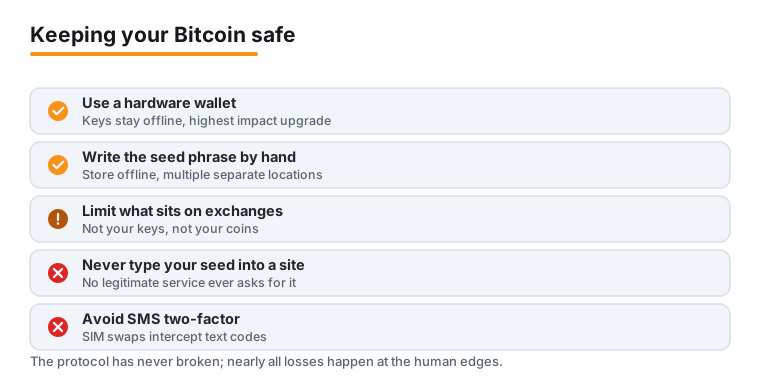
A hardware wallet keeps your private keys inside a dedicated, offline device with a secure element, and it requires physical confirmation on the device for every transaction. Even if your computer is infected, the keys never leave the device. This is the single highest-impact upgrade most holders can make. Buy directly from the manufacturer to avoid tampered units.
Protect your seed phrase like the asset it is
Your recovery phrase is your bitcoin. Anyone who has it can take everything; anyone who loses it loses everything. Sound practices:
- Write it by hand and store it offline. Never type it into a website, screenshot it, or save it in cloud notes, email, or a password manager you also use online.
- Keep more than one backup in separate secure locations to survive fire, flood, or theft. Metal backup plates resist physical damage.
- Consider a BIP39 passphrase (an optional extra "word") for an additional layer, but only if you are certain you can remember or safely store it. Lose it and the funds are unrecoverable.
- Actually test recovery on a spare or reset device before trusting a backup with real value.
Harden your accounts
- Use a unique, long, random password for every exchange and account, generated and stored in a reputable password manager.
- Enable two-factor authentication using an authenticator app or a hardware security key, not SMS.
- Where possible, set a separate PIN or port-out lock with your mobile carrier to blunt SIM-swap attacks.
Reduce custodial exposure
Do not store more on an exchange than you are willing to lose to a hack or freeze, and withdraw long-term holdings to a wallet you control. For larger balances, a multisignature setup, commonly a 2-of-3 arrangement with keys in different places (a hardware wallet at home, a backup off-site, and a third with a trusted service), means no single stolen or lost key can move your funds. Multi-party computation (MPC) wallets offer a similar no-single-point-of-failure benefit.
Practice everyday operational hygiene
- Keep your operating system, wallet software, and firmware up to date to close known vulnerabilities.
- Download wallets and apps only from official sources, and double-check URLs and app publishers.
- Avoid managing funds over public or untrusted Wi-Fi.
- Send a small test transaction first when moving a large amount or using a new address.
- Be skeptical of unsolicited "support," giveaways, and urgency. Pressure to act fast is a hallmark of fraud.
A note on privacy tools: VPNs can help protect your connection, but mixing or anonymizing services carry legal and compliance risks that vary widely by country. Research the rules where you live before using them.
If you get hacked
If you believe your wallet or accounts are compromised, speed matters, but so does avoiding panic mistakes. Work through these steps in order.
- Move any remaining funds immediately, but only to a wallet you are confident is clean. If your device may be infected, use a different, trusted device and a brand-new seed phrase. Sending funds to another address controlled by the same compromised keys does nothing.
- Lock down connected accounts. Change passwords from a clean device, revoke active sessions, and reset two-factor authentication. Disconnect or wipe any device you suspect is infected.
- Revoke risky permissions. If you may have signed a malicious approval, revoke token or spending allowances using a reputable revocation tool.
- Contact your exchange. If the breach involves a custodial account, notify the platform's official support at once. They may be able to freeze the account or flag deposit addresses.
- Document everything. Record transaction IDs, addresses, timestamps, and screenshots. This evidence is essential for any report or investigation.
- Report it. File a report with your local law enforcement and any relevant national cybercrime or financial-fraud authority. Some stolen funds have been recovered when exchanges and investigators trace and freeze them, though recovery is never guaranteed.
Set realistic expectations. On-chain transactions are irreversible and most theft is permanent. Be extremely wary of "recovery services" that promise to retrieve stolen crypto for an upfront fee; these are almost always a second scam targeting victims. Afterward, review how the breach happened and rebuild with a cleaner setup so it cannot recur.
Frequently asked questions
Can Bitcoin itself be hacked?
The Bitcoin network has never been broken. Its cryptography and globally distributed ledger make altering confirmed transactions effectively impossible with today's technology. Real-world losses come from the surrounding layer, including wallets, exchanges, devices, and people, rather than from a flaw in the protocol. In short, Bitcoin is robust; the way individuals store and access it is where the weaknesses lie.
Is a hardware wallet or an exchange safer for storing bitcoin?
For meaningful, long-term holdings, a hardware wallet you control is generally safer because your private keys stay offline and outside any company's reach. Leaving coins on an exchange means trusting that platform's security and solvency, which has failed in several high-profile cases. Exchanges can be convenient for small balances or active trading, but the principle "not your keys, not your coins" applies: custody is a counterparty risk, not full ownership.
What should I never do with my recovery phrase?
Never type it into a website, never store it as a screenshot or in cloud notes, email, or chat, and never share it with anyone, including people claiming to be support staff. No legitimate service ever needs your seed phrase. Write it down by hand, keep it offline, and store more than one backup in separate secure locations. Anyone who obtains the phrase can take all of your bitcoin.
Do I need to report my bitcoin for taxes?
Tax treatment varies significantly by country, and rules change over time. Many jurisdictions treat selling, spending, or exchanging bitcoin as a taxable event, and some require reporting of holdings or transactions. Because requirements differ and can be detailed, keep clear records of your transactions and consult a qualified tax professional or your national tax authority's official guidance. This article is not tax or legal advice.
Is multisig worth the extra complexity?
For larger balances, often yes. A multisignature setup such as 2-of-3 spreads keys across different locations so that a single stolen, lost, or damaged key cannot move your funds, removing the single point of failure that plagues ordinary wallets. The tradeoff is added setup and recovery complexity, so it suits savings you rarely touch more than everyday spending money. Test your recovery process before relying on it.
Last updated: 2026-06.