Crypto Taxes Explained
This guide is general information, not tax advice. Crypto tax rules differ from country to country, they change often, and the right answer for you depends on your personal circumstances. Before you act on anything here, confirm it with a qualified tax professional or your national tax authority.
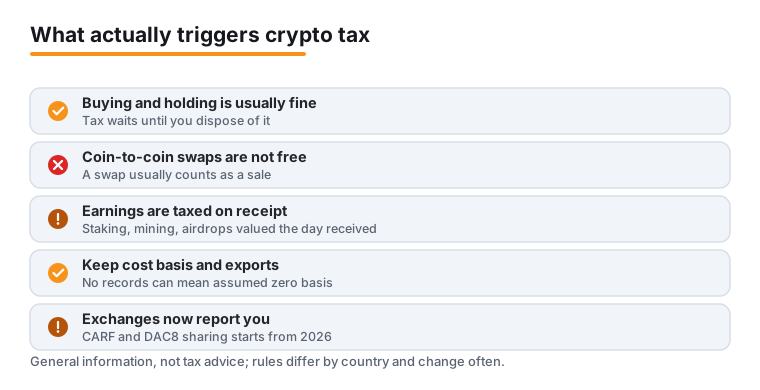
With that said, here is the honest picture. Crypto taxes are easy to get wrong, mostly because the taxable moments are not where beginners expect them. Buying and holding is usually fine. Swapping one coin for another, which feels like nothing, is often a taxable sale. And 2026 is the year the old assumption that the tax office cannot see your exchange account stopped being true: under new international rules, exchanges in dozens of countries now collect customer data for automatic sharing between tax authorities. This guide covers how crypto tax usually works, which events trigger it, what records to keep, how major countries differ, legal ways to reduce the bill, and what to do if you are behind.
How crypto tax usually works
Most tax offices do not treat crypto as money. They treat it as property, the same broad category as shares. The United States, the United Kingdom, Canada, Australia and Germany all take some version of this view, and that one decision drives everything else.
Because crypto is property, two familiar taxes do nearly all of the work:
- Capital gains tax applies when you dispose of crypto, which is tax language for selling it, swapping it or spending it. You are taxed on the gain: what you got out minus what you put in. Buy bitcoin for 1,000 and sell it later for 1,400, and your gain is 400. The 400 is what gets taxed, not the full 1,400.
- Income tax applies when crypto arrives as a form of earnings: staking rewards, mining income, an airdrop (free tokens sent to your wallet) or wages paid in crypto. The taxable amount is usually the market value of the coins, in your local currency, on the day you receive them.
The same coins can be taxed twice across their life, and that is normal, not a mistake. Say you earn a staking reward worth 50. You may owe income tax on 50 now. If it grows to 80 and you sell, you may owe capital gains tax on the extra 30. Two different taxes on two different events.
Losses count too. If you sell at a loss, most systems let you subtract that loss from your gains, and often carry the leftover into future years, which is why reporting a bad year can work in your favour. And simply holding while the price rises is generally not taxed: tax waits until something happens to the asset.
Which events are usually taxable: a plain table
The most useful habit in crypto tax is asking one question before you press confirm: am I disposing of an asset, or receiving one as earnings? If either answer is yes, there is probably a tax event. If you are just moving your own property around, there probably is not.
| What you did | Typical treatment |
|---|---|
| Bought crypto with regular money and held it | Usually not taxable. Tax starts when you dispose of it. |
| Held while the price went up | Usually not taxable. Paper gains are generally untaxed until you sell. |
| Moved coins between your own wallets | Usually not taxable. Ownership did not change. Keep records so it is not mistaken for a sale. |
| Sold crypto for regular money | Usually taxable. Capital gains on the difference between buy and sell price. |
| Swapped one coin for another | Usually taxable. Counts as selling the first coin at its market value that day. |
| Spent crypto on goods or services | Usually taxable. Same logic as a sale. |
| Got paid in crypto, or earned staking, mining or most airdrop rewards | Usually taxable as income at the value on the day received. |
| Gifted or donated crypto | Varies widely by country. Sometimes tax free, sometimes a disposal. Check locally. |
The row that surprises everyone is the coin-to-coin swap. Trading ether for solana feels like a sideways move, but in most countries you have just sold your ether. If you bought it for 200 and it was worth 350 at the moment of the swap, you have a 150 gain to report, even though your bank account never moved. Spending works the same way: pay for a laptop with coins that have doubled, and you have realised a gain on those coins.
The word usually is doing real work here. India taxes crypto its own way, Germany ignores gains on coins held for over a year, and a few countries have no capital gains tax at all. Treat the table as the default, not as the rule for your country.
Cost basis and record keeping that actually works
Cost basis is simply what an asset cost you, including purchase fees. Buy 0.1 bitcoin for 3,000 plus a 10 fee, and your basis is 3,010. It is the number you subtract from the sale price to work out your gain, and it is the number people most often lose. That loss is expensive: if you cannot show what you paid, some tax offices are entitled to assume a cost of zero, which turns your entire sale price into taxable gain.
A record keeping routine that takes one evening a year:
- Export the full transaction history from every exchange, as CSV files: trades, deposits, withdrawals, fees and rewards, not just the year-end tax summary. Do it annually, and always before closing an account, because data from closed or collapsed exchanges can be impossible to recover.
- Keep a list of your own wallet addresses. Blockchains are public, so activity in self-custody wallets can be reconstructed if you know which addresses are yours.
- Note income events when they happen: date, amount and market value at receipt for staking, mining and airdrops. Finding a price for an obscure token two years later is miserable work.
- Document the odd stuff: lost keys, stolen funds, gifts in or out, anything from a platform that shut down, with whatever evidence exists.
Crypto tax software such as Koinly, CoinTracking or CoinLedger can import these files, match transfers between your own accounts and calculate gains using your country's required matching method (the US allows identifying specific lots, the UK pools assets by type, many others require first in, first out). What software cannot do is take responsibility: the duty to file an accurate return stays with you, so sanity-check the output, especially flagged gaps and duplicated transfers.
The 2026 reality: your exchange increasingly reports you
For years, the quiet assumption behind unreported crypto was simple: the tax office cannot see my exchange account. That assumption is now wrong in much of the world, and 2026 is the year it changed.
The OECD, the organisation through which major economies coordinate tax standards, developed the Crypto-Asset Reporting Framework (CARF). Under CARF, exchanges and brokers must identify their customers and report their transactions to the local tax authority, which shares the data automatically with the tax authority where the customer lives. In many participating countries the rules took effect on 1 January 2026: platforms are collecting data on 2026 activity right now, with the first automatic exchanges between tax offices scheduled for 2027. As of March 2026, 76 jurisdictions had announced their intention to exchange information under CARF, most starting in 2027. The OECD's CARF FAQ explains the mechanics.
The EU implemented CARF through a directive known as DAC8, in force since 1 January 2026. It covers any platform serving EU residents, including platforms based outside the EU, with first reports due to national tax authorities in 2027 and the data then shared across member states. The UK runs its own version on the same timetable: UK providers began collecting customer data on 1 January 2026 and must file their first reports to HMRC by 31 May 2027. In the United States, brokers already report your sale proceeds to the IRS on the new Form 1099-DA, starting with 2025 transactions, with cost basis added for some assets from 2026.
None of this changes what you owe. What it changes is who else knows. When the data a tax office receives does not match a return, the usual first step is a letter asking you to explain or correct. They will not find out was never a good plan; from 2026 it is barely a plan at all. The calm response is the boring one: report properly, keep your exports, and let the letters be about other people.
How the rules differ by country
Everything above is the shared skeleton. Rates, allowances and special rules are national, and they differ enough to change behaviour. A few examples, each covered in depth on our country pages:
- United States. The IRS treats digital assets as property, and every federal return now asks a direct yes or no question about digital asset activity near the top of Form 1040, so you answer it under penalty of perjury either way. Hold an asset for more than a year and gains are taxed at lower long-term rates; a year or less and they are taxed like ordinary income. The IRS digital assets page is the official starting point, and our United States page covers the wider rules.
- United Kingdom. HMRC taxes most individual crypto activity under capital gains tax, with a 3,000 pound annual exempt amount for the 2025 to 2026 tax year, and income tax on rewards and earnings. HMRC's Cryptoassets Manual is unusually detailed for official guidance. See our United Kingdom page.
- Germany. Home of the famous one-year rule: sell privately held crypto after holding it for more than a year and the gain is tax free. Sell within the year and gains are taxed at your personal income tax rate once they pass a 1,000 euro yearly threshold. The rule has been debated in German politics, but as of mid 2026 current guidance still applies it. Our Germany page tracks the status.
- Portugal. No longer the tax-free haven of legend, but still kind to patience: gains on crypto held for less than 365 days are taxed at a flat 28 percent, while gains on crypto held longer are generally exempt for individuals, though the sale must still be declared. Details on our Portugal page.
- India. One of the strictest regimes: a flat 30 percent tax on gains from virtual digital assets, a 1 percent deduction at source on most trades, and no offsetting crypto losses against other income, or even against gains on a different coin. Our India page has the full picture.
A handful of places, including the UAE and Singapore, currently charge individuals no capital gains tax at all, which is why relocation threads fill every crypto forum. Moving country for tax is a serious legal step involving residency tests and sometimes exit taxes, not a weekend decision. For the broader picture beyond tax, see our guide to crypto regulation around the world.
Legal ways people reduce the bill
There is a bright line between tax planning, which uses the written rules to lower your bill, and evasion, which means hiding what happened. The first is normal; the second is what the new reporting rules exist to catch. Within the rules, a few levers come up again and again. Whether each exists for you depends on your country.
- Hold longer. Several countries reward patience directly: the US taxes gains at lower rates after a year, Germany drops the tax to zero after a year, Portugal after 365 days. If you are near a threshold and planning to sell anyway, the calendar is worth checking first.
- Use your allowances. Where an annual tax-free amount exists, like the UK's 3,000 pounds, realising some gains each year within it can beat realising one large gain in a single year. Unused allowances usually do not roll over.
- Harvest losses. If a coin sits at a loss and you no longer believe in it, selling makes the loss real and usable. With a 600 gain on one coin and a 250 realised loss on another, you are typically taxed on 350. Watch the anti-abuse rules: the UK, for example, matches a sale against any repurchase of the same asset within 30 days, which can cancel the effect.
- Time your disposals. Where gains stack on top of income, selling in a low-income year, or spreading a sale across two tax years, can land the gain in a lower band.
- Use household and wrapper options where they exist. Some countries let spouses transfer assets tax free, effectively doubling allowances; in the US, certain retirement accounts can hold crypto exposure with tax advantages.
None of this requires secrecy or offshore creativity. The expensive mistakes usually come from copying something clever from a forum without checking whether it works, or is even legal, where you live.
Common mistakes
The same handful of errors produce most crypto tax pain, and almost all are avoidable with the habits above.
- Treating coin-to-coin swaps as tax free. The single most common surprise bill. A swap is usually a disposal of the coin you gave up.
- Losing history when an account closes. If an exchange shuts down or you close an account without exporting, your cost basis can vanish with it. Export first, close second.
- Ignoring small income events. A staking reward worth 3 a week feels like nothing, but in most countries it is income on receipt, and it adds up and shows up.
- Assuming no profit means no filing. Many countries expect disposals reported even in a losing year, and reporting losses is how you bank them against future gains.
- Letting software double-count transfers. A transfer between your own wallets imported from two sources can look like a sale on one side and a purchase on the other. Review anything your tax software flags before filing.
- Confusing where you owe tax. Tax usually follows your tax residence, not your passport and not the exchange's country. Using an overseas platform does not move your obligation overseas.
- Waiting for the exchange to send a form. In most places the duty to report is yours whether or not a form arrives.
If you are behind on reporting
Plenty of people are behind, and usually not from dishonesty. They did not know swaps counted, or the records are scattered across five platforms, one of which no longer exists. The situation is almost always fixable, and it is cheaper to fix early.
- Reconstruct before you panic. Export everything you still can, gather old statements and wallet addresses, and let tax software assemble the timeline. Document any genuine gaps and the assumptions you used to fill them.
- Work out what you actually owe. It is often less than feared: losses offset gains, allowances may have covered small years, and some years may show nothing taxable at all.
- Use the official routes. Most tax authorities accept amended returns, and many run voluntary disclosure programmes with reduced penalties for people who come forward before being contacted. HMRC operates a dedicated disclosure service for unpaid tax on cryptoassets; US taxpayers can amend past returns with Form 1040-X.
- Bring in a professional for anything big. Multiple years, large sums or business activity is worth a specialist who has handled crypto cases. The fee is usually small next to the penalties it avoids.
Order matters. Coming forward before the tax office writes to you generally means lower penalties and a calmer process. With CARF and DAC8 data starting to flow between countries in 2027, the window in which disclosure still counts as voluntary is real, but not endless.
A final reminder: this guide is general information, not tax advice. Rules differ by country, change frequently, and depend on your personal circumstances. Confirm anything you plan to act on with a qualified tax professional or your national tax authority.
Frequently asked questions
Do I owe tax just for buying and holding crypto?
Usually no. In most countries, buying crypto with regular money and holding it is not a taxable event, and neither is watching its price rise. Tax normally arrives when you sell, swap or spend it, or when you receive crypto as earnings. Keep a record of what you paid and when, because that becomes your cost basis later.
Is swapping one cryptocurrency for another really taxable?
In most countries, yes. A swap counts as selling the first coin at its market value that day, even though no regular money is involved. If the coin you gave up had gained value since you acquired it, that gain is usually taxable at the moment of the swap. Record the local-currency value of both sides of every trade.
Will my exchange report my activity to the tax office?
Increasingly, yes. Under the OECD's Crypto-Asset Reporting Framework and the EU's DAC8 directive, platforms in many countries began collecting customer and transaction data on 1 January 2026, with the first automatic exchanges between tax authorities due in 2027. US brokers already report sale proceeds on Form 1099-DA. Assume your tax office will eventually see your exchange activity.
Do I pay tax on staking rewards even if I never sell them?
In most countries, yes. Staking, mining and similar rewards are typically taxed as income at their market value on the day you receive them, whether or not you sell. If you sell later, any change in value since receipt is a separate capital gain or loss. A few countries treat rewards differently, so check your local rules.
I lost money overall. Do I still need to report?
Often yes, and it can work in your favour. Many countries expect disposals declared even in a losing year, and formally reporting losses is usually what lets you offset them against gains now or in future years. An unreported loss is often a wasted loss, so file even when no tax is due.
I have not reported my crypto for past years. What should I do?
Reconstruct your records first: export histories from every platform, gather wallet addresses, and let tax software build the timeline. Then correct past returns through official channels. Most tax authorities allow amended returns, and many offer voluntary disclosure with reduced penalties if you come forward before being contacted. For multiple years or large amounts, use a professional who handles crypto cases.
Last updated: 2026-06.