Home › Crypto Regulation › Australia
Bitcoin & Cryptocurrency Regulation in Australia
Quick answer — Australia, 2026
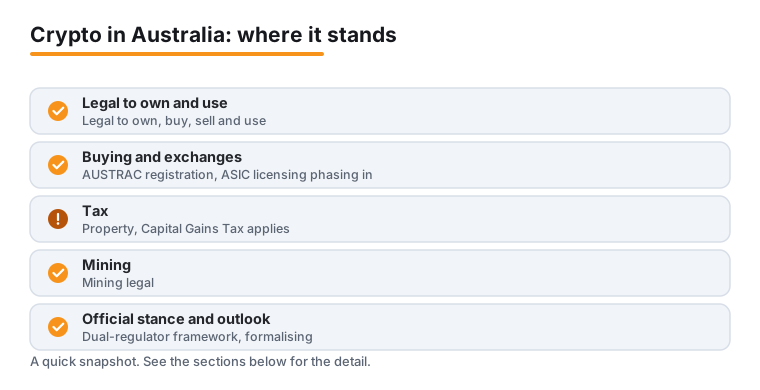
- Legal: Legal to own and use, not legal tender
- Tax: Treated as property, Capital Gains Tax on disposals, some income
- Buying: Via AUSTRAC-registered providers with KYC
Australia is one of the more developed jurisdictions for digital assets. Owning, buying, selling and using Bitcoin and other cryptocurrencies is legal, and the country has an active exchange market, a large network of crypto ATMs and a growing professional services industry around blockchain. In 2025 and 2026 Australia moved from a patchwork of guidance and registration rules toward a dedicated, formal regime built on a dual-regulator model: AUSTRAC oversees anti-money-laundering obligations, while ASIC brings most crypto platforms inside the existing financial-services licensing system. Two milestones anchor this shift: on 31 March 2026 AUSTRAC's expanded regime replaced the old digital-currency-exchange registration with a broader virtual-asset-service-provider (VASP) framework, and on 8 April 2026 the Corporations Amendment (Digital Assets Framework) Act 2026 received Royal Assent, setting up a financial-services licensing regime for digital asset platforms that commences from 9 April 2027.
This guide explains the current legal status of crypto in Australia, who the regulators are, the key laws and frameworks, how exchanges are registered and licensed, how crypto is taxed, the AML and KYC rules, and the main risks and protections to weigh before investing. It is general information as of 2026 and is NOT legal, tax or financial advice. Crypto rules in Australia are changing quickly, so always verify specifics with the named official regulators such as ASIC, AUSTRAC and the Australian Taxation Office, or with a licensed adviser, before acting. For broader context see our crypto regulation guide and the regulation hub.
On this page: Legal status · Who regulates it · Taxes · How to buy · Mining
Is Bitcoin and crypto legal in Australia?
Yes. Buying, holding, selling and using Bitcoin and other crypto assets is legal in Australia for individuals and businesses. There is no ban on personal ownership or trading, and the country hosts numerous registered exchanges, custodians and ATM operators.
Crypto is not legal tender. The Australian dollar remains the only legal tender, and no merchant is obliged to accept Bitcoin. The Australian Taxation Office treats crypto as property rather than as money or foreign currency, which has significant tax consequences (see the taxation section below). Businesses may choose to accept crypto as payment, but that is a commercial decision rather than a legal requirement.
Because crypto is legal but increasingly regulated, the practical question for most people is not whether they can use it, but which obligations apply, in particular identity verification when using a registered provider and tax reporting when disposing of holdings.
Who regulates crypto in Australia
Australia uses a dual-regulator model, and many crypto businesses must answer to more than one body.
- AUSTRAC (the Australian Transaction Reports and Analysis Centre) is the financial-intelligence agency and anti-money-laundering and counter-terrorism-financing (AML/CTF) regulator. Crypto exchanges, ATM operators and other virtual-asset service providers must register or enrol with AUSTRAC and meet AML/CTF obligations.
- ASIC (the Australian Securities and Investments Commission) regulates financial products and services under the Corporations Act 2001. Where a crypto offering behaves like a financial product, ASIC's rules and licensing apply. ASIC also runs the Moneysmart consumer resource.
- The ATO (Australian Taxation Office) administers the tax treatment of crypto.
- The RBA (Reserve Bank of Australia), the central bank, is responsible for monetary policy and payments, and is researching tokenised money and a possible wholesale central bank digital currency, but it does not license crypto exchanges.
Official websites: ASIC at asic.gov.au, AUSTRAC at austrac.gov.au, the ATO at ato.gov.au and the RBA at rba.gov.au.
Key laws and frameworks
Several distinct legal instruments shape crypto in Australia, and they operate on different timelines.
- Anti-Money Laundering and Counter-Terrorism Financing Act 2006 (AML/CTF Act). Since 2018 this Act has required digital currency exchange providers to register with AUSTRAC. It is the legal basis for KYC, transaction monitoring and reporting obligations.
- AML/CTF Amendment Act 2024. This Act, which passed Parliament in late 2024, modernises the AML/CTF regime to meet Financial Action Task Force (FATF) standards. It expands the regulated perimeter beyond fiat-to-crypto exchanges to cover services such as crypto-to-crypto exchange, virtual-asset safekeeping and virtual-asset transfers. On 31 March 2026 the expanded regime took effect and the old digital-currency-exchange (DCE) registration was replaced by a broader virtual-asset-service-provider (VASP) framework, with providers registered as a DCE immediately before that date automatically rolled over to VASP status. The international Travel Rule for virtual-asset transfers is reported to apply from 1 July 2026. Confirm the current dates and obligations with AUSTRAC.
- Corporations Act 2001. ASIC applies existing financial-product and financial-services concepts to digital assets through Information Sheet 225 (INFO 225), which it substantially updated in late 2025.
- Corporations Amendment (Digital Assets Framework) Act 2026. This Act passed Parliament on 1 April 2026 and received Royal Assent on 8 April 2026. It brings crypto exchanges, brokers and custodians inside the financial-services licensing system as regulated Digital Asset Platforms (DAPs) and Tokenised Custody Platforms (TCPs). The framework is reported to commence from 9 April 2027, with an implementation period after that. As detail and timing can still change, verify the current position on the official ASIC and Parliament of Australia websites.
Licensing and registration of exchanges and VASPs
Two layers of obligation apply to crypto businesses serving Australians, and a single exchange may need both.
- AUSTRAC registration or enrolment (AML/CTF). Any business providing digital currency exchange or other in-scope virtual-asset services to Australian customers must register or enrol with AUSTRAC. This is a mandatory compliance registration, not a discretionary quality license, and operating without it is an offence. AUSTRAC publishes its register and takes enforcement action against non-compliant providers.
- ASIC financial-services licensing (AFSL). Where a platform deals in something ASIC treats as a financial product, the operator generally needs an Australian Financial Services Licence (AFSL) or to operate under an authorised representative arrangement. ASIC released a substantially updated Information Sheet 225 (INFO 225) on 29 October 2025 explaining how existing financial-services law applies to digital assets, alongside a class no-action position to ease the move to licensing. ASIC reported extending that no-action period from 30 June 2026 to 30 September 2026, subject to conditions such as lodging an AFSL application and holding Australian Financial Complaints Authority (AFCA) membership. The separate Digital Asset Platform and Tokenised Custody Platform regime under the Digital Assets Framework Act is reported to commence from 9 April 2027.
The two regimes run on different clocks: AUSTRAC's AML/CTF obligations are largely active and expanding through 2026, while ASIC's full licensing regime is phasing in over a transition period. Because thresholds, categories and dates are still settling, check the live requirements with AUSTRAC and ASIC rather than relying on a fixed figure from any article.
From DCE to VASP: what changed in 2026
The most concrete change for crypto businesses in 2026 was the shift from the old digital-currency-exchange (DCE) registration to a broader virtual-asset-service-provider (VASP) framework under AUSTRAC.
- Effective date. The expanded AML/CTF regime took effect on 31 March 2026.
- Automatic rollover. A business registered as a DCE provider with AUSTRAC immediately before 31 March 2026 is automatically treated as a VASP from that date and does not need to re-register.
- Update obligation. The rollover is administrative, not a free pass. Existing providers must update their enrolment in AUSTRAC Online to reflect the specific virtual-asset services they offer. Reporting has put this update deadline at 30 May 2026.
- Wider net. Services that previously sat outside registration, such as crypto-to-crypto exchange, custody and certain transfer and intermediary services, can now be captured and may need to enrol.
For customers the practical effect is that a wider set of providers now sit inside AML/CTF rules, so expect identity checks across more services. For the authoritative list of designated services and deadlines, check AUSTRAC.
Crypto and Bitcoin tax in Australia
The ATO treats crypto as property and, for most individuals, as an asset subject to Capital Gains Tax (CGT) rather than as money. A CGT event generally happens when you dispose of crypto, for example by selling it for Australian dollars, trading one crypto for another, spending it, or gifting it. The gain or loss is calculated against your cost base. For a wider explanation see our crypto taxes guide.
- Disposals are taxable events. Even crypto-to-crypto swaps can trigger CGT, not just cashing out to fiat.
- CGT discount. Australia has long offered a CGT discount, commonly 50 percent, for assets held longer than 12 months by eligible individuals such as investors and trusts. A federal budget measure reported in 2026 would replace this flat 50 percent discount with an inflation-based discount from 1 July 2027, applying broadly across shares, property and crypto for individuals, while Gains accrued before that date keep the existing 50 percent treatment, because assets held before 1 July 2027 are deemed sold just before that date and reacquired at market value, with the notional gain disregarded and deferred until an actual later sale. Government tax settings can change between years and this measure was still proposed at the time of writing, so confirm what applies to your situation and year.
- Income, not capital, in some cases. Crypto received from staking rewards, certain airdrops, mining as a business, or being paid in crypto can be treated as ordinary income at its Australian-dollar value when received.
- Personal-use asset rules can apply in narrow situations and are easily misunderstood.
- Records and data-matching. Keep dates, AUD values, amounts, wallet addresses and the purpose of each transaction; the ATO runs a crypto data-matching program and records should generally be retained for at least five years.
Tax outcomes depend heavily on whether you are an investor, a trader, or running a business, and on rules that vary between financial years. Do not rely on a specific rate or threshold from any article. Confirm your position with the ATO or a registered tax agent. This is general information, not tax advice.
AML and KYC rules
Anti-money-laundering and know-your-customer obligations are the most visible part of crypto regulation for everyday users.
- Identity verification (KYC). Registered providers must verify your identity before you can trade or withdraw. Expect to supply government ID and personal details. This is a legal requirement under the AML/CTF Act, not an optional step.
- Transaction monitoring and reporting. Providers monitor for suspicious activity and must report suspicious matters and certain threshold transactions to AUSTRAC.
- Travel Rule. The international Travel Rule, which requires originator and beneficiary information to accompany transfers, applies to in-scope virtual-asset transfers, with reforms reported to take effect from 1 July 2026.
- Expanded perimeter. Under the AML/CTF Amendment Act 2024, more service types, including crypto-to-crypto exchange, safekeeping and transfers, are being brought into the regime during 2026.
For the authoritative position on AML/CTF obligations and timelines, see AUSTRAC.
Buying and using crypto in practice
Australians can buy crypto through domestic and international exchanges, brokers and peer-to-peer platforms, paying with bank transfers (including PayID and Osko), cards and other methods. Reputable platforms serving Australian residents are registered with AUSTRAC and apply standard onboarding controls.
A typical, careful path looks like this:
- Choose a provider. Prefer an AUSTRAC-registered exchange or broker and, as the regime evolves, one with appropriate ASIC licensing or transitional status. Compare fees, security, payment methods and reputation.
- Create and verify your account. Complete KYC and enable two-factor authentication, ideally an authenticator app rather than SMS.
- Deposit and buy. Fund the account and place a market or limit order, allowing for any bank limits or delays.
- Secure your holdings. For meaningful amounts, consider withdrawing to a wallet you control, such as a hardware (cold) wallet with an offline backup of the recovery phrase. Never store the phrase online or share it.
- Keep records of transactions and AUD values for tax time.
Some banks apply their own limits or scam-prevention friction on transfers to crypto platforms, so payments are not always instant. Be alert to fake apps, unsolicited investment managers, guaranteed-return schemes and requests to move funds urgently.
Crypto ATMs and cash limits
Australia has one of the larger crypto-ATM networks in the world, with machines that let users buy crypto with cash and, in some cases, sell crypto for cash. ATM operators are treated as digital currency exchange providers and must register with AUSTRAC and meet AML/CTF obligations.
Responding to a sharp rise in scams, many targeting older Australians pressured into feeding cash into machines, AUSTRAC introduced minimum standards for crypto-ATM operators that took effect in June 2025. Reported measures include:
- A cash limit of around AU$5,000 on both deposits and withdrawals per transaction.
- Enhanced customer due diligence and stronger identity checks.
- Mandatory, prominent scam-warning messages on machines.
- More rigorous transaction monitoring, backed by enforcement against non-compliant operators.
If you use a crypto ATM, treat any urgent instruction to deposit cash, especially from someone you have only spoken to by phone or message, as a major red flag. ATM fees are also typically higher than on exchanges. Confirm current limits and rules with AUSTRAC, as figures can change.
Bitcoin mining in Australia
Bitcoin mining is legal in Australia. There is no specific ban, and the main considerations are commercial and regulatory rather than questions of legality.
- Energy. Retail electricity costs are high in many areas, which directly affects mining profitability. Operators increasingly look to renewable, off-peak or curtailed power and cheaper locations to manage costs and emissions.
- Tax and business obligations. Mining can be treated as a hobby or as a business depending on scale and intent, with different tax consequences. Rewards may be assessable as income, and equipment and running costs have their own treatment. Confirm specifics with the ATO.
- Compliance and conduct. Commercial miners should consider company, consumer-protection and, where relevant, AML obligations, and keep transparent records.
For most individuals, small-scale home mining of Bitcoin is rarely profitable after electricity and hardware costs. Serious mining tends to be an industrial activity tied to cheap, ideally low-carbon, power.
Recent developments (2025 to 2026)
Australia's regime has moved quickly over the past two years.
- Crypto-ATM standards (June 2025). AUSTRAC introduced minimum standards for crypto-ATM operators, including the reported AU$5,000 cash limit and mandatory scam warnings.
- Updated ASIC guidance (late 2025). ASIC substantially updated Information Sheet 225 on digital assets, adding worked examples and clarifying when crypto activities are financial products, alongside transitional no-action arrangements to support the move to licensing.
- DCE to VASP transition (31 March 2026). AUSTRAC's expanded AML/CTF regime took effect and the old digital-currency-exchange registration was replaced by a broader virtual-asset-service-provider (VASP) framework, with existing DCE providers automatically rolled over and required to update their enrolment details.
- Travel Rule (1 July 2026). The international Travel Rule for virtual-asset transfers applied from this date to both existing and newly regulated providers, with no exemption and no minimum threshold. On transfers to a self-hosted wallet the ordering institution must collect, but is not required to verify, the payee's full name.
- ASIC no-action extension (2026). On 25 June 2026 ASIC extended its class no-action position for digital asset businesses moving to licensing from 30 June 2026 to 30 September 2026, and widened it to cover businesses operating under or entering into authorised representative and intermediary authorisation arrangements with an AFS licensee. To rely on it a business must have been operating in Australia on or before 31 December 2025, must be an AFCA member if it is retail-facing, and must lodge an AFS licence application or variation by 30 September 2026.
- Digital Assets Framework Act (April 2026). The Corporations Amendment (Digital Assets Framework) Act 2026 passed Parliament on 1 April 2026 and received Royal Assent on 8 April 2026, setting up licensing for Digital Asset Platforms and Tokenised Custody Platforms that commences on 9 April 2027.
- RBA research. The Reserve Bank, with the Digital Finance Cooperative Research Centre, ran Project Acacia exploring tokenised money and a wholesale central bank digital currency for institutional settlement, with findings reported in 2026.
The main dates are now settled: AUSTRAC's virtual asset service provider regime commenced 31 March 2026, the Travel Rule applied from 1 July 2026, the transitional registration application deadline was 29 July 2026, ASIC's class no-action position ends 30 September 2026, the Digital Assets Framework commences 9 April 2027, and the capital gains tax change applies from 1 July 2027 and verify them with the official regulators.
Consumer risks and protection
Crypto is highly volatile, can fall sharply, and is not covered by the protections that apply to bank deposits. Australians should weigh these risks before investing.
- Volatility and drawdowns can be severe; only consider money you can afford to lose.
- No deposit guarantee. Crypto on a platform or in a wallet is not protected like a bank deposit, so platform failure or loss of keys can mean total loss.
- Scams and fraud. Regulators have flagged crypto scams as widespread, particularly involving ATMs, impersonation and unsolicited investment offers.
- Irreversible transactions. A wrong address or a scam payment generally cannot be reversed.
- Self-custody trade-off. Holding your own keys removes counterparty risk but puts the full responsibility for security on you.
Protections are strengthening as AUSTRAC's AML/CTF obligations expand and ASIC's licensing framework brings exchanges, custodians and tokenised-asset platforms inside familiar financial-services rules, with stronger custody, disclosure and dispute-resolution standards over time. None of this removes market risk. Before investing, consider ASIC's Moneysmart resources and speak with a licensed financial adviser. This is general information, not financial advice.
Official sources and how to verify
Crypto rules in Australia are evolving, so always check the current position with the official regulators rather than relying on secondary summaries. This article is general information as of 2026 and is NOT legal, tax or financial advice; verify your situation with the named official regulator or a licensed adviser before acting.
- ASIC, digital assets: asic.gov.au digital assets (financial-product status, licensing, INFO 225).
- AUSTRAC: austrac.gov.au (registration, AML/CTF obligations, crypto-ATM standards).
- Australian Taxation Office: ato.gov.au crypto asset investments (CGT and income treatment).
- Reserve Bank of Australia: rba.gov.au (payments, central bank digital currency research).
You can also read our internal guides: the crypto regulation overview, crypto taxes, and the country regulation hub.
What is changing: status as of August 2026
Australia now has a crypto-specific licensing law on the books, but it is not yet operating. The Corporations Amendment (Digital Assets Framework) Act 2026 is Act No. 38 of 2026, received Royal Assent on 8 April 2026, and commences on 9 April 2027. Until then the rules that actually bind Australian crypto businesses are the anti-money-laundering regime and existing financial services law.
Three things moved after 30 June 2026, the date this page was last reviewed.
- The Travel Rule went live on 1 July 2026. Every AUSTRAC-registered virtual asset service provider must now pass payer and payee information with virtual asset transfers. There is no minimum threshold, so a A$5 withdrawal carries the same data obligation as a A$50,000 one. On a withdrawal to a self-hosted wallet the ordering institution must collect, but is not required to verify, the payee's full name. In practice this is why withdrawal screens now ask who owns the destination address.
- AUSTRAC's transitional registration window closed on 29 July 2026. Persons providing only new registrable virtual asset services had to apply to register as a VASP by that date. That date has passed.
- The capital gains tax change stopped being a proposal. The Treasury Laws Amendment (Tax Reform No. 1) Act 2026 is Act No. 49 of 2026 and received Royal Assent on 26 June 2026, after being introduced on 28 May 2026. The changes apply from 1 July 2027.
The nearest deadline is 30 September 2026, when ASIC's class no-action position ends. Platforms that have not lodged an Australian Financial Services Licence application or variation, or entered an authorised representative or intermediary authorisation arrangement, are exposed to enforcement after that date. ASIC has warned that unlicensed conduct carries serious civil and criminal penalties, including fines that could reach up to 10 percent of annual turnover. ASIC had received approximately 30 licence applications since October 2025. For an ordinary holder the practical consequence is that some smaller platforms may withdraw from the Australian market rather than license.
The legislative pipeline and when each piece bites
Four separate reforms are moving at once, on different clocks. This is the order they take effect.
| Measure | Stage | Date it bites | What it means in practice |
|---|---|---|---|
| AUSTRAC VASP regime and Travel Rule, under the AML/CTF transitional rules | In force | 31 March 2026 and 1 July 2026 | Registration, customer due diligence and transfer data sharing on every virtual asset transfer, with no minimum threshold. Existing DCE registrations converted automatically to VASP status. |
| ASIC class no-action position under INFO 225 | In force, expiring | Ends 30 September 2026 | Last date to lodge an AFS licence application or variation, or enter an authorised representative or intermediary authorisation arrangement. After that, unlicensed dealing in digital assets that are financial products is enforceable. |
| Corporations Amendment (Digital Assets Framework) Act 2026, Act No. 38 of 2026 | Adopted, not yet in force | Commences 9 April 2027 | DAP and TCP become licensed financial products. A six month transition follows commencement, so operators have until around October 2027 to comply. ASIC's roadmap sequences consultation on standards and guidance, then new regulatory guidance, then licence applications. |
| Treasury Laws Amendment (Tax Reform No. 1) Act 2026, Act No. 49 of 2026 | Adopted, not yet in force | Applies from 1 July 2027 | 50 percent CGT discount replaced by CPI cost base indexation, plus a 30 percent minimum rate on gains accruing after that date. |
| Payment Entities (Prudential Regulation) Bill 2026 and payments regulations | Exposure draft, consultation closed | Not introduced to Parliament as at August 2026 | The stablecoin route. Payment stablecoin issuers treated as stored value facility providers, with APRA empowered to set prudential standards for major providers. Intended to start 12 months after Royal Assent. |
| Treasury consultation on the minimum tax and discretionary trusts | Consultation | Trust measures commence 1 July 2028 | Affects crypto held through a family or discretionary trust. Design still open. |
Stablecoins are the notable gap in the Digital Assets Framework. Rather than sit inside the new DAP and TCP categories, payment stablecoins are being pushed into the payments licensing regime as stored value facilities, following the exposure draft released on 9 October 2025 and the March 2026 tranche. Digital tokens connected to a tokenised stored value facility, meaning the redemption right attached to the token, are expressly excluded from being a financial product, which keeps them outside the digital asset licensing net.
The 2027 capital gains tax change and what crypto holders should do before 30 June 2027
This is the change with the widest reach for ordinary Australian holders, and it is now law rather than a proposal. From 1 July 2027 the 50 percent CGT discount for Australian resident individuals and trusts is replaced with cost base indexation using the Consumer Price Index, and a minimum 30 percent rate applies to capital gains. The indexed cost base is calculated as cost base multiplied by CPI at disposal divided by CPI at acquisition. The real gain after indexation is then taxed at the higher of your marginal tax rate or the 30 percent minimum. The minimum operates as a floor rather than a flat rate, so if your marginal rate already produces 30 percent or more it adds nothing.
The mechanics matter more for crypto than for most assets:
- Every parcel is deemed sold at the transition date. Each CGT asset held before 1 July 2027 is deemed sold just before that date and reacquired at market value, with the notional gain or loss disregarded and deferred until an actual later sale. No tax is payable at the deemed-sale moment itself. The AUD spot price on the transition date locks in the split between the pre-reform gain, which keeps the 50 percent discount, and the post-reform gain, which does not.
- Indexation removes far less than the old discount for a high-growth asset. On a five year hold after the reform with CPI running at 2.5 percent a year, the indexation uplift factor is roughly 1.13. On an asset that has multiplied, almost all of the nominal gain remains taxable.
- Record keeping is the real burden. Staking rewards, airdrops, hard forks, DEX swaps and recurring buys create dozens of small parcels a year, and each one needs an acquisition date, a cost base in AUD and a transition-date market value.
Practical steps before 30 June 2027: reconstruct acquisition dates and cost bases across every wallet and exchange now rather than in the final quarter, capture and retain the AUD market value of each holding at the transition date, and model outcomes under both the current and incoming rules with a registered tax agent before deciding whether an earlier disposal makes sense. Gains accrued before 1 July 2027 are generally protected, so there is no need to sell simply to preserve the discount on gains already accrued. This is general information, not tax advice.
Frequently asked questions
Is Bitcoin legal in Australia?
Yes. Owning, buying, selling and using Bitcoin and other crypto assets is legal in Australia. However, crypto is not legal tender, so no business is required to accept it, and the ATO treats it as property for tax purposes.
Who regulates cryptocurrency in Australia?
Australia uses a dual-regulator model. AUSTRAC oversees anti-money-laundering obligations and registers crypto exchanges and ATM operators. ASIC regulates crypto activities that amount to financial products or services and is bringing many platforms under Australian Financial Services Licence (AFSL) requirements. The ATO handles tax, and the Reserve Bank of Australia is the central bank. See austrac.gov.au and asic.gov.au.
Do crypto exchanges need a licence in Australia?
Crypto exchanges serving Australians must register or enrol with AUSTRAC for AML/CTF purposes. In addition, under ASIC's updated INFO 225 guidance and the proposed Digital Assets Framework, exchanges, brokers and custodians are increasingly expected to hold an Australian Financial Services Licence, with a transition period. Confirm the live requirements with AUSTRAC and ASIC.
Do I have to pay tax on crypto in Australia?
Generally yes. The ATO treats crypto as property, and disposing of it by selling, swapping, spending or gifting can trigger Capital Gains Tax. Crypto received from staking, mining as a business or being paid in crypto may be taxed as income. A CGT discount may apply to assets held longer than 12 months, but tax settings can change between years, so confirm your situation with the ATO or a registered tax agent. This is not tax advice.
Are there limits on crypto ATMs in Australia?
Yes. After a rise in scams, AUSTRAC introduced minimum standards for crypto-ATM operators that took effect in June 2025, including a per-transaction cash limit reported at around AU$5,000, enhanced identity checks, mandatory scam warnings and stronger transaction monitoring. Limits can change, so check the current position with AUSTRAC.
What is changing for crypto rules in 2026?
On 31 March 2026 AUSTRAC's expanded AML/CTF regime took effect, replacing the old digital-currency-exchange registration with a broader virtual-asset-service-provider (VASP) framework. The Travel Rule for virtual-asset transfers applied from 1 July 2026 to both existing and newly regulated virtual asset service providers, with no exemption and no minimum threshold. ASIC also updated its INFO 225 guidance and reported extending its no-action period for firms moving to financial-services licensing to 30 September 2026. Because dates and details are still settling, verify the current position with AUSTRAC and ASIC.
What is a VASP in Australia and did DCE registration end?
VASP stands for virtual-asset service provider. From 31 March 2026 AUSTRAC's expanded regime replaced the older digital-currency-exchange (DCE) registration with the broader VASP framework. Businesses registered as a DCE immediately before that date were automatically rolled over to VASP status, but had to update their enrolment details to reflect the specific virtual-asset services they provide. The change also brings in some services, such as crypto-to-crypto exchange and custody, that were not previously registered. Confirm current obligations with AUSTRAC.
Did the Digital Assets Framework become law in Australia?
Yes. The Corporations Amendment (Digital Assets Framework) Act 2026 passed Parliament on 1 April 2026 and received Royal Assent on 8 April 2026. It sets up financial-services licensing for Digital Asset Platforms and Tokenised Custody Platforms, reported to commence from 9 April 2027 with an implementation period after that. Because commencement detail can change, verify the current position with ASIC and the Parliament of Australia.
Is the 50 percent CGT discount on crypto changing?
Possibly. A federal budget measure reported in 2026 would replace the flat 50 percent capital gains tax discount with an inflation-based discount from 1 July 2027, applying across shares, property and crypto for individuals. Gains accrued before that date are reported to keep the existing 50 percent treatment. This is now law. The Treasury Laws Amendment (Tax Reform No. 1) Act 2026, Act No. 49 of 2026, received Royal Assent on 26 June 2026 and the change applies from 1 July 2027. Confirm how it applies to your circumstances with the ATO or a registered tax agent. This is general information, not tax advice.
Has Australia's crypto licensing law actually started?
Not yet. The Corporations Amendment (Digital Assets Framework) Act 2026 is Act No. 38 of 2026 and received Royal Assent on 8 April 2026, but it commences on 9 April 2027. Until then, exchanges are governed by AUSTRAC's anti-money-laundering regime and by existing financial services law under the Corporations Act 2001. Law firm analyses describe a six month transition period after commencement, so operators have until around October 2027 to comply. ASIC published an implementation roadmap on 20 April 2026 that sequences consultation on standards and guidance, then new regulatory guidance for platforms, then licence applications.
What is the deadline Australian crypto businesses need to meet in 2026?
30 September 2026. That is when ASIC's class no-action position for digital asset businesses ends. To rely on it, a firm must lodge an Australian Financial Services Licence application or variation, or enter an authorised representative or intermediary authorisation arrangement with an existing licensee, by that date. Firms needing an Australian Market Licence or a clearing and settlement facility licence must notify ASIC in writing and hold a pre-meeting. ASIC has said unlicensed conduct carries serious civil and criminal penalties, including fines that could reach up to 10 percent of annual turnover.
Does the Travel Rule apply to small crypto transfers in Australia?
Yes. There is no minimum threshold. Since 1 July 2026 an AUSTRAC-registered virtual asset service provider must collect and pass payer and payee information on every virtual asset transfer, so a A$5 withdrawal is treated the same as a A$50,000 one. For transfers to a self-hosted wallet the ordering institution must collect the payee's full name but is not required to verify it.
Do I need to record the value of my crypto at 30 June 2027?
Yes, if you want the pre-reform gain calculated correctly. Under the Treasury Laws Amendment (Tax Reform No. 1) Act 2026, assets you hold before 1 July 2027 are deemed sold just before that date and reacquired at market value. No tax is payable at that moment and the notional gain is deferred, but that value fixes the split between the gain that still gets the 50 percent discount and the gain that falls under CPI indexation and the 30 percent minimum rate. Keep the AUD market value of each parcel at that date, along with acquisition dates and cost bases.
Are stablecoins regulated in Australia?
Not under the Digital Assets Framework. Payment stablecoins are being brought in through the separate payments licensing reform, where issuers are treated as stored value facility providers, closer to electronic cash than to a digital asset platform product. An exposure draft including the Payment Entities (Prudential Regulation) Bill 2026 was released in March 2026 with consultation closing 9 April 2026, and would empower APRA to set prudential standards for major stored value facility providers. As at August 2026 the bill had not been introduced to Parliament, though the government has said it is working towards introducing the finalised legislation during 2026.
Facts reviewed: 5 August 2026. Page updated: 5 August 2026.