Home › Crypto Regulation › Nauru
Bitcoin & Cryptocurrency Regulation in Nauru
Quick answer — Nauru, 2026
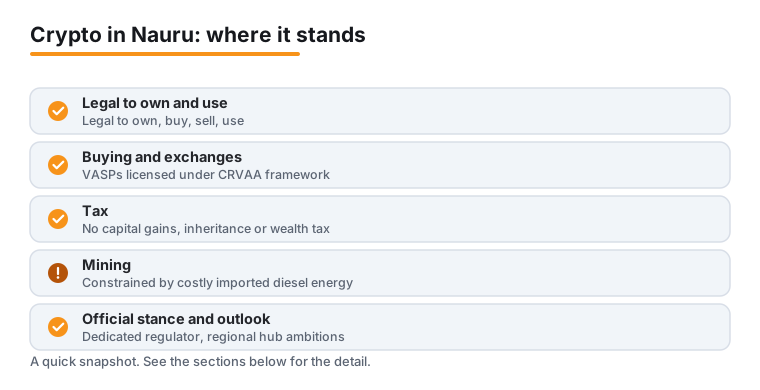
- Legal: Legal to own and use, not legal tender; VASPs licensed by the CRVAA
- Tax: No capital gains, inheritance or wealth tax; business income taxed
- Buying: Mostly via international exchanges with KYC
Nauru, the world's smallest island republic, sits in the central Pacific with a population of roughly twelve thousand people. In June 2025 it became the first Pacific island nation to pass dedicated virtual-asset legislation and to stand up a purpose-built crypto regulator, the Command Ridge Virtual Asset Authority. That step moved the country from an unregulated-but-permitted position to one of active, framework-based oversight, and it reflects an explicit government ambition to attract digital-asset businesses to the island. This page explains, in plain terms, the legal status of Bitcoin and other cryptocurrencies in Nauru as of 2026: who regulates the sector, the laws that apply, how exchanges and other providers are licensed, what is known about taxation and anti-money-laundering rules, and the practical realities of buying, holding, mining and sending crypto. The information here is general and educational as of 2026. It is not legal, tax or financial advice, and readers should verify the current position with the Command Ridge Virtual Asset Authority or another named Nauruan authority before relying on it. You can also read our broader explainer on how crypto regulation works.
On this page: Legal status · Who regulates it · Taxes · How to buy · Mining
Is Bitcoin and crypto legal in Nauru?
Yes. Owning, buying, selling and using Bitcoin and other cryptocurrencies is legal in Nauru. There has never been a ban. For most of the country's history there was no specific law on digital assets, which left them in a grey zone rather than an illegal one, but that gap has now been filled by a formal regime.
Cryptocurrency is not legal tender in Nauru. The country does not issue its own currency and uses the Australian dollar (AUD) for everyday transactions. Bitcoin is therefore treated as a tradable asset rather than official money, and no business is obliged to accept it. Notably, the 2025 framework generally classifies crypto as a commodity rather than a security, and it excludes payment tokens from being treated as investment contracts. For the wider picture of how different countries approach this, see our regulation hub.
Who regulates crypto in Nauru?
The lead regulator for digital assets is the Command Ridge Virtual Asset Authority (CRVAA), named after the highest point on the island. It was created by the Command Ridge Virtual Asset Authority Act 2025 as an autonomous body overseeing virtual assets, digital banking and Web3 innovation. With it, Nauru became the first Pacific nation to establish a standalone crypto regulator rather than bolting oversight onto an existing agency.
The CRVAA grants and suspends licences for virtual-asset service providers (VASPs), defines permitted and prohibited activities, and holds enforcement powers: it can conduct audits, freeze or suspend suspicious activity, issue cease-and-desist orders, impose fines, bring legal proceedings, and refer suspected crimes to the Nauru Police Force.
Its inaugural chief executive is Brian Phelps, an Australian financial-markets veteran and former general manager at CommSec, appointed in July 2025 shortly after the Act was passed. The government has said the authority will supervise virtual-asset transactions, require cybersecurity protocols and run the licensing system for providers operating from the island.
It does not work alone. Nauru's Financial Intelligence Unit (FIU), a statutory body within the Department of Justice and Border Control, handles anti-money-laundering and counter-terrorist-financing supervision and intelligence. Company formation runs through Nauru's general business and corporate registries. You can confirm the FIU's role and legal basis on the official Department of Justice and Border Control site.
Key laws and frameworks
Several instruments shape the Nauruan position:
- Command Ridge Virtual Asset Authority Act 2025. The centrepiece. It is Act No. 25 of 2025, certified by the Speaker on 17 June 2025 and notified in Government Gazette No. 244 of 17 June 2025 (G.N. No. 688/2025), creating the CRVAA and the VASP licensing framework with effect from that date. Section 14 makes it an offence to offer or operate virtual-asset services in Nauru without a licence from the Authority, punishable with a fine not exceeding AUD 20,000 and imprisonment of up to three years for an individual, or a fine of up to AUD 100,000 for a body corporate. It classifies crypto as a commodity and excludes payment tokens from being treated as investment contracts.
- Anti-Money Laundering and Targeted Financial Sanctions Act 2023. This statute, which repealed and replaced the earlier Anti-Money Laundering Act 2008, governs AML and counter-terrorist-financing obligations and underpins the FIU's supervisory role.
- Nauru Virtual Asset Service Provider Policy 2023 (with later amendments), which set out an early AML-focused approach to VASPs ahead of the 2025 Act.
- Business Licences Act 2017 and general corporate law, under which crypto firms register and obtain the underlying business licence.
Nauru is not an EU member, so the EU Markets in Crypto-Assets (MiCA) regulation does not apply here. Because the 2025 regime is new, supporting regulations and supervisory practice are still maturing, so anyone operating under it should obtain the current text of the Act and take local legal advice rather than relying on summaries.
Licensing and registration of exchanges and VASPs
Exchanges and other VASPs that want to operate from, or be licensed in, Nauru fall under CRVAA oversight. Reported in-scope activities include operating exchanges, custodial and non-custodial wallet services, token issuance through ICOs and STOs, NFTs, lending, staking and yield farming, DeFi platforms, stablecoin issuance, and elements of digital banking and cross-border payments.
Reported licensing conditions include a minimum authorised capital starting at AUD 25,000, appointment of an AML compliance officer, maintaining accounting records within Nauru, and implementing KYC and transaction-monitoring systems. In practice a provider also needs to incorporate a local entity, register a business name and disclose beneficial owners, then open a corporate bank account, which can be challenging given the island's limited banking infrastructure.
Fees, licence categories and detailed conditions still have no published legal text. No subsidiary legislation under the Command Ridge Virtual Asset Authority Act 2025 appears in the Nauru Government Gazette between the Act's certification on 17 June 2025 and Gazette No. 284 of 12 August 2026, and none of the 30 Acts certified by Parliament during 2026 amends it. Under the national AML/CFT/CPF strategy published on 5 August 2026, the Authority was to complete its review of the framework by August 2026 and to introduce amendments by July 2027. Treat the figures above as indicative and confirm the current requirements directly with the CRVAA before committing.
How crypto is taxed in Nauru
Nauru is positioning itself as a low-tax base for digital-asset business. Reporting indicates the country imposes no capital gains tax, no inheritance tax and no wealth tax on cryptocurrency, and there is no general VAT. Business income is taxed under the Business Tax Act 2016, which the Nauru Revenue Office administers, and which imposes three separate taxes. Business profits tax is 20 percent for a resident company with annual gross revenue of AUD 0 to AUD 15 million, and 25 percent for a resident company with annual gross revenue above AUD 15 million, for a resident company controlled by a non-resident person or associate, and for a non-resident company conducting business in Nauru through a permanent establishment. Individuals pay 20 percent, with a tax-free threshold of AUD 250,000 for Nauruan residents; partnerships and trusts pay 20 percent, with a tax-free threshold of AUD 250,000 for each Nauruan partner or beneficiary. Small business tax is 2.5 percent of gross revenue and applies only to a non-resident individual conducting business solely in Nauru with annual gross revenue not exceeding AUD 250,000. Non-resident tax is 20 percent on interest, royalties or insurance premiums derived from sources in Nauru.
These rates are the Nauru Revenue Office's own published summary of the laws it administers, not a crypto-specific ruling; Nauru has issued no tax determination on virtual assets. The office administers four tax laws, the Revenue Administration Act 2014, the Employment and Services Tax Act 2014, the Business Tax Act 2016 and the Telecommunications Service Tax Act 2009, together with the Gaming Act 2011, which is a licensing law rather than a tax. None of those taxes reaches a private capital gain, so a personal profit on disposing of crypto falls outside the taxes the Revenue Office levies, while crypto income earned by carrying on a business in Nauru is taxed as business income. This page does not give a definitive rate for any particular situation. Anyone with a potential liability should confirm the current treatment with Nauruan tax authorities or a qualified adviser, and may find our general guide to crypto taxes useful as background.
AML, KYC and financial-crime rules
Anti-money-laundering compliance is a core part of the Nauruan framework. The Anti-Money Laundering and Targeted Financial Sanctions Act 2023 mirrors the Financial Action Task Force (FATF) Recommendation 15 on virtual assets, and licensed VASPs must run customer identification (KYC) checks, monitor transactions, maintain beneficial-ownership records, and appoint a compliance officer who liaises with the FIU.
The FIU receives and analyses suspicious-activity reports, disseminates intelligence to domestic and foreign law enforcement, and assesses financial-crime risks. Nauru is a member of the Asia/Pacific Group on Money Laundering, which adopted and published its mutual evaluation report in November 2024. Nauru's national AML/CFT/CPF strategy for 2026 to 2030 records that the 2024 report noted the need for Nauru to properly assess and mitigate the money-laundering, terrorist-financing and proliferation-financing risks related to virtual assets, VASPs and the citizenship-by-investment programme. Nauru's national risk assessment published in August 2026 rates virtual assets and VASPs as HIGH risk, the joint highest sector rating alongside the shipping registry, against an overall national money-laundering risk of LOW. Nauru itself is not on the FATF list of jurisdictions under increased monitoring in the update of 19 June 2026 circulated by the Financial Intelligence Unit. For users, the practical takeaway is that regulated intermediaries will ask for identity documents and may report unusual activity, and that informal or unlicensed services carry greater legal and fraud risk.
Buying and using crypto in practice
For an individual in Nauru, buying Bitcoin works much as it does elsewhere: most people use international exchanges accessed online rather than a domestic platform, because local financial infrastructure is limited. Whether a given global exchange formally serves Nauruan residents depends on that platform's own country policies and KYC onboarding, so availability can change and should be checked directly with the exchange.
A general sequence looks like this: choose a reputable exchange and confirm it currently accepts Nauru residents; complete KYC with valid identification; plan in advance how you will both deposit and, crucially, withdraw back to Australian dollars, since on-island off-ramps are narrow; place your order, ideally starting small; and move anything beyond a trivial amount to a wallet you control, protecting your keys and recovery phrase. Keep records of every transaction for your own bookkeeping and any future tax reporting. There is no public evidence of Bitcoin ATMs on the island, so cash conversion generally happens through online exchanges or peer-to-peer arrangements. None of this is a recommendation of any specific service.
Bitcoin mining in Nauru
Mining in Nauru faces a hard physical constraint: energy. The island depends heavily on imported diesel for electricity, generation capacity is limited, and power can be expensive and at times unreliable. Large-scale proof-of-work mining is extremely energy-hungry, so it competes directly with households and essential services for a scarce resource.
For that reason, claims of a significant mining industry on the island should be read sceptically. Small or experimental operations are conceivable, but the economics and infrastructure do not naturally favour Nauru as a mining hub the way countries with cheap surplus hydro or geothermal power are favoured. There is also a sustainability dimension: a low-lying Pacific nation acutely exposed to climate change has obvious reasons to weigh the carbon footprint of energy-intensive computing. Anyone contemplating mining should check both electricity tariffs and supply realities, and whether any mining-specific licensing or energy rules apply under the CRVAA regime or other national law.
Recent developments (2025 to 2026)
The defining event was the passage of the Command Ridge Virtual Asset Authority Act 2025, certified on 17 June 2025, which established the CRVAA and the VASP licensing framework. Commentators have compared Nauru's ambition to that of Dubai's Virtual Asset Regulatory Authority, with the country openly seeking to become a regional crypto hub.
In July 2025, a month after the Act was passed, the government named Brian Phelps, a former CommSec markets general manager, as the CRVAA's inaugural chief executive. In April 2026 Nauru went further and appointed Dadvan Yousuf, a digital-currency entrepreneur, as its first international trade commissioner, a diplomatic role intended to support cross-border engagement with virtual-asset service providers, financial institutions and technology firms considering operations under the Nauruan framework. The government has framed the crypto programme as a way to diversify revenue and channel inflows toward its Intergenerational Trust Fund while reducing reliance on climate financing. This crypto push runs alongside the Nauru Economic and Climate Resilience Citizenship Program, a citizenship-by-investment scheme that, by some accounts, can accept cryptocurrency as a source of funds subject to enhanced documentation. On the enforcement side, in 2026 the FIU publicly warned residents about a fraudulent crypto investment scheme linked to entities trading as DSJ Exchange (DSJEX) and BG Wealth Sharing, stressing that those operators were not licensed or registered with the CRVAA or any other authority. The regulator's licensing rules and supervisory practice are expected to keep evolving, so the official sources below are the best place to check the current state of play.
Consumer risks and protection
The main risks for crypto users in Nauru combine the universal and the local. Universally, there is price volatility, the irreversibility of transactions, exchange and custody risk, and the prevalence of scams; crypto is not covered by any deposit-protection scheme. Locally, the small size of the economy, dependence on imported energy, limited banking infrastructure and narrow off-ramps amplify the practical difficulty of using crypto day to day.
Scam risk is real and acknowledged by the authorities themselves: the FIU's 2026 warning highlighted social-media-driven schemes promising guaranteed returns of up to 100 percent before restricting withdrawals and disappearing. A practical defence is to deal only with providers that are properly licensed or registered, to treat any promise of guaranteed profit as a red flag, to verify that a service is recognised by the CRVAA before sending funds, and to report suspected fraud to the FIU. Never invest more than you can afford to lose, and consider speaking with a qualified adviser about whether crypto fits your situation.
Official sources and how to verify
Because Nauru's regime is new and still developing, always confirm the current position against primary sources rather than summaries. The most useful official and authoritative references are:
- Government of the Republic of Nauru for official announcements, departments and the Government Gazette in which laws such as the CRVAA Act are published.
- Nauru Financial Intelligence Unit, Department of Justice and Border Control for AML/CFT rules, the VASP policy and public scam warnings.
- FATF country profile for Nauru for the international assessment of Nauru's AML/CFT regime, including its treatment of virtual assets.
- Nauru Economic and Climate Resilience Citizenship Program for the official citizenship scheme that intersects with digital-asset interest.
This page is general information as of 2026 and is not legal, tax or financial advice. Laws and policies change, so verify any decision with the Command Ridge Virtual Asset Authority or another named Nauruan authority, or a qualified local professional, before acting.
What changed in 2026
Nauru's legal position on crypto has not moved since June 2025. The Command Ridge Virtual Asset Authority Act 2025 is still the only crypto statute, and no regulations have been made under it. What moved in 2026 is everything around the Act, and all of it is on the public record.
- The regulator has a budget for the first time. The Appropriation Act 2026-2027 (Act No. 30 of 2026) was certified on 20 July 2026 and notified in Government Gazette No. 240 of 20 July 2026. Schedule 3 of the Appropriation Bill 2026-27 lists department 19, Command Ridge Virtual Asset Authority, with AUD 3,342,008 for 2026-27, against nil in the 2024-25 actual column and nil in every 2025-26 column. Budget Paper 1 breaks that down as AUD 1,803,000 expatriate salary, AUD 800,000 consultants fees and AUD 435,000 plant and equipment, and records AUD 122,220 of actual and committed spending in 2025-26 against no approved budget.
- Nauru now rates crypto as one of its two highest-risk sectors. The Naoero National Risk Assessment 2025, published on 8 August 2026, rates the shipping registry HIGH, virtual assets and VASPs HIGH and the citizenship-by-investment programme MEDIUM-HIGH, while the country's overall money-laundering risk stays LOW.
- A dated work programme now exists. The Naoero National AML/CFT/CPF Strategy and Action Plan 2026-2030, published on 5 August 2026, assigns the Authority named deadlines for reviewing and amending the VASP framework.
- Still no regulations and still no licensees. No subsidiary legislation under the Act appears in any issue of the Nauru Government Gazette between the Act's certification on 17 June 2025 and Gazette No. 284 of 12 August 2026, and none of the 30 Acts certified in 2026 amends it. The national risk assessment states that as of 30 June 2025 no VASPs were registered or licensed under the Business Names Registration Act 2018, the Business Licence Act 2017 or the CRVAA Act 2025, and calls the sector not yet operational.
- The board turned over twice. Cabinet appointed Walat Yousuf and Carlos Eoe as members on 4 July 2025 (G.N. No. 782/2025), replaced Yousuf with Loretta Teueli on 21 November 2025 (G.N. No. 1404/2025), added Bradley Eoe as third member for a three-year term effective 5 March 2026 (G.N. No. 246/2026), and replaced Teueli with Dane Dageago for a three-year term on 23 March 2026 (G.N. No. 312/2026).
- Crypto sits with Commerce, not Finance. The Republic of Nauru Administrative Arrangements (No. 2) Order 2026, SL No. 24 of 2026, published in Gazette No. 181 of 25 May 2026, assigns the Command Ridge Virtual Asset Authority and its Act to the Minister for Commerce and Foreign Investment. Cabinet portfolio notices through 2026 list Crypto Currency under the same portfolio, alongside the offshore registry.
- Nauru is not on the FATF grey list. The Financial Intelligence Unit's notice on the FATF update of 19 June 2026 lists the jurisdictions under increased monitoring, and Nauru is not among them.
What is coming next, and when
The Naoero National AML/CFT/CPF Strategy and Action Plan 2026-2030, published on 5 August 2026, is the only published document that puts dates on Nauru's remaining crypto work. Its action plan names lead agencies and deadlines.
| Deadline | Commitment | Lead |
|---|---|---|
| August 2026 | Conduct a review of the existing legal and regulatory framework governing VASPs in Nauru | CRVAA, supported by the FIU and the Department of Justice and Border Control |
| July 2027 | Recommend and introduce necessary amendments to effectively regulate and supervise the VASP sector | CRVAA, supported by the FIU and the Department of Justice and Border Control |
| July 2027 | Establish effective monitoring and enforcement mechanisms to detect and prevent unlicensed activities | CRVAA, supported by the FIU |
| August 2027 | Establish systems and procedures for VASP compliance with legislative requirements | CRVAA, supported by the FIU and the Department of Justice and Border Control |
| August 2027 | Procedures for joint supervision of the VASP sector, and quarterly CRVAA updates to the FIU on off-site and on-site inspections | FIU, supported by the CRVAA |
| September 2027 | Outreach informing registered VASPs of their obligations; procedures and IT tools for risk-based supervision of the sector | CRVAA and FIU |
| October to November 2027 | Develop the methodology for, then adopt and publish, the national money-laundering, terrorist-financing and proliferation-financing risk assessment of virtual assets and VASPs | FIU, supported by the CRVAA |
| November to December 2027 | Training of CRVAA staff on risk-based supervision; general public awareness campaign on risks associated with virtual assets | CRVAA and FIU |
| February 2028 | Issue or update AML/CFT/CPF guidance for the VASP sector, including suspicious indicators | FIU, supported by the CRVAA |
Read practically: an exchange or custodian applying under today's conditions should expect those conditions to be rewritten before July 2027, and Nauru's first published assessment of crypto-specific money-laundering risk is not due until November 2027. None of this creates a new tax or reporting duty for a person who simply holds crypto in Nauru. Source: Naoero National AML/CFT/CPF Strategy and Action Plan 2026-2030.
Operating without a CRVAA licence: the actual penalties
Section 14 of the Command Ridge Virtual Asset Authority Act 2025 makes it an offence for any person or entity to offer or operate virtual-asset services in Nauru without a licence from the Authority. Nauru's national risk assessment sets out the penalty: a fine not exceeding AUD 20,000 and imprisonment of up to three years for an individual, and a fine of up to AUD 100,000 for a body corporate.
The services the Act brings within that licence are the operation of centralised or decentralised virtual-asset platforms; exchange of virtual assets or fiat currencies; custodial and non-custodial wallet services; token issuance, including initial coin offerings and non-fungible token minting; lending, staking, yield farming and decentralised finance services; stablecoin issuance and cross-border payment solutions; and any other services that may be prescribed by regulations. No such regulations have been made.
The anti-money-laundering side carries heavier numbers. VASPs are included in the definition of financial institutions by section 4(1)(n) of the Anti-Money Laundering and Targeted Financial Sanctions Act 2023. The risk assessment records that sections 68 to 70 of that Act designate the Financial Intelligence Unit as the regulator, that sections 78 to 80 give it powers to inspect, demand information and impose penalties, and that sanctions run up to AUD 1 million for legal persons and imprisonment of up to 20 years for individuals. The Virtual Asset Service Provider Policy, published on 6 October 2023 and revised on 22 February, 20 March, 10 April and 20 May 2024, is still listed as current FIU guidance, though the risk assessment calls it more declaratory than practical while no virtual-asset activity is licensed.
One thing is unresolved. The risk assessment states that it is unclear whether the CRVAA is only the prudential supervisor and the FIU the AML/CFT supervisor, how the two divide responsibilities, and how they will cooperate. The 2026-2030 strategy sets August 2027 as the date for joint supervision procedures and quarterly CRVAA reporting to the FIU.
Frequently asked questions
Is cryptocurrency legal in Nauru?
Yes. Buying, holding and using cryptocurrency is legal in Nauru, and there is no ban. Since June 2025 the country has also had a formal regulatory framework under the Command Ridge Virtual Asset Authority Act 2025. Crypto is not legal tender, however; Nauru uses the Australian dollar.
Who regulates crypto in Nauru?
The Command Ridge Virtual Asset Authority (CRVAA), created by the Command Ridge Virtual Asset Authority Act 2025, is Nauru's dedicated virtual-asset regulator. It licenses and supervises crypto exchanges, wallet providers, token issuers, DeFi services and stablecoins. The Financial Intelligence Unit, within the Department of Justice and Border Control, handles anti-money-laundering supervision alongside it. Nauru was the first Pacific nation to establish such a body.
How is crypto taxed in Nauru?
Industry sources report that Nauru imposes no capital gains tax, inheritance tax or wealth tax on cryptocurrency, and there is no general VAT, while business income is taxed under the Business Tax Act, with non-resident companies reported at around 20 percent. These figures come from secondary sources rather than a single consolidated official crypto-tax notice, and rules can change. Confirm your specific position with Nauruan tax authorities or a qualified adviser.
Do crypto exchanges need a licence in Nauru?
Yes. Exchanges and other virtual-asset service providers operating from or licensed in Nauru must be authorised by the CRVAA. Reported conditions include a minimum authorised capital from AUD 25,000, an appointed AML compliance officer, accounting records kept in Nauru, and KYC and transaction-monitoring systems. Exact fees and full licence conditions are still being defined, so verify them directly with the CRVAA.
Are there AML and KYC rules for crypto in Nauru?
Yes. The Anti-Money Laundering and Targeted Financial Sanctions Act 2023 applies, mirroring FATF Recommendation 15 on virtual assets. Licensed providers must verify customer identity, monitor transactions, keep beneficial-ownership records and report suspicious activity to the Financial Intelligence Unit. Nauru's AML/CFT regime is peer-reviewed against FATF standards.
How do I check whether a crypto service is legitimate in Nauru?
Verify that the provider is licensed or registered with the Command Ridge Virtual Asset Authority before sending any funds, and treat any promise of guaranteed returns as a warning sign. In 2026 the Financial Intelligence Unit warned the public about unlicensed schemes such as DSJ Exchange and BG Wealth Sharing. Check the official Government of Nauru and Department of Justice and Border Control sites, and report suspected scams to the FIU.
Who leads the Command Ridge Virtual Asset Authority?
Its inaugural chief executive is Brian Phelps, an Australian financial-markets veteran and former general manager at CommSec, appointed in July 2025 shortly after the Command Ridge Virtual Asset Authority Act 2025 was passed. He leads licensing, supervision and enforcement for virtual-asset service providers operating from Nauru.
Why is Nauru building a crypto framework?
The government, under President David Adeang, has said the aim is to diversify revenue, attract digital-asset businesses to the island and channel new financial inflows toward its Intergenerational Trust Fund while reducing reliance on climate financing. Nauru is a small economy ranked among the most exposed to economic and climate shocks, and it sees regulated virtual assets as one route to greater resilience. In April 2026 it appointed a digital-currency entrepreneur, Dadvan Yousuf, as its first international trade commissioner to support engagement with virtual-asset firms.
Are there any licensed crypto exchanges in Nauru?
No licensed virtual-asset service provider is on the public record. Nauru's national risk assessment, published in August 2026, states that as of 30 June 2025 no VASPs were registered or licensed under the Business Names Registration Act 2018, the Business Licence Act 2017 or the Command Ridge Virtual Asset Authority Act 2025, and describes the sector as not yet operational. No register of licensees appears on any Nauru government site, so a company's claim to hold a CRVAA licence cannot be checked against an official list. The risk assessment also notes there is no policy or procedure in place for detecting unlicensed VASP activity.
What is the penalty for running a crypto business in Nauru without a licence?
Section 14 of the Command Ridge Virtual Asset Authority Act 2025 makes it an offence to offer or operate virtual-asset services in Nauru without a licence from the Authority. Nauru's national risk assessment records the penalty as a fine not exceeding AUD 20,000 and imprisonment of up to three years for an individual, and a fine of up to AUD 100,000 for a body corporate. Separately, the same document records that breaches of the Anti-Money Laundering and Targeted Financial Sanctions Act 2023 carry sanctions of up to AUD 1 million for legal persons and imprisonment of up to 20 years for individuals.
Is Nauru on the FATF grey list?
No. The Financial Intelligence Unit's notice on the FATF update of 19 June 2026 sets out the jurisdictions under increased monitoring, and Nauru is not among them. Nauru is a member of the Asia/Pacific Group on Money Laundering, which adopted and published its mutual evaluation report in November 2024, and Nauru's own August 2026 national risk assessment puts overall money-laundering risk at LOW while rating virtual assets and VASPs HIGH.
When will Nauru's crypto rules be finished?
The national AML/CFT/CPF strategy published on 5 August 2026 sets the dates. The CRVAA was to complete a review of the existing VASP framework by August 2026, recommend and introduce amendments by July 2027, establish monitoring and enforcement mechanisms against unlicensed activity by July 2027, put compliance systems and joint supervision with the Financial Intelligence Unit in place by August 2027, publish a national money-laundering risk assessment of virtual assets by November 2027, and issue AML guidance to the VASP sector by February 2028. No bill has been introduced yet, and no draft or consultation has been published.
How is a crypto gain taxed in Nauru?
The Nauru Revenue Office administers four tax laws: the Revenue Administration Act 2014, the Employment and Services Tax Act 2014, the Business Tax Act 2016 and the Telecommunications Service Tax Act 2009. None of them taxes a private capital gain, so a personal profit on selling crypto falls outside the taxes the Revenue Office levies, and Nauru has issued no tax determination on virtual assets. If you trade crypto as a business in Nauru, business profits tax applies at 20 percent for a resident company with annual gross revenue up to AUD 15 million, and 25 percent above that or where the company is controlled by a non-resident or is a non-resident company operating through a permanent establishment.
Facts reviewed: 13 August 2026. Page updated: 13 August 2026.