Home › Crypto Regulation › Marshall Islands
Bitcoin & Cryptocurrency Regulation in Marshall Islands
Quick answer — Marshall Islands, 2026
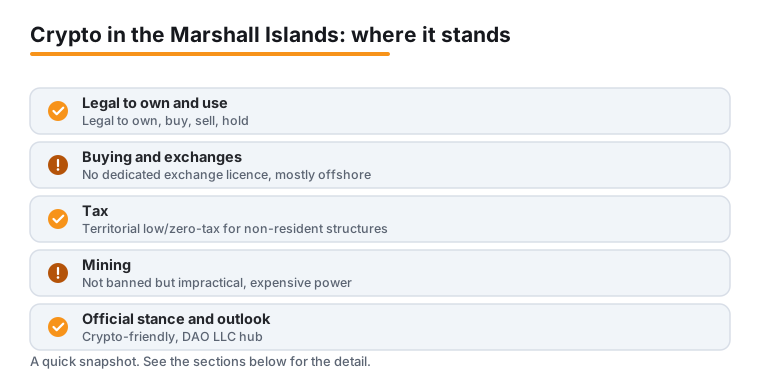
- Legal: Legal to own and trade, not legal tender; DAOs can register as LLCs
- Tax: Zero or low tax for qualifying non-resident entities; local income taxed
- Buying: No local exchanges, use international platforms via KYC
The Republic of the Marshall Islands (RMI) is an independent Pacific nation in free association with the United States, and it occupies an unusual place in global crypto policy. It made headlines in 2018 when it tried to issue its own blockchain-based legal tender, and again from 2022 onward when it became one of the first jurisdictions to grant decentralized autonomous organizations (DAOs) formal legal status as limited liability companies. As of 2026 the picture has shifted: the national cryptocurrency project has been wound down, the country has moved to create its first dedicated financial regulator, and its role as a registration hub for crypto-native legal entities continues.
This guide explains where cryptocurrency stands in the Marshall Islands today, who regulates it, and what residents and businesses should know about legal status, tax, licensing, AML rules, buying, and mining. It is general information as of 2026 and is NOT legal, tax, or financial advice. RMI law has specific nuances and is evolving quickly, so verify anything that affects you with the named official regulators or a qualified local adviser. For broader background see our guide to crypto regulation.
On this page: Legal status · Who regulates it · Taxes · How to buy · Mining
Is Bitcoin and crypto legal in the Marshall Islands?
Yes. Owning, buying, selling, and holding Bitcoin and other cryptocurrencies is legal in the Marshall Islands. There is no general prohibition on individuals or businesses using digital assets, and the country has actively positioned itself as crypto-friendly through its corporate and DAO legislation.
One important clarification concerns legal tender. The official currency of the Marshall Islands is the US dollar; the country does not issue its own national fiat currency. In 2018 the government passed the Sovereign Currency Act to create a blockchain-based token called the Sovereign (SOV) that would have circulated as legal tender alongside the dollar. That token never went into circulation and faced sustained opposition from the International Monetary Fund and from the US correspondent banks the RMI depends on. The Sovereign Currency Act 2018 was repealed in its entirety by section 473(6) of the Monetary Authority Act 2025 (P.L. 2025-32), which commenced on 23 September 2025, ending the SOV initiative. Bitcoin and other cryptocurrencies remain legal to use, but no cryptocurrency is legal tender in the Marshall Islands today.
Who regulates crypto in the Marshall Islands?
The Marshall Islands has historically lacked a single, independent central bank or financial-sector regulator. For decades the principal authority has been the Office of the Banking Commissioner (OBC), established under the Banking Act 1987. That office ceased to exist on 20 February 2026, and the Marshall Islands Monetary Authority (MIMA) now supervises banks and the wider financial sector for both prudential and anti-money-laundering purposes, and houses the country's Financial Intelligence Unit (FIU), which receives and analyses suspicious transaction reports.
In 2025 the government moved to consolidate and modernise this oversight by creating the Marshall Islands Monetary Authority (MIMA) under the Monetary Authority Act 2025. MIMA is intended to be the country's first dedicated, independent financial regulator, with a mandate covering banks, money-service businesses, and payment systems, and it is described by the government as the supervisor of newer instruments such as the USDM1 sovereign digital bond. The transition is now complete. Nitijela Resolution 63, passed on 20 February 2026, confirmed Sultan T. Korean as Governor of the Monetary Authority, which under section 472(2) of the Monetary Authority Act 2025 caused the Banking Commissioner to vacate office, and section 473(1) with the Schedule repealed the provisions that created that office. For current supervisory questions the body to approach is the Marshall Islands Monetary Authority and the Office of the Banking Commissioner. There is no separate crypto licensing agency, because crypto licensing sits inside the general financial services provider licence that MIMA now issues under the Banking Act 1987. As at August 2026 MIMA has no functioning public website, so licensing questions have to go through the Ministry of Finance or MIMA directly.
Key crypto laws and frameworks
The Marshall Islands does not have a single consolidated crypto code. Instead, digital-asset activity is shaped by a combination of corporate law, anti-money-laundering rules, and a distinctive framework for decentralized organizations:
- Decentralized Autonomous Organization (DAO) Act 2022, a 2023 amendment, and DAO Regulations introduced in 2024. This framework lets a DAO register as a limited liability company (LLC) with legal personhood, so it can enter contracts, hold assets, and limit members' liability. It is the main reason many Web3 and DeFi projects choose the RMI as a base. The 2024 changes shortened the maximum registration time to about 30 days, introduced a Beneficial Owner Information Report to refine know-your-customer checks, and clarified that governance tokens lacking economic rights are not treated as securities. In practice, DAO LLC registrations are handled through MIDAO, a public-private partnership authorized by the RMI government to process and manage these filings.
- Banking Act 1987, which establishes the Office of the Banking Commissioner and the legal basis for banking licensing, supervision, and AML controls.
- Monetary Authority Act 2025, which establishes the Marshall Islands Monetary Authority as a dedicated regulator.
- AML/CFT framework aligned to international Financial Action Task Force (FATF) standards, including guidance on virtual assets and virtual-asset service providers.
An Asia/Pacific Group on Money Laundering and FATF Mutual Evaluation of the Marshall Islands, published in November 2024, assessed the country's AML/CFT regime and specifically flagged the DAO and virtual-asset sectors as posing money-laundering and terrorist-financing risks owing to limited supervision. You can read it via the FATF country page for the Marshall Islands.
Licensing and registration of crypto businesses and exchanges
There is no separate crypto exchange licence and no public VASP register, but crypto firms are inside the licensing perimeter. Section 123(2) of the Banking Act 1987 provides that no virtual asset service provider business shall be transacted by a corporation or entity incorporated or otherwise formed in the Republic except by a licensed financial services provider, and section 123(6) makes doing so without a licence an offence carrying a fine not exceeding 10,000 dollars. Virtual asset and virtual asset service provider are defined in FATF terms at sections 102(hh) and 102(ii). Instead, crypto businesses are reached through a combination of corporate registration, the DAO LLC framework, and AML/CFT obligations.
In practice this means: a crypto-native organization can incorporate as a DAO LLC or other RMI entity through a registered agent; entities are expected to meet anti-money-laundering, counter-terrorist-financing, and beneficial-owner reporting requirements; and the Monetary Authority, which took over supervision from the Banking Commissioner in February 2026, can supervise and sanction non-compliant entities. The 2024 FATF Mutual Evaluation noted that virtual-asset activity and DAOs had been under-supervised, and tightening supervision is an ongoing area of reform. Because the rules are implemented through registration agents and specific regulations rather than a single public licensing portal, anyone forming or operating a crypto business in or from the RMI should obtain professional legal advice and confirm the current requirements with the regulators directly.
Crypto taxation in the Marshall Islands
The Marshall Islands operates a territorial tax system and is widely known as a low-tax or zero-tax jurisdiction for qualifying non-resident corporate structures. Non-resident entities formed in the RMI that earn their income outside the country have historically not been subject to local corporate income tax, capital gains tax, dividend tax, or withholding taxes on foreign-source income. This is a major reason the jurisdiction is popular for international business companies and crypto holding structures.
That does not mean crypto is automatically tax-free for everyone. The Marshall Islands does levy personal income tax on locally sourced employment income, and tax outcomes depend heavily on residency, where income is sourced, and the rules of other countries that may have a claim on the same income. The rates are set out in the Income Tax Act 1989. Section 103 charges 8 percent on the first 10,400 dollars of wages and salaries and 12 percent above that, with a 5 percent rate for United States contractor personnel. Since April 2026, section 103(3) as replaced by the Income Tax (Amendment) Act 2026 (P.L. 2026-68) allows every employee an annual exemption of 8,320 dollars, where previously only employees earning 8,320 dollars or less qualified. Section 109 charges businesses 80 dollars per year on gross revenues up to 10,000 dollars and 3 percent per year above that. Section 116 charges 3 percent on gross income from leased immovable property, and section 117 charges 10 percent on a non-resident's gross income from services relating to a client in the Marshall Islands. There is no capital gains tax, no corporate profits tax and no VAT. If you are a resident, an expatriate, or you run a crypto business connected to the RMI, confirm your position with the Marshall Islands tax authorities and a qualified tax adviser, and consider obligations in your country of citizenship or residence. See also our overview of how crypto is taxed. This is not tax advice.
AML and KYC rules
Anti-money-laundering (AML) and counter-terrorist-financing (CFT) compliance is the most developed strand of crypto-relevant regulation in the Marshall Islands. The Marshall Islands Monetary Authority supervises reporting entities for AML/CFT purposes, and under section 436 of the Monetary Authority Act 2025 the Financial Intelligence Unit sits within its premises and operations. The unit collects and analyses suspicious transaction reports and cooperates with domestic and international partners.
The RMI has progressively integrated FATF guidance on virtual assets and virtual-asset service providers into domestic law, and blockchain-related compliance capability has been added to the supervisor and the FIU. In practice, crypto businesses connected to the RMI, and DAO LLCs in particular, are expected to maintain know-your-customer (KYC) checks, beneficial-owner (UBO) reporting, internal controls, record-keeping, and suspicious-activity reporting consistent with international standards. The November 2024 FATF Mutual Evaluation found gaps in the supervision of virtual-asset and DAO activity, so this is an area where requirements are being strengthened. The operative rules are the Anti-Money Laundering Regulations 2002 as revised, which Cabinet approved on 24 August 2023 by Cabinet instrument C.M. 143 (2023) and which took effect the same day under section 106 of the Administrative Procedures Act 1979. They impose risk based customer due diligence, record keeping and suspicious transaction reporting on banks, financial services providers and designated non-financial businesses and professions. The enforcement backstops sit in the Banking Act 1987: section 181(1) allows civil money penalties of up to 10,000 dollars per violation, and section 170A(4) punishes wilful failure to report a suspicious transaction related to terrorist financing by a fine of up to 2,000,000 dollars or up to twenty years imprisonment, or both.
Buying and using crypto in practice
There is no law preventing residents of the Marshall Islands from buying or using cryptocurrency. In practice, most people access crypto through international exchanges rather than locally headquartered platforms, since the domestic financial sector is small and the country uses the US dollar.
Practical points to keep in mind:
- Platform availability: Whether a given global exchange serves RMI residents depends on that exchange's own onboarding policy. Check the platform's list of supported countries before signing up.
- Identity verification: Reputable exchanges require KYC documentation, and AML expectations apply to crypto businesses connected to the RMI.
- Banking and payments: Funding accounts is often the main friction point. The Marshall Islands depends on US-dollar correspondent banking, and those banks apply strict AML scrutiny, which can affect how easily fiat moves to and from crypto platforms.
- Bitcoin ATMs: There is no evidence of an established Bitcoin ATM network in the RMI; the country is small and remote, so cash-to-crypto conversion is usually done online or peer-to-peer.
As anywhere, favour established, well-secured exchanges, enable two-factor authentication, keep transaction records, and be cautious about moving large balances through unfamiliar services.
Crypto mining in the Marshall Islands
There is no specific ban on cryptocurrency mining in the Marshall Islands, but the country is one of the least practical places in the world to mine at scale. The economics of proof-of-work mining depend on cheap, reliable electricity, and the RMI relies heavily on imported diesel for power generation, which makes electricity relatively expensive. The islands are also exposed to climate and energy-security pressures.
For these reasons the Marshall Islands is far better known as a legal home for crypto organizations and DAOs than as a mining destination. Anyone considering mining-related activity should look closely at energy costs, environmental and import regulations, and any business-registration or AML requirements before committing capital.
Recent developments (2025 to 2026)
The past two years have seen significant change in the RMI's digital-finance posture:
- Repeal of the Sovereign Currency Act (August 2025). The 2018 law authorizing the SOV legal-tender token was repealed, formally ending that project.
- Monetary Authority Act 2025. The government legislated to create the Marshall Islands Monetary Authority (MIMA), its first dedicated, independent financial regulator, partly in response to long-running correspondent-banking pressures.
- USDM1 and the Lomalo wallet (from late 2025). Through the Ministry of Finance, Banking and Postal Services, the RMI introduced USDM1, described by the government as a fully collateralized, US-dollar-denominated sovereign bond issued on-chain (structured like a Brady bond), rather than a stablecoin or central bank digital currency. A citizen digital wallet called Lomalo, settling on the Stellar blockchain, was launched to deliver payments, with the first distribution under the country's ENRA universal-basic-income style programme made in late 2025. The Stellar Development Foundation and infrastructure provider Crossmint supported the technical rollout, and USDM1 is described as being supervised by MIMA. Early uptake was small: reporting in December 2025 indicated only around a dozen recipients chose to receive USDM1 in the first cycle, partly because Compact of Free Association trust-fund rules require payment first by bank deposit or paper check, which recipients then convert, adding an extra step.
- FATF/APG Mutual Evaluation (November 2024). Highlighted virtual-asset and DAO supervision as risk areas, driving ongoing AML/CFT reform.
Several of these initiatives are new and still being implemented, so treat specifics as evolving and confirm them against the official sources.
Consumer risks and protection
The Marshall Islands is crypto-friendly at the corporate level, but ordinary users should be aware that crypto-specific consumer protection is limited and that several local factors add risk:
- Regulatory change: Frameworks here have shifted meaningfully within a few years, from the SOV project to the new Monetary Authority, and they can shift again.
- Banking dependency: Reliance on US-dollar correspondent banking means external AML and de-risking pressures strongly shape what is possible domestically.
- Under-supervised sectors: The 2024 FATF evaluation flagged virtual-asset and DAO activity as exposed to money-laundering, terrorist-financing, and reputational risk; users of RMI-linked projects should do extra due diligence.
- Market and scam risk: Crypto is a volatile, high-risk asset class, and fraud affects users everywhere. Never invest money you cannot afford to lose, use established platforms, and secure your accounts and keys.
If something goes wrong with a regulated financial institution, the Marshall Islands Monetary Authority is the relevant point of contact; for purely offshore crypto platforms, local recourse may be limited.
Official sources and how to verify
Because RMI crypto policy is evolving, always check the primary sources before acting. The most authoritative official references are:
- Office of the Banking Commissioner (OBC), the financial-sector regulator and home of the Financial Intelligence Unit, administering the Banking Act 1987.
- Marshall Islands Monetary Authority (MIMA), the new regulator established under the Monetary Authority Act 2025.
- Ministry of Finance, Banking and Postal Services, responsible for the USDM1 instrument and the Lomalo wallet.
- FATF country page for the Marshall Islands, including the November 2024 AML/CFT Mutual Evaluation.
- Primary legislation, including the Banking Act 1987, DAO Act 2022 and amendments, and the Monetary Authority Act 2025, is published by the RMI Parliament.
You can also compare frameworks across countries on our crypto regulation hub. This article is general information as of 2026 and is not legal, tax, or financial advice; verify your specific position with the named official regulators or a qualified local adviser before acting.
August 2026 status: what has actually changed
Three things moved between the last review of this page and August 2026, and one thing conspicuously did not.
- The Marshall Islands now has one financial regulator, not two. Nitijela Resolution 63 was passed on 20 February 2026 and signed before the Clerk on 23 February 2026. It confirms appointments approved by the President and Cabinet on 5 February 2026: Sultan T. Korean as Governor and Executive Member of the Board of the Monetary Authority for six years, with Lindsay M. Timarong for six years, Leo Seewald for five years and Dr. Peter Dittus for three years as Non-Executive Members, under section 416 of the Monetary Authority Act 2025 (Resolution 63). That appointment is the trigger in section 472(2) of the Act for the Banking Commissioner to vacate office, and section 473(1) with paragraph 1(4) of the Schedule repealed Part II of the Banking Act 1987, sections 104 to 106, the provisions that created the office in the first place (Monetary Authority Act 2025, P.L. 2025-32).
- The Monetary Authority Act commenced on 23 September 2025, not August. That is the date printed on the certified text, and it is also the date the Declaration and Issuance of the Sovereign Currency Act 2018 was repealed, by section 473(6) of the same Act rather than by any standalone repeal statute.
- The wage tax exemption changed in April 2026. The Income Tax (Amendment) Act 2026 (Bill No. 103, P.L. 2026-68) was passed on 16 March 2026, certified on 1 April 2026, and states that it takes effect on April 2026. It keeps the 8 and 12 percent rates unchanged and rewrites the exemption (2026 public laws).
- No crypto bill exists. The Nitijela's list of bills before it in the 47th Constitutional Regular Session 2026 runs to Bill 2026-0097, introduced 5 March 2026, and contains nothing on crypto, digital assets or virtual assets (bills before the Nitijela). The public laws for 2026, P.L. 2026-56 through P.L. 2026-75, contain nothing either.
MIMA is being built rather than merely announced. The IMF's Monetary and Capital Markets Department has published a technical assistance report, Republic of the Marshall Islands: Technical Assistance Report, Operationalizing A New Monetary Authority, Volume 2026 Issue 048. It recommends establishing core central banking functions including an integrated payments and clearing system and core banking operations, and a phased approach to organisational development that prioritises recruitment and capacity building during the start-up phase (IMF, 2026 Issue 048). No target date has been published for MIMA to issue rules of its own on payment instruments, stablecoins or virtual assets.
On the government's own digital money project, the Ministry of Finance states that USDM1 is supervised by MIMA and is not a cryptocurrency, a central bank digital currency or a stablecoin, but a US dollar denominated sovereign obligation backed 1:1 by short dated US Treasury instruments. Its authorisations page lists guidance on USDM1 as Level 1 HQLA published on 11 November 2025, and a document titled Financial Access and the Path to USDM1 published on 15 December 2025 (Ministry of Finance, USDM1). ENRA distributions began in November 2025 and are set to continue quarterly for the next two decades, with eligibility, enrollment and benefit entitlements administered by the Marshall Islands Social Security Administration as sole system of record (Ministry of Finance, ENRA). Uptake has grown since the December 2025 figures: reporting from the 2026 Forum Economic Ministers Meeting in Majuro said Lomalo was accepted by more than 30 merchants, with participating businesses in Arno, Wotje, Ebeye, Jaluit and Majuro, alongside a Bank of Guam trial integration and a MoneyGram cash-out option (RNZ via Scoop, 24 June 2026).
Crypto legislation in the Marshall Islands: adopted, in force, and absent
There is no consolidated crypto code, and no crypto bill is before the Nitijela. What follows is the set of instruments that actually bear on digital assets, with the stage each has reached and the commencement date printed on its certified text.
| Instrument | Stage | In force from | What it does for crypto |
|---|---|---|---|
| Banking Act 1987 (P.L. 1987-9), ss.102(hh), 102(ii), 102(t), 123, 126, as amended by P.L. 2019-114, P.L. 2020-07, P.L. 2020-24 | In force | 20 March 1987, virtual asset provisions from the 2019 and 2020 amendments | Defines virtual asset and virtual asset service provider in FATF terms, and requires a financial services provider licence for VASP business carried on by an entity formed in the Republic |
| Anti-Money Laundering Regulations 2002, as revised | In force | 24 August 2023, Cabinet instrument C.M. 143 (2023) | Applies risk based customer due diligence, record keeping and suspicious transaction reporting duties to banks, financial services providers and DNFBPs |
| Decentralized Autonomous Organization Act 2022 (P.L. 2022-50), amended by P.L. 2023-83 | In force | 25 November 2022 | DAO LLC with legal personality, 30 day registration under s.705(5), beneficial owner reporting under s.712, governance tokens without economic rights are not securities under s.703(2)(d) |
| Electronic Transactions Act 2025 (P.L. 2025-25) | In force | 21 April 2025 | Legal validity of electronic records, signatures and transactions. Not crypto specific and names no blockchain or distributed ledger |
| Digital Transformation and Identity Verification Act 2025 (P.L. 2025-26) | In force | 21 April 2025 | Digital Transformation Unit and electronic identity verification framework. Not crypto specific |
| Monetary Authority Act 2025 (P.L. 2025-32) | In force, succession completed 20 February 2026 | 23 September 2025 | Creates MIMA as the licensing and supervisory authority for banks and financial service providers, houses the FIU, repeals the Sovereign Currency Act 2018 |
| Nitijela Resolution 63 (2026) | Adopted | Passed 20 February 2026 | Confirms the Governor and three non-executive board members of MIMA, the event that ends the Office of the Banking Commissioner |
| Income Tax (Amendment) Act 2026 (P.L. 2026-68) | In force | April 2026 | Rewrites the wage and salary exemption. Rates unchanged. No capital gains tax created |
| Declaration and Issuance of the Sovereign Currency Act 2018 | Repealed | Repealed 23 September 2025 by s.473(6) Monetary Authority Act 2025 | Would have made the SOV token legal tender. Never circulated |
| A dedicated crypto, VASP or stablecoin statute | Does not exist and is not proposed | Not applicable | No such bill appears in the 47th Constitutional Regular Session 2026 lists |
Sources for the table: the certified texts linked in each row above, the 2026 public laws list and the bills before the Nitijela.
One earlier episode is worth knowing about because it shapes expectations. The APG mutual evaluation records a 2021 proposal for a Digital Economic Zone of Rongelap Atoll, known as DEZRA, alongside earlier 2018 and 2020 proposals for a Rongelap Atoll Special Administrative Region. The assessors note that these schemes, along with the SOV, were progressed to various stages before their risks were fully understood, and that several Marshall Islands agencies were somewhat successful in mitigating the negative effects, as in the case of DEZRA (APG MER 2024).
Licensing: the rule that actually catches crypto businesses
The Marshall Islands does not run a public VASP register, but it is not true that crypto firms sit outside the licensing perimeter. The perimeter is inside the Banking Act 1987 (consolidated text, 17 MIRC Chapter 1).
- Section 102(hh) defines a virtual asset as a digital representation of value, other than digital representations of fiat currencies, securities and other financial assets already covered elsewhere in the Chapter, that can be digitally traded or transferred and used for payment or investment purposes.
- Section 102(ii) defines a virtual asset service provider as any natural or legal person, other than a bank, who as a business conducts exchange between virtual assets and fiat currencies, exchange between forms of virtual assets, transfer of virtual assets, safekeeping or administration of virtual assets or of instruments enabling control over them, or participation in and provision of financial services related to an issuer's offer or sale of a virtual asset.
- Section 102(t) sweeps into the definition of financial services providers any person offering financial products, which may include virtual assets.
- Section 123(2) is the operative prohibition: no virtual asset service provider business shall be transacted by a corporation or entity incorporated or otherwise formed in the Republic except by a licensed financial services provider.
- Section 123(6) makes transacting financial services provider business, including virtual asset service provider business, without a licence an offence punishable on conviction by a fine not exceeding 10,000 dollars. Section 126 requires an annual licence fee set by regulation, on a Government fiscal year ending on the last day of September.
Since 20 February 2026 that licence is issued by the Governor of the Monetary Authority, because the Schedule to the Monetary Authority Act 2025 replaces any reference to Banking Commissioner or Commissioner in the Banking Act with Governor of Monetary Authority, and section 475(3) transfers pending licensing applications to MIMA.
The practical reality is documented in the APG mutual evaluation, adopted at the APG annual meeting in September 2024 and published on 13 November 2024, reflecting an onsite visit in November and December 2023 (APG country page). At paragraph 285 the assessors record that there are currently no licensed VASPs in the Marshall Islands, and that it appears a number of DAOs conduct activities which meet the definition of a VASP. At paragraph 311 Recommendation 15 on new technologies is rated partially compliant, with the assessors noting that VASPs which are natural persons are unable to obtain a licence, that it is unclear how the regulator is able to identify and sanction VASPs operating without a licence, and that no guidelines have been issued to VASPs about AML and CFT weaknesses in foreign jurisdictions. At paragraph 276 the assessors record that the national risk assessment rates virtual assets and dealers in virtual currencies as a high vulnerability to money laundering and terrorist financing, while also noting no evidence of cryptocurrency usage in the Marshall Islands, largely due to telecommunications availability (APG MER 2024).
For DAO LLCs specifically, registration is with the Attorney General's Office as Registrar for resident domestic entities, and MIDAO Directory Services, Inc. is named in section 702(q) of the DAO Act as the registered agent. The APG report notes at paragraph 412 that there are no resources or capability within the Attorney General's Office to monitor DAOs after registration, and at paragraph 413 that MIDAO only came under the AML Regulations as a trust and company service provider at the time of the onsite visit and had not yet been supervised.
Crypto tax in the Marshall Islands: the rates the statute actually sets
The Income Tax Act 1989 (P.L. 1989-50, 48 MIRC Chapter 1, commenced 14 April 1989) imposes only a small number of taxes, and none of them is a capital gains tax (consolidated text).
- Wages and salaries, section 103: 8 percent on the first 10,400 dollars, prorated at 200 dollars per week or 866.67 dollars per month, and 12 percent on the amount over 10,400 dollars. United States contractor personnel are taxed at 5 percent. Since April 2026, section 103(3) as replaced by the Income Tax (Amendment) Act 2026 allows every employee an exemption of 8,320 dollars of annual wages and salaries, prorated at 160 dollars per week or 693.33 dollars per month, with only one exemption available to an employee holding two or more jobs. Before that amendment the exemption was available only to an employee whose gross annual wages were 8,320 dollars or less.
- Gross revenue, section 109: 80 dollars per year on the portion of a business's gross revenues not exceeding 10,000 dollars, and 3 percent per year on the portion above 10,000 dollars. Gross revenue is defined widely in section 102(i) to include receipts from a trade, business, commerce or sale, and interest, discount, rentals, royalties and fees, with no deduction for the cost of property sold, materials, labour or any other expense.
- Income from immovable property, section 116: 3 percent per year on all gross income from immovable property leased, exclusive of buildings and other improvements on land.
- Non-resident income tax, section 117: 10 percent on the gross income earned by a non-resident person for services provided or performed relating to a client in the Marshall Islands, withheld by the client under section 118.
There is no capital gains tax, no corporate income tax on profits and no value added tax in the Act. The DAO Act 2022 confirms the point indirectly at section 702(n), which adopts the Income Tax Act meaning of gross revenue and states that it excludes dividends and capital gains (DAO Act 2022).
For DAOs the position is set out expressly in section 703(3) of the DAO Act. DAOs not doing business in the Republic, and the persons or entities doing business with them, are not subject to the Income Tax Act. A DAO that elects for-profit status is subject to sections 109 and 110 and pays gross revenue tax, and every for-profit DAO must file a gross revenue tax return annually alongside its annual registration renewal, paying to the Secretary of Finance.
What this means for an individual holder is that the Marshall Islands imposes no head of charge that reaches a private gain on selling cryptocurrency. What it means for a business is that the relevant question is not capital gains but whether receipts are gross revenue under section 102(i), charged at 3 percent above the 10,000 dollar threshold. No crypto specific tax guidance has been published by the Ministry of Finance, Banking and Postal Services (Ministry of Finance), so the classification of a particular activity should be confirmed with the tax authorities before relying on it. This is general information, not tax advice, and residents of other countries will usually still owe tax at home.
Where to verify this now
Two of the web addresses commonly cited for Marshall Islands financial regulation no longer serve official content. As at August 2026 both mimamh.org and rmiobc.com return a placeholder page that redirects to a domain parking lander rather than to a regulator site, so neither can be used to check a licence or a notice. The Marshall Islands Monetary Authority has no functioning public website that could be verified for this update.
The sources that do load and are authoritative are these.
- The certified texts published by the Nitijela, including the Banking Act 1987, the Income Tax Act 1989, the DAO Act 2022 and the Monetary Authority Act 2025, each carrying its commencement date and source public law number on the first page.
- Public laws by year, 2026 and bills before the Nitijela, the two lists to check before believing any claim that a new Marshall Islands crypto law has passed, plus adopted resolutions for 2026 for appointments to the Monetary Authority board.
- Ministry of Finance, USDM1 and Lomalo Citizen Wallet, the government's own pages for the sovereign instrument and the citizen wallet. The Ministry states that participation is voluntary, that Lomalo is not a national identification system, a generalized payment system or a bank account, and that it is operated by Lomalo Labs, an independent technology contractor authorized by the Ministry of Finance.
- Asia Pacific Group on Money Laundering, Marshall Islands, which hosts the mutual evaluation report adopted in September 2024 and published on 13 November 2024, following an onsite visit in November and December 2023.
- IMF technical assistance report, Volume 2026 Issue 048, on operationalizing the new Monetary Authority.
Frequently asked questions
Is cryptocurrency legal in the Marshall Islands?
Yes. Buying, holding, and using cryptocurrency such as Bitcoin is legal for individuals and businesses. However, no cryptocurrency is legal tender. The official currency is the US dollar, and the country's planned national token, the SOV, was abandoned when the Sovereign Currency Act was repealed in August 2025.
Who is the financial regulator for crypto in the Marshall Islands?
The regulator is the Marshall Islands Monetary Authority (MIMA). The Office of the Banking Commissioner, established under the Banking Act 1987, held that role until 20 February 2026, when the confirmation of MIMA's Governor caused the Banking Commissioner to vacate office and repealed the provisions creating it. MIMA was created in 2025 under the Monetary Authority Act 2025 as its first dedicated independent regulator. For current questions, check both bodies, as MIMA is still standing up its operations.
What happened to the Marshall Islands SOV cryptocurrency?
The Sovereign (SOV) was a proposed blockchain-based legal-tender currency authorized by the Sovereign Currency Act of 2018. It never entered circulation and drew strong opposition from the IMF and from US correspondent banks over money-laundering and financial-stability concerns. The enabling law was repealed in August 2025, ending the project.
Why is the Marshall Islands popular for DAOs and crypto companies?
The Marshall Islands was among the first jurisdictions to let a decentralized autonomous organization register as an LLC with legal personhood, under its DAO Act of 2022, a 2023 amendment, and DAO Regulations from 2024. Combined with a territorial, low-tax system for qualifying non-resident entities, this makes it attractive to Web3 and DeFi projects seeking legal recognition and limited liability. Note that the 2024 FATF evaluation flagged the sector as needing stronger supervision.
Are there taxes on crypto in the Marshall Islands?
The RMI uses a territorial tax system and is a low- or zero-tax jurisdiction for qualifying non-resident corporate structures, with no local tax on foreign-source income for those entities. It does levy personal income tax on locally sourced employment income, so crypto is not automatically tax-free for everyone. Outcomes depend on residency and income source, plus the rules of other countries. The statutory rates are 8 percent on the first 10,400 dollars of wages and salaries and 12 percent above, with an 8,320 dollar exemption for every employee since April 2026; 80 dollars per year of business gross revenue up to 10,000 dollars and 3 percent above; and 10 percent withholding on a non-resident's service income from a Marshall Islands client. There is no capital gains tax. Confirm how your own activity is classified with the Marshall Islands tax authorities and a qualified adviser. This is not tax advice.
What is USDM1 and is it a stablecoin?
USDM1 is described by the Marshall Islands Ministry of Finance as a US-dollar-denominated sovereign obligation backed 1:1 by short-dated US Treasury instruments, redeemable at par, and governed under New York law in the style of a Brady bond, rather than a stablecoin or central bank digital currency. It is delivered through the government's Lomalo digital wallet on the Stellar blockchain, with the first distribution made in late 2025, and it is described as supervised by the Marshall Islands Monetary Authority.
How do I register a DAO in the Marshall Islands?
DAO LLC registrations are processed through MIDAO, a public-private partnership authorized by the RMI government, under the DAO Act of 2022, its 2023 amendment, and the 2024 DAO Regulations. The 2024 changes cut the maximum registration time to about 30 days, added a Beneficial Owner Information Report for know-your-customer purposes, and clarified that governance tokens without economic rights are not treated as securities. Registrants still need to meet AML and beneficial-owner reporting requirements, and professional legal advice is recommended.
Can Marshall Islands residents receive government payments in crypto?
The government launched the Lomalo digital wallet on the Stellar blockchain to deliver USDM1 under its ENRA basic-income style programme from late 2025. Uptake was small at first: reporting in December 2025 indicated only about a dozen recipients chose USDM1 in the first cycle, partly because Compact of Free Association trust-fund rules require an initial bank deposit or paper check that recipients then convert. This is a new programme, so check official sources for current terms.
Who regulates crypto in the Marshall Islands in 2026?
The Marshall Islands Monetary Authority. Nitijela Resolution 63, passed on 20 February 2026 and signed before the Clerk on 23 February 2026, confirmed Sultan T. Korean as Governor and Executive Member of the Board, together with Lindsay M. Timarong, Leo Seewald and Dr. Peter Dittus as Non-Executive Members, under section 416 of the Monetary Authority Act 2025. That appointment triggered section 472(2), under which the Banking Commissioner vacates office, and section 473(1) with the Schedule repealed Part II of the Banking Act 1987, sections 104 to 106, which had created the Office of the Banking Commissioner. MIMA also houses the Financial Intelligence Unit under section 436. As at August 2026 MIMA has no working public website.
Do I need a licence to run a crypto exchange from the Marshall Islands?
Yes, if the business is carried on by an entity formed in the Republic. Section 123(2) of the Banking Act 1987 provides that no virtual asset service provider business shall be transacted by a corporation or entity incorporated or otherwise formed in the Republic except by a licensed financial services provider. Operating without a licence is an offence under section 123(6) carrying a fine not exceeding 10,000 dollars, and section 126 requires an annual licence fee set by regulation. The APG mutual evaluation published in November 2024 recorded at paragraph 285 that there were no licensed VASPs in the Marshall Islands at that time, and at paragraph 311 that a VASP which is a natural person is unable to obtain a licence.
Is there capital gains tax on crypto in the Marshall Islands?
No. The Income Tax Act 1989 charges tax on wages and salaries under section 103, on business gross revenue under section 109, on income from leased immovable property under section 116, and on non-resident service income under section 117. There is no capital gains tax, no corporate profits tax and no VAT. The DAO Act 2022 confirms the point indirectly at section 702(n), which adopts the Income Tax Act meaning of gross revenue and notes that it excludes dividends and capital gains. Trading as a business is a different question, because business receipts can fall within the wide definition of gross revenue in section 102(i), which is charged at 3 percent above 10,000 dollars per year.
Did the Marshall Islands change its tax rates in 2026?
Not the rates. The Income Tax (Amendment) Act 2026 (Bill No. 103, P.L. 2026-68) was passed on 16 March 2026, certified on 1 April 2026 and takes effect April 2026. It restates the existing 8 percent rate on the first 10,400 dollars of wages and salaries, the 12 percent rate above that, and the 5 percent rate for United States contractor personnel, all of which were already in force. What it changes is the exemption: the previous text allowed the 8,320 dollar exemption only to an employee whose gross annual wages were 8,320 dollars or less and expressly denied it to anyone earning more, while the 2026 Act allows every employee an exemption of 8,320 dollars. None of this creates a tax on crypto gains.
Is a Marshall Islands crypto or stablecoin law coming?
There is no sign of one. The Nitijela's list of bills before it in the 47th Constitutional Regular Session 2026 runs to Bill 2026-0097, introduced on 5 March 2026, and contains nothing on crypto, digital assets, virtual assets or stablecoins. The public laws for 2026, P.L. 2026-56 through P.L. 2026-75, contain nothing either. If rules do arrive, the most likely route is a regulation made by the Monetary Authority under section 432(2) of the Monetary Authority Act 2025, which lets it regulate and oversee the issuance and quality of payment instruments, rather than a new Act. No date for any such regulation has been published.
What is the SOV and is it coming back?
The Sovereign, or SOV, was a proposed blockchain based legal tender token authorised by the Declaration and Issuance of the Sovereign Currency Act 2018. It never circulated. That Act was repealed in its entirety by section 473(6) of the Monetary Authority Act 2025, which commenced on 23 September 2025, so the repeal date often given as August 2025 is wrong. Section 443(1) of the Monetary Authority Act keeps the US dollar as the official monetary unit and legal tender, and section 443(3) provides that if the Republic decides to introduce a national currency, the Monetary Authority has the exclusive right to issue it, including in digital form, and only by means of a law.
Facts reviewed: 13 August 2026. Page updated: 13 August 2026.