Home › Crypto Regulation › United States
Bitcoin & Cryptocurrency Regulation in United States
Quick answer — United States, 2026
- Legal: Legal to own and trade nationwide, not legal tender
- Tax: Treated as property, capital gains or income tax applies
- Buying: Via FinCEN-registered, state-licensed exchanges with KYC
The United States is one of the largest and most influential cryptocurrency markets in the world, and in 2025 and 2026 its rules became significantly clearer after years of regulation through enforcement. Owning, buying, selling and mining Bitcoin and other crypto is legal nationwide. What makes the US distinctive is that oversight is layered: several federal agencies, the tax authority and dozens of separate state regulators each play a role, and major federal legislation is still being implemented or debated.
This guide explains where US crypto regulation stands as of 2026: who the regulators are, the key laws such as the GENIUS Act, how digital assets are taxed and reported, the anti-money-laundering rules exchanges must follow, how to buy and use crypto in practice, the state of mining, recent developments, and how to verify everything against official sources. This is general information as of 2026 and is not legal, tax or financial advice; because the rules are evolving and vary by state, always confirm specifics with the relevant official regulator or a licensed professional before acting. See our broader crypto regulation overview for global context.
On this page: Legal status · Who regulates it · Taxes · How to buy · Mining
Is Bitcoin and crypto legal in the United States?
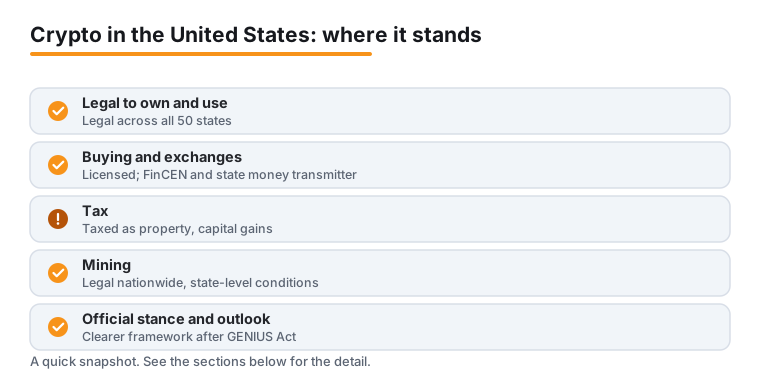
Yes. Buying, holding, selling, transferring and mining cryptocurrency is legal across all 50 states and US territories. Bitcoin is not legal tender, as the US dollar remains the only legal tender, but there is no federal ban on owning or using crypto, and a large share of American adults hold digital assets.
What is regulated is the activity around crypto rather than ownership itself. Businesses that exchange, transmit or custody digital assets for customers must register and obtain licenses, and individuals carry tax and reporting obligations. The federal government is now itself a Bitcoin holder: Executive Order 14233 of March 2025 directed the Treasury to account for federal crypto holdings and establish a Strategic Bitcoin Reserve and a US Digital Asset Stockpile, capitalized largely from assets seized through criminal and civil forfeiture.
Rules differ meaningfully from state to state. Some states actively court crypto businesses with favorable licensing and tax treatment, while others impose stricter licensing or limits on particular activities. So while crypto is legal everywhere in the country, the practical experience of using crypto or operating a crypto business depends heavily on where you are.
Who regulates crypto in the United States?
There is no single national crypto regulator. Instead, oversight is divided among federal agencies based on what a token or service does, layered on top of state regulators. The principal federal bodies are:
- Securities and Exchange Commission (SEC): oversees crypto assets and arrangements that function as securities, including many token offerings and investment products such as spot Bitcoin exchange-traded products. Official site: sec.gov.
- Commodity Futures Trading Commission (CFTC): treats Bitcoin and many other tokens as commodities and oversees crypto derivatives markets. Official site: cftc.gov.
- Financial Crimes Enforcement Network (FinCEN): administers the Bank Secrecy Act. Exchanges, custodial wallet providers, crypto kiosk (ATM) operators and similar businesses are treated as money services businesses and must register and run anti-money-laundering programs. Official site: fincen.gov.
- Internal Revenue Service (IRS): sets and enforces the tax treatment of digital assets, which it treats as property.
- Federal banking regulators (OCC, Federal Reserve, FDIC): shape how banks may custody crypto, serve crypto businesses and, under the GENIUS Act, issue stablecoins.
Because authority is split, a single crypto business can answer to several federal agencies at once, plus state regulators in every state where it operates.
Key laws and frameworks
The United States does not have one consolidated crypto code. The current framework combines longstanding securities, commodities, banking and tax law with new crypto-specific measures. The most important recent developments are:
- The GENIUS Act (2025): the Guiding and Establishing National Innovation for US Stablecoins Act was signed into law on July 18, 2025. It created the first comprehensive federal framework for payment stablecoins, defining who may issue them (subsidiaries of insured depository institutions, federally qualified nonbank issuers, or state-qualified issuers), requiring 1-to-1 reserve backing with cash or short-term Treasuries, mandating monthly reserve disclosures, and providing that permitted payment stablecoins are not treated as securities. Two 2026 deadlines mattered most. California's licensing cut-off of July 1, 2026 took effect. The GENIUS Act's rulemaking deadline of July 18, 2026 was missed, with every federal stablecoin rule still at the proposal stage, so the Act now takes effect on January 18, 2027 unless final rules are issued sooner.
- The CLARITY Act (Digital Asset Market Clarity Act, H.R. 3633): passed the House of Representatives in July 2025 and would draw clearer lines between SEC and CFTC jurisdiction over digital assets. The Senate Banking Committee approved its version of the bill on May 14, 2026 by a 15-9 vote, and on June 1, 2026 it was placed on the Senate legislative calendar, making it eligible for a full floor vote. It still has to be reconciled with a Senate Agriculture Committee version, pass the Senate, be reconciled with the House-passed text and be signed, so the overall market-structure framework is not yet final.
- SEC and CFTC joint interpretation (March 2026): on March 17, 2026 the SEC issued an interpretation, joined by the CFTC, clarifying how federal securities laws apply to crypto assets. It set out a five-part taxonomy sorting crypto assets into digital commodities, digital collectibles, digital tools, stablecoins, and digital securities, with four of the five categories treated as not securities. The interpretation named a set of tokens as examples of digital commodities, including Bitcoin, Ether, Solana and XRP, and noted the list is not exhaustive. It is a formal agency action binding on both agencies, and the two also announced a joint effort to harmonize oversight.
Because parts of this framework are still being written and litigated, treat any final characterization with caution and rely on official agency and Congressional sources for the latest status. For where laws are headed worldwide, see our crypto regulation guide.
Licensing and registration for exchanges and VASPs
Crypto exchanges and virtual asset service providers face obligations at both the federal and state levels.
At the federal level, a business that exchanges or transmits convertible virtual currency generally qualifies as a money services business and must register with FinCEN by filing FinCEN Form 107, typically within 180 days of being established. Registration brings a standing obligation to maintain a written anti-money-laundering program, conduct customer identification, monitor transactions, keep records and file suspicious activity reports.
At the state level, most crypto money-transmission businesses must also obtain a money transmitter license in each state where they operate. Requirements, fees, bonding and timelines vary widely from state to state. New York's BitLicense regime, administered by the New York Department of Financial Services, is the best known and among the strictest, while several other states are more accommodating. There is no single nationwide license, so operating across the country means securing and maintaining licenses state by state. New York's BitLicense and California's Digital Financial Assets Law, whose licensing deadline fell on July 1, 2026, are the two heaviest, and Texas Chapter 160 adds segregation and reporting duties for large providers.
How crypto is taxed in the United States
The IRS treats virtual currency as property, not currency. In practice this means:
- Selling crypto, trading one token for another, or spending it on goods and services can be a taxable event, generally producing a capital gain or loss measured against your cost basis.
- Crypto received as income, including mining rewards, many staking rewards, and payment for work, is generally taxable as income at its value when received.
- Holding period matters, as assets held longer versus shorter can be taxed at different rates, and you are responsible for tracking cost basis and reporting accurately.
Reporting is tightening. US digital-asset brokers are phasing in Form 1099-DA reporting to the IRS: gross-proceeds reporting applies to transactions effected on or after January 1, 2025 (first forms arriving in early 2026), and cost-basis reporting for covered assets begins with transactions on or after January 1, 2026 (first forms with basis arriving in early 2027). The IRS also asks every individual filer a digital-asset question on the income tax return. Specific rates, thresholds and filing details change over time and depend on your circumstances, so verify them with the IRS digital assets page or a qualified tax professional. For a plain-language primer, see our crypto taxes guide. This is not tax advice.
AML and KYC rules
Anti-money-laundering and know-your-customer obligations are central to operating a crypto business in the US, and they are administered chiefly by FinCEN under the Bank Secrecy Act.
Exchanges, custodial wallet providers and crypto kiosk operators that qualify as money services businesses must implement a written AML program. Typical elements include KYC procedures to verify customer identity, ongoing transaction monitoring, screening against sanctions lists maintained by the Treasury's Office of Foreign Assets Control, record-keeping (commonly for at least five years), and filing of suspicious activity reports and currency transaction reports where thresholds are met.
Enforcement has been active. In 2025 FinCEN issued Notice FIN-2025-NTC1 (August 4, 2025) flagging financial-crime risks tied to convertible virtual currency kiosks, and regulators and the Department of Justice have brought significant penalties against platforms for willful AML failures. For users, the practical effect is that compliant US platforms will ask you to verify your identity before you can trade or withdraw, and may request additional information for larger or unusual transactions.
Buying and using crypto in practice
Buying Bitcoin and other crypto in the US is straightforward and legal, with several mainstream routes. Whichever you choose, you will generally need to verify your identity, because compliant providers must follow KYC and AML rules.
- Centralized exchanges: the most common option. US-serving platforms let you fund an account by bank transfer, card or other methods and buy crypto. Look for a provider registered with FinCEN as a money services business and licensed in your state.
- Brokerages and crypto ETPs: if you prefer not to hold coins directly, regulated spot Bitcoin and other crypto exchange-traded products can be bought through a standard brokerage account, giving price exposure without managing wallets or keys.
- Crypto kiosks (Bitcoin ATMs): available in many retail locations for cash purchases. Operators are regulated as money transmitters and must perform identity checks; fees and spreads are often higher than on exchanges, and FinCEN has highlighted fraud risks at kiosks, so be cautious and compare costs.
- Peer-to-peer: direct trades between individuals are possible but carry higher counterparty and fraud risk; use reputable platforms with escrow and never send funds to a stranger on a promise.
Practical tips: confirm the platform's federal registration and state licensing before depositing; decide between leaving assets on a platform (convenient, but you rely on it) and self-custody (you control the keys but are solely responsible for them); enable a unique password and app-based two-factor authentication rather than SMS where possible; and keep records of every purchase, sale and transfer for tax reporting.
Bitcoin mining in the United States
Bitcoin mining is legal throughout the United States, and the country hosts one of the largest shares of global mining capacity. There is no nationwide mining ban, but the regulatory and economic conditions for miners are largely set at the state level and revolve around electricity.
Several states have built reputations as mining-friendly through abundant, comparatively cheap power and supportive policies; Texas, with its deregulated grid and demand-response programs, is a frequent example, and states such as Wyoming, Oklahoma and Kentucky are also commonly cited as favorable. Other jurisdictions are more restrictive: New York, for instance, adopted a temporary moratorium on certain fossil-fuel-powered proof-of-work mining.
Federal questions for miners center on taxes and reporting. Mining rewards are generally treated as taxable income when received, and broker-reporting rules have raised questions about how validators and miners fit in. Lawmakers have introduced various mining-related proposals, but several remain proposals rather than settled law. Anyone mining at scale should confirm local zoning, energy and tax rules and consult a professional, since the details differ sharply by location.
Recent developments (2025-2026)
The period from 2025 into 2026 was among the most consequential for US crypto policy:
- March 2025: Executive Order 14233 established the Strategic Bitcoin Reserve and the US Digital Asset Stockpile, directing the government to retain forfeited Bitcoin as a reserve asset rather than sell it.
- July 2025: the GENIUS Act was signed into law, creating the first federal framework for payment stablecoins; the House also passed the CLARITY Act market-structure bill.
- 2025-2026 tax years: Form 1099-DA broker reporting began phasing in, with gross-proceeds reporting for 2025 transactions and cost-basis reporting starting for 2026 transactions.
- March 2026: the SEC issued a formal interpretation, joined by the CFTC, establishing a five-part token taxonomy and clarifying how securities laws apply to crypto assets.
- May to June 2026: the Senate Banking Committee approved the CLARITY Act (15-9) on May 14, 2026 and the bill was placed on the Senate calendar on June 1, 2026, though it still had to pass the full Senate and be reconciled with House and Senate Agriculture versions. Regulators also worked on GENIUS Act implementing rules, including contested questions about stablecoin yield. The market-structure framework was not yet finalized at the time of writing.
Because so much remains in motion, treat any single article, including this one, as a starting point and confirm current status with official agency and Congressional sources.
Consumer risks and protection
The most pervasive risk in any crypto market is volatility: prices can move sharply and quickly. Unlike bank deposits, crypto holdings are generally not insured; there is no FDIC or SIPC protection for crypto held on an exchange or in a wallet. Some custodians carry private insurance for specific losses such as certain hacks, but coverage and exclusions vary and never extend to ordinary market losses, so assume nothing. Self-custody adds the risk of losing access if keys or recovery phrases are lost, while keeping funds on a platform adds counterparty and custody risk.
Fraud is widespread. Common schemes include fraudulent token offerings, Ponzi and guaranteed-return programs, social-media and romance scams that steer victims to fake platforms, phishing sites that mimic real companies, SIM-swap attacks that hijack a phone number to intercept verification codes, and pump-and-dump manipulation of thinly traded tokens. Federal and state authorities, including the SEC, CFTC, DOJ and FTC, pursue crypto fraud, and penalties can include heavy fines and prison. Victims can report incidents to the FBI's IC3, the FTC, the SEC or the CFTC, but recovery is often difficult. The best protection is prevention: be skeptical of guaranteed returns, verify platforms independently against regulator registries, and never share private keys or seed phrases.
Official sources and how to verify
Because US crypto rules are layered and changing, always confirm details against primary official sources rather than secondary summaries. Useful starting points include:
- SEC (sec.gov) for securities-related crypto guidance and the 2026 joint interpretation.
- CFTC (cftc.gov) for commodities and derivatives oversight.
- FinCEN (fincen.gov) for money-services-business registration and AML rules.
- IRS digital assets page (irs.gov) for tax treatment and Form 1099-DA.
- Congress.gov (GENIUS Act, S.1582) for the text and status of federal crypto legislation.
For your state, check your state financial regulator or department of financial services for money-transmitter licensing. You can also browse our country regulation hub to compare jurisdictions. This article is general information as of 2026 and is not legal, tax or financial advice; verify specifics with the named official regulators or a licensed professional before making decisions.
What changed since June 30, 2026
Three things moved between the end of June 2026 and August 3, 2026, and they all point the same way. The United States is running its crypto market on regulator interpretation rather than statute, and both of the deadlines that were meant to change that slipped.
- The CLARITY Act missed its window. Senate Majority Leader John Thune told reporters on July 23, 2026 that he did not expect the Digital Asset Market Clarity Act to reach the Senate floor before the recess beginning around August 7, while saying he would like to at least get the bill started (CoinDesk). The bill has sat on the Senate Legislative Calendar as Calendar No. 423 since June 1, 2026, with no cloture motion filed and only two Democratic senators publicly supportive against a 60-vote threshold (Disruption Banking).
- The GENIUS Act's rulemaking deadline passed with nothing final. The Act required implementing regulations by July 18, 2026, one year after enactment. As of early August 2026 the OCC, the FDIC, and FinCEN with OFAC have issued proposals, and no agency has issued a final rule. Comment periods are still running, with the FDIC proposal closing August 4 and the FinCEN customer identification proposal closing August 21, 2026 (Chapman and Cutler rulemaking tracker).
- California's licensing regime became operative. From July 1, 2026 any firm exchanging, transferring, storing or administering digital assets for California residents must hold a Department of Financial Protection and Innovation licence or have submitted an application (Global Legal Insights).
What did not change: owning, buying, selling, spending and mining crypto remain legal in all 50 states, and no bill in front of Congress would change that. What is unresolved is who supervises the market and under what statute.
The US crypto legislative pipeline as of August 3, 2026
| Measure | Stage on August 3, 2026 | What it would do | Timing |
|---|---|---|---|
| GENIUS Act, S. 1582, Public Law 119-27 | Signed July 18, 2025, not yet in force | Federal licensing, reserve and disclosure regime for payment stablecoin issuers | Effective the earlier of January 18, 2027 or 120 days after final rules. The rules deadline of July 18, 2026 was missed |
| CLARITY Act, H.R. 3633 | Passed House July 17, 2025 by 294 to 134. Senate Banking advanced it May 14, 2026 by 15 to 9. Senate Calendar No. 423 | Puts the SEC and CFTC jurisdictional split into statute and creates federal registration for digital commodity exchanges and brokers | No floor vote scheduled. Next window is the September 2026 session, then the November 3, 2026 midterms compress the calendar |
| S. 2207, Lummis digital asset tax bill | Referred to Senate Finance July 3, 2025, no committee action | $300 per transaction de minimis with a $5,000 annual cap, tax deferral on mining and staking until disposal, 30-day wash sale rule | Senator Daines said in June 2026 the Senate could release a crypto tax bill by fall 2026. Nothing scheduled |
| House Ways and Means digital asset tax drafts | Seven discussion drafts, legislative hearing held June 9, 2026 | De minimis relief, stablecoin payment treatment, mining and staking timing, wash sale rules, charitable appraisal relief | No markup scheduled. Full text not public and no bill numbers assigned |
| Anti-CBDC Surveillance State Act, H.R. 1919 | Passed House July 17, 2025 by 219 to 210 | Bars the Federal Reserve from issuing a retail central bank digital currency or holding accounts for individuals | Pending Senate action, no vote scheduled |
| BITCOIN Act of 2025, S. 954 | In Senate Banking Committee since March 2025, no action | Would direct Treasury to buy 200,000 BTC a year for five years and hold reserve coins 20 years | Stalled. Treasury has publicly opposed further purchases |
Sources: Latham and Watkins US Crypto Policy Tracker, Disruption Banking, GovTrack on H.R. 1919, Tiger Research.
Stablecoins: the one crypto statute actually on the books, and why it is not live yet
The GENIUS Act, S. 1582, was signed on July 18, 2025 as Public Law 119-27 (GovInfo). It is the only comprehensive federal crypto statute enacted to date, and it is not yet in force.
- Reserves must be backed one to one with US dollars, Treasury securities, money received under repurchase agreements or similarly liquid assets, held segregated from operational funds and not rehypothecated (Covington).
- Only three categories may issue: subsidiaries of insured depository institutions regulated by a federal banking agency, nonbank institutions supervised by the OCC, and state-chartered entities under a substantially similar state regime. Issuers with $10 billion or less in consolidated outstanding issuance may choose state supervision if the state framework is certified substantially similar.
- Non-financial services public companies are barred from issuing payment stablecoins unless unanimously approved by the Stablecoin Certification Review Committee.
- The Act takes effect on the earlier of 18 months after enactment, which is January 18, 2027, or 120 days after the primary federal stablecoin regulators issue final rules.
Implementation is behind. The OCC announced its proposed rules, a new 12 CFR part 15 covering issuance, reserve assets, redemption, risk management, audits, custody and applications, in Bulletin 2026-3 on February 25, 2026. FinCEN and OFAC jointly proposed the AML and sanctions framework on April 8, 2026, treating permitted payment stablecoin issuers as financial institutions under the Bank Secrecy Act, requiring suspicious activity reports for transactions involving or aggregating at least $5,000, records for funds transfers of $3,000 or more, and a five-element sanctions compliance program, with civil penalties up to $100,000 per day for material violations and final rules proposed to take effect 12 months after issuance (Mayer Brown). None of these is final.
Practical effect for a holder: a dollar stablecoin you buy today is not yet covered by the statutory reserve and redemption protections. Those bind when the Act goes live, most likely January 18, 2027.
What US crypto tax actually costs in 2026
The IRS treats digital assets as property, not currency, so every sale, trade or use of crypto to pay for something is a disposal that produces a capital gain or loss (IRS Digital Assets). There is no de minimis exemption for taxpayers. Buying a coffee with Bitcoin is a reportable disposal, even though brokers may report some small stablecoin and NFT sales on an aggregate basis.
- Held more than one year. Long-term capital gains rates of 0, 15 and 20 percent apply. For tax year 2026, under Revenue Procedure 2025-32, the 15 percent rate starts at $49,450 of taxable income for single filers and $98,900 for married couples filing jointly, and the 20 percent rate starts at $545,500 and $613,700 respectively (Tax Foundation).
- Held one year or less. Gains are taxed at ordinary income rates, which in 2026 run 10, 12, 22, 24, 32, 35 and 37 percent.
- Received rather than bought. Mining rewards, staking rewards and airdrops are ordinary income at fair market value when you gain dominion and control, and that amount becomes your cost basis.
Reporting is tightening. Brokers report gross proceeds on Form 1099-DA for transactions effected on or after January 1, 2025, and cost basis for certain transactions effected on or after January 1, 2026, meaning the first basis-carrying forms reach taxpayers in early 2027. Related guidance includes Revenue Procedure 2024-28 on allocating unused basis to remaining units, Notice 2025-07 on alternative identification methods, and Revenue Procedure 2025-31, a safe harbour for trusts that stake digital assets.
Two separate efforts would change this. S. 2207, introduced July 3, 2025, would exempt personal transaction gains under $300, capped at $5,000 of excluded gain a year, and defer tax on mining and staking until disposal; it has had no action in the Senate Finance Committee (Bitcoin Policy Institute). The House Ways and Means Committee circulated seven digital asset tax discussion drafts and held a legislative hearing on June 9, 2026 covering de minimis relief, stablecoin payments, mining and staking timing, wash sale rules and charitable appraisals (CoinDesk). Neither has been enacted, so the rules above are what apply for the 2026 tax year.
Licensing: federal registration plus a state layer that now has hard deadlines
There is no single federal crypto exchange licence. FinCEN classifies custodial exchanges, hosted wallet providers and kiosk operators as money services businesses, which means registration and a risk-based AML program with customer identification, suspicious activity reporting, sanctions screening and travel rule compliance. On top of that a platform needs state authorisation wherever it serves customers (Global Legal Insights).
- New York. The state continues to issue BitLicenses and charter limited-purpose trust companies, with formalised expectations on coin listing and delisting, operational resilience and incident reporting.
- California. The Digital Financial Assets Law became operative July 1, 2026. Applications opened March 9, 2026. Firms serving California residents must hold a DFPI licence or have submitted an application by that date to keep operating while it is pending, unless an exemption applies.
- Texas. Chapter 160 imposes segregation and reporting obligations on large digital asset service providers and authorises administrative penalties.
Separately, the OCC has been chartering crypto firms as national trust banks, giving custodians a federal supervisory home. Circle received final OCC approval for a national trust bank in July 2026, with other applications still pending. The charter permits custody but not deposit-taking or lending. If the CLARITY Act passes, it would create a federal registration route for digital commodity exchanges and address preemption of this state-by-state patchwork. Until then, the patchwork is the system.
Frequently asked questions
Is cryptocurrency legal in the United States?
Yes. Buying, holding, selling and mining cryptocurrency is legal in all 50 states and US territories. Crypto is not legal tender, but there is no federal ban on owning or using it. The regulated activities are exchanging, transmitting and custodying crypto for others, plus your own tax obligations. This is general information as of 2026, not legal advice.
Who regulates crypto in the US?
Oversight is shared. The SEC handles crypto that behaves like securities, the CFTC treats Bitcoin and many tokens as commodities and oversees derivatives, FinCEN enforces anti-money-laundering rules on exchanges and similar businesses, and the IRS governs taxation. Most states also license money transmitters separately, so businesses face both federal and state rules. Verify with the relevant regulator at sec.gov, cftc.gov, fincen.gov or irs.gov.
What is the GENIUS Act?
The GENIUS Act, signed into law on July 18, 2025, is the first comprehensive US federal framework for payment stablecoins. It defines who may issue them, requires 1-to-1 reserve backing with cash or short-term Treasuries plus monthly disclosures, and provides that permitted payment stablecoins are not treated as securities. Implementing regulations are being phased in through 2026.
How is Bitcoin taxed in the United States?
The IRS treats crypto as property, so selling, trading or spending it can trigger capital gains or losses, and crypto received as income is generally taxable when received. Brokers are phasing in Form 1099-DA reporting, with gross proceeds for 2025 transactions and cost basis starting with 2026 transactions. Rates and thresholds depend on your circumstances, so verify with the IRS digital assets page or a tax professional. This is not tax advice.
Do US crypto exchanges have to be licensed?
Yes. Businesses that exchange or transmit crypto generally must register with FinCEN as a money services business and maintain an anti-money-laundering program. Most must also obtain a money transmitter license in each state where they operate; New York's BitLicense is among the strictest. There is no single national license, so requirements vary by state.
Is crypto on a US exchange insured?
Generally no, not the way bank deposits are. Crypto is not covered by FDIC or SIPC insurance. Some custodians and exchanges carry private insurance for specific losses such as certain hacks, but coverage and exclusions vary and do not protect against market losses. Review each platform's actual policy and assume nothing.
Has the US passed a crypto market structure law?
Not yet as of mid-2026. The CLARITY Act, which would split oversight between the SEC and CFTC, passed the House in July 2025. The Senate Banking Committee approved its version by a 15-9 vote on May 14, 2026, and the bill was placed on the Senate calendar on June 1, 2026, but it still had to pass the full Senate and be reconciled with House and Senate Agriculture Committee versions. The stablecoin-focused GENIUS Act did become law in July 2025. Check congress.gov for current status.
Does the US government hold Bitcoin?
Yes. Executive Order 14233, signed on March 6, 2025, directed the Treasury to establish a Strategic Bitcoin Reserve and a US Digital Asset Stockpile, capitalized mainly with crypto obtained through criminal and civil forfeiture. The order said any further Bitcoin acquisition strategies must be budget neutral and impose no incremental cost on taxpayers. Confirm details on the official Federal Register and White House sources.
Has the US passed a crypto market structure law as of August 2026?
No. The Digital Asset Market Clarity Act, H.R. 3633, passed the House on July 17, 2025 by 294 to 134 and was advanced by the Senate Banking Committee on May 14, 2026 by 15 to 9. It has been on the Senate Legislative Calendar as Calendar No. 423 since June 1, 2026 but has had no floor vote and no cloture motion. Senate Majority Leader John Thune said on July 23, 2026 that he did not expect a vote before the August recess. The next realistic window is the September 2026 session.
Is the GENIUS Act in force yet?
Not yet. It was signed on July 18, 2025 as Public Law 119-27, but it takes effect on the earlier of 18 months after enactment, which is January 18, 2027, or 120 days after the primary federal stablecoin regulators issue final implementing rules. The statutory deadline for those rules was July 18, 2026 and it was missed. The agencies have issued proposals only, with some comment periods still open into late August 2026, so January 18, 2027 is currently the operative date.
What tax rate do I pay on crypto gains in the US in 2026?
If you held more than one year, 0, 15 or 20 percent. Under Revenue Procedure 2025-32 the 15 percent rate begins at $49,450 of taxable income for single filers and $98,900 for married couples filing jointly, and 20 percent begins at $545,500 and $613,700. If you held one year or less, gains are taxed at ordinary income rates of 10 to 37 percent. Mining, staking and airdrop receipts are ordinary income when you gain dominion and control over them.
Is there a tax-free allowance for small crypto purchases in the US?
No. Every disposal is reportable by the taxpayer, including paying for goods with crypto. S. 2207 would exempt personal transaction gains under $300 with a $5,000 annual cap, and the House Ways and Means Committee circulated seven digital asset tax discussion drafts for a June 9, 2026 hearing that include de minimis relief. None has been enacted, so no taxpayer allowance applies for the 2026 tax year.
Do I need to do anything different to use a crypto exchange in California from July 2026?
You do not need a licence as an individual, but the platform does. Since July 1, 2026, California's Digital Financial Assets Law requires firms exchanging, transferring, storing or administering digital assets for California residents to hold a Department of Financial Protection and Innovation licence or to have submitted an application. Some platforms may restrict service to California residents as a result.
Does the US government buy Bitcoin for its Strategic Bitcoin Reserve?
No. The reserve was created by executive order on March 6, 2025 and holds Bitcoin accumulated through criminal and civil forfeiture proceedings. No open-market purchases have been made. The BITCOIN Act of 2025, S. 954, would direct Treasury to buy 200,000 BTC a year for five years, but it has sat in the Senate Banking Committee since March 2025 with no action.
Which cryptocurrencies have US regulators said are not securities?
The joint SEC and CFTC interpretive release of March 17, 2026 names 16 assets as digital commodities: Bitcoin, Ether, Solana, Cardano, Avalanche, XRP, Dogecoin, Litecoin, Chainlink, Polkadot, Hedera, Bitcoin Cash, Shiba Inu, Stellar, Tezos and Aptos. This is interpretive guidance rather than statute, so the agencies can revise or withdraw it without Congress. Assets not on the list are not automatically securities, and platforms still have to assess each one on its facts.
Facts reviewed: 3 August 2026. Page updated: 3 August 2026.
Related guides
More countries in the region
Practical guides