Home › Crypto Regulation › United Kingdom
Bitcoin & Cryptocurrency Regulation in United Kingdom
Quick answer — United Kingdom, 2026
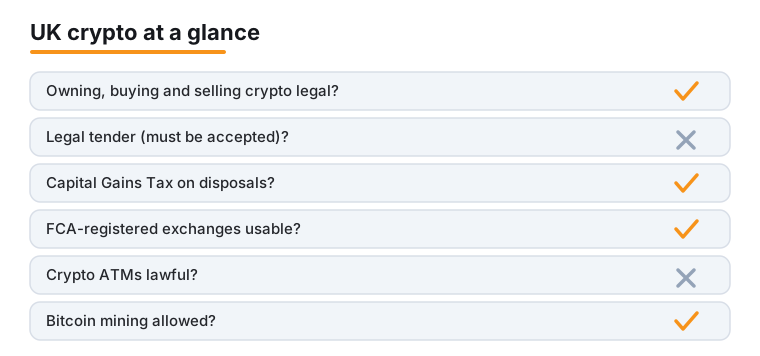
- Legal: owning, buying and selling crypto is legal in the UK, though it is not legal tender.
- Taxed: yes. Capital Gains Tax usually applies when you sell, swap or spend at a profit; Income Tax can apply to mining, staking or crypto paid as income.
- How to buy: use an FCA-registered provider, complete ID and address checks (KYC), then deposit pounds and place your order.
The United Kingdom is one of the world's largest and most active markets for Bitcoin and other cryptoassets, and it is in the middle of the biggest change to its rules since crypto first appeared. Buying, holding and selling cryptocurrency is legal in the UK, but the country is moving away from its earlier light-touch approach (focused mainly on anti-money-laundering registration and crypto advertising) toward a comprehensive financial-services regime overseen by the Financial Conduct Authority (FCA). New legislation, The Financial Services and Markets Act 2000 (Cryptoassets) Regulations 2026, was made on 4 February 2026 and sets out which crypto activities will require FCA authorisation, with the full regime due to take effect on 25 October 2027.
This page explains, in plain terms, how crypto is treated in the UK as of 2026: its legal status, the regulators involved, the key laws and frameworks, how exchanges are registered and authorised, how tax works, the AML and KYC rules, what buying and using crypto looks like in practice, the position on mining, recent developments, consumer risks, and how to verify everything with official sources. This is general information as of 2026 and is NOT legal, tax or financial advice; because UK crypto rules are changing quickly, always confirm the current position with the FCA and the other official bodies named below before acting. For background, see our overview of crypto regulation.
On this page: Legal status · Who regulates it · Taxes · How to buy · Mining
Legal status of Bitcoin and crypto in the United Kingdom
Owning, buying, selling and transferring Bitcoin and other cryptoassets is legal in the United Kingdom. There is no law banning individuals from holding crypto, and millions of UK residents own digital assets. Two distinctions matter, however:
- Crypto is not legal tender. Bitcoin and other cryptoassets are treated as property or assets rather than as official money. Businesses are not required to accept them, and the only legal tender in the UK is the pound sterling.
- Legal to hold is not the same as fully regulated. Historically most crypto activity sat outside the main financial-services rulebook. The long-standing exceptions are anti-money-laundering (AML) registration for crypto firms and the rules on how crypto is marketed to consumers. That is now changing as the UK builds a full regime under the 2026 Cryptoassets Regulations (see below).
In short, you can legally use crypto in the UK, but the firms you use face a growing set of legal obligations, and the consumer-protection rules around how crypto is promoted are already in force.
The regulators: who oversees crypto in the UK
There is no single "crypto regulator" in the UK; responsibility is shared between several bodies:
- Financial Conduct Authority (FCA) is the lead conduct regulator. It runs the AML registration regime for cryptoasset businesses, enforces the financial-promotions rules, and is building and will supervise the wider regime that takes effect in 2027.
- HM Treasury (HMT) sets government policy and writes the underlying legislation that defines which crypto activities are regulated.
- Bank of England (BoE) focuses on financial stability, payment systems, systemic stablecoins, and the digital pound project.
- HM Revenue & Customs (HMRC) sets and collects tax on cryptoassets.
The FCA is the body most UK consumers and firms deal with directly. You can confirm a firm's status and read the official rules on the FCA's dedicated pages: FCA: a new regime for cryptoasset regulation.
Key laws and frameworks
The UK does not have a single "crypto law." Several rules apply, and a broad new framework is being phased in:
- Money Laundering Regulations 2017 (MLRs): Since 10 January 2020 (and amended over time), cryptoasset exchange providers and custodian wallet providers operating in the UK must register with the FCA and meet AML and know-your-customer (KYC) obligations. Operating these activities without registration is a criminal offence.
- Financial promotions regime: From 8 October 2023, "qualifying cryptoassets" fall within the UK financial-promotions regime under the Financial Services and Markets Act 2000 (FSMA). Crypto marketing must be fair, clear and not misleading, carry risk warnings, and be communicated or approved through one of four permitted routes. Breaching section 21 FSMA is a criminal offence.
- The Financial Services and Markets Act 2000 (Cryptoassets) Regulations 2026: Made on 4 February 2026, this statutory instrument brings a range of crypto activities into the scope of formal regulation, including operating a cryptoasset trading platform, dealing as principal or agent, arranging deals, safeguarding (custody), arranging staking, and issuing qualifying stablecoins. Firms carrying on these regulated activities will need FCA authorisation. The regime is due to come into force on 25 October 2027.
On 21 April 2026 HM Treasury published a draft amending statutory instrument that would take UK qualifying stablecoins out of the dealing and arranging activities while keeping lending and borrowing in scope. Written feedback closed on 22 May 2026 and no final instrument had appeared on legislation.gov.uk by early August 2026. The FCA's core rules are no longer in consultation: it published five final policy statements, PS26/9 to PS26/13, on 30 June 2026. The government's policy material is published on GOV.UK.
Licensing and registration of exchanges and VASPs
The requirements come in two layers, and the second is being introduced now:
1. AML registration (current)
Under the MLRs, all cryptoasset exchange providers and custodian wallet providers serving the UK must register with the FCA as a cryptoasset business and demonstrate adequate AML and KYC procedures. This is a registration, not a full authorisation. The FCA applies a high bar and has rejected the large majority of applications it has received. Operating an unregistered crypto business is a criminal offence.
2. FCA authorisation (incoming)
Under the 2026 Cryptoassets Regulations, firms carrying on regulated crypto activities in or to the UK will need full FCA authorisation. On 30 June 2026 the FCA published its final rules in five policy statements: PS26/9 on admissions and disclosures and the market abuse regime for cryptoassets, PS26/10 on stablecoin issuance, PS26/11 on regulated cryptoasset activities, PS26/12 on the prudential regime and PS26/13 on how the wider FCA Handbook applies. PS26/11 includes safeguarding requirements set out in CASS 17 for cryptoasset custodians, and the package is accompanied by FG26/5, guidance on applying the Consumer Duty to cryptoasset firms. The application window for firms seeking cryptoasset permissions runs from 30 September 2026 to 28 February 2027, ahead of the regime taking effect on 25 October 2027. Because the exact application dates and detailed conditions are set and updated by the FCA, check the regulator's website for the current timetable: FCA: cryptoassets, who needs to register.
For users, the practical rule is simple: prefer FCA-registered (and, in due course, FCA-authorised) providers, and check the firm's status on the FCA register before depositing funds.
Crypto and Bitcoin taxation in the UK
This is general information, not tax advice. Rates, allowances and rules change; always check the current guidance on GOV.UK or speak to a qualified tax adviser.
HMRC does not treat cryptoassets as currency for tax purposes. The tax depends on how you acquire and use them:
- Capital Gains Tax (CGT): Most individuals who sell, swap or spend crypto are subject to CGT on any gain. Selling crypto for pounds, trading one token for another, and using crypto to pay for goods can all be disposals that may trigger a gain or loss. There is an annual tax-free allowance (the annual exempt amount), which has been cut sharply in recent years to £3,000 for the 2026 to 2027 tax year, down from £12,300 in 2022 to 2023. Gains above the allowance are taxed at 18 percent within the basic-rate band and 24 percent in the higher and additional-rate bands for 2026 to 2027. The UK tax year runs from 6 April to 5 April. Rates and allowances change, so confirm the current figures with HMRC.
- Income Tax: Crypto received as payment for work, or from activities such as mining, staking or certain airdrops, is generally treated as income and may be subject to Income Tax and National Insurance, valued at the time received. Frequent, organised trading can also be treated as a trade taxed as income.
- Record-keeping: You must keep records of dates, pound values, fees and counterparties for every transaction. HMRC's share-pooling rules affect how cost is calculated.
New reporting framework (CARF)
The UK has adopted the OECD's Cryptoasset Reporting Framework (CARF). From 1 January 2026, UK cryptoasset service providers must collect standardised data on their users and transactions, with the first reports to HMRC due in 2027 and automatic international exchange of that information following. In practice, HMRC will receive far more visibility over crypto activity, so accurate self-reporting matters. UK Self Assessment returns include a dedicated section for declaring crypto gains and income. For the official rules, see GOV.UK: CARF domestic reporting and our general guide to crypto taxes.
AML and KYC rules
Anti-money-laundering and know-your-customer rules are the most established part of the UK's crypto framework:
- Registration: Crypto exchange and custodian wallet businesses must register with the FCA under the MLRs and maintain effective AML controls; operating without registration is a criminal offence.
- Customer due diligence: Registered firms must verify customer identity (ID documents, proof of address) and, where relevant, ask about source of funds. Expect KYC checks before you can trade or withdraw.
- Transaction monitoring and the Travel Rule: Firms must monitor for suspicious activity, report it, and comply with the cryptoasset "travel rule" requiring identifying information to accompany certain transfers.
- Tax data sharing (CARF): The Reporting Cryptoasset Service Providers (Due Diligence and Reporting Requirements) Regulations 2025 (SI 2025/744) came into force on 1 January 2026, separately from AML obligations. You must give every provider you use your full name, date of birth, the address and country where you normally live, and your tax identification number, which for a UK resident is a National Insurance number or Unique Taxpayer Reference. HMRC says you could get a penalty of up to £300 if you give inaccurate information or none at all to a UK service provider.
For individuals, the takeaway is that compliant platforms will always require identity verification, and any service that lets you trade large sums with no checks is a warning sign that it may be operating unlawfully.
Buying and using crypto in practice
Buying Bitcoin and other cryptoassets is legal and straightforward in the UK, and major global and domestic exchanges serve UK customers. A typical, compliant route looks like this:
- Choose an FCA-registered provider. Check the firm's status on the FCA register and prefer established platforms with strong security records. The FCA publishes lists of registered firms and warns about unregistered ones.
- Create and verify your account. Complete KYC by providing ID and proof of address. As a new retail customer you will typically see prominent risk warnings, complete an appropriateness assessment, and face a cooling-off period before your first purchase, all consequences of the financial-promotions rules.
- Fund your account. Deposit pounds by bank transfer or card. Some UK banks limit, delay or block payments to crypto platforms as a fraud-prevention measure; this is a commercial decision by the bank, not a legal ban on buying crypto.
- Place your order and secure your holdings. Review fees and the price spread before confirming, enable two-factor authentication, and for larger or long-term holdings consider a private wallet where you control the keys.
- Keep records. Save transaction details and pound values for tax reporting.
Avoid unregistered platforms and crypto ATMs (see below), and be sceptical of anyone promising guaranteed profits or pressuring you to act quickly. Note that crypto ATMs are a special case: there are no FCA-registered crypto ATM operators in the UK, so any crypto ATM you encounter is operating unlawfully, the FCA has seized machines and secured the UK's first criminal conviction of an unregistered operator.
Bitcoin mining in the UK
Bitcoin mining is legal in the United Kingdom. There is no specific law that bans or licenses crypto mining as an activity, but general rules apply:
- Tax: Mining rewards are generally taxable. HMRC typically treats mined coins as income at their value when received; if you later sell them, CGT may apply to any further gain. Mining run as a business has its own tax treatment and record-keeping requirements.
- Energy and cost: The UK has relatively high electricity prices, which makes large-scale mining less economical than in some other countries. There are no special crypto-mining electricity tariffs; you pay standard energy rates.
- Planning, environment and safety: Larger operations may need to consider planning permission, grid-connection rules, noise, and electrical and fire-safety standards, as with any energy-intensive equipment.
There is no dedicated crypto-specific "green mining" tax incentive, so treat any such claim with caution and verify it. If you mine at scale, get professional tax and regulatory advice.
Recent developments (2025-2026)
The UK is moving quickly from a light-touch approach toward a comprehensive regime:
- The 2026 Cryptoassets Regulations: Made on 4 February 2026, this statutory instrument brings exchanges, dealing, arranging, custody, staking arrangements and qualifying-stablecoin issuance within FCA regulation, with the regime due to commence on 25 October 2027.
- FCA final rulebook: On 30 June 2026 the FCA published its final rules and guidance for the new regime, setting standards for governance, consumer protection, custody, market integrity and operational resilience. The authorisation application window opens on 30 September 2026 and closes on 28 February 2027.
- Stablecoins: On 22 June 2026 the Bank of England published its policy statement and draft Code of Practice for sterling denominated systemic stablecoins. It did not introduce the per coinholder holding limits it consulted on in November 2025, applying a temporary issuance guardrail to each systemic stablecoin instead, initially set at £40 billion, and it raised the maximum share of backing held in short term UK government debt from 60 percent to 70 percent, with the remainder in central bank deposits. Feedback closes 22 September 2026 and the Bank intends to finalise the Code by the end of 2026. HM Treasury decides whether to recognise a payment system as systemic under the Banking Act 2009, and the Bank says its regime will not cover stablecoins used for buying and selling cryptoassets, which will be supervised solely by the FCA.
- Tax transparency (CARF): Reporting obligations on UK cryptoasset service providers began on 1 January 2026, with first reports to HMRC due in 2027.
- Enforcement: The FCA has continued to crack down on unregistered crypto ATMs and illegal financial promotions, including the UK's first crypto-ATM conviction (a four-year sentence handed down in 2025).
- Digital pound: The Bank of England and HM Treasury are running the design phase of a potential digital pound (a central bank digital currency). The Bank published an update on the design phase in October 2025 and says the findings will support a joint assessment by the Bank and HM Treasury ahead of a decision on next steps in 2026. It has not published a firmer date. Parliament would also have a say before any digital pound is launched, and further public consultation would follow. It is not live, the earliest any issuance would occur is the second half of the decade, and it is intended to complement rather than replace cash.
Consumer risks and protection
Nothing here is financial advice or a recommendation. Crypto is high-risk and you could lose all the money you invest.
The FCA's consistent message is that cryptoassets are high-risk and largely speculative, and that consumers should be prepared to lose everything they put in. Key points for UK users:
- No compensation safety net: Crypto is generally not covered by the Financial Services Compensation Scheme or the Financial Ombudsman Service the way some traditional products can be, so if a platform fails or you are defrauded, you may have no recourse.
- Volatility: Prices can swing sharply over short periods.
- Scams and unregistered operators: Avoid services that are not FCA-registered, crypto ATMs, and anyone promising guaranteed returns or rushing you. Check the FCA Warning List.
- Irreversible transactions: Crypto transfers cannot be reversed, so verify wallet addresses carefully.
- Tax exposure: Gains are usually taxable and reporting is tightening under CARF; keep good records.
The sensible posture is to use FCA-registered providers, never invest more than you can afford to lose, keep records, and verify the current rules with official sources before acting.
Official sources and how to verify
UK crypto rules are evolving, so always confirm the current position with the responsible bodies rather than relying on third-party summaries. The primary official sources are:
- Financial Conduct Authority (FCA) for the regulatory regime, AML registration, financial promotions and the firm register: FCA new cryptoasset regime and FCA cryptoassets AML/CTF regime.
- GOV.UK / HM Treasury for legislation and policy, including the 2026 Cryptoassets Regulations: GOV.UK cryptoasset regulations policy note.
- HMRC for tax treatment and the Cryptoasset Reporting Framework: GOV.UK CARF guidance.
- Bank of England for stablecoins and the digital pound: Bank of England digital pound.
To verify a specific firm, search the FCA register and the FCA Warning List before depositing funds. For related reading on wikicrypto, see our hub on crypto regulation by country and our overview of how crypto regulation works. This page is general information as of 2026 and is not legal, tax or financial advice; verify the current rules with the FCA and the other official bodies named above before acting.
Where UK crypto rules stand in August 2026
The legal position has not changed. Owning, buying and selling cryptoassets is legal in the UK, and the mandatory FCA regime created by the Financial Services and Markets Act 2000 (Cryptoassets) Regulations 2026, SI 2026/102, still comes into force on 25 October 2027. What moved since the end of June 2026 is the detail.
- On 22 June 2026 the Bank of England published its policy statement and draft Code of Practice for sterling denominated systemic stablecoins. It did not introduce the per coinholder holding limits it consulted on in November 2025, and applied a temporary issuance guardrail to each systemic stablecoin instead, initially set at £40 billion. Backing assets can now be up to 70 percent short term UK government debt, raised from 60 percent, with the remainder in central bank deposits. Feedback closes 22 September 2026 and the Bank intends to finalise the Code by the end of 2026.
- On 30 June 2026 the FCA published five final policy statements, PS26/9 to PS26/13, covering admissions and disclosures and market abuse, stablecoin issuance, regulated cryptoasset activities, the prudential regime and application of the FCA Handbook.
- On 13 July 2026 HMRC published draft Finance Bill 2026-27 legislation on the tax treatment of stablecoins and on cryptoasset loans and liquidity pools. Both are draft and take effect in April 2027 at the earliest. The technical consultation closes 7 September 2026.
- Still open as this page was updated: FCA consultation CP26/19, which would extend the FCA penalty framework to cryptoasset market abuse. It closes 10 August 2026.
- Still not made: the draft amending statutory instrument HM Treasury published on 21 April 2026 to take UK qualifying stablecoins out of the dealing and arranging activities. Written feedback closed on 22 May 2026 and no final instrument had appeared on legislation.gov.uk by early August 2026.
UK crypto legislation: adopted, drafted and in consultation
| Measure | Stage | What it does | Timing |
|---|---|---|---|
| FSMA 2000 (Cryptoassets) Regulations 2026, SI 2026/102 | Made, not yet fully in force | Makes trading platforms, dealing as principal and agent, arranging, safeguarding, staking and qualifying stablecoin issuance regulated activities needing FCA authorisation, and creates a cryptoasset market abuse regime | Made 4 February 2026, full commencement day 25 October 2027 |
| FCA policy statements PS26/9 to PS26/13 | Final rules published | The rulebook: admissions and disclosures and market abuse, stablecoin issuance, regulated activities including CASS 17 safeguarding for custodians, the prudential regime, and Handbook application with Consumer Duty guidance FG26/5 | Published 30 June 2026, applies with the regime |
| Money Laundering and Terrorist Financing (Amendment) Regulations 2026, SI 2026/621 | In force | Adds enhanced customer due diligence for cryptoasset exchange providers, custodian wallet providers and correspondent relationships, and applies the FSMA Part 12 control test to registered cryptoasset businesses | Made 9 June 2026, main provisions 21 days later, correspondent due diligence from 1 February 2027, control provisions in full from 25 October 2027 |
| Reporting Cryptoasset Service Providers (Due Diligence and Reporting Requirements) Regulations 2025, SI 2025/744 | In force | Implements the OECD Cryptoasset Reporting Framework, with due diligence, self certification, registration, reporting and penalties | In force 1 January 2026, first reports in 2027 |
| Individual Savings Account (Amendment) Regulations 2026, SI 2026/248 | In force | Stops UK crypto exchange traded notes being held in a stocks and shares account unless already held immediately before 6 April 2026, and allows them in an innovative finance account | Made 9 March 2026, in force 6 April 2026 |
| Property (Digital Assets etc) Act 2025, c. 29 | In force | Confirms a digital thing is not prevented from being the object of personal property rights merely because it is neither a thing in possession nor a thing in action | Royal Assent 2 December 2025, in force the same day |
| Bank of England draft Code of Practice, systemic stablecoins | Consultation | Backing at up to 70 percent short term UK government debt, remainder in central bank deposits, and a temporary issuance guardrail per systemic coin set initially at £40 billion in place of holding limits | Published 22 June 2026, feedback by 22 September 2026, Code to be finalised by end of 2026 |
| Draft FSMA 2000 (Cryptoassets) (Amendment) Regulations 2026 | Draft, feedback closed | Would take UK qualifying stablecoins out of the dealing and arranging activities, keeping lending and borrowing in scope | Published 21 April 2026, feedback closed 22 May 2026, not yet made |
| Tax treatment of stablecoins, draft Finance Bill 2026-27 | Draft legislation | Would exempt disposals of eligible stablecoins from Capital Gains Tax for individuals and trustees and tax interest like returns as savings income | Announced 13 July 2026, effect from 6 April 2027 for individuals and trustees and 1 April 2027 for companies |
| Cryptoasset loans and liquidity pools, draft Finance Bill 2026-27 | Draft legislation | Would treat disposals involving cryptoasset loans and liquidity pools as no gain, no loss and disregard collateral provision for Capital Gains Tax | Published 13 July 2026, effect from 6 April 2027 |
| FCA CP26/19 | Consultation | Would extend the FCA penalty framework to cryptoasset market abuse and raise the minimum penalty for individuals in the most serious market abuse cases from £100,000 to £150,000 | Published 15 June 2026, closes 10 August 2026 |
Crypto ETNs, ISAs and pensions: the regulated route retail investors can use now
Alongside buying tokens on an exchange, UK retail investors have had a second, regulated route since 8 October 2025. On that date the FCA opened retail access to crypto exchange traded notes (cETNs).
- A cETN available to retail must be traded on an FCA approved, UK based investment exchange, known as a Recognised Investment Exchange.
- Financial promotion rules apply, and the FCA states the Consumer Duty applies to firms offering these products to retail investors.
- There is no Financial Services Compensation Scheme protection for these products. They are high risk and you can lose the money you put in.
- The FCA ban on retail access to cryptoasset derivatives remains in place. Retail access was reopened for cETNs only.
The tax wrapper position changed on 6 April 2026. Under the Individual Savings Account (Amendment) Regulations 2026 (SI 2026/248), made on 9 March 2026, a UK cryptoasset exchange traded note cannot be held under a stocks and shares account unless it was already held there immediately before 6 April 2026, and they are instead allowed under an innovative finance account. HMRC's policy paper states that ISA managers wanting to offer cETNs within an innovative finance ISA need HMRC approval to offer that ISA, and that the government will keep the position under review with a view to including cETNs in the stocks and shares ISA at a later date as the market matures. The same paper states the government is allowing cETNs to be held within registered pension schemes from 8 October 2025. See the policy on the tax treatment of cryptoasset exchange traded notes.
Crypto tax changes already drafted for April 2027
Nothing changes for the 2026 to 2027 tax year. Two measures published on 13 July 2026 as part of the draft Finance Bill 2026-27 would change how crypto is taxed from April 2027. Both are draft legislation under technical consultation until 7 September 2026, so treat them as likely direction rather than settled law.
- Stablecoins. Disposals of eligible stablecoins would be exempt from Capital Gains Tax for individuals and trustees, and interest like returns would be taxed as interest under the savings and investment income rules. For companies, eligible stablecoins would be brought into the loan relationship rules and treated as a money debt. An eligible stablecoin is defined broadly as a cryptoasset that maintains a stable value in relation to a particular fiat currency, with fiat currency or other assets held to support that stable value. The stated effect dates are 6 April 2027 for individuals and trustees and 1 April 2027 for companies. The measure followed a Call for Evidence launched on 26 March 2026 that ran until 7 May 2026.
- Cryptoasset loans and liquidity pools. Disposals involving cryptoasset loans and liquidity pools would be treated as no gain, no loss. Borrowed cryptoassets would be treated as acquired for market value consideration at the time of the borrowing, and any provision of collateral under the borrowing arrangements would be disregarded for Capital Gains Tax. The stated effect date is 6 April 2027.
Until those dates the existing position stands: swapping into and out of a stablecoin, and depositing into a lending arrangement or liquidity pool, can be a disposal for Capital Gains Tax purposes, and you must keep the records to support it.
What the FCA authorisation gateway means if you are a customer, not a firm
The FCA has set out how the authorisation gateway works. It expects the application period to open on 30 September 2026 and close on 28 February 2027, as set out in its direction, with the regime commencing on 25 October 2027. Four points affect customers directly.
- There is no automatic conversion. The FCA states that firms registered under the Money Laundering Regulations will need to secure authorisation under FSMA, and firms already authorised for other activities will need to vary their permissions.
- A firm that applies during the application period and is still awaiting a decision when the regime commences can continue to provide cryptoasset services under a saving provision in the Treasury statutory instrument until its application is finally determined, including where it has referred a refusal to the Upper Tribunal.
- A firm that applies late, after the application period closes but before the regime commences, and is not authorised in time, enters the transitional provision by operation of law. It may only act to the extent necessary to perform pre-existing contracts and cannot enter new contracts with existing or new UK customers.
- A firm that does not apply must run off its UK cryptoasset business before the regime commences. It gets neither the saving nor the transitional provision, and risks conducting unauthorised business.
The practical step for a UK holder is to ask, during 2027, whether the platform you use has applied and where its application stands, and to check the FCA register before depositing new funds. Firms can already discuss their plans with the FCA through its free Pre-Application Support Service, which has taken requests since 11 May 2026 with meetings from July 2026.
Crypto is legally property in England, Wales and Northern Ireland
The Property (Digital Assets etc) Act 2025 (2025 c. 29) received Royal Assent on 2 December 2025, and section 2(2) provides that it comes into force on the day on which it is passed. Section 1 provides that a thing, including a thing that is digital or electronic in nature, is not prevented from being the object of personal property rights merely because it is neither a thing in possession nor a thing in action. Section 2(1) provides that the Act extends to England and Wales and Northern Ireland.
In plain terms, crypto tokens can be the object of personal property rights under the law of those jurisdictions. The Act does not define which assets qualify, leaving that to the courts. It does not create any licensing regime, does not change how HMRC taxes crypto, and does not give you compensation if a platform fails.
Frequently asked questions
Is cryptocurrency legal in the UK?
Yes. Buying, holding and selling cryptoassets is legal for UK residents. Crypto is not legal tender, and businesses are not required to accept it, but there is no ban on owning it. The firms you use are increasingly regulated, and rules on how crypto is marketed have been in force since October 2023. This is general information, not legal advice; verify the current position with the FCA.
Who regulates crypto in the UK?
The Financial Conduct Authority (FCA) is the lead regulator, handling AML registration, the financial-promotions rules and the incoming authorisation regime. HM Treasury sets policy and legislation, the Bank of England covers financial stability, stablecoins and the digital pound, and HMRC handles tax. You can check firm status and the official rules on the FCA website.
Do exchanges need a licence to operate in the UK?
Currently, cryptoasset exchange and custodian wallet providers must register with the FCA under the Money Laundering Regulations and meet AML and KYC requirements; operating without registration is a criminal offence. Under The Financial Services and Markets Act 2000 (Cryptoassets) Regulations 2026 (made on 4 February 2026), firms will also need full FCA authorisation, with the regime due to commence on 25 October 2027. Check the FCA for the latest timetable.
Do I have to pay tax on crypto in the UK?
Usually, yes. HMRC generally applies Capital Gains Tax when you sell, swap or spend crypto at a profit, and Income Tax (and possibly National Insurance) on crypto received as payment or from activities like mining and staking. Rates and allowances change, and new reporting rules under the Cryptoasset Reporting Framework began on 1 January 2026, so keep records and check current guidance on GOV.UK. This is general information, not tax advice.
Are Bitcoin ATMs legal in the UK?
In practice, no. Crypto ATM operators must be FCA-registered, and the FCA has not approved any operator, so any crypto ATM in the UK is operating unlawfully. The FCA has seized machines and secured the UK's first crypto-ATM conviction, with a four-year sentence handed down in 2025. Use an FCA-registered exchange instead.
What is changing in UK crypto regulation in 2026?
The Financial Services and Markets Act 2000 (Cryptoassets) Regulations 2026 were made on 4 February 2026, bringing activities such as exchanges, dealing, arranging, custody, staking arrangements and qualifying-stablecoin issuance into formal FCA regulation, with the regime due to take effect on 25 October 2027. On 30 June 2026 the FCA published its final rules and guidance, and the authorisation application window runs from 30 September 2026 to 28 February 2027. Tax reporting under CARF began on 1 January 2026. Confirm the exact timing on the FCA and GOV.UK websites, as details are still being finalised.
How much is the crypto Capital Gains Tax allowance in the UK?
For the 2026 to 2027 tax year, the annual exempt amount is £3,000, down from £12,300 in 2022 to 2023. Gains above that allowance are taxed at 18 percent within the basic-rate band and 24 percent in the higher and additional-rate bands. You report gains above the allowance, and all crypto income, through Self Assessment, with the deadline of 31 January following the tax year end. Rates and allowances change, so check current guidance on GOV.UK. This is general information, not tax advice.
When can UK crypto firms apply for FCA authorisation?
The FCA published its final rules and guidance on 30 June 2026. Firms can apply for cryptoasset authorisation during a window that runs from 30 September 2026 to 28 February 2027, so they are ready for the mandatory regime that takes effect on 25 October 2027. Check the FCA website for the current timetable, as details can change.
Can I hold crypto in an ISA in the UK?
Not the tokens themselves. You cannot hold Bitcoin or other cryptoassets directly in an ISA. Since 8 October 2025 retail investors have been able to buy crypto exchange traded notes (cETNs) traded on an FCA approved, UK based investment exchange known as a Recognised Investment Exchange. From 6 April 2026, under the Individual Savings Account (Amendment) Regulations 2026 (SI 2026/248), a UK cryptoasset exchange traded note cannot be held under a stocks and shares account unless it was already held there immediately before 6 April 2026, and it is instead allowed under an innovative finance account. HMRC says ISA managers wanting to offer cETNs in an innovative finance ISA need HMRC approval, and that the government will keep the position under review with a view to including them in the stocks and shares ISA later as the market matures. Crypto ETNs are not covered by the Financial Services Compensation Scheme.
Will my crypto exchange still be able to serve UK customers after October 2027?
Only if it gets FCA authorisation. The FCA says a firm registered under the Money Laundering Regulations does not convert automatically and must secure FSMA authorisation. It expects the application period to run from 30 September 2026 to 28 February 2027. A firm that applies in that period and is still awaiting a decision when the regime commences on 25 October 2027 can keep providing cryptoasset services under a saving provision until its application is finally determined. A firm that applies late and is not authorised in time enters the transitional provision by operation of law, which allows it only to perform pre-existing contracts and not to enter new contracts with existing or new UK customers. A firm that never applies must run off its UK business before the regime starts. Check the FCA register before depositing funds and ask your platform where its application stands.
Is crypto legally property in the UK?
In England, Wales and Northern Ireland, yes. The Property (Digital Assets etc) Act 2025 (2025 c. 29) received Royal Assent on 2 December 2025 and came into force the same day. Section 1 says a thing, including one that is digital or electronic in nature, is not prevented from being the object of personal property rights merely because it is neither a thing in possession nor a thing in action. That matters in fraud recovery, insolvency, divorce and inheritance. It does not create any licensing regime and does not change how HMRC taxes crypto. The Act extends to England and Wales and Northern Ireland, so it does not extend to Scotland.
Is the UK going to stop taxing stablecoins?
Not yet, and only in part. Draft Finance Bill 2026-27 legislation published on 13 July 2026 would exempt disposals of eligible stablecoins from Capital Gains Tax for individuals and trustees, and tax interest like returns as interest under the savings and investment income rules. For companies, eligible stablecoins would be brought into the loan relationship rules. The stated effect dates are 6 April 2027 for individuals and trustees and 1 April 2027 for companies. It is draft legislation under technical consultation until 7 September 2026, so it is not law. For the 2026 to 2027 tax year every stablecoin disposal is still a disposal for Capital Gains Tax purposes.
Does putting crypto into a liquidity pool trigger a tax bill in the UK?
Under the current rules it can. Draft Finance Bill 2026-27 legislation published on 13 July 2026 would treat disposals involving cryptoasset loans and liquidity pools as no gain, no loss, with borrowed cryptoassets treated as acquired for market value consideration at the time of borrowing and any collateral provision disregarded for Capital Gains Tax. The stated effect date is 6 April 2027 and the technical consultation closes on 7 September 2026, so it does not apply to the 2026 to 2027 tax year. Until then, keep records of every deposit and withdrawal and check current HMRC guidance or take advice.
Is there a limit on how many stablecoins I can hold in the UK?
No. In November 2025 the Bank of England consulted on temporary holding limits per coinholder for sterling denominated systemic stablecoins. In its policy statement of 22 June 2026 it decided not to introduce them, applying instead a temporary issuance guardrail on each systemic stablecoin, initially set at £40 billion, which it says allows unrestricted use by households and businesses and will be reviewed regularly and removed once risks to credit provision have been addressed. The cap sits on the issuer, not on you. The draft Code of Practice is out for feedback until 22 September 2026 and the Bank intends to finalise it by the end of 2026.
Facts reviewed: 5 August 2026. Page updated: 5 August 2026.