Home › Crypto Regulation › Belgium
Bitcoin & Cryptocurrency Regulation in Belgium
Quick answer — Belgium, 2026
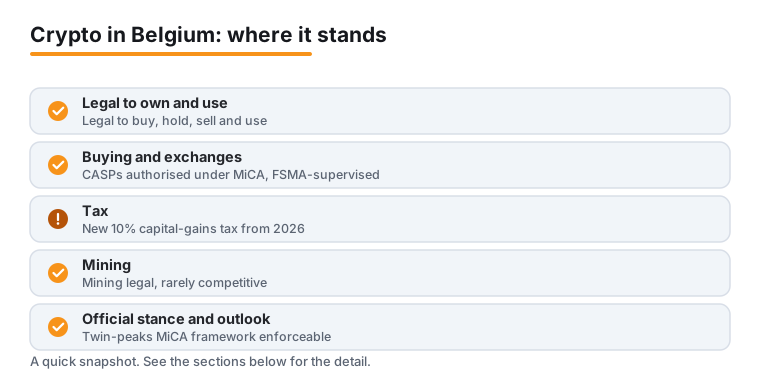
- Legal: Legal to own and use, not legal tender; providers licensed under EU MiCA
- Tax: New 10 percent capital gains tax from 2026, with annual exemption
- Buying: Via MiCA-authorised exchanges, apps or banks after KYC
Bitcoin and other cryptocurrencies are legal to buy, hold, and sell in Belgium. They are not legal tender, only the euro is, and no one is obliged to accept crypto as payment, but owning and trading digital assets is permitted and the firms that provide crypto services are now formally licensed and supervised. Oversight follows Belgium's long-standing "twin peaks" model: the Financial Services and Markets Authority (FSMA) authorises crypto-asset service providers and handles conduct, consumer protection, and market integrity, while the National Bank of Belgium (NBB) handles prudential and systemic-stability matters, including issuers of certain stablecoins. Above both sits the EU's Markets in Crypto-Assets Regulation (MiCA), which provides a single rulebook across the bloc.
This guide explains how digital assets are treated in 2026, a year of significant change. A Belgian implementing law, the Law of 11 December 2025, was published in the Official Gazette on 24 December 2025 and entered into force on 3 January 2026, turning MiCA into an enforceable national regime. Separately, a new general capital-gains tax on financial assets, explicitly including crypto, applies to gains realised from 1 January 2026 at a 10 percent rate with an annual exemption. Below we cover legal status, the regulators, the key laws, licensing of exchanges, taxation, AML and KYC, buying and using crypto in practice, mining, recent developments, consumer risks, and how to verify everything with official sources. This is general information as of 2026 and is NOT legal, tax, or financial advice; rules and figures change and individual circumstances differ, so confirm specifics with the FSMA, the NBB, and the Federal Public Service (SPF/FOD) Finance, or a qualified Belgian adviser. See also our overview of crypto regulation.
On this page: Legal status · Who regulates it · Taxes · How to buy · Mining
Is Bitcoin and crypto legal in Belgium?
Yes. Buying, holding, selling, and using Bitcoin and other cryptocurrencies is legal in Belgium. What crypto is not is legal tender or an official means of payment: the euro is the only legal tender, and no one is required to accept crypto. Merchants may choose to accept it, and individuals can trade and hold it freely, including in self-custody.
The regulated part of the market is the infrastructure around crypto. Exchanges, brokers, custodians, and similar businesses, known under MiCA as crypto-asset service providers (CASPs), must be authorised and follow anti-money-laundering (AML) rules. For ordinary users the practical takeaway is simple: using a licensed, MiCA-compliant platform is both legal and the safest way to buy and store crypto. Advertising crypto to the Belgian public is also subject to FSMA rules, so promotional offers should come from authorised firms. For background, see our explainer on how crypto is regulated.
Who regulates crypto in Belgium?
Belgium uses a "twin peaks" supervisory model, and the Law of 11 December 2025 divides crypto powers between two authorities.
- The FSMA (Financial Services and Markets Authority) authorises and supervises crypto-asset service providers and oversees conduct of business, consumer protection, advertising, and market integrity. Most CASPs are supervised by the FSMA. Its official site is the place to check licensing and warnings.
- The National Bank of Belgium (NBB) is the prudential and systemic-stability supervisor. It oversees issuers of certain stablecoins, namely asset-referenced tokens (ARTs) and e-money tokens (EMTs), and, by exception, supervises some CASPs that are already subject to its prudential oversight (for example credit institutions offering crypto services).
On tax matters, the relevant authority is the Federal Public Service Finance (SPF Finances / FOD Financien). A practical benefit of MiCA is "passporting": a CASP authorised in one EU member state can serve customers across the EU. Informational only, not legal advice; verify authorisations and the current rules with the FSMA and NBB.
Key crypto laws and frameworks in Belgium
Belgium's framework combines directly applicable EU law with national implementing legislation.
MiCA
MiCA is the EU's harmonised regulation for crypto-asset markets, covering the public offering and admission to trading of tokens, the provision of crypto-asset services by CASPs, stablecoins, and market-abuse prevention. Its rules for CASPs became directly applicable across the EU at the end of 2024.
The Law of 11 December 2025
Belgium initially lacked a national framework saying which authority supervises what and how breaches are sanctioned. That gap was filled by the Law of 11 December 2025, published in the Belgian Official Gazette on 24 December 2025 and in force from 3 January 2026. It allocates powers between the FSMA and the NBB and turns MiCA into an enforceable national regime. From 3 January 2026, services such as custody, operating a trading platform, exchange, and portfolio management may no longer be provided from Belgium without complying with this supervisory framework.
Related EU rules
The EU's revised Transfer of Funds Regulation (TFR) extends the "travel rule" to crypto transfers, and the EU Anti-Money Laundering Regulation (AMLR) tightens and harmonises AML duties. Fully decentralised protocols with no identifiable operator sit at the edge of MiCA. The European Commission opened a targeted consultation on the review of MiCA on 20 May 2026, under the mandate in Articles 140 and 142 of the regulation, which closes on 30 September 2026. Reporting on the consultation indicates it asks whether the framework should extend to areas such as decentralised finance, staking, lending and NFTs. Any change would come through the Commission report and, if warranted, a legislative proposal that follows it. Informational only, not legal advice; confirm current requirements with the FSMA and NBB.
Licensing and registration of exchanges and CASPs
Since 3 January 2026, providing crypto-asset services from Belgium requires authorisation as a CASP under the MiCA regime, with the FSMA as the principal authority. Authorised CASPs must meet both prudential rules (such as capital and governance requirements) and conduct rules (such as disclosure, custody safeguarding, and complaints handling).
Transitional regime
MiCA includes a grandfathering window. Providers that were lawfully offering crypto services under an EU member state's national law before 30 December 2024 may continue to provide the same services until 1 July 2026, or until their CASP authorisation is granted or refused, whichever comes first. After that, only authorised CASPs may operate.
What this means for users
The rule of thumb is to use a provider authorised to serve EU customers under MiCA, which brings consumer-protection, custody, and disclosure standards, and to benefit from EU passporting. You can check a firm's status and any warnings on the FSMA website before sending money to a new platform.
Crypto and Bitcoin tax in Belgium
Belgium's tax treatment of crypto changed materially in 2026, so older guides are often out of date. How a gain is taxed still depends partly on how you act as an investor, but a new general capital-gains tax now sits over the top.
The new general capital-gains tax
From 1 January 2026, capital gains realised by private individuals on financial assets, explicitly including crypto-assets, are, as a rule, taxable at a flat rate of 10 percent. There is an annual exemption of EUR 10,000 per taxpayer (indexed), and an unused portion of that first tranche can be carried forward for up to five years, up to a maximum of EUR 1,000 per year, which can raise the exempt amount to EUR 15,000. A valuation as at 31 December 2025 acts as a "step-up" so that gains accrued before 2026 are not retroactively taxed. There is no withholding at source, so taxpayers must report gains themselves. The rates and exemptions are now fixed by the Law of 6 April 2026, published in the Moniteur belge on 21 April 2026, and the collection mechanics by the Royal Decree of 18 May 2026, published on 27 May 2026 and in force since 1 June 2026. Confirm how they apply to your own position with the SPF/FOD Finance or a Belgian tax adviser.
The investor categories
- Normal private management: a prudent private investor falls under the new 10 percent capital-gains regime, with the annual exemption.
- Speculative or frequent trading: where activity goes beyond normal wealth management, active short-term trading can instead be taxed as "miscellaneous income" at a flat rate of 33 percent.
- Professional activity: if trading or mining amounts to a professional occupation, profits are taxed as professional income at progressive rates, with possible social contributions.
Reporting and records
Under the EU's DAC8 rules, crypto platforms increasingly report user data to tax authorities automatically, so assume the tax office can see activity on regulated exchanges. Keep detailed records (dates, amounts, euro values, fees, platform) for every buy, sell, swap, and reward. See our guide to crypto taxes. Informational only, not tax advice.
AML and KYC rules
Crypto-asset service providers in Belgium are subject to strict anti-money-laundering and know-your-customer obligations, drawn from both Belgian and EU law.
- Identity verification (KYC): regulated platforms must verify your identity before you can trade or withdraw, typically requiring a government ID and proof of address. This is a legal AML requirement, not an optional check.
- Customer due diligence: Belgium's Anti-Money Laundering Act of 2017 requires firms to verify clients, assess the purpose of the relationship, and understand the source of funds, with enhanced due diligence for higher-risk clients such as politically exposed persons.
- EU harmonisation: the EU Anti-Money Laundering Regulation (AMLR) is shifting KYC from a one-off onboarding check toward continuous, risk-based monitoring.
- The travel rule: under the revised Transfer of Funds Regulation, in force since 30 December 2024, CASPs must collect and transmit identifying information about the sender and recipient of crypto transfers between regulated providers.
In practice, large or unusual transactions may trigger extra checks. Using an authorised provider that complies with these rules is the norm for legal access.
Buying and using crypto in practice
People in Belgium can buy crypto through international exchanges, brokers, regulated apps, and increasingly through banks. The practical steps on a regulated platform are straightforward:
- Choose a regulated provider authorised to serve EU customers under MiCA, and compare fees, supported assets, and how it custodies funds.
- Complete KYC by verifying your identity with a government ID and usually proof of address.
- Fund your account, most cheaply by SEPA bank transfer; cards are often supported but cost more.
- Buy, placing a one-off order or setting up recurring buys to average in over time.
- Decide on custody: leave assets on the platform for convenience, or withdraw to a personal wallet (a hardware wallet for larger amounts) to control your own keys. Self-custody is legal but places all security responsibility on you; back up your recovery phrase securely and never share it.
- Keep records of dates, amounts, and euro values for tax reporting.
Using crypto to pay merchants is permitted where the merchant chooses to accept it, but no business is obliged to. Bitcoin ATMs (crypto kiosks) exist only in small numbers, are themselves regulated, require identity verification, and typically charge far higher fees than an online platform.
Banks offering crypto in Belgium
Belgian banks are starting to offer crypto directly to retail customers under the MiCA framework. In February 2026, KBC, one of the country's largest banks, became the first Belgian bank to let retail customers buy and sell Bitcoin and Ether, offered through its Bolero online investment platform.
Bank-based access tends to come with limits that differ from a dedicated exchange. The KBC offering, for example, was launched on an execution-only basis (no investment advice), and was reported as a "closed-loop" service, meaning customers buy and sell within the platform rather than withdrawing coins to an external personal wallet. Customers were also required to complete a knowledge-and-experience test before trading, in line with investor-protection rules. If self-custody or a wider range of tokens matters to you, a dedicated MiCA-authorised exchange may suit better; if you value keeping the holding inside your existing bank, a bank offer can be simpler. Compare fees, the assets supported, and whether withdrawals to a personal wallet are allowed before choosing. This is not financial advice.
Bitcoin mining in Belgium
Mining cryptocurrency is legal in Belgium, but rarely competitive at scale because of high electricity prices. Proof-of-work mining is energy-intensive, so margins are thin compared with regions that have cheaper power, and energy-heavy computing sits awkwardly with Belgium's and the EU's climate priorities. There is no outright ban.
On tax, mining rewards are generally treated as taxable income at their euro value when received, and a serious, ongoing operation can be classified as a professional activity with extra obligations and possible social contributions. Anyone mining beyond a hobby scale should take tax advice and check the grid, permitting, and energy rules that apply to any energy-intensive business.
Recent developments (2025 to 2026)
2026 is a pivotal year for crypto rules in Belgium.
- MiCA enforcement: the Law of 11 December 2025 came into force on 3 January 2026, giving Belgium a fully operational supervisory and enforcement framework and dividing powers between the FSMA and the NBB.
- Transitional window closed: grandfathering ended on 1 July 2026. In a notice of 25 June 2026 the FSMA confirmed that providers must hold a CASP authorisation as of that date, that without one they must cease offering these services in Europe, and that no CASP holds an authorisation granted by the FSMA in Belgium. Both FSMA registers carry a last verified date of 31 July 2026 and both read Nihil.
- New capital-gains tax: a general 10 percent capital-gains tax on financial assets, including crypto, applies to gains realised from 1 January 2026, with a EUR 10,000 annual exemption and a 31 December 2025 step-up valuation. The regime was finalised by the Law of 6 April 2026 and the Royal Decree of 18 May 2026. Withholding at source by Belgian banks, brokers and insurers has run since 1 June 2026, but EY's summary states that no withholding applies to crypto-assets, so crypto gains must be reported by the taxpayer.
- AML overhaul: the EU AML Regulation and the revised Transfer of Funds Regulation are tightening KYC and the travel rule across the bloc.
- Mainstream access: regulated, MiCA-compliant providers, including banks, are increasingly offering crypto buying and selling to Belgian retail customers. In February 2026, KBC became the first Belgian bank to offer direct Bitcoin and Ether trading to retail customers, through its Bolero online investment platform.
The direction of travel is toward clearer, harmonised, EU-wide rules with national enforcement on a firm footing.
Consumer risks and protection
Crypto in Belgium is now more clearly regulated, but it is not risk-free. The two biggest user risks are market volatility and fraud.
Scams to watch for
Common schemes include fake or "cloned" platforms that mimic real exchanges; investment scams promising guaranteed or unusually high returns, including Ponzi schemes and fraudulent token offerings; phishing messages and sites that capture your login or recovery phrase; and "pig butchering" or romance scams that build trust before pushing a fake investment.
How to protect yourself
Use only authorised providers, verify website addresses carefully, enable two-factor authentication, never share your seed phrase, and treat any unsolicited "opportunity" with suspicion. The FSMA publishes warnings about unauthorised firms and fraudulent platforms, and it is worth checking those lists before sending money anywhere new. Remember that prices are highly volatile and can fall substantially: a common conservative principle is to invest only money you can afford to lose. This is not financial advice.
Official sources and how to verify
Because crypto rules in Belgium are evolving, always confirm the current position with primary, official sources rather than secondary summaries. The most authoritative references are:
- FSMA - Crypto-Asset Service Provider (CASP) for licensing, the supervisory framework, and warnings about unauthorised firms.
- National Bank of Belgium for prudential and stablecoin supervision.
- SPF Finance / FOD Financien for tax rules, including the 2026 capital-gains regime.
- ESMA - Markets in Crypto-Assets Regulation (MiCA) for the EU-wide framework.
For broader context, see our regulation hub. This page is general information as of 2026 and is NOT legal, tax, or financial advice; verify your situation with the named official regulators or a qualified Belgian professional before acting.
What is changing: Belgium in August 2026
Two things have moved since this page's facts were reviewed on 30 June 2026.
The first is the end of the MiCA transition. The grandfathering window closed on 1 July 2026. In a notice published on 25 June 2026, the FSMA stated that crypto-asset service providers must, as of 1 July 2026, hold an authorisation as a CASP, and that without one they must cease offering these services in Europe. The same notice records that no CASP holds an authorisation granted by the FSMA in Belgium.
That is still true. The FSMA maintains two public registers, one of authorised Belgian crypto-asset service providers and one of Belgian providers that have notified an intention to provide crypto-asset services under Article 60 of Regulation (EU) 2023/1114. Both carry a last verified date of 31 July 2026 and both contain a single word: Nihil. Belgium has a complete supervisory framework, two designated regulators, a closed transition window and no authorised providers under it.
The second change is fiscal. The 10 percent capital gains tax stopped being a coalition plan and became a numbered law with an implementing decree, set out in the tax section below.
Why no provider is authorised in Belgium, and what that means in practice
The empty register is less dramatic than it sounds, and the FSMA explains why. Under the previous Belgian regime, the Royal Decree of 8 February 2022, exchange and custody providers had to register with the FSMA. The FSMA records that it granted no registrations under those national rules, and that before they expired no applicant had submitted a complete application demonstrating that it met the conditions for registration. There was therefore no domestic population of grandfathered firms waiting to be converted into MiCA licences.
Buying and holding crypto in Belgium remains legal and remains practical, because MiCA is a passporting regime. A provider authorised in any EU member state may serve Belgian residents across the single market without a separate Belgian licence. The FSMA does not tell consumers to look for a Belgian licence. In its warning of 6 July 2026 it advises consumers who wish to use a crypto-asset service to determine whether the company holds the requisite authorisation, and links to the ESMA register.
That warning named Aurum Foundation, Bank Bit, Bithf Pro, Dxago, Global Dynamic Trade and ZeriaFunding as firms offering crypto-asset services without the required authorisation.
Applications for authorisation are made to the FSMA by email to [email protected]. The FSMA does not publish how many applications are pending, so there is no public basis for predicting when a first Belgian authorisation will be granted.
Capital gains tax: the Law of 6 April 2026 and the Royal Decree of 18 May 2026
The general 10 percent capital gains tax on financial assets is now settled law. The Law of 6 April 2026 was published in the Moniteur belge on 21 April 2026, under numac 2026002780, and applies to gains realised from 1 January 2026, so it was published after it took effect. The Royal Decree of 18 May 2026, published on 27 May 2026, set the collection mechanics and entered into force on 1 June 2026. The federal tax administration lists crypto-monnaies among the financial assets in scope.
| Item | Position |
|---|---|
| Rate | 10 percent on realised gains |
| Annual exemption | EUR 10,000 per taxpayer, indexed |
| Carry-forward | Up to EUR 1,000 per year for five years, ceiling EUR 15,000 |
| Step-up valuation | 31 December 2025, so earlier gains are protected |
| Applies from | Gains realised on or after 1 January 2026 |
| Withholding at source | From 1 June 2026, through Belgian banks, brokers and insurers. EY states no withholding applies to crypto-assets. |
The part that matters most for crypto is what the withholding system does not reach. The Royal Decree makes withholding the default on securities accounts held with a Belgian intermediary. EY's summary of the regime states that for crypto-assets no withholding applies and taxpayers must report gains themselves. Gains realised through a foreign bank or broker are likewise outside the withholding system. The practical position for a crypto holder is therefore unchanged: the 10 percent is owed, but nobody deducts it for you and the declaration is yours to make.
Where withholding does apply, it is calculated without applying the EUR 10,000 exemption or offsetting losses at source. That is not the end of the matter. The SPF Finances states that you can recover withholding taken on exempt gains through your personal income tax return. Taxpayers can also opt out, in which case the intermediary reports the gain to the tax administration and the taxpayer declares it. For accounts with transactions between 1 June and 1 September 2026, the opt-out election is due by the deadline set by the intermediary and ultimately by 31 August 2026.
A disposal is not only a cash-out. EY's summary states that crypto gains are taxable when assets are exchanged for other tokens, for fiat, or used to acquire goods and services. RSM Belgium records that crypto-assets are in scope in the broad sense, including stablecoins, e-money tokens and NFTs, and notes that the regime is complex with significant uncertainties still to be clarified administratively.
Reporting: DAC8 and declaring foreign crypto accounts
From 1 January 2026 crypto platforms operating in the EU collect and report user data under Council Directive (EU) 2023/2226, known as DAC8, which EU countries adopted on 17 October 2023 and had to transpose by 31 December 2025.
The timing is what a Belgian holder should note. The European Commission states that the exchanges relating to the first reporting year, 2026, will take place by 30 September 2027. In practice the Belgian administration is due to hold a picture of your 2026 EU platform activity around the 2027 filing season.
Separately, Belgium requires foreign accounts to be reported both to the Central Point of Contact for accounts and financial contracts at the National Bank of Belgium and in box XIII, section A of the personal income tax return. On crypto specifically, the tax administration does not claim the point is settled. Its own guidance says that although the precise obligations may evolve, it is advisable to declare cryptocurrency accounts located abroad. Read that as a recommendation from the tax authority rather than a confirmed statutory duty, and treat it as the cautious default.
What is coming next, and roughly when
Nothing is pending in the Belgian federal parliament that would change the basic position. The live pipeline is at EU level, and both items would apply in Belgium directly.
| Item | Stage | Next date |
|---|---|---|
| MiCA review, targeted consultation by the European Commission under Articles 140 and 142 of MiCA | Consultation open since 20 May 2026 | Closes 30 September 2026, then a Commission report that may be accompanied by a legislative proposal |
| Market Integration and Supervision Package, which proposes moving direct supervision of CASPs to ESMA | Published 4 December 2025, under European Parliament scrutiny | ECON hearing held 5 May 2026, rapporteurs' draft reports published 11 June 2026, not yet adopted |
| DAC8 first exchange between member states of 2026 crypto data | Adopted and applying | By 30 September 2027 |
For a Belgian holder the honest read is that the framework is built and the next phase is refinement rather than upheaval. The MiCA review consultation is aimed at providers, issuers, supervisors, central banks and finance ministries, and is the route by which gaps around decentralised finance, staking and NFTs would be examined. The supervision package would change who issues the licence, not whether one is needed, and the tracker notes it does not affect the MiCA authorisation regime or the transitional deadline that has already passed.
Crypto advertising rules that still apply in Belgium
One Belgian rule survives MiCA and catches people out. The FSMA Regulation restricting the marketing of virtual currencies to consumers, dated 5 January 2023, has not been fully displaced. The FSMA's published position is that MiCA's advertising provisions take precedence where they apply, while its own regulation continues to apply in the areas MiCA does not cover.
Those remaining areas are broad in practice:
- Advertisements disseminated when distributing virtual currencies to consumers in Belgium by persons who do not provide crypto-asset services.
- Influencers and intermediaries who disseminate such advertisements, who the FSMA states remain subject to the Regulation.
- Advertisements offering to the public crypto-assets with no identifiable issuer, the example the FSMA gives being Bitcoin.
The practical consequence is that anyone promoting Bitcoin to Belgian consumers, including affiliates and social media promoters, is subject to Belgian advertising restrictions rather than MiCA marketing rules alone.
Frequently asked questions
Is Bitcoin legal in Belgium?
Yes. Buying, holding, selling, and using Bitcoin and other cryptocurrencies is legal in Belgium. Crypto is not legal tender like the euro and no one must accept it as payment, but it is treated as an asset you can own and trade, and the businesses that provide crypto services are licensed and supervised by the FSMA and the National Bank of Belgium under the EU's MiCA framework, made enforceable nationally by the Law of 11 December 2025.
Which authority regulates crypto in Belgium?
Two do, under Belgium's "twin peaks" model. The FSMA (Financial Services and Markets Authority) authorises and supervises most crypto-asset service providers and oversees conduct, consumer protection, and market integrity. The National Bank of Belgium handles prudential and systemic-stability matters and supervises issuers of certain stablecoins (asset-referenced and e-money tokens). Both operate under the EU-wide MiCA regulation, which the Law of 11 December 2025 implemented in Belgian law with effect from 3 January 2026.
Do I pay tax on crypto profits in Belgium?
Usually yes, and the rules changed in 2026. From 1 January 2026 a new general capital-gains tax applies to financial assets including crypto, at a flat rate of 10 percent, after an annual exemption of EUR 10,000 per taxpayer (indexed). A 31 December 2025 valuation acts as a step-up so earlier gains are not retroactively taxed, and there is no withholding, so you must report gains yourself. Speculative or professional activity can be taxed more heavily. The figures are set by the Law of 6 April 2026: 10 percent, an annual exemption of EUR 10,000 indexed, carry-forward of up to EUR 1,000 per year for five years to a ceiling of EUR 15,000, and a step-up valuation at 31 December 2025. Informational only, not tax advice.
Do crypto exchanges need a licence in Belgium?
Yes. Since 3 January 2026, providing crypto-asset services from Belgium requires authorisation as a CASP under the MiCA regime, supervised mainly by the FSMA. Providers that were already operating lawfully under a member state's national law before 30 December 2024 may continue under a transitional regime until 1 July 2026, or until their authorisation is granted or refused, whichever comes first. After that, only authorised CASPs may operate. Check a firm's status on the FSMA website.
What KYC and AML rules apply to crypto in Belgium?
Regulated platforms must verify your identity before you can trade or withdraw, typically requiring a government ID and proof of address, under Belgium's Anti-Money Laundering Act of 2017 and the EU's Anti-Money Laundering Regulation. The revised EU Transfer of Funds Regulation, in force since 30 December 2024, adds a "travel rule" requiring providers to share sender and recipient information on crypto transfers between regulated firms. Large or unusual transactions may trigger additional checks.
What is the safest way to buy Bitcoin in Belgium?
Use a provider authorised to serve EU customers under MiCA, such as a licensed exchange, broker, app, or one of the regulated banks now offering crypto. Complete the required identity verification, fund your account by SEPA transfer, and consider moving larger holdings to a personal hardware wallet. Avoid unsolicited offers and platforms you cannot verify, check the FSMA's warning lists first, and never share your wallet recovery phrase.
Can I buy crypto through my Belgian bank?
Increasingly, yes. In February 2026, KBC became the first Belgian bank to offer direct Bitcoin and Ether trading to retail customers, through its Bolero online investment platform, under the MiCA framework. Bank offers can differ from a dedicated exchange: the KBC service was launched on an execution-only basis, required a knowledge-and-experience test first, and was reported as "closed-loop", meaning you buy and sell within the platform rather than withdrawing coins to your own wallet. If self-custody or a wider choice of tokens matters to you, a dedicated MiCA-authorised exchange may fit better. Not financial advice.
What is the tax rate on speculative crypto trading in Belgium?
If your activity stays within normal private wealth management, gains realised from 1 January 2026 fall under the general capital-gains tax at a flat 10 percent, after the EUR 10,000 annual exemption. Where trading goes beyond normal management and is treated as speculative, the gains are instead taxed as "miscellaneous income" at a flat rate of 33 percent. If trading or mining amounts to a professional activity, profits are taxed as professional income at progressive rates, with possible social contributions. The line between these categories depends on the facts, so confirm your position with the SPF/FOD Finance or a Belgian tax adviser. Informational only, not tax advice.
Is any crypto exchange licensed in Belgium?
No. The FSMA register of authorised Belgian crypto-asset service providers reads Nihil, with a last verified date of 31 July 2026, and so does the register of Belgian providers that have notified an intention to provide crypto-asset services. The FSMA stated in its notice of 25 June 2026 that no CASP holds an authorisation granted by the FSMA in Belgium. This does not make crypto unavailable: MiCA is a passporting regime, so a provider authorised in another EU member state may lawfully serve Belgian residents. The FSMA points consumers to the ESMA register of authorised providers.
Why is the Belgian register empty?
Because no firm was ever registered under the previous national regime. Under the Royal Decree of 8 February 2022, exchange and custody providers had to register with the FSMA. The FSMA records that it granted no registrations under those rules, and that before they expired no applicant had submitted a complete application demonstrating that it met the required conditions. There was therefore no population of grandfathered Belgian firms to convert into MiCA licences when the transitional period closed on 1 July 2026.
Will 10 percent be deducted automatically when I sell crypto?
Not by a crypto exchange. The withholding introduced by the Royal Decree of 18 May 2026, running from 1 June 2026, operates through Belgian banks, brokers and insurers. EY's summary of the regime states that no withholding applies to crypto-assets and that taxpayers must report those gains themselves. Gains realised through a foreign bank or broker are also outside the withholding system. The 10 percent is still owed on gains above the annual exemption; the difference is that nobody deducts it for you, so the declaration is yours to make.
Do I have to declare my Binance or Kraken account in Belgium?
Belgium requires foreign accounts to be reported both to the Central Point of Contact for accounts and financial contracts at the National Bank of Belgium and in box XIII, section A of the personal income tax return. On crypto specifically the tax administration stops short of a firm rule: its guidance says that although the precise obligations may evolve, it is advisable to declare cryptocurrency accounts located abroad. Declaring is the cautious default, particularly since DAC8 data on 2026 activity is exchanged between tax authorities by 30 September 2027.
When will the Belgian tax office see my exchange data?
Under DAC8, Council Directive (EU) 2023/2226, crypto platforms have applied the reporting provisions since 1 January 2026. The European Commission states that the exchanges relating to the first reporting year, 2026, will take place by 30 September 2027.
Are the EU crypto rules about to change again?
Not immediately, but two processes are live. The European Commission opened a targeted consultation on the review of MiCA on 20 May 2026 under Articles 140 and 142, closing 30 September 2026; the resulting Commission report may be accompanied by a legislative proposal. Separately, the Market Integration and Supervision Package published on 4 December 2025 proposes moving direct supervision of crypto-asset service providers to ESMA. The Parliament's ECON committee held a hearing on 5 May 2026 and rapporteurs published draft reports on 11 June 2026, but it has not been adopted and does not affect the authorisation regime or the deadline that has already passed.
Can I advertise Bitcoin to Belgian consumers?
Only within Belgian restrictions. The FSMA Regulation restricting the marketing of virtual currencies to consumers, dated 5 January 2023, still applies where MiCA does not. The FSMA's published position is that MiCA's advertising provisions take precedence where they apply, while its own regulation continues to apply to advertisements disseminated by persons who do not provide crypto-asset services, including influencers and intermediaries, and to advertisements offering to the public crypto-assets with no identifiable issuer, the example the FSMA gives being Bitcoin.
Facts reviewed: 6 August 2026. Page updated: 6 August 2026.