Home › Crypto Regulation › Ireland
Bitcoin & Cryptocurrency Regulation in Ireland
Quick answer — Ireland, 2026
- Legal: Legal to own and use, not legal tender; providers need CASP authorisation
- Tax: Disposals face 33% capital gains tax after annual exemption; income taxed separately
- Buying: Via EU-authorised exchanges and apps, funded by SEPA or card, after KYC
Ireland regulates crypto-assets primarily through European Union law. Since the EU's Markets in Crypto-Assets Regulation (MiCA / MiCAR) took effect, the rules governing how crypto businesses operate in Ireland are set at EU level and supervised domestically by the Central Bank of Ireland, which is the designated national competent authority. For individuals, owning, buying and using Bitcoin and other crypto-assets remains legal, while tax is administered by Revenue under existing capital gains, income and corporation tax rules. This guide explains where Ireland stands in 2026: legal status, the regulator, the key laws, licensing for exchanges, taxation, anti-money-laundering rules, practical use, mining, recent developments, consumer risks, and how to verify everything with official sources.
This is general information current as of 2026 and is not legal, tax or financial advice. Crypto rules change frequently, so always verify your obligations directly with the Central Bank of Ireland and Revenue, or a qualified professional, before acting. See our overview of crypto regulation and our country regulation guides for context.
On this page: Legal status · Who regulates it · Taxes · How to buy · Mining
Legal status of Bitcoin and crypto in Ireland
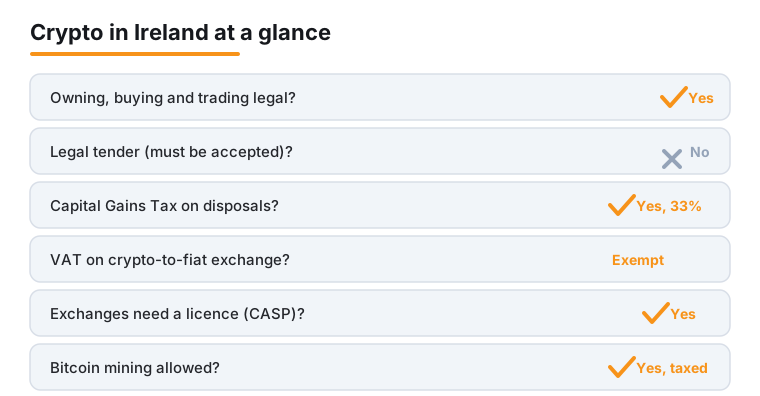
Buying, holding, selling and using Bitcoin and other crypto-assets is legal in Ireland for both individuals and businesses. There is no ban on crypto ownership or trading. Two clarifications matter:
- Crypto is not legal tender. The euro is the only legal tender in Ireland. No merchant is obliged to accept Bitcoin; acceptance is entirely at each business's discretion.
- Legal does not mean unregulated. Holding crypto requires no licence for an individual, but firms that provide crypto services to the public are now regulated and must be authorised. The era in which Irish crypto activity sat largely outside any tailored regime has ended.
In short, you can lawfully use crypto in Ireland, but within a defined consumer-protection, anti-money-laundering and tax framework rather than a legal vacuum.
The regulator: Central Bank of Ireland
The Central Bank of Ireland (CBI) is the designated national competent authority for crypto-asset regulation in the State. It authorises and supervises crypto-asset service providers, sets expectations on governance, conduct and consumer protection, and runs the authorisation process for firms wishing to serve Irish and EU customers.
The CBI also publishes consumer information warning that crypto is a high-risk, speculative asset, and it maintains the registers and guidance that firms and consumers should consult. You can verify the regulator and check current guidance on the official site: Central Bank of Ireland - Markets in Crypto Assets Regulation. Tax is administered separately by Revenue (the Office of the Revenue Commissioners).
Key laws and frameworks
Ireland's crypto rulebook is shaped by EU law, transposed and supervised at home.
Markets in Crypto-Assets Regulation (MiCA / MiCAR)
MiCA (Regulation (EU) 2023/1114) is the EU-wide regime bringing crypto-asset issuers and service providers under a single set of rules across all member states. It applied to issuers of asset-referenced tokens and e-money tokens from 30 June 2024, and to crypto-asset service providers (CASPs) from 30 December 2024. MiCA covers exchange and custody services, stablecoin issuance, market-abuse rules and disclosure (white papers) for token offerings. A firm authorised as a CASP in Ireland can passport its services across the EU and EEA without separate national licences.
Irish implementing law
MiCA was given effect in Irish law by Statutory Instrument No. 607 of 2024 (the European Union (Markets in Crypto-Assets) Regulations 2024), published in November 2024, which formally designated the Central Bank of Ireland as the competent authority for MiCAR. You can read the regulator's overview at the Central Bank's MiCAR FAQ.
Anti-money-laundering law
Before MiCA, the Criminal Justice (Money Laundering and Terrorist Financing) (Amendment) Act 2021, which came into force on 23 April 2021, first brought Virtual Asset Service Providers (VASPs) within Ireland's AML/CFT regime and required them to register with the Central Bank. This sits alongside general Irish and EU law, including GDPR for personal data and consumer-protection rules.
Licensing and registration of exchanges (VASP to CASP)
Crypto exchanges, brokers, custodians and similar providers operating from or into Ireland must be authorised. The framework moved from the older VASP registration to full MiCA CASP authorisation.
- VASP registration (legacy). Under the 2021 AML Act, firms had to register with the Central Bank as VASPs, primarily for anti-money-laundering supervision. It was, and remains, a criminal offence to carry on VASP business without registration.
- CASP authorisation (current). Under MiCA, providers must obtain CASP authorisation from the Central Bank. The CBI has stressed that a prior VASP registration does not guarantee or shortcut CASP authorisation; it is treated as a fresh application.
- Transitional period. Ireland chose a 12-month transitional window (rather than the EU maximum of 18 months) for VASPs registered before 30 December 2024 to transition to CASP status. The Central Bank's MiCAR page states that a transitional period of 12 months ending on 29 December 2025 was set in accordance with Regulation 20 of S.I. No. 607/2024, while its VASP guidance states that a VASP that did not apply for CASP authorisation, or whose application was refused, had to cease VASP operations by 30 December 2025 or when the application was refused, whichever was sooner. Either way the Irish window is closed. Since 2 April 2026 all CASP application documentation must be submitted through the Central Bank Portal.
The transitional deadlines have now all passed. Ireland's window closed at the end of December 2025, the EU-wide backstop in Article 143(3) of MiCA ran only until 1 July 2026, and the Central Bank's No Action Letter set 2 March 2026 as the date by which CASPs transacting e-money tokens needed a payment institution licence under PSD2 or a partnership with a payment service provider, stating it had no discretion to extend it. A firm serving Irish clients today needs a full CASP authorisation or a passport from another member state. Major international exchanges have used Ireland as their EU base. Firms listed on the ESMA MiCA register as authorised by the Central Bank of Ireland include Kraken's European entities (Payward), Interactive Brokers Ireland, Ramp Network, StoneX Digital International, CoinJar Europe, Confirmo and Skrill and NETELLER. The register changes as authorisations are granted and withdrawn, so check the ESMA MiCA register or the Central Bank's own register before relying on any published list. The Central Bank sets a demanding bar and has published what it expects. Applicants must employ local leadership with crypto expertise and demonstrate substance and autonomy, appoint a Head of Client Asset Oversight and assure segregation of client assets, have a board-approved business strategy that addresses product-related vulnerabilities, safeguard continuity of service including distributed ledger and blockchain systems, disclose direct and indirect shareholders in a full, transparent and corroborated manner, and demonstrate robust AML and CFT risk management. Applicants must also prepare a detailed Key Facts Document during the pre-application stage before submitting. A CASP authorised in Ireland can then passport its services across the EU and EEA.
Crypto taxation in Ireland
Crypto is taxable in Ireland. Revenue states there are no special tax rules for crypto-assets; instead existing tax principles apply, and crypto is generally treated as property rather than money.
Capital Gains Tax (CGT)
Disposals (selling crypto for euro, swapping one crypto for another, spending crypto, or gifting it) can trigger CGT on any gain. The standard CGT rate is 33%, after an annual personal exemption of the first 1,270 euro of gains. Rates and thresholds can change, so confirm current figures with Revenue before filing.
Income tax
Crypto received as employment income (subject to PAYE), from mining carried on as a trade, or from staking and similar rewards, is generally taxable as income at its euro value when received. That value typically becomes the cost basis for a later CGT calculation on disposal. Where crypto activity is treated as trading (income) rather than investing, income tax applies at the standard rate of 20% or the higher rate of 40% depending on your income band, plus USC and PRSI.
Capital Acquisitions Tax (CAT) on gifts and inheritances
Revenue notes that receiving crypto-assets as a gift or inheritance may create a Capital Acquisitions Tax liability. CAT applies at 33% on amounts above the relevant lifetime group threshold, valued at the euro equivalent at the date of the gift or inheritance. The thresholds differ by relationship (for example Group A for gifts and inheritances from a parent, and lower thresholds for other relatives and unrelated persons). Gifts and inheritances between spouses or civil partners are generally exempt. Confirm current thresholds with Revenue.
Companies and VAT
Companies dealing in or accepting crypto are generally subject to corporation tax on relevant profits. The exchange of cryptocurrencies for fiat currency is treated as exempt from VAT, consistent with EU case law.
Records and filing
Keep detailed records: acquisition and disposal dates, euro values at each point, amounts, counterparties where relevant, and fees. CGT in Ireland has two payment windows that are separate from the return deadline: tax on gains realised between 1 January and 30 November is due by 15 December of the same year, and tax on gains realised in December is due by 31 January of the following year. Late payment can attract interest and a Revenue surcharge. The gain itself is then reported in the annual return, generally due by 31 October: PAYE taxpayers typically use Form CG1, while self-assessed taxpayers use Form 11 through the Revenue Online Service (ROS) or myAccount. The detailed guidance is in Revenue's Tax and Duty Manual Part 02-01-03 on taxation of crypto-assets. See also our general guide to crypto taxes. This is an overview only and not tax advice.
AML, KYC and the Travel Rule
Crypto service providers must apply anti-money-laundering (AML) and know-your-customer (KYC) procedures: verifying customer identity, monitoring transactions, identifying ultimate beneficial owners and politically exposed persons, and reporting suspicious activity. These obligations originate in the 2021 AML Act and continue under MiCA and broader EU AML rules.
The EU's Travel Rule requires that identifying information on the originator and beneficiary accompany crypto transfers between regulated providers. For ordinary users this typically means identity verification when opening accounts and, in some cases, additional checks on larger transfers. Failure to register as a VASP historically carried criminal penalties, including fines up to 500,000 euro and potential imprisonment, underlining how seriously the regime is treated.
Buying and using crypto in practice
Residents in Ireland can buy crypto through EU-based and international exchanges, brokers and apps serving the Irish market, typically funding via SEPA bank transfer, debit or credit card. Practical points:
- Identity verification is standard. Authorised platforms require KYC documents before you can trade, withdraw or, often, deposit.
- Use authorised, reputable platforms. Favour providers transparent about regulatory status, security and fees. Confirm a provider is authorised by the Central Bank or operating under valid transitional arrangements; unregulated or anonymous services carry materially higher risk.
- Banking interaction varies. Some banks scrutinise transfers to and from crypto platforms, and crypto-focused businesses have historically found banking relationships harder to secure.
- Crypto is not legal tender, so using it to pay for goods or services depends on the merchant agreeing, and spending crypto can itself be a taxable disposal.
- Consumer protection is limited. Even under MiCA, crypto holdings are not protected like bank deposits; if a platform fails or you are defrauded, recovery may be difficult.
Bitcoin ATMs have operated in cities such as Dublin and Cork, but operators are treated as crypto-asset service providers, so expect identity verification and relatively high fees, and availability fluctuates.
Bitcoin mining in Ireland
Bitcoin mining is not illegal in Ireland, but conditions are challenging. Two factors dominate:
- Electricity costs and grid pressure. Irish electricity prices are relatively high by European standards, squeezing mining margins. The grid is also under demand pressure from large energy users such as data centres, and connection of new high-consumption operations faces scrutiny. This makes large-scale, energy-intensive proof-of-work mining commercially difficult.
- Tax and business treatment. Where mining is carried on as a trade, rewards and profits are generally taxable as income, and the operation must meet normal business, accounting and energy-use obligations. Hobbyist mining still has tax consequences on the value of coins received and on later disposal.
There is no special licence purely for mining, but miners should account for income and CGT treatment of rewards and comply with electricity-supply and planning requirements. Always confirm tax treatment with Revenue.
Recent developments (2024 to 2026)
The pace of change has been rapid:
- MiCA application: CASP rules applied across the EU from 30 December 2024.
- Irish implementation: S.I. No. 607 of 2024 designated the Central Bank as competent authority in November 2024.
- Transition close: Ireland used a 12-month transitional window for legacy VASPs, ending 30 December 2025. A VASP that did not apply for CASP authorisation, or whose application was refused, had to cease operations. During the transition, legacy VASPs did not hold passporting rights until fully authorised as a CASP.
- **EU-wide cutoff, now passed:** The grandfathering clause in Article 143(3) of MiCA allowed entities providing crypto-asset services under national law before 30 December 2024 to continue only until 1 July 2026, or until they were granted or refused a MiCA authorisation. Since that date no firm anywhere in the EU can serve clients on transitional cover.
- **Operational rollout, completed:** From 2 April 2026 all CASP application documentation must go through the Central Bank Portal. With effect from 28 July 2026 the scope of the Minimum Competency Code 2017 and the Minimum Competency Regulations 2017 incorporates knowledge and competence requirements for staff in crypto-asset service providers, under S.I. 295 of 2026, requiring six months experience and 10 CPD hours a year for staff giving information, and one year and 20 CPD hours for staff giving advice.
- **Tax reporting, live since 1 January 2026:** Ireland implemented the OECD Crypto-Asset Reporting Framework and DAC8 through section 891HA of the Taxes Consolidation Act 1997, inserted by section 92 of the Finance Act 2025, and section 891M of the TCA 1997, inserted by Regulation 2(g) of S.I. No. 584 of 2025. Reporting Crypto-Asset Service Providers have had to collect information on reportable users and their transactions since 1 January 2026. Returns for 2026 are due to Revenue by 31 May 2027, and the data is exchanged with other jurisdictions by 30 September 2027.
The next dated milestones are 31 May 2027 for the first CARF and DAC8 returns to Revenue, 10 July 2027 for the EU Anti-Money Laundering Regulation (EU) 2024/1624 to apply directly with no national transposition required, and 2028 for AMLA in Frankfurt to begin direct supervision of selected significant cross-border entities. Undated but pending are the Central Bank's feedback statement on Discussion Paper 12, and the European Commission's December 2025 proposal to move direct supervision of CASPs to ESMA, which still needs European Parliament and Council agreement.
Consumer risks and protection
The Central Bank of Ireland warns consumers that crypto behaves more like a very high-risk speculative asset than a currency, with large and rapid price swings, and recommends not spending money on crypto that you cannot afford to lose. Key risks:
- Market risk: crypto is highly volatile and can lose substantial value quickly.
- Limited safety nets: crypto assets are generally not covered by the deposit guarantee scheme, so there is no comeback if you lose money through platform failure, hacks, lost keys or scams.
- Scams and unregulated platforms: the CBI advises checking whether a provider is registered or authorised in Ireland and being cautious of unregulated services.
- **Regulatory risk:** the framework is settled for 2026, but two changes are already dated. From 31 May 2027 your platform reports your 2026 activity to Revenue, and from 10 July 2027 the EU Anti-Money Laundering Regulation prohibits anonymous crypto-asset wallets and anonymity-enhancing coins at regulated providers.
You can read the regulator's guidance directly via the Central Bank consumer hub. Use authorised providers, secure your holdings, and consider independent advice before investing.
Official sources and how to verify
Because crypto rules and tax treatment change frequently, verify anything material against primary, official sources rather than secondary articles. The most authoritative references for Ireland are:
- Central Bank of Ireland - Markets in Crypto Assets Regulation (MiCAR), including its MiCAR FAQ.
- Revenue - Cryptocurrencies and crypto-assets, plus the detailed Tax and Duty Manual Part 02-01-03.
For broader context, see our pages on crypto regulation, crypto taxes, and our wider country regulation guides. This article is general information current as of 2026 and is not legal, tax or financial advice; readers should verify their obligations with the Central Bank of Ireland and Revenue, or a qualified professional, before acting.
What changed by August 2026
The legal status of crypto in Ireland has not changed. What changed over the first half of 2026 is operational, and the most recent item took effect six days before this update.
- 28 July 2026, now in force. The Central Bank of Ireland extended the Minimum Competency Code 2017 and Minimum Competency Regulations 2017 to staff of crypto-asset service providers, through S.I. 295 of 2026. It aligns Ireland with the ESMA MiCA guidelines on knowledge and competence published in January 2026. Staff giving information on crypto-assets need at least six months relevant experience and 10 hours of continuing professional development each year. Staff giving advice need at least one year and 20 hours a year. Detail here.
- 1 July 2026, passed. The EU-wide backstop in Article 143(3) of MiCA expired. Legacy providers relying on national transitional cover anywhere in the EU had to stop serving clients. Ireland's own window had already closed at the end of December 2025.
- 2 April 2026. All documentation for a CASP application must be submitted through the Central Bank Portal. The Central Bank also hosted a CASP industry briefing on 10 March 2026, and its No Action Letter set 2 March 2026 as the date by which CASPs transacting e-money tokens needed a payment institution licence under PSD2 or a partnership with a payment service provider, a deadline it stated it had no discretion to extend.
- 24 March 2026. The revised Consumer Protection Code took effect and applies to crypto-asset service providers. An amendment published on 27 March 2026 provides that a CASP's statement of suitability includes the suitability report and periodic statement referred to in Article 81 of MiCAR.
- 1 January 2026. Crypto platforms began collecting reportable user and transaction data for Revenue under the Crypto-Asset Reporting Framework.
Tax reporting: your exchange now reports you to Revenue
This is the change most likely to affect an ordinary Irish holder, and it is already running. Ireland implemented the OECD Crypto-Asset Reporting Framework and the EU DAC8 directive through section 891HA of the Taxes Consolidation Act 1997, inserted by section 92 of the Finance Act 2025, and section 891M of the TCA 1997, inserted by Regulation 2(g) of S.I. No. 584 of 2025.
- Who reports. Reporting Crypto-Asset Service Providers, meaning firms that facilitate the purchase, sale or transfer of crypto-assets, or carry out reportable retail payment transactions.
- From when. Collection of information on reportable users and their transactions started on 1 January 2026.
- First filing. Returns covering the 2026 calendar year are due to Revenue by 31 May 2027.
- Onward exchange. The information is exchanged with other jurisdictions by 30 September 2027.
In practice this means Revenue will hold your 2026 exchange activity before you file the 2026 return. Expect authorised platforms to ask you to confirm tax residence and identification details. The primary guidance is on Revenue's CARF and DAC8 page.
Enforcement: the Central Bank has already fined a crypto firm
Ireland is no longer a jurisdiction where crypto rules exist only on paper. On 6 November 2025 the Central Bank of Ireland fined Coinbase Europe Limited 21,464,734 euro and reprimanded it for breaching anti-money-laundering and counter-terrorist-financing transaction monitoring obligations. The Central Bank stated this was its first enforcement outcome in the crypto sector.
- Period. 23 April 2021 to 19 March 2025.
- Scale. 30,442,437 transactions worth over 176 billion euro went unmonitored, around 31 per cent of the firm's transactions during the period when the faults existed.
- Result. Once the backlog was monitored, 2,708 suspicious transaction reports were filed with the Financial Intelligence Unit.
- Discount. The fine reflects a 30 per cent settlement discount applied to a sanction of 30,663,906 euro.
The full statement is on the Central Bank's press release. The practical point for users is that Irish authorisation now carries real supervisory consequences, and that authorised does not mean risk-free.
What is coming next, and when
Four things are in the pipeline. Two are certain and dated, two are proposals.
| What | Stage | When | What it means in practice |
|---|---|---|---|
| First CARF and DAC8 returns to Revenue | Law in force, first filing pending | Returns due 31 May 2027; onward exchange by 30 September 2027 | Revenue receives your 2026 crypto activity from your platform |
| Regulation (EU) 2024/1624 (AMLR) and Directive (EU) 2024/1640 | Adopted, not yet applying | Applies directly from 10 July 2027 with no national transposition required; AMLA direct supervision of selected significant cross-border entities from 2028 | Anonymous crypto-asset wallets and anonymity-enhancing coins prohibited at regulated providers, a single EU AML rulebook replaces the Irish one, and a 10,000 euro EU-wide cash limit applies |
| ESMA as direct supervisor of CASPs, under the Commission's Market Integration and Supervision Package of 4 December 2025 | Commission proposal before the European Parliament and Council | Not adopted, timing not settled. Most ESMA powers would apply 12 months after entry into force | If adopted, your Irish-authorised exchange would be supervised by ESMA rather than the Central Bank of Ireland |
| Central Bank Discussion Paper 12 on DLT and tokenisation | Submissions invited by 5 June 2026, feedback statement pending | No date stated for the feedback statement | No obligations yet. Signals future Irish supervisory guidance on tokenised funds and settlement |
Separately, the Department of Finance published Ireland's third National Risk Assessment and a 30-Point Action Plan on 22 June 2026. It identifies crypto-assets as a sector with very significant money laundering and terrorist financing risk, and targets Q2 2027 for giving AML and CFT supervisors powers of pecuniary sanction. Summary here.
Frequently asked questions
Is Bitcoin legal in Ireland?
Yes. Owning, buying, selling and using Bitcoin and other crypto-assets is legal in Ireland. However, crypto is not legal tender, so no business is required to accept it, and firms providing crypto services to the public must be authorised by the Central Bank of Ireland and follow anti-money-laundering rules.
Who regulates cryptocurrency in Ireland?
The Central Bank of Ireland is the designated national competent authority. It authorises and supervises crypto-asset service providers under the EU's Markets in Crypto-Assets Regulation (MiCA), given effect in Irish law by S.I. No. 607 of 2024. Tax matters are administered separately by Revenue.
How is crypto taxed in Ireland?
Revenue generally treats crypto as property under existing tax rules. Disposals can trigger Capital Gains Tax at a standard rate of 33% after an annual exemption of the first 1,270 euro of gains. Crypto received as income, mining or staking rewards is generally subject to income tax at its euro value when received. Verify current rates, exemptions and deadlines with Revenue, as this is not tax advice.
Do crypto exchanges need a licence in Ireland?
Yes. Under MiCA, crypto-asset service providers must obtain CASP authorisation from the Central Bank of Ireland. This replaced the older VASP registration regime. A prior VASP registration does not guarantee or shortcut CASP authorisation, which is treated as a fresh application. Check a provider's current status with the Central Bank.
Do I have to verify my identity to buy crypto in Ireland?
Yes, on compliant platforms. Authorised exchanges, brokers and Bitcoin ATMs apply know-your-customer checks and must follow the EU Travel Rule for transfers. Expect to provide identity documents before trading or withdrawing, particularly for larger amounts.
Are crypto investments protected if a platform fails in Ireland?
Generally no. The Central Bank of Ireland warns that crypto is a high-risk, speculative asset and that holdings are not covered by the deposit guarantee scheme. If a platform fails, is hacked, or you are defrauded, recovery may be difficult. Only invest money you can afford to lose, and use authorised providers.
When do I have to pay Capital Gains Tax on crypto in Ireland?
CGT payment is separate from filing your return. Tax on gains realised between 1 January and 30 November is due by 15 December of the same year, and tax on gains realised in December is due by 31 January of the following year. You then report the gain in your annual return, generally due by 31 October. Late payment can attract interest and a surcharge, so confirm your obligations with Revenue.
Is crypto received as a gift or inheritance taxed in Ireland?
It can be. Revenue notes that receiving crypto-assets by gift or inheritance may create a Capital Acquisitions Tax (CAT) liability, charged at 33% on value above the relevant lifetime group threshold, using the euro value at the date received. Thresholds differ by relationship, and transfers between spouses or civil partners are generally exempt. Check current thresholds with Revenue.
Did Irish crypto firms need to be authorised by the end of 2025?
Yes. Ireland used a 12-month transitional window that ended on 30 December 2025 for VASPs registered before 30 December 2024. A firm that did not apply for CASP authorisation from the Central Bank of Ireland, or whose application was refused, had to stop offering services. Across the EU, providers without CASP authorisation could no longer serve EU clients from 1 July 2026.
Has the Central Bank of Ireland ever fined a crypto company?
Yes. On 6 November 2025 the Central Bank fined Coinbase Europe Limited 21,464,734 euro and reprimanded it for failures in anti-money-laundering transaction monitoring between 23 April 2021 and 19 March 2025. More than 30 million transactions worth over 176 billion euro went unmonitored, around 31 per cent of the firm's transactions in the affected period, and 2,708 suspicious transaction reports were filed once the backlog was cleared. The Central Bank described it as its first enforcement outcome in the crypto sector.
Will my crypto exchange report me to Revenue?
Yes, if it is a Reporting Crypto-Asset Service Provider. Ireland implemented the Crypto-Asset Reporting Framework and DAC8 through section 891HA of the Taxes Consolidation Act 1997, inserted by section 92 of the Finance Act 2025, and section 891M of the TCA 1997, inserted by Regulation 2(g) of S.I. No. 584 of 2025. Platforms have been collecting reportable user and transaction data since 1 January 2026, the first returns are due to Revenue by 31 May 2027, and the data is exchanged with other jurisdictions by 30 September 2027.
What changed for crypto firms in Ireland on 28 July 2026?
The Central Bank of Ireland extended the Minimum Competency Code 2017 and the Minimum Competency Regulations 2017 to staff of crypto-asset service providers, through S.I. 295 of 2026. It aligns Ireland with the ESMA MiCA guidelines on knowledge and competence published in January 2026. Staff giving information on crypto-assets need at least six months relevant experience and 10 hours of CPD a year, and staff giving advice need at least one year and 20 hours a year.
Can a crypto platform still serve Irish customers without a MiCA licence?
No. Ireland's 12 month transitional window closed at the end of December 2025, and the grandfathering clause in Article 143(3) of MiCA allowed continued operation only until 1 July 2026. There is no longer any lawful transitional cover anywhere in the EU. A platform serving Irish residents must hold a CASP authorisation or be passporting in from another member state, and should appear on the ESMA MiCA register.
What happens to Irish crypto rules on 10 July 2027?
Regulation (EU) 2024/1624, the EU Anti-Money Laundering Regulation, applies directly from that date with no national transposition required, alongside the transposition deadline for Directive (EU) 2024/1640. It replaces much of the national AML rulebook for crypto-asset service providers, prohibits anonymous crypto-asset wallets and anonymity-enhancing coins, harmonises customer due diligence, and introduces an EU-wide 10,000 euro cash transaction limit. The Anti-Money Laundering Authority in Frankfurt begins direct supervision of selected significant cross-border entities from 2028.
Could the Central Bank of Ireland stop being the crypto regulator?
Possibly. On 4 December 2025 the European Commission published its Market Integration and Supervision Package, which proposes making ESMA the direct supervisor of crypto-asset service providers, with a full set of supervisory powers, sanctions and a central register. It is a proposal, not law, and still needs agreement from the European Parliament and the Council. Until it is adopted, the Central Bank of Ireland remains the national competent authority.
Facts reviewed: 3 August 2026. Page updated: 3 August 2026.