Home › Crypto Regulation › France
Bitcoin & Cryptocurrency Regulation in France
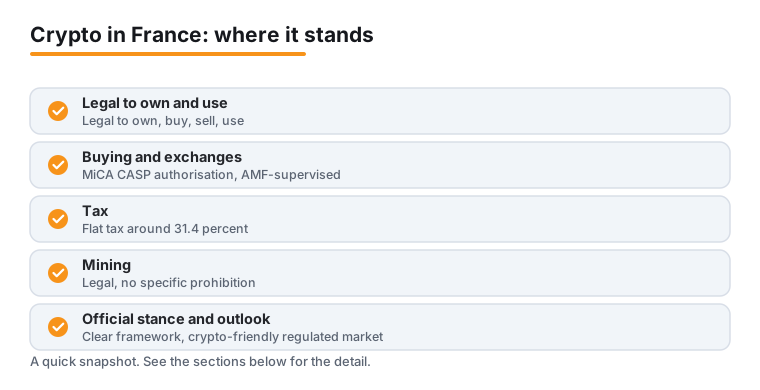
Quick answer — France, 2026
- Legal: Legal to own and use, not legal tender
- Tax: Flat tax 31.4% on gains cashed to fiat, crypto swaps not taxed until cashout
- Buying: Via AMF-registered or MiCA-authorised providers with KYC
France is one of Europe's most established and openly regulated cryptocurrency markets. Buying, holding, selling and using Bitcoin and other crypto-assets is legal, and the country built one of the EU's earliest dedicated regimes for crypto businesses through its 2019 PACTE law. That national framework is now being absorbed into the EU-wide Markets in Crypto-Assets Regulation (MiCA), which has reshaped how exchanges, custodians and other service providers must be authorised to serve French residents.
This page explains the current legal status of Bitcoin and crypto in France, who regulates the sector, the key laws and frameworks, how exchanges are licensed, how crypto is generally taxed, the AML and KYC rules, and the practical side of buying, using and mining crypto. It reflects the position as at 3 August 2026, after the MiCA transitional period for French providers closed at the start of July 2026. Rules change frequently, so always confirm the latest details with the official French and EU sources named below.
This article is general information as of 2026 and is not legal, tax or financial advice. Verify your situation with the named official regulators (the AMF, the ACPR and the French tax authority) or a qualified professional before acting.
On this page: Legal status · Who regulates it · Taxes · How to buy · Mining
Is Bitcoin and crypto legal in France?
Yes. Buying, holding, selling and transferring Bitcoin and other crypto-assets is legal for individuals and businesses in France. There is no ban on cryptocurrency ownership or trading, and France is widely regarded as one of the more crypto-friendly regulated markets in the EU.
However, crypto is not legal tender. The euro is the only official currency, and no person or merchant is obliged to accept Bitcoin as payment. Where a business chooses to accept crypto, it does so voluntarily and remains subject to the usual commercial, consumer-protection and anti-money-laundering rules.
Crypto-assets are treated as a regulated activity rather than as money. The practical effect for users is that crypto is fully legal to use, but the companies that offer crypto services to French residents must be properly authorised. For a broader overview of how different countries approach this, see our guide to crypto regulation.
Who regulates crypto in France?
Supervision of crypto in France is shared between three authorities, with the financial markets regulator in the lead.
- AMF (Autorite des marches financiers) is the financial markets authority and the lead supervisor for crypto-asset service providers. It authorises and registers firms, maintains public registers, and publishes warning lists of unauthorised operators. Its official website is amf-france.org.
- ACPR (Autorite de controle prudentiel et de resolution), attached to the Banque de France, is the prudential and anti-money-laundering supervisor. It gives assent on AML matters for crypto registrations and authorises issuers of stablecoins (e-money tokens and asset-referenced tokens) under MiCA. Its site is acpr.banque-france.fr.
- Banque de France oversees stablecoins used as a means of payment and broader financial-stability questions.
The Ministry of the Economy and Finance sets policy, while the tax authority, the Direction generale des finances publiques (DGFiP), sets and collects tax via impots.gouv.fr. At EU level, the European Securities and Markets Authority (ESMA) and the new EU Anti-Money Laundering Authority (AMLA) also play a role.
Key laws and frameworks
France's approach to crypto has two layers: an established national regime and the newer EU-wide MiCA regulation that now takes precedence.
From PACTE to MiCA
The 2019 PACTE law introduced the PSAN regime (in English, Digital Asset Service Provider, or DASP), requiring crypto businesses such as exchanges and custodians to register with the AMF, with optional fuller licensing available. More than 100 providers registered under this national framework.
The EU's MiCA regulation (Regulation (EU) 2023/1114) became applicable to crypto-asset service providers on 30 December 2024 and now governs the sector across all member states. Under MiCA, firms operate as authorised Crypto-Asset Service Providers (CASPs), and an authorisation granted in one EU country can be passported across the bloc.
How French law was adapted
France aligned its national law with MiCA through Ordonnance no. 2024-936 of 15 October 2024 on crypto-asset markets and Decret no. 2025-169 of 21 February 2025, which amended the Monetary and Financial Code, set the split of duties between the AMF and ACPR, and fixed the transition arrangements. The accompanying AML package, including the Transfer of Funds Regulation (TFR), has applied to CASPs since December 2024. The official texts are published on Legifrance (Decret 2025-169).
Licensing and registration of exchanges
Any firm offering crypto services to French residents, such as exchanges, brokers, custodial wallets and trading platforms, must be authorised. Under the legacy national regime, the regulated activities requiring AMF registration included custody of digital assets for third parties, buying or selling digital assets against legal tender, trading crypto for other crypto, and operating a trading platform.
The AMF began accepting MiCA CASP applications in early 2025 and offers fast-track routes for firms that already held a French DASP registration or licence. That transitional period has now ended. Legacy PSAN/DASP providers had 18 months from MiCA's application to keep operating while seeking MiCA authorisation. The AMF states that since 2 July 2026 the transition between the PACTE regime and MiCA is over, and only firms authorised as CASPs under MiCA, or authorised in another member state and passporting into France, may legally provide crypto services to French residents. The AMF says its own role has shifted from national registration to supervising authorised CASPs.
More than 100 providers had registered under the earlier national PSAN/DASP regime, making France one of the more structured crypto markets in the EU, and on 6 July 2026 the AMF put the number of CASPs it had authorised at 31, out of 283 authorisations granted across the European Union, which made France the second most common location for authorised CASPs in the bloc. The AMF said further authorisations were being finalised, so the figure moves. Operating without authorisation is a criminal offence. Under Articles L.54-10-4 and L.572-23 of the Monetary and Financial Code, providing crypto-asset services in France without the required authorisation can carry up to two years' imprisonment and a fine of 30,000 euros. For everyday users, the main takeaway is to check that any platform you use appears in the AMF's registers or is authorised under MiCA, and to expect identity verification as standard. See the AMF's MiCA information hub for current details.
Crypto and Bitcoin taxation in France
Crypto gains are taxable in France, and the system distinguishes between occasional private investors and those whose activity is treated as professional. The figures below are general and can change each year; confirm the current rules with the DGFiP. This is not tax advice.
Individuals (private investors)
For most private investors, capital gains realised when crypto is converted into euros (or other fiat) or used to buy goods and services are taxed under France's flat tax on capital income, the prelevement forfaitaire unique (PFU), known informally as the flat tax. The PFU combines income tax and social contributions. Following the 2026 social-security budget (PLFSS 2026), the combined flat-tax rate rose to 31.4 percent from 1 January 2026, up from the long-standing 30 percent. The 31.4 percent is made up of 12.8 percent income tax plus 18.6 percent social contributions, the latter increased by a higher CSG rate. Because such rates change, verify the current figure with the DGFiP rather than relying on a number quoted online. Taxpayers may instead elect the progressive income-tax scale where that is more favourable.
What is and is not a taxable event
- Converting crypto to euros, or spending it on goods or services, is generally a taxable disposal.
- Crypto-to-crypto exchanges (for example BTC to ETH) are generally not taxed at the moment of the swap for private investors; tax typically applies only when you cash out to fiat or spend.
- A small annual allowance applies: gains are exempt if the sum of your sale prices for the year does not exceed 305 euros. The test looks at the annual gross amount of your sales, not at your profit, and the transactions must still be reported.
Professional activity and reporting
Frequent, organised or business-scale activity, including mining, may be taxed under business or non-commercial-profit (BNC) categories rather than the flat tax, potentially at higher progressive rates. Gains are declared on Form 2086 attached to the annual return, and French residents must also declare crypto accounts held on platforms based abroad. From 1 January 2026, the EU DAC8 directive requires crypto service providers to report clients' transactions to tax authorities; providers make their first reports in early 2027, and EU tax administrations exchange the 2026 data with each other by 30 September 2027. In France the duty was created by article 54 of law no. 2025-127 of 14 February 2025, which inserted articles 1649 AC bis to 1649 AC sexies into the Code general des impots, and decret no. 2025-1276 of 19 December 2025 set the mechanics: a provider registers with the tax administration before 15 April of the year after it meets the conditions, and files its annual declaration before 15 June of the following year. A provider that fails to report faces 15 euros per transaction not declared or declared late, capped at 2,000,000 euros per provider per year, and up to 50,000 euros for failures of due diligence. See the official form at impots.gouv.fr (Formulaire 2086), and our general guide to crypto taxes.
AML, KYC and the Travel Rule
Crypto in France sits within strict anti-money-laundering (AML) and counter-terrorist-financing (CTF) rules. Registered and authorised providers must verify customer identity (KYC), monitor transactions and report suspicious activity.
The EU Transfer of Funds Regulation (TFR), part of the wider AML package, has applied to CASPs since December 2024 and implements the crypto Travel Rule: identifying information about the sender and recipient must accompany transfers between regulated entities. Enhanced due diligence applies to certain transfers, including some involving self-hosted (private) wallets. KYC checks generally apply regardless of amount.
France has also tightened domestic law: Law no. 2025-532 of 13 June 2025, aimed at narcotics trafficking, extends the presumption of money laundering to transactions using crypto-assets with built-in anonymisation features, meaning assets moved through such mechanisms can be presumed to be crime proceeds unless proven otherwise. At EU level, the Anti-Money Laundering Authority (AMLA), based in Frankfurt, became operational in 2025 and will increasingly coordinate supervision.
Buying and using crypto in practice
French residents have several straightforward ways to buy and use Bitcoin and other crypto-assets. Whichever route you choose, prioritise platforms that are properly authorised to operate in France.
- Crypto exchanges registered with the AMF or authorised as MiCA CASPs let you buy crypto with euros via bank transfer, card or instant SEPA. These usually offer the widest selection and the best rates for larger amounts.
- Brokers and fintech apps available in France offer simpler crypto buying, often with a friendlier interface but sometimes higher fees.
- Bitcoin ATMs and kiosks are legal but are themselves a regulated service requiring AMF registration; expect ID verification and higher fees (see the next section).
- Peer-to-peer trades are possible but carry higher counterparty and fraud risk; favour escrow-based platforms.
Typical steps
- Choose an AMF-registered or MiCA-authorised provider and create an account.
- Complete KYC identity verification (expect to upload ID and proof of address).
- Deposit euros, place your buy order, and review fees and the exchange rate before confirming.
- Consider moving larger holdings to a wallet you control, and keep records for tax purposes.
Using crypto to send money to or from France is also legal, but converting crypto to euros at either end can be a taxable disposal, and money-transfer services are subject to the AML and Travel Rule obligations described above.
Bitcoin and crypto ATMs
Crypto ATMs (kiosks that let you buy or sell crypto with cash or card) are legal in France and can be found in larger cities, though numbers fluctuate as the sector adapts to tighter rules.
Operating a crypto ATM is a regulated service. The AMF and ACPR have publicly reminded operators that buying or selling digital assets for legal tender through a machine requires the appropriate AMF authorisation, with ACPR involvement on AML. Running such machines without authorisation is a criminal offence that can carry imprisonment and a significant fine.
Because of MiCA and the EU AML rules, including the Travel Rule, expect identity verification at ATMs. Anonymous, no-ID cash purchases are increasingly restricted. If you use an ATM, choose an authorised operator, check the fees and exchange rate before confirming, and keep your transaction records.
Bitcoin mining in France
Bitcoin mining is legal in France. There is no specific prohibition on running mining hardware, and France has not banned proof-of-work mining.
The main constraints are economic and environmental rather than legal. France's electricity is relatively low-carbon thanks to its large nuclear fleet, but retail power prices and grid considerations mean large-scale mining is not always commercially attractive compared with cheaper-energy regions. Energy use and the climate impact of crypto remain active topics in French and EU policy debate, and miners should expect continued scrutiny.
From a tax perspective, mining rewards are generally treated as taxable income, and at scale mining may be considered a professional or business activity with its own tax and reporting obligations. Anyone mining commercially should check the applicable rules and budget for electricity, hardware and tax costs.
Recent developments (2025 to 2026)
The move from France's national PSAN/DASP regime to the EU's MiCA framework is now complete. The open questions have shifted to who supervises CASPs in future and to tax.
- MiCA application: rules for crypto-asset service providers became applicable on 30 December 2024, with stablecoin rules already in force earlier in 2024.
- National adaptation: Ordonnance 2024-936 (15 October 2024) and Decret 2025-169 (21 February 2025) brought French law into line and set the transition.
- CASP authorisations: the AMF began accepting applications in early 2025; the transitional window for legacy providers closes on 1 July 2026, after which only MiCA-authorised CASPs may serve French residents. On 5 February 2026 the AMF reminded providers that had not yet applied to do so without delay, noted that a CASP review can take up to four months once a complete file has been submitted, and invited firms not seeking authorisation to carry out only operations strictly necessary to wind down their activities, on 30 March 2026 at the latest. Firms without authorisation that continued faced criminal liability of up to two years' imprisonment and a 30,000 euro fine.
- Tax: the flat tax (PFU) rose to 31.4 percent from 1 January 2026 under the PLFSS 2026 budget (12.8 percent income tax plus 18.6 percent social contributions), and EU DAC8 reporting obligations began, with the first cross-border exchange of data due by 30 September 2027.
- AML: Law 2025-532 (13 June 2025) tightened the treatment of anonymising crypto, and the EU AMLA became operational.
- Enforcement: the AMF and ACPR have continued to expand blacklists of unauthorised crypto and forex websites, adding many names in 2025 and into 2026.
France is expected to keep balancing support for its blockchain and fintech ecosystem with strong consumer protection and AML enforcement. For the latest position, rely on the AMF, the ACPR, the DGFiP and official EU sources. For other jurisdictions, see our regulation hub.
Consumer risks and protection
France offers one of the clearer regulatory environments for crypto in Europe, but users should stay aware of the main risks.
Key risks
- Market volatility: prices can fall sharply, and crypto holdings are generally not covered by deposit-guarantee or investor-compensation schemes, so losses from price falls, platform failures, hacks or scams may not be recoverable.
- Fraud and unauthorised platforms: the AMF and ACPR regularly publish blacklists of illegitimate providers. Using an unauthorised platform offers little recourse if things go wrong.
- Compliance and tax errors: failing to declare foreign accounts or gains can lead to penalties.
- Provider transition risk: this is no longer hypothetical. Binance told EU customers in late June 2026 that it would stop providing crypto-asset services from 1 July 2026 after failing to obtain a MiCA licence, with notices going to users in France, Italy, Poland and Spain, and told customers their assets remained safe and accessible. Check your platform against the AMF white list, or the ESMA register if it is authorised in another member state, before depositing.
Protecting yourself
Use only AMF-registered or MiCA-authorised platforms; check the AMF blacklists before signing up; be wary of offers promising guaranteed or unusually high returns; never invest more than you can afford to lose; understand the tax consequences before you sell; and consider self-custody and strong security for significant holdings. The AMF's warnings and blacklists are published at amf-france.org (warnings and blacklists). This is general information, not financial advice.
Official sources and how to verify
Crypto rules in France are evolving, so always confirm the current position with primary official sources rather than third-party summaries (including this page).
- AMF for the regulator's registers, MiCA guidance and investor warnings: amf-france.org MiCA hub and amf-france.org blacklists.
- ACPR / Banque de France for prudential, AML and stablecoin supervision: acpr.banque-france.fr.
- DGFiP for taxation and the crypto declaration form: impots.gouv.fr.
- Legifrance for the official legal texts (Ordonnance 2024-936, Decret 2025-169 and the Monetary and Financial Code): legifrance.gouv.fr.
To verify a platform, search the AMF's registers and check it is not on the AMF or ACPR blacklists before depositing funds. This page is general information as of 2026 and is not legal, tax or financial advice; confirm your situation with the AMF, the ACPR, the DGFiP or a qualified professional.
What is changing (updated 3 August 2026)
The MiCA transition that the rest of this page treats as a future deadline has now happened. The AMF states that since 2 July 2026 the transitional period between the PACTE regime and MiCA is over, the PSAN/DASP regime no longer provides a legal basis for serving French residents, and MiCA authorisation is the only route into the French market.
- 31 authorised CASPs in France. In a news release of 6 July 2026 the AMF said France had authorised 31 crypto-asset service providers, out of 283 authorisations granted across the European Union, which made France the second most common location for authorised CASPs in the bloc. Further authorisations were being finalised, so the figure moves.
- The AMF's job has changed. The regulator now describes its role as supervising CASPs' compliance with their professional and good conduct obligations rather than running a national registration regime, and says it will scrutinise the implementation of the orderly winding-down plans of firms that did not obtain authorisation, with preserving clients' interests as the stated priority.
- Binance stopped serving French clients on 1 July 2026. Binance told EU customers in late June 2026 that it would no longer provide crypto-asset services, having withdrawn its MiCA licence application in Greece shortly before the deadline. Notices went to users in France, Italy, Poland and Spain, and Binance's French entity said it could no longer accept new clients from 1 July. Binance told customers their assets remain safe and secure and accessible at all times, and said it would seek authorisation in another EU country. See CoinDesk, 26 June 2026 and Euronews, 25 June 2026.
- The wind-down had its own earlier deadline. On 5 February 2026 the AMF warned that a CASP review can take up to four months once a complete file has been submitted, and invited providers not seeking authorisation to carry out only operations strictly necessary to wind down their activities, on 30 March 2026 at the latest. ESMA set out matching expectations on 23 June 2026, stressing that MiCA protections apply only to the entity authorised in the EU and not to affiliated or offshore entities.
- There is no French wealth tax on crypto. Deputies voted on 31 October 2025 for an impot sur la fortune improductive that would have applied a single rate of 1 percent to net taxable wealth above 1,300,000 euros and brought digital assets into the base. It did not survive into the enacted text of LOI n. 2026-103 du 19 fevrier 2026 de finances pour 2026; the reform was abandoned and the wealth tax still applies to real estate only.
- Tax rates are unchanged since January. The flat tax remains 31.4 percent, made up of 12.8 percent income tax and 18.6 percent social contributions.
To check a platform now, use the AMF CASP white list, which is also published as an open dataset on data.gouv.fr and updated daily, and the ESMA register for firms authorised in another member state and passporting into France.
Crypto legislation in progress: what is coming and roughly when
Nothing on the list below is law today. Each row states what is proposed, where it has reached, and when it could move. French crypto tax changes are made in the autumn budget, so the date to watch domestically is 30 September 2026.
| Measure | Stage as at August 2026 | Expected timing | What it would mean |
|---|---|---|---|
| Proposition de loi n. 3090, on adapting the legal and tax framework for crypto-assets (Paul Midy, 91 co-signatories) | Filed in the Assemblee nationale on 23 July 2026 and referred to the Commission des finances. Not scheduled for debate. | No date. Getting parliamentary time is the uncertain step. | Crypto capital losses carried forward for ten years instead of dying at year end; airdropped tokens taxed on sale rather than on receipt; up to 1,000 euros a year of crypto payments exempt; directors' home addresses masked in public registers. |
| EU Market Integration and Supervision Package | Published by the Commission on 4 December 2025. Under negotiation in the European Parliament and the Council. | Most ESMA powers would apply 12 months after entry into force. No agreed adoption date. | ESMA would become the direct supervisor of CASPs, replacing the AMF for most firms, with one central EU register instead of national white lists. Credit institutions stay under banking supervision unless crypto is their main activity. |
| MiCA review consultation | Consultation opened 20 May 2026. | Closes 31 August 2026. A legislative proposal would follow; no date announced. | Options include regulating crypto lending, borrowing and staking, allowing remuneration on stablecoins, and an equivalence route for third-country stablecoin issuers. |
| AMLA direct supervision | Preparatory data collection closes 15 August 2026. | Provisional list of eligible entities by end September 2026; selection in 2027; direct supervision from 2028. | AML supervision of a small number of large cross-border firms moves from the ACPR to AMLA in Frankfurt. The ACPR keeps everyone else. |
| Digital euro regulation | ECON committee position adopted 5 November 2025 by 43 votes to 14 with 1 abstention; Council position adopted December 2025; Parliament mandate announced at the July 2026 plenary. | Interinstitutional negotiations next. No adoption date. | A retail central bank digital currency distributed through banks and payment providers. Separate from crypto-assets and does not restrict them. |
| Projet de loi de finances pour 2027 | Not yet published. | Presented to the Conseil des ministres on 30 September 2026; solemn vote on the revenue part on 20 October 2026; solemn vote on the full text on 17 November 2026. Calendar provisional. | The only realistic vehicle for changing the 31.4 percent flat tax, the 305 euro threshold, or reviving an unproductive wealth tax covering crypto. |
Reporting duties and penalties: how DAC8 works in French law
The page mentions DAC8 in general terms. These are the actual French instruments and the numbers attached to them.
- The duty itself. Article 54 of LOI n. 2025-127 du 14 fevrier 2025 de finances pour 2025 inserted articles 1649 AC bis to 1649 AC sexies into the Code general des impots. It applies to transactions from 1 January 2026, with the first declarations filed in 2027.
- The mechanics. Decret n. 2025-1276 du 19 decembre 2025, published in the Journal officiel on 24 December 2025, requires a provider to register with the tax administration before 15 April of the year after it meets the conditions, and to file its annual declaration before 15 June of the following year. It entered into force on 1 January 2026.
- What it costs a provider to get it wrong. 15 euros per transaction not declared or declared late, capped at 2,000,000 euros per provider per year, plus up to 50,000 euros for breaches of due-diligence obligations.
- What you still have to do yourself. Provider reporting does not replace your return. Gains go on form 2086, then in box 3AN on form 2042 C, losses in box 3BN. To elect the progressive income tax scale instead of the 31.4 percent flat tax, tick box 3CN. Source: impots.gouv.fr.
- The trap the page does not mention. A loss on digital assets can only be set against gains of the same nature realised in the same year. It is not set against gains on other assets and is not carried forward to later years. Sell at a loss in December and you cannot use it against a gain the following March. This is the single largest gap between crypto and listed securities in French tax law, and it is exactly what proposition de loi n. 3090 proposes to fix.
Frequently asked questions
Is cryptocurrency legal in France?
Yes. Owning, buying, selling and using Bitcoin and other crypto-assets is legal in France. Crypto is not legal tender, so no one is obliged to accept it as payment, and companies offering crypto services to French residents must be authorised, historically under the national PSAN/DASP regime and now under the EU's MiCA regulation.
Who regulates crypto in France?
The Autorite des marches financiers (AMF) is the lead supervisor for crypto-asset service providers. It works with the ACPR (the prudential and AML authority attached to the Banque de France), which also authorises stablecoin issuers, and with the Banque de France on stablecoins used for payment. Tax is handled by the DGFiP. Since the end of 2024 the sector is also governed by the EU-wide MiCA regulation.
What changes for crypto firms on 1 July 2026 in France?
Providers registered under France's national PSAN/DASP regime were given a transitional period to keep operating while obtaining MiCA authorisation. From 1 July 2026, only firms authorised as MiCA Crypto-Asset Service Providers (CASPs) may legally serve French residents. Operating without authorisation can carry criminal penalties, including imprisonment and fines.
How is crypto taxed in France?
For most private investors, gains realised when crypto is converted to euros or spent are taxed under France's flat tax (PFU). The combined rate rose to 31.4 percent from 1 January 2026 under the PLFSS 2026 budget, up from 30 percent (12.8 percent income tax plus 18.6 percent social contributions), with an option to elect the progressive income-tax scale. Crypto-to-crypto swaps are generally not taxed until you cash out, and total disposals up to 305 euros per year are exempt (but should still be reported on Form 2086). Professional traders and miners may be taxed differently. Rates change, so confirm with the DGFiP. This is not tax advice.
What KYC and AML rules apply to crypto in France?
Authorised providers must verify customer identity (KYC), monitor transactions and report suspicious activity. The EU Transfer of Funds Regulation, applicable to CASPs since December 2024, implements the crypto Travel Rule, requiring sender and recipient information to accompany transfers between regulated entities, with enhanced checks for certain transfers including some involving self-hosted wallets. France's Law 2025-532 of 13 June 2025 also tightened the treatment of anonymising crypto.
How do I check whether a crypto platform is authorised in France?
Check the AMF's official registers of registered and authorised providers, and confirm the platform is not on the AMF or ACPR blacklists of unauthorised websites before depositing funds. Both are published on the AMF website under Warnings and Blacklists. Avoid offers promising guaranteed or unusually high returns, as these are common signs of fraud.
What happens to a crypto platform in France without MiCA authorisation after 1 July 2026?
Legacy providers registered under France's national PSAN/DASP regime could keep operating during an 18 month transitional period that ends on 1 July 2026. From that date, a platform without a granted MiCA CASP authorisation must stop offering crypto services to French residents. Under Articles L.54-10-4 and L.572-23 of the Monetary and Financial Code, continuing without authorisation can carry up to two years' imprisonment and a fine of 30,000 euros, and the AMF can blacklist the firm or seek to block its website.
Does DAC8 mean my French crypto platform reports my trades to the tax office?
Yes. From 1 January 2026 the EU DAC8 directive requires crypto-asset service providers to collect and report client transaction data. Providers file their first reports in early 2027, and EU tax administrations exchange the 2026 data with each other by 30 September 2027. You should still declare your own gains and any foreign crypto accounts yourself on Form 2086 with your annual return; the reporting does not remove your filing obligations. This is not tax advice.
Can I still use Binance in France in 2026?
No, not for trading. Binance told EU customers in late June 2026 that it would stop providing crypto-asset services from 1 July 2026 after failing to secure a MiCA licence, having withdrawn its licence application in Greece shortly before the deadline. Notices went to users in France, Italy, Poland and Spain, and Binance's French entity said it was no longer in a position to accept new clients from 1 July. Binance told customers their assets remain safe and secure and accessible at all times, and said it would seek authorisation in another EU country. Check the AMF white list of authorised CASPs before assuming any platform can still serve you.
How many crypto platforms are authorised in France now?
In a news release dated 6 July 2026 the AMF said France had authorised 31 crypto-asset service providers, out of 283 authorisations granted across the European Union, which made France the second most common location for authorised CASPs in the bloc. The AMF said further authorisations were being finalised, so the number changes. The authoritative list is the AMF CASP white list, also published as an open dataset on data.gouv.fr and updated daily. Firms authorised in another member state can also serve French residents by passporting, so check the ESMA register too.
Is there a wealth tax on crypto in France?
No. Deputies voted on 31 October 2025 for an impot sur la fortune improductive that would have replaced the real-estate wealth tax, applying a single rate of 1 percent to net taxable wealth above 1,300,000 euros and bringing digital assets into the base. That measure did not survive into the enacted text of LOI n. 2026-103 of 19 February 2026, the finance law for 2026. The reform was abandoned and the wealth tax continues to apply to real estate only. A future budget could revive the idea, so the text to watch is the projet de loi de finances pour 2027, due to be presented on 30 September 2026.
Can I carry forward crypto losses in France?
No. A capital loss on digital assets can only be set against gains of the same nature realised in the same tax year. It is not set against gains on other assets and is not carried forward to later years, unlike losses on listed securities. A bill filed in the Assemblee nationale on 23 July 2026, proposition de loi n. 3090, would allow a ten year carry forward, but it has not been scheduled for debate and is not law. This is general information, not tax advice.
What crypto laws are coming in France?
Domestically, proposition de loi n. 3090 was filed on 23 July 2026 and would allow ten year loss carry forward, tax airdrops on sale rather than on receipt, and exempt up to 1,000 euros a year of crypto payments; it has no debate date. The projet de loi de finances pour 2027 is due on 30 September 2026 and is the only realistic route for changing the 31.4 percent flat tax. At EU level, the Commission proposed on 4 December 2025 to make ESMA the direct supervisor of CASPs in place of national regulators such as the AMF, and a MiCA review consultation closes on 31 August 2026, covering crypto lending, borrowing, staking and whether stablecoins may pay a return.
What happened at the start of July 2026 in France?
The MiCA transitional period ended. Providers registered under the national PSAN/DASP regime created by the 2019 PACTE law could no longer rely on it, and the AMF states that since 2 July 2026 only firms authorised as MiCA CASPs, or passported in from another member state, may serve French residents. The AMF says its role is now supervising authorised CASPs rather than running a national register, and that it will scrutinise the orderly winding-down plans of firms that did not obtain authorisation, with preserving clients' interests as the priority.
Facts reviewed: 3 August 2026. Page updated: 3 August 2026.