Tether (USDT) & Stablecoins Explained
Tether (USDT) is the most widely used stablecoin in cryptocurrency, a token designed to track the value of one US dollar so that one USDT trades at roughly $1 at all times. Launched in 2014, it has grown into one of the largest assets in the entire market by circulating supply, and it serves as the default trading pair, settlement layer, and dollar substitute across thousands of exchanges and blockchains.
This guide explains what Tether actually is, how stablecoins keep their peg, the practical difference between the ERC-20 and TRC-20 versions of USDT, and the real risks you should weigh before holding or moving it. The same mechanics apply to most fiat-backed stablecoins, so understanding USDT gives you a working model for the whole category. None of this is financial, legal, or tax advice; always confirm current figures and rules with official sources before you act.
What is Tether (USDT)?
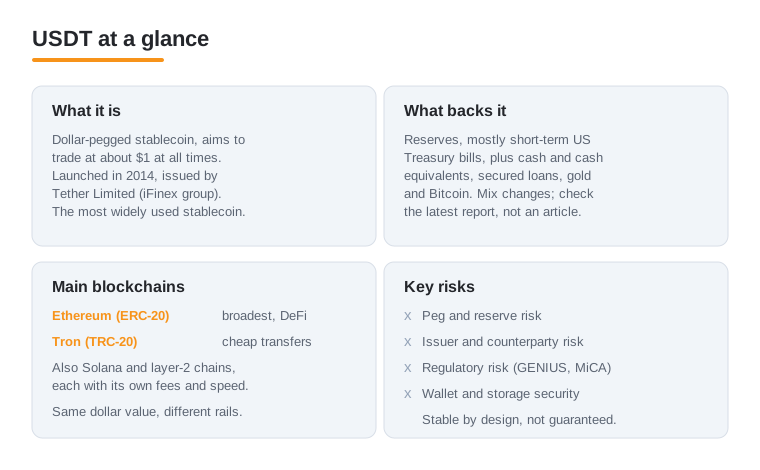
Tether is a stablecoin: a cryptocurrency engineered to hold a steady value rather than appreciate or fall like Bitcoin or Ether. USDT is pegged to the US dollar on a one-to-one basis, meaning the issuer aims to keep each token redeemable for, and tradable at, approximately one dollar. It is issued by Tether Limited, a company affiliated with the iFinex group, and circulates on many different blockchains simultaneously.
The token exists to solve a specific problem. Cryptocurrencies are volatile, and historically it was slow and expensive to move in and out of traditional bank dollars. A dollar-pegged token lets traders, businesses, and individuals park value in something stable, settle transactions, and move money between platforms without leaving the crypto ecosystem. That is why USDT functions as the market's primary unit of account: the majority of crypto trading volume is denominated against a stablecoin rather than against fiat.
What people actually use USDT for
- Trading and liquidity: Buying and selling crypto against a stable dollar value instead of constantly converting to bank money.
- A safe harbour during volatility: Moving out of a falling asset into USDT to preserve value without cashing out to fiat. This reduces exposure to crypto price swings, but it does not eliminate stablecoin risk.
- Cross-border transfers: Sending dollar-denominated value across blockchains, often faster and cheaper than traditional international wire transfers, and accessible to anyone with a wallet and internet connection.
- Payments and savings in unstable economies: In countries with high inflation or limited banking, dollar-pegged tokens are increasingly used as an informal store of value. This carries its own legal and counterparty considerations that vary by jurisdiction.
It is worth separating two ideas that are easily confused. A stablecoin like USDT is a privately issued token backed by reserves. A central bank digital currency (CBDC) is a digital form of a national currency issued directly by a central bank, carrying government backing and oversight, whereas a stablecoin depends on the issuer's reserves and conduct. Several central banks have explored or piloted CBDCs; whether they compete with or complement private stablecoins is still an open question.
How stablecoins hold their peg
A stablecoin holding its peg is not magic, and it is not guaranteed. USDT and most large dollar stablecoins use a fiat-collateralised model, which combines two reinforcing mechanisms: real reserves behind the token, and market arbitrage that corrects small price deviations.
Reserve backing
The core promise is that every token in circulation is backed by at least an equivalent value of reserve assets. For USDT, the issuer reports that reserves are held predominantly in cash and cash-equivalent instruments, with US Treasury bills making up the large majority, alongside smaller allocations to assets such as secured loans, precious metals, and Bitcoin. The exact composition changes over time, so treat any specific percentage as a snapshot and check the issuer's latest published breakdown rather than relying on a figure from an article.
If holders trust that they can ultimately redeem tokens for dollars, the market price stays close to a dollar. If that trust weakens, the peg can come under pressure regardless of what the reserves technically contain.
Arbitrage and authorised redemption
Day to day, the peg is enforced by traders, not by the issuer. The mechanism is simple supply and demand:
- If USDT trades below $1, it becomes profitable for large participants to buy the discounted tokens and redeem them with the issuer (or buy where it is cheap and sell where it is dearer), pushing the price back up.
- If USDT trades above $1, participants can mint new tokens at par or sell their holdings into the higher price, increasing supply until the price falls back toward the peg.
This arbitrage loop makes the peg self-correcting under normal conditions, but it depends on confidence that redemption at par is genuinely available. During a panic, redemptions can slow or queue, arbitrage can break down, and a stablecoin can trade meaningfully off its peg.
Attestations and transparency
Because the peg rests on reserves most users cannot see, transparency matters. Tether publishes regular attestation reports prepared by an external accounting firm, along with more frequent reserve breakdowns. An attestation is a point-in-time confirmation that reserves existed and met stated criteria on a given date. It is useful, but it is not the same as a full financial audit conducted under comprehensive auditing standards, and critics have long pressed Tether for the latter. When you read about reserves, note whether the source is an attestation or a full audit, because the difference is real.
A note on algorithmic stablecoins
Not all stablecoins are reserve-backed. Some so-called algorithmic stablecoins tried to hold a peg using trading incentives and a linked token instead of real collateral. Several have failed dramatically, wiping out holders. USDT is collateral-backed rather than purely algorithmic, but the history is a reminder that a stable name does not guarantee a stable asset.
ERC-20 vs TRC-20
One point that confuses newcomers: USDT is not a single token on a single network. The same dollar peg is issued natively on many blockchains, and the two most common versions are ERC-20 USDT (on Ethereum) and TRC-20 USDT (on the Tron network). The dollar value is identical; what differs is the rails the token rides on.
| Aspect | ERC-20 (Ethereum) | TRC-20 (Tron) |
|---|---|---|
| Underlying network | Ethereum | Tron |
| Typical transfer fee | Higher and variable; depends on network congestion (gas) | Very low, often near zero |
| Speed | Fast, but can slow and get costly under heavy load | Generally fast and cheap |
| Ecosystem support | Broadest; deeply integrated with DeFi, custodians, and tooling | Widely supported on exchanges; very popular for transfers and remittances |
| Common use case | DeFi, smart-contract interactions, institutional flows | Low-cost peer-to-peer and cross-exchange transfers |
The practical takeaway is about cost and compatibility. TRC-20 is popular for cheap, frequent transfers, which is why it dominates many remittance and exchange-to-exchange flows. ERC-20 is the most universally supported and is the standard for interacting with Ethereum-based decentralised finance. Other networks (such as Solana and various layer-2 chains) also host USDT, each with its own fee and speed profile.
The single most important safety rule here: the network must match on both ends of a transfer. If you send TRC-20 USDT to an address or deposit page expecting ERC-20 (or vice versa), the funds can be lost permanently. Always confirm that the sending wallet, the receiving address, and the chosen network all agree before you transfer. When an exchange shows multiple USDT deposit options, pick the network deliberately and copy the matching address.
Risks & safety
USDT is stable by design, not by guarantee. Treating it as risk-free is the most common and most dangerous mistake. The risks fall into a few categories, and they stack on top of the ordinary security risks of holding any crypto.
Peg and reserve risk
The token is only as sound as the reserves and the issuer behind it. A loss of confidence, a reserve shortfall, or a redemption freeze could push USDT off its peg. It has briefly traded below a dollar during past market stress. Diversifying which stablecoins you hold, and not parking life-changing sums in any single token, are reasonable ways to limit exposure.
Issuer and counterparty risk
USDT is a liability of a private company, not a bank deposit, and it is generally not covered by deposit insurance. Your ability to redeem at par depends on that company's solvency, banking relationships, and conduct. This is the structural difference between a stablecoin and money in an insured bank account.
Regulatory risk
Stablecoin rules are tightening worldwide, and they directly affect where and how you can use USDT. In the United States, federal stablecoin legislation (the GENIUS Act) was enacted in 2025, with regulators issuing implementing rules through 2026; the full effect on specific issuers continues to unfold. In the European Union, the MiCA framework imposes requirements on stablecoins offered to EU users, and major EU exchanges removed USDT trading pairs for European customers because Tether did not pursue MiCA authorisation. Availability, compliance status, and tax treatment differ sharply by country and change frequently, so verify the current position with official regulators or a qualified professional in your jurisdiction before relying on USDT.
Wallet and storage security
Most users lose crypto to theft and mistakes, not to a broken peg. How you store USDT matters as much as which token you hold. The main trade-off is between hot and cold storage.
| Hot wallet | Cold wallet | |
|---|---|---|
| Connection | Online (app, exchange, browser extension) | Offline (hardware device, paper, air-gapped) |
| Convenience | High; ideal for active trading and frequent transfers | Lower; better for holding rather than daily use |
| Security | More exposed to hacks, malware, and phishing | Strongly resistant to remote attacks |
| Best for | Working balances you transact with regularly | Larger amounts you intend to hold long term |
A common approach is to keep a small working balance in a hot wallet and move the bulk to cold storage. Whichever you use, the fundamentals are the same:
- Enable two-factor authentication on every exchange and app, preferably with an authenticator app or hardware key rather than SMS.
- Protect your seed phrase and private keys offline. Anyone who has them controls the funds, and no one legitimate will ever ask for them.
- Verify addresses and the network before every transfer, and beware of phishing sites and fake support staff.
- Be cautious with funds left on exchanges; assets in a custodial account are controlled by the platform, not by you.
A word on trading
Because USDT is the market's base trading currency, it is often the on-ramp to risky activity such as leveraged trading, which can amplify losses as easily as gains. A stablecoin's stability says nothing about the safety of what you trade with it.
This article is educational and is not financial, legal, or tax advice. Cryptocurrency carries risk, including the risk of total loss. Confirm reserve data, regulatory status, and tax obligations with official and qualified sources before acting.
USDT and the new 2026 rules
The story of USDT in 2026 is mostly a story about regulation. Two big rulebooks now shape where you can hold it and how it is treated: the GENIUS Act in the United States and MiCA in the European Union. Neither one bans USDT outright, but both change the picture, and it helps to understand each separately. For the wider background on the US law, see our explainer on stablecoins and the GENIUS Act, and our overview of crypto regulation for the global view.
The US GENIUS Act, in plain terms
The GENIUS Act (Guiding and Establishing National Innovation for US Stablecoins) was signed into law in July 2025 and is the first federal framework for dollar payment stablecoins. In broad strokes it says a payment stablecoin sold in the US must be backed one-to-one by safe, liquid assets such as cash and short-term US Treasuries, must publish monthly reserve reports, and must be issued by a licensed entity. Federal regulators spent 2026 writing the detailed rules; the Office of the Comptroller of the Currency published its proposed rule in early 2026, and the law's core requirements are set to take effect in the months that follow. You can read the OCC's proposal on the Federal Register, and the bill text itself on Congress.gov.
What it means for USDT specifically
Here is the catch for Tether. USDT is issued by a company based outside the US, and the GENIUS Act treats foreign issuers differently: to keep serving US customers long term, a foreign stablecoin generally needs its home regulator judged "comparable" by US authorities and has to register with the OCC. As of mid-2026 that path is still being worked out, and parts of USDT's reserve mix (it holds gold and Bitcoin alongside Treasuries) do not fit the narrow asset list the US law expects of a fully compliant payment stablecoin.
Tether's answer was to launch a separate US-focused token, USAT, in January 2026. USAT is built to meet the GENIUS Act rules: it is issued through a federally chartered bank (Anchorage Digital), with Cantor Fitzgerald handling reserve custody, and it runs on its own reserves and redemption rails. The key thing to understand is that USAT and USDT are not the same token. USAT is the compliant US product; USDT continues as the global token used everywhere else. Tether announced the launch on its own site if you want the primary source: tether.io.
Europe and MiCA: why USDT vanished from some EU exchanges
The EU's Markets in Crypto-Assets rules (MiCA) require any stablecoin offered to EU users to be authorised, with an EU-licensed issuer and reserves held to set standards. Tether chose not to apply for that authorisation. Because a MiCA-licensed exchange risks its own licence by listing an unauthorised stablecoin, major venues serving the EU removed or restricted USDT spot trading pairs for European customers, with the cutoff for unauthorised tokens landing in 2026. In practice this means a European user may find USDT pairs gone on a regulated exchange while USDC and other authorised stablecoins remain. USDT itself is not illegal to hold in the EU, but on-exchange access has shrunk. Rules vary by country, so check your local regulator and our regulation guide for specifics.
The practical upshot for you: where you live now affects which stablecoin is easiest to use. In the US, watch how the foreign-issuer rules settle and whether your platform offers USAT or USDT. In the EU, expect USDC and other MiCA-authorised tokens to be the default on regulated venues. None of this is financial or legal advice; confirm the current position with official sources before acting.
Reserves and safety
The whole promise of USDT rests on one question: is there really a dollar's worth of assets behind every token? In 2026 there is more public information to answer that than ever before, though a familiar gap remains. This builds on the peg mechanics covered earlier; here we focus on what the reserves actually look like today and how to check them yourself.
What backs USDT in 2026
By its own reporting, Tether holds a very large reserve pool, the bulk of it in short-term US Treasury bills, with the rest spread across cash and cash equivalents, overnight repo, secured loans, gold, and Bitcoin. The Treasury holdings alone run into the hundreds of billions of dollars, which has made Tether one of the larger holders of short-dated US government debt in the world. USDT also remains by far the biggest stablecoin by circulating supply, sitting near the top of the market through 2026. The exact figures move every quarter, so treat any single number as a snapshot and check the latest report rather than an article.
Attestations, not a full audit
Tether publishes quarterly attestation reports prepared by the accounting firm BDO, plus more frequent reserve breakdowns on its transparency page. This is a real and useful disclosure, but it is worth being precise about what it is. An attestation confirms that, on a specific date, the stated assets existed and met stated criteria. A full audit examines a company's systems, controls, and records across a whole period and offers a stronger opinion. As of 2026, Tether has still not produced a full audit from a major (Big Four) accounting firm, and that remains the main transparency criticism leveled at it. You can view Tether's own reserve disclosures at tether.io; for primary regulatory context on what counts as adequate reserves, the GENIUS Act materials linked above are the source.
USDT vs USDC: the practical comparison
The most common question new holders ask is whether to use USDT or USDC, the second-largest dollar stablecoin, issued by Circle. They serve the same basic purpose but differ on transparency and regulatory standing.
| Aspect | USDT (Tether) | USDC (Circle) |
|---|---|---|
| Issuer | Tether, based outside the US | Circle, US-based |
| Reserve reporting | Quarterly attestations (BDO); no full Big Four audit | Monthly attestations; reserves in cash and short-term Treasuries |
| EU (MiCA) status | Not authorised; pairs removed on many EU exchanges | MiCA-authorised; widely available to EU users |
| Liquidity | Largest by supply; deepest trading liquidity, especially outside the US/EU | Large and widely used, strong with regulated and institutional venues |
| Common strength | Availability and liquidity across global exchanges and Tron transfers | Transparency and regulatory acceptance in the US and EU |
Neither is automatically "safer" for every purpose. USDT generally wins on raw liquidity and global reach; USDC generally wins on disclosure and regulatory acceptance in the US and EU. Many people hold some of each to spread issuer risk. You can read Circle's own reserve disclosures at circle.com. Whichever you pick, the storage and security habits from the section above still apply, and the same caution goes for using stablecoins inside decentralised finance, where extra smart-contract risk sits on top of issuer risk.
This section is educational and is not financial, legal, or tax advice. Reserve composition, regulatory status, and supply figures change often, so confirm them with official sources such as the issuer's transparency page and your local regulator before acting.
Frequently asked questions
Is USDT actually backed by US dollars?
Tether reports that USDT is fully backed by reserves, held mostly in cash and cash-equivalent assets, with US Treasury bills making up the large majority and smaller allocations to other holdings. The issuer publishes regular attestation reports from an external accounting firm. Note that an attestation is a point-in-time confirmation rather than a full audit, and the exact reserve mix changes over time, so check Tether's latest published figures directly rather than relying on a single number.
What is the difference between ERC-20 and TRC-20 USDT?
They are the same dollar-pegged token issued on different blockchains: ERC-20 USDT runs on Ethereum and TRC-20 USDT runs on Tron. The value is identical. TRC-20 transfers are usually much cheaper, which makes them popular for moving funds, while ERC-20 has the broadest ecosystem support, especially in decentralised finance. Critically, the network must match on both ends of a transfer, or the funds can be lost.
Can USDT lose its peg or break the dollar value?
Yes. The peg is maintained by reserves and market arbitrage under normal conditions, but it is not guaranteed. USDT has briefly traded below a dollar during periods of market stress. A loss of confidence, a reserve problem, or restricted redemptions could move it off peg. Treat it as low-volatility, not risk-free.
Is it safe to keep USDT on a crypto exchange?
Keeping USDT on an exchange is convenient for trading but means the platform, not you, controls the assets, which exposes you to hacks, withdrawal freezes, or platform failure. A common practice is to hold only a working balance on exchanges and move larger amounts to a personal wallet, ideally cold storage, with two-factor authentication and your recovery phrase kept offline.
How is a stablecoin different from a central bank digital currency (CBDC)?
A stablecoin such as USDT is a privately issued token backed by a company's reserves. A CBDC is a digital form of a national currency issued directly by a central bank, carrying government backing and regulatory oversight. They can feel similar to use, but the source of trust is different: an issuer's reserves and conduct for a stablecoin, versus the state for a CBDC. Whether CBDCs will compete with or complement private stablecoins is still developing.
Does the US GENIUS Act ban or change USDT?
It does not ban USDT, but it changes the rules around it. The GENIUS Act, the first US federal stablecoin law (enacted 2025, with regulators writing the detailed rules through 2026), requires dollar payment stablecoins sold in the US to be fully backed by safe, liquid assets, to report reserves monthly, and to be issued by a licensed entity. Because Tether is a foreign issuer and USDT holds assets such as gold and Bitcoin alongside Treasuries, Tether launched a separate, US-focused token called USAT in January 2026 to meet the new rules, while USDT continues as the global token. See our GENIUS Act explainer for the full picture. This is general information, not legal advice; check official sources for your situation.
Why was USDT removed from some European exchanges?
Because of the EU's MiCA rules. MiCA requires any stablecoin offered to EU users to be authorised, and Tether did not apply for that authorisation. A MiCA-licensed exchange can risk its own licence by listing an unauthorised stablecoin, so major venues serving the EU removed or restricted USDT trading pairs for European customers, with the cutoff for unauthorised tokens falling in 2026. USDT is not illegal to hold in the EU, but on-exchange access has shrunk, and authorised stablecoins such as USDC are often the default on regulated venues. Rules differ by country, so check your local regulator and our regulation guide.
Last updated: 2026-06.