Bitcoin Cash (BCH): What It Is & How to Buy
Bitcoin Cash (BCH) is a cryptocurrency that split away from Bitcoin in 2017 with one main goal: to keep transactions cheap and fast enough to use as everyday electronic cash. It shares Bitcoin's core design, a fixed 21-million coin supply, proof-of-work mining, and an open public ledger, but raised the block size limit so the network can process far more payments at low cost. This page explains what Bitcoin Cash is, how it differs from Bitcoin (BTC), how to buy and store BCH safely, and what it is actually used for in 2026. It is informational and not financial, legal, or tax advice; verify current figures and rules with official sources before acting.
What is Bitcoin Cash?
Bitcoin Cash is a decentralized, open-source cryptocurrency that was created on 1 August 2017 through a hard fork of the Bitcoin blockchain. A hard fork is a permanent split: up to a specific block, BCH and BTC shared an identical transaction history, so anyone holding bitcoin at the moment of the fork also received an equal amount of Bitcoin Cash. After that block, the two networks went their separate ways with different rules, developers, and communities.
The split grew out of a long-running disagreement often called the "block size debate." Bitcoin limits each block of transactions to a small size, which keeps the network easy to run on modest hardware but causes fees to spike and confirmations to slow down when the network is busy. One group wanted to keep Bitcoin's blocks small and scale mainly through separate layers; another wanted to enlarge the blocks so more transactions fit on the main chain directly. The second group launched Bitcoin Cash, increasing the block size limit so the network could handle more on-chain payments at lower cost.
How the network works
Technically, Bitcoin Cash is very similar to Bitcoin under the hood. It uses the same SHA-256 proof-of-work mining algorithm, the same roughly ten-minute target between blocks, and the same hard cap of 21 million coins. New BCH is created as a reward to miners, and that reward is cut in half roughly every four years (every 210,000 blocks) in an event known as a halving. The most recent BCH halving took place in April 2024, reducing the block reward to 3.125 BCH; the next is expected around 2028.
The most visible difference is capacity. Bitcoin Cash's block size limit is much larger than Bitcoin's, on the order of 32 MB versus Bitcoin's roughly 1 MB base block, which lets it confirm many more transactions per block and keeps typical fees to a fraction of a cent. To keep block production steady, BCH also uses its own difficulty-adjustment algorithm that retargets after every block rather than every two weeks.
Smart contracts and CashTokens
Bitcoin Cash is no longer just a payments coin. A 2023 upgrade called CashTokens added native support for issuing tokens directly on the BCH blockchain, both fungible tokens (like a stablecoin or project token) and non-fungible tokens (NFTs). Subsequent upgrades have expanded the network's smart-contract capabilities, enabling more complex on-chain applications while keeping the security model of Bitcoin's UTXO design. The result is a small but growing ecosystem of tokens and decentralized apps built on top of cheap, fast BCH transactions.
BCH vs BTC
Because Bitcoin Cash came directly from Bitcoin, the two are easy to confuse, but they are separate coins with different priorities. The simplest way to think about it: Bitcoin (BTC) optimizes for maximum security and decentralization and is widely treated as "digital gold," while Bitcoin Cash (BCH) optimizes for cheap, high-volume payments and aims to be usable "digital cash." They are not interchangeable; sending BCH to a BTC address (or vice versa) can result in lost funds.
| Feature | Bitcoin (BTC) | Bitcoin Cash (BCH) |
|---|---|---|
| Launched | 2009 | 2017 (fork of Bitcoin) |
| Main goal | Store of value and settlement | Low-cost everyday payments |
| Block size limit | ~1 MB base block | ~32 MB |
| Typical fee | Can rise to several dollars when busy | Usually a fraction of a cent |
| On-chain throughput | ~7 transactions per second | Much higher capacity per block |
| Consensus | Proof-of-work (SHA-256) | Proof-of-work (SHA-256) |
| Maximum supply | 21 million | 21 million |
| Main scaling approach | Layers such as the Lightning Network | Larger on-chain blocks |
| Tokens / smart contracts | Limited scripting | CashTokens and expanded scripting |
The core trade-off
The disagreement behind the fork is really about how a blockchain should scale. Larger blocks let more transactions settle directly on the main chain for low fees, which is good for spending. But larger blocks also make the ledger grow faster and can make running a full node more demanding, which some argue weakens decentralization over time. Bitcoin chose to keep blocks small and push most everyday activity to separate layers; Bitcoin Cash chose to scale on the base chain itself. Neither approach is universally "correct", they reflect different beliefs about what matters most.
It is also worth knowing that Bitcoin Cash has itself been forked. In 2018, a faction split off to create Bitcoin SV (BSV). So "the Bitcoin family" today includes BTC, BCH, and BSV, among others, all sharing a common ancestor but pursuing different visions.
How to buy & store BCH
Buying Bitcoin Cash works much like buying any major cryptocurrency. The steps that matter most are choosing a trustworthy place to buy and deciding where the coins ultimately live. The process below is neutral and applies to most reputable services; any platform categories named are examples, not endorsements.
Step 1: Choose a reputable exchange
BCH is widely listed, so most people start with a centralized exchange that operates in their country and complies with local regulation. Look for a solid operating history, transparent fees, proof of reserves or audits, and strong security. Compare the all-in cost, trading fee plus the spread between buy and sell prices, rather than the headline fee alone.
Step 2: Create an account and complete KYC
Regulated exchanges require identity verification (Know Your Customer, or KYC): usually your name, address, and a government-issued ID. This is standard practice and helps protect against fraud. Turn on two-factor authentication (2FA) using an authenticator app rather than SMS where possible.
Step 3: Fund the account and buy BCH
Deposit funds by bank transfer, debit or credit card, or a supported payment service. Cards and instant-buy options are convenient but usually cost more than a bank transfer. Once funded, select BCH, enter the amount, review the fees, and confirm. You can buy a small fraction of one coin, there is no need to purchase a whole BCH.
Step 4: Decide where to store it
Leaving BCH on an exchange is convenient but means a third party holds the private keys, the common warning is "not your keys, not your coins." For amounts you care about, consider moving BCH into a wallet you control:
- Hot wallets (mobile and desktop software wallets) stay connected to the internet. They are handy for spending and everyday use but more exposed to malware and phishing.
- Cold / hardware wallets keep your private keys offline on a dedicated device. They are the safer choice for larger balances and longer-term holdings. Most major hardware wallets support BCH.
Step 5: Withdraw to self-custody (optional but recommended)
To take custody, withdraw BCH from the exchange to your wallet's Bitcoin Cash address. Always send a small test amount first, double-check the address character by character, and make sure you are sending on the Bitcoin Cash network, not Bitcoin or another chain. BCH uses a "CashAddr" address format (often starting with bitcoincash:) to help avoid confusion with BTC addresses. Whatever wallet you choose, write down the recovery phrase, store it offline in more than one secure place, and never share it or enter it on a website. Anyone with that phrase can take your coins.
Use cases
Bitcoin Cash was designed around a single practical idea, money you can actually spend, and its low fees shape what it is used for. The following are common, real-world uses rather than guarantees of adoption.
- Everyday payments. The most prominent use case is buying goods and services. Because a typical BCH transaction costs a fraction of a cent and confirms quickly, it is practical for small, frequent purchases that would be uneconomical on higher-fee networks. Many point-of-sale and online checkout tools support BCH, often via a simple QR code scan.
- Remittances and cross-border transfers. Sending money internationally through traditional services can be slow and expensive. BCH lets people move value across borders directly, with fees that stay low regardless of the amount, which can be useful where banking access is limited or costly.
- Micropayments and tipping. Tiny payments, tipping a creator, paying per article, or in-app purchases, are difficult when fees exceed the payment itself. BCH's near-zero fees make these small transfers feasible.
- Merchant acceptance. Businesses can accept BCH to reach crypto-paying customers and to avoid the chargeback risk associated with card payments, since blockchain transactions are final once confirmed. Payment processors can convert BCH to local currency automatically if a merchant prefers not to hold crypto.
- Tokens and apps via CashTokens. Since the CashTokens upgrade, developers can issue fungible tokens and NFTs and build decentralized applications directly on Bitcoin Cash, creating uses beyond simple payments, for example, tokenized assets or on-chain games, while keeping fees low.
Limitations to keep in mind
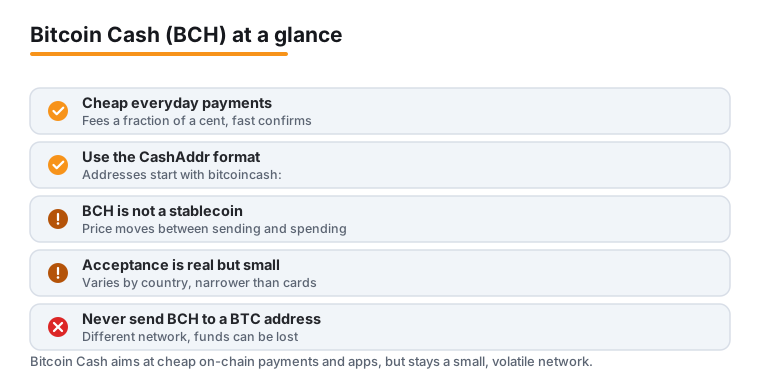
BCH is not a stablecoin: its price moves with the wider crypto market, so the local-currency value of a payment can change between sending and spending. Merchant acceptance, while real, is narrower than for major payment cards, and availability varies by region. As with any crypto, you are responsible for your own security and for understanding the tax and legal treatment of payments where you live. None of this is financial, legal, or tax advice, confirm the rules that apply to you with a qualified professional or official sources.
What changed in 2025-2026
Bitcoin Cash spent 2025 and 2026 turning into far more than a payments coin, through two yearly protocol upgrades that both activate on 15 May. These were ordinary planned upgrades, not contentious splits, and the network kept running normally through both.
The May 2025 upgrade: bigger numbers, more contract room
On 15 May 2025 the network activated two changes aimed squarely at smart contracts: CHIP-2021-05 VM Limits (a redesign of how much work a contract is allowed to do, swapping old fixed caps for fairer density-based budgets) and CHIP-2024-07 BigInt (high-precision arithmetic, so contracts can handle very large numbers). Together they removed limits that had been in place since the early days and made room for things like zero-knowledge proof checks on chain. You can read the official summary at bch.info and a plain-language write-up of the changes at The Crypto Kiosk.
The May 2026 “Layla” upgrade: a real scripting language
On 15 May 2026 the network activated a larger upgrade often called Layla, which finished building out a scripting system the community calls CashVM. It bundled four approved proposals: Loops (bounded repetition with OP_BEGIN/OP_UNTIL), Functions (reusable bytecode via OP_DEFINE/OP_INVOKE), Bitwise operations, and Pay to Script. In plain terms, contract authors can now write shorter, more capable programs directly on Bitcoin Cash, including support for post-quantum cryptography in some wallets. Details of the four proposals are on bitjson's blog.
A first stablecoin on chain
The CashTokens system (live since 2023) also got its first stablecoin in this period: MUSD, issued by the Moria Protocol, the first stablecoin built as a CashToken on Bitcoin Cash. It is a small early project, not a household name, but it shows the network can host the same kind of dollar-pegged tokens people use elsewhere. If you are new to how those work, see our overview of stablecoins and the GENIUS Act. None of this is a recommendation to use any specific token.
BCH vs Bitcoin today
The original BCH vs BTC table above still holds: Bitcoin Cash keeps fees tiny with large blocks, Bitcoin keeps blocks small and leans on extra layers. But a few things are worth adding for where the two stand in 2026.
Fees and blocks, in practice
The gap people argued about in 2017 is still real day to day. A normal Bitcoin Cash transaction costs roughly a hundredth of a cent and confirms in the next block, while a Bitcoin transaction can cost anywhere from cents to several dollars depending on how busy the network is. Bitcoin's answer for cheap spending is the Lightning Network, a separate layer on top of BTC; Bitcoin Cash instead keeps the cheap payments on the base chain itself. That is the core design difference, and after the 2025 and 2026 upgrades it also means BCH now runs richer smart contracts on that same base chain, something Bitcoin deliberately keeps minimal.
Honest standing in the market
It helps to be straight about scale. As of mid-2026, Bitcoin Cash sits around the mid-20s by market value (roughly 26th, near $4 billion), with a price in the low $200s, according to CoinGecko. Bitcoin remains the largest cryptocurrency by a wide margin. So while BCH and BTC share a name and a starting point, they are not close competitors by size: Bitcoin is the dominant store-of-value asset, and Bitcoin Cash is a much smaller network focused on cheap payments and on-chain apps. Both share the same 21-million cap and SHA-256 mining, and both went through their last halving in 2024. For a wider side-by-side with other coins, see our crypto comparisons guide.
If you are weighing the two, neither one is automatically the “better” choice; they were built for different jobs. This is background to help you understand them, not financial advice.
Real-world payment use in 2026
Bitcoin Cash was made to be spent, and in 2025-2026 that is still its clearest role. The picture is positive but modest, so it is worth describing plainly rather than overselling it.
- Where it is accepted. Crypto-payment trackers list on the order of a few thousand businesses worldwide that take BCH directly, plus dozens of payment gateways that handle it. By one widely cited count it ranks among the most-used coins for payments after Bitcoin, Ethereum and Litecoin. Reporting on this 2025 merchant growth is collected by ABC Money.
- Where it gets used most. Everyday spending leads: shops, online stores and internet services, rather than big-ticket luxury purchases. Low fees make small payments practical, which is the whole point of the network.
- Cross-border and high-inflation use. Coverage points to growing use as a payment method in parts of South America, Africa and Southeast Asia, where low fees and fast settlement matter more than brand recognition. This overlaps with the broader story of crypto and financial inclusion and with crypto remittances.
- Event and point-of-sale demos. Conferences and pop-up markets have run live BCH checkout to show it works at a counter, scanning a QR code and confirming in seconds.
The honest caveats
Adoption is real but still small next to card networks, and it varies a lot by country, so do not assume your local shop takes it. BCH is also not a stablecoin: its price moves with the market, so the local-currency value of a payment can change between the moment you send and the moment a merchant cashes out (many use a processor that converts to local money instantly to avoid that). And you are responsible for the tax and reporting rules where you live; see our note on crypto taxes. This is educational information, not financial, legal, or tax advice.
Frequently asked questions
Is Bitcoin Cash the same as Bitcoin?
No. Bitcoin Cash (BCH) is a separate cryptocurrency that split off from Bitcoin (BTC) in a 2017 hard fork. They share a common history and a similar design, including the 21-million supply cap and SHA-256 mining, but they are independent networks with different rules, prices, and communities. BCH uses much larger blocks to keep fees low for payments, while BTC keeps blocks small and is treated more as a store of value. The two coins are not interchangeable.
Why was Bitcoin Cash created?
It was created to keep transactions cheap and fast enough for everyday use. As Bitcoin grew popular, its limited block size led to congestion, higher fees, and slower confirmations during busy periods. A group of developers and miners wanted to scale by enlarging blocks on the main chain rather than relying mainly on separate layers. When that approach was not adopted by Bitcoin, they launched Bitcoin Cash as a separate network in August 2017.
Does Bitcoin Cash have a maximum supply?
Yes. Like Bitcoin, Bitcoin Cash is capped at 21 million coins. New BCH is issued to miners as a block reward, and that reward halves roughly every four years (every 210,000 blocks). The most recent halving was in April 2024, which set the block reward at 3.125 BCH; the next is expected around 2028. This predictable, limited issuance is one of the features BCH inherited from Bitcoin.
What are CashTokens?
CashTokens is an upgrade activated in 2023 that lets people create tokens directly on the Bitcoin Cash blockchain, both fungible tokens (such as a project token or stablecoin) and non-fungible tokens (NFTs). Combined with later upgrades that expanded BCH's smart-contract abilities, it allows developers to build decentralized applications and tokenized assets on top of Bitcoin Cash while keeping its low fees and fast confirmations.
Is Bitcoin Cash a good investment?
That depends entirely on your own goals, risk tolerance, and research, and this page does not give investment advice. BCH is a volatile asset whose price can rise or fall sharply, and it competes with many other cryptocurrencies. If you are considering it, learn how it works, only commit money you can afford to lose, and consider speaking with a qualified financial professional. Avoid relying on price predictions, which are inherently unreliable.
What is the Layla / CashVM upgrade?
Layla is the name of the Bitcoin Cash network upgrade that activated on 15 May 2026. It finished building out a contract scripting system the community calls CashVM by adding four features: bounded loops, reusable functions, bitwise operations, and pay-to-script. The short version is that smart contracts on Bitcoin Cash can now do much more, with shorter and cheaper code, while keeping the same low fees. It followed the May 2025 upgrade (VM Limits and BigInt), which laid the groundwork by replacing old fixed limits with fairer density-based budgets and adding high-precision math.
Where does Bitcoin Cash rank today?
As of mid-2026, Bitcoin Cash sits roughly in the mid-20s by total market value (around 26th place, near $4 billion), with a price in the low $200s, per CoinGecko. That makes it a well-known but mid-sized cryptocurrency, far smaller than Bitcoin, which remains the largest by a wide margin. Rankings and prices change constantly, so check a live source such as CoinGecko or CoinMarketCap before relying on any figure. This is not investment advice.
Last updated: 2026-06.