Bitcoin Halving Explained
Roughly every four years, the amount of new bitcoin created with each block of transactions is cut in half. This scheduled event is the bitcoin halving (sometimes written "halvening"), and it is one of the few things about Bitcoin that is genuinely predictable: it is written into the protocol's source code, it happens automatically, and no company, government, or developer can move it. The halving sits at the heart of Bitcoin's monetary design, the mechanism that enforces a fixed supply of 21 million coins and steadily slows the rate at which new ones enter circulation. This guide explains what the halving actually does, why Bitcoin was built this way, what the historical record does and does not tell us about price, and how each halving reshapes the economics of mining. None of it is financial, tax, or investment advice; it is an explanation of how the system works so you can interpret the headlines for yourself.
What is the halving?
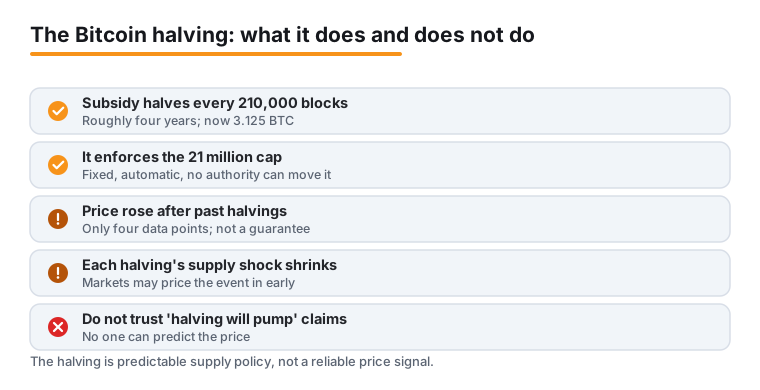
New bitcoin is not printed by a central bank. It is created as a reward paid to miners, the operators who run specialized computers to validate transactions and add new blocks to the blockchain roughly every ten minutes. Part of what a miner earns for each block is the block subsidy: a fixed number of freshly minted bitcoin. The halving is the moment that subsidy is cut in half.
It is not scheduled by date. It is triggered by block count: every 210,000 blocks the subsidy halves. Because blocks are targeted to arrive about every ten minutes, 210,000 blocks works out to roughly four years, but the exact timing drifts depending on how fast blocks are actually found. When Bitcoin launched in 2009, the subsidy was 50 BTC per block. It has since fallen on the following schedule:
| Halving | Approx. date | Block height | Subsidy before | Subsidy after |
|---|---|---|---|---|
| 1st | Nov 2012 | 210,000 | 50 BTC | 25 BTC |
| 2nd | Jul 2016 | 420,000 | 25 BTC | 12.5 BTC |
| 3rd | May 2020 | 630,000 | 12.5 BTC | 6.25 BTC |
| 4th | Apr 2024 | 840,000 | 6.25 BTC | 3.125 BTC |
| 5th | Expected ~2028 | 1,050,000 | 3.125 BTC | 1.5625 BTC |
As of 2026, the current block subsidy is 3.125 BTC, following the April 2024 halving. The next halving is expected around 2028, when the subsidy will drop to roughly 1.5625 BTC. This continues until around the year 2140, when the subsidy will have shrunk through about 32 halvings to effectively zero and no new bitcoin will be created. From that point miners will be paid only by transaction fees. Because exact dates depend on block timing, treat any specific countdown as an estimate and confirm the current block height and subsidy on a public blockchain explorer.
Why it happens
The halving exists to enforce a fixed, transparent, and slowing supply. Bitcoin's pseudonymous creator, Satoshi Nakamoto, designed the issuance to imitate the extraction of a scarce commodity like gold, where the easy deposits are mined first and each additional unit becomes harder to obtain. Instead of leaving that to geology, Bitcoin encodes it in software.
Two design goals drive it:
- A hard cap of 21 million coins. Adding up every block subsidy across all the halvings produces a geometric series that converges to just under 21 million BTC. The halving is simply the mechanism that makes the math work, each four-year era issues half as much as the one before, so the total can never exceed the cap. This is the feature most often summarized as Bitcoin's "digital scarcity."
- A predictable, disinflationary issuance. Traditional currencies can be created in unlimited quantity at the discretion of a central bank. Bitcoin takes the opposite approach: its inflation rate (the pace at which new supply is added) is fixed in advance and steps down at each halving. After the 2024 halving, annual new issuance fell to roughly 0.8% of circulating supply and will keep falling. Supporters describe this as "sound money" with a known, unchangeable monetary policy.
Crucially, the rule is enforced by consensus, not by any authority. Every node on the network independently checks that each block pays out only the allowed subsidy. A miner who tried to award itself more bitcoin than the rules permit would simply have its block rejected by everyone else. Changing the cap or the schedule would require an overwhelming majority of the network to agree to new software, something the community has shown no appetite for. That is why the 21 million limit is often called credibly fixed: it is protected by the economic self-interest of everyone who holds and runs Bitcoin.
Past halvings & price
This is the topic that draws the most attention and the most overconfident claims. The honest summary: in the cycles that followed the 2012, 2016, and 2020 halvings, Bitcoin's price rose substantially over the following twelve to eighteen months. That historical pattern is real. What it is not is a guarantee, a schedule, or a law of nature.
A few points help put the record in perspective:
- The reaction is not instant. Prices have historically not spiked on the day of the halving. Any moves have tended to play out over the months that followed, and each cycle has included sharp drawdowns along the way, not a smooth climb.
- Three or four data points is a very small sample. Bitcoin has only ever had four halvings. Drawing a confident trend line through so few events, each occurring in wildly different macroeconomic conditions, is statistically weak. Correlation here is not proof of causation.
- The supply shock shrinks each time. A halving from 50 to 25 BTC was a far larger proportional cut to new supply than the 2024 cut from 6.25 to 3.125 BTC. As the subsidy becomes a smaller fraction of the total existing supply, the mechanical impact of each halving on the flow of new coins diminishes.
- Markets may price it in ahead of time. The halving date is known years in advance. In an efficient market, a widely anticipated event is at least partly reflected in the price before it happens, which complicates any simple before-and-after story.
- Many other forces move the price. Interest rates, regulation, the launch of new investment products, exchange failures, and broad risk sentiment have all driven large price moves that had nothing to do with the issuance schedule. Attributing later price action solely to the halving ignores these.
One related concept worth knowing is the ripple effect on altcoins. Historically, when Bitcoin enters a strong period, attention and capital have often flowed into other cryptocurrencies as well, and broad market sentiment tends to rise and fall together. But altcoins do not have their own Bitcoin halving, the event is specific to Bitcoin's issuance, so any effect on them is indirect and driven by market psychology rather than by their own supply mechanics. This guide does not make price predictions, and no one can reliably tell you what any token will do. Treat "halving will pump the market" narratives with healthy skepticism, do your own research, and never invest money you cannot afford to lose.
Impact on miners
For miners, the halving is the most consequential event in the cycle, because it instantly cuts the block subsidy portion of their revenue in half while their costs, electricity, hardware, and facilities, do not change overnight. A miner earning 6.25 BTC per block one day was earning 3.125 BTC the next. This single change drives a chain of adjustments across the mining ecosystem.
- A profitability squeeze. Operations running on expensive electricity or older, less efficient machines can suddenly find that the cost to mine a coin exceeds its market value. Unless the bitcoin price rises enough to offset the reduced subsidy, the least efficient miners are forced to power down or sell out.
- Difficulty adjustment cushions the network. Bitcoin automatically retargets its mining difficulty about every two weeks to keep blocks arriving roughly every ten minutes. If miners switch off after a halving and blocks slow down, difficulty falls, making mining easier and more profitable for those who remain. This built-in stabilizer is why the network keeps running smoothly even when some miners capitulate.
- A push toward efficiency. Each halving raises the premium on cheap power and modern, energy-efficient hardware. Miners respond by upgrading rigs, renegotiating energy contracts, seeking stranded or surplus energy, and in some cases relocating to regions with lower electricity costs. Over successive halvings this has contributed to shifts in the geographic distribution of mining and a steady drive toward more efficient operations.
- Consolidation. Because scale and low costs matter more after each cut, halvings tend to favor larger, well-capitalized, professionally run operations over small hobbyists, gradually consolidating the industry.
- The growing role of transaction fees. As the subsidy shrinks toward zero over the coming century, transaction fees are designed to become the primary, and eventually the only, way miners are paid. How robust that fee market becomes is one of the genuinely open long-term questions about Bitcoin's security budget, and it is something researchers actively debate rather than a solved problem.
The key takeaway is that the halving does not threaten the network's operation, the difficulty adjustment and miner competition keep it secure, but it does relentlessly test the economics of mining, rewarding efficiency and punishing waste with each cycle.
Frequently asked questions
When is the next Bitcoin halving?
The most recent halving occurred in April 2024 at block height 840,000, cutting the subsidy to 3.125 BTC. The next one is expected around 2028, at block height 1,050,000, when the subsidy will fall to roughly 1.5625 BTC. Because the halving is triggered by block count rather than a fixed calendar date, and blocks arrive at slightly variable speeds, the exact date is only an estimate. Check a public blockchain explorer for the current block height to see how close it is.
Does the halving make the price of Bitcoin go up?
There is no guarantee. The price rose over the months following each of the past halvings, but with only four halvings on record, that is a very small sample, and many other factors, regulation, interest rates, investment products, and overall market sentiment, also move the price. The supply impact of each halving also shrinks over time. Anyone claiming to know what the price will do is guessing. This is not investment advice; do your own research and never risk money you cannot afford to lose.
What happens to miners after a halving?
Their block subsidy revenue is instantly cut in half while their electricity and hardware costs stay the same, squeezing profit margins. Less efficient miners may shut down or sell. The network's automatic difficulty adjustment then makes mining easier for those who remain, keeping blocks arriving about every ten minutes. Over time, halvings push the industry toward cheaper energy, more efficient hardware, and larger-scale operations.
Will Bitcoin halvings continue forever?
No. The subsidy halves every 210,000 blocks (about four years) and will keep doing so until roughly the year 2140, after approximately 32 halvings, at which point the new-coin reward effectively reaches zero and the 21 million supply cap is reached. After that, no new bitcoin will be created and miners will be compensated entirely through transaction fees.
Can anyone change or cancel the halving?
Not in any practical sense. The schedule and the 21 million cap are enforced by every node on the network independently, and blocks that violate the rules are rejected. Altering them would require an overwhelming majority of participants to adopt new software that breaks Bitcoin's core monetary policy, which the community has consistently rejected. This is why the issuance schedule is described as fixed and credibly enforced rather than a matter of anyone's discretion.
Last updated: 2026-06.