Bitcoin History & Satoshi Nakamoto
Bitcoin is the first cryptocurrency, a form of money that runs on a public network of computers instead of a bank or government. Its story begins with a problem older than the internet: how do you let strangers send value directly to each other, over a network, without a trusted middleman to prevent the same coin from being spent twice? In late 2008, a person or group using the name Satoshi Nakamoto published a short technical paper proposing an answer, and a few weeks later launched the software that made it real. This guide traces the history of Bitcoin and Satoshi Nakamoto from that 2008 whitepaper through the key milestones that followed, and explains how the system has evolved into the network used worldwide today. It is written to be accurate and brand-neutral; where exact figures, dates, or laws matter to a decision, verify them against primary sources rather than relying on any single summary.
Who is Satoshi Nakamoto?
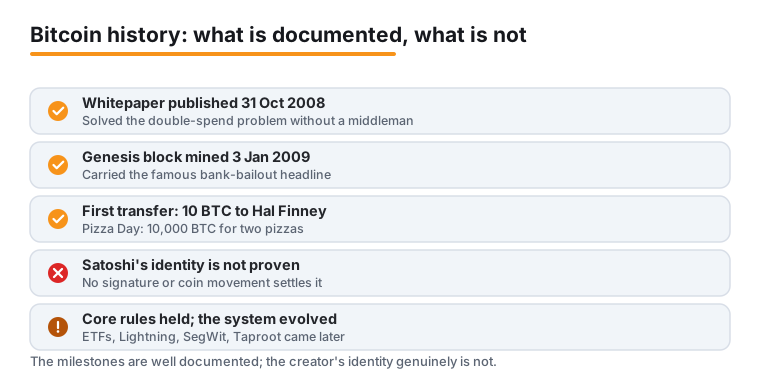
Satoshi Nakamoto is the pseudonym used by the creator (or creators) of Bitcoin. The name appears on the original whitepaper, on the early software releases, and in thousands of forum posts and emails written between 2008 and 2011, but no one has ever conclusively proven who was behind it. Satoshi communicated only in text, never appeared on video or in person, and the personal details that were given (such as a Japanese name and a birth date) are widely believed to be fictional. To this day the true identity remains unknown, which makes the genuinely decentralized nature of Bitcoin part of its founding story: the network was deliberately designed to keep running without its creator.
What is documented is the work itself. Satoshi corresponded with established cryptographers, refined the design in public, mined the first blocks, and handed out the earliest coins. One of the most important early collaborators was Hal Finney, a respected cryptographer who ran the software within days of its release and received the first-ever person-to-person Bitcoin transaction. Over time, Satoshi gradually stepped back. In emails around April 2011, Satoshi told other developers they had "moved on to other things" and handed control of the project's code repository and the network-alert key to early contributor Gavin Andresen, then went silent. The coins Satoshi is believed to have mined in the earliest days have never moved.
Several people have been named as candidates over the years, and at least one individual has publicly claimed to be Satoshi, but none of these claims has been backed by the one piece of proof that would settle the question: a cryptographic signature from the keys known to belong to Bitcoin's creator, or movement of the early coins. Treat any confident "Satoshi unmasked" headline with skepticism. The honest answer in 2026 is that the identity is still genuinely unknown.
The 2008 whitepaper
On 31 October 2008, Satoshi posted a link to a nine-page paper titled "Bitcoin: A Peer-to-Peer Electronic Cash System" to a cryptography mailing list. The paper did not invent its ingredients from scratch. Digital-cash and timestamping ideas had circulated for decades, and Bitcoin built on earlier concepts such as hash-based proof of work and cryptographic time-stamping. What the whitepaper combined into a single working design was an answer to the long-standing double-spend problem: in a purely digital system, what stops someone from copying a coin and spending it twice?
The paper's core ideas remain the foundation of the network today:
- A public, shared ledger (the blockchain). Every transaction is grouped into a block and chained to the previous one, so the whole history is visible and tamper-evident. Altering an old record would require redoing all the work that came after it.
- Proof of work. Participants called miners compete to solve a computational puzzle to add the next block. This makes rewriting history expensive and lets the network agree on a single valid order of transactions without a central authority.
- A fixed, predictable issuance schedule. New bitcoin enters circulation as a block reward, and that reward is cut in half at regular intervals (the "halving"). The design caps the eventual supply at 21 million coins, making Bitcoin scarce by rule rather than by promise.
- Decentralized consensus. No single server runs Bitcoin. Thousands of independent nodes each keep a copy of the rules and the ledger and reject anything that breaks them, so there is no central point to shut down or corrupt.
The whitepaper is short, freely available, and still worth reading directly; it is the clearest primary source on what Bitcoin was meant to be. Many later "explanations" drift from the original, so going to the source is the best way to separate fact from marketing.
Key milestones
Bitcoin's history is easiest to follow as a sequence of concrete events rather than hype cycles. The dates below are well documented; the table summarizes the foundational ones.
| Date | Milestone | Why it mattered |
|---|---|---|
| 31 Oct 2008 | Whitepaper published | The design for a peer-to-peer electronic cash system is shared publicly |
| 3 Jan 2009 | Genesis block mined | The network goes live; the first block carries a now-famous news headline |
| 12 Jan 2009 | First transaction | Satoshi sends 10 BTC to Hal Finney, the first person-to-person transfer |
| 22 May 2010 | First real-world purchase | 10,000 BTC are paid for two pizzas, now remembered as "Bitcoin Pizza Day" |
| ~Apr 2011 | Satoshi steps away | The creator hands off the project and stops posting |
A few of these deserve a closer look. The very first block, the genesis block mined on 3 January 2009, contained an embedded line of text: "The Times 03/Jan/2009 Chancellor on brink of second bailout for banks." That headline, taken from a London newspaper during the financial crisis, both timestamps the block and reads as a comment on the banking system Bitcoin was meant to offer an alternative to. The early block reward was 50 BTC.
The "pizza" transaction of May 2010, in which a programmer paid 10,000 BTC for two pizzas, is celebrated every year because it was one of the first times bitcoin was used to buy a physical good, establishing that it could function as money and not just a number on a screen. After Satoshi's departure in 2011, Bitcoin had no leader, only an open-source codebase and a global community of developers, miners, and users, which is exactly how it was designed to operate.
How Bitcoin evolved
From a single experiment among cryptographers, Bitcoin grew into a global, multi-trillion-dollar network. Its evolution falls into a few broad themes rather than a smooth line, and along the way it shifted in public perception from a fringe curiosity to a topic covered routinely by mainstream finance and technology media.
The issuance schedule and halvings. The block reward halves roughly every four years (every 210,000 blocks). It started at 50 BTC, then fell to 25, 12.5, 6.25, and at the fourth halving in April 2024 dropped to 3.125 BTC. The next halving is expected around 2028, when the reward is scheduled to fall again to about 1.5625 BTC. This predictable, decreasing supply is central to Bitcoin's design as a scarce digital asset; the schedule is enforced by the software, not by anyone's discretion.
Scaling and software upgrades. As usage grew, so did debate over how to handle more transactions. Bitcoin's base layer prioritizes security and decentralization over raw speed, so much of the scaling work moved to additional layers and protocol refinements. The Lightning Network, a "layer 2" built on top of Bitcoin, enables fast, low-cost payments by settling many small transactions off-chain and recording the net result on the main ledger. Protocol upgrades such as SegWit (2017) and Taproot (2021) improved capacity, efficiency, and privacy. Because Bitcoin has no central operator, such changes happen only when a broad majority of the network adopts them, which is deliberately slow and conservative.
- Infrastructure matured. Custody moved from clunky early software toward dedicated hardware wallets, regulated exchanges, and professional custodians, lowering the barrier to holding bitcoin safely.
- Institutional access widened. In January 2024, U.S. regulators approved the first spot Bitcoin exchange-traded funds (ETFs), letting investors gain exposure through ordinary brokerage accounts. Other jurisdictions have introduced their own regulated products. Availability and rules differ by country and change over time, so check what applies where you live.
- Regulation took shape. Governments moved from largely ignoring Bitcoin to writing tax, securities, and anti-money-laundering rules around it. These vary widely between countries and continue to evolve.
- New uses and debates emerged. Beyond payments and saving, people experiment with bitcoin for micropayments, remittances, and as a reserve asset, while debates continue over volatility, energy use, and the right regulatory approach.
Through all of this, the core rules Satoshi described in 2008, the capped supply, proof-of-work consensus, and a public ledger maintained by a decentralized network, have stayed intact. That continuity, more than any single price moment, is what defines Bitcoin's history.
This article is educational and is not financial, legal, or tax advice. Bitcoin's price is highly volatile and you can lose money; nothing here is a recommendation to buy or sell. For anything involving your own taxes, regulations, or investments, confirm the current rules with official sources or a qualified professional.
Frequently asked questions
Who created Bitcoin, and is their identity known?
Bitcoin was created by someone using the pseudonym Satoshi Nakamoto, who published the whitepaper in 2008 and launched the network in 2009. The true identity has never been confirmed. Satoshi communicated only in writing, stepped away from the project around 2011, and the coins believed to be theirs have never moved. Several people have been proposed or have claimed to be Satoshi, but none has provided the cryptographic proof that would settle the matter, so as of 2026 the identity remains genuinely unknown.
When was the Bitcoin whitepaper published, and what did it solve?
The paper, titled "Bitcoin: A Peer-to-Peer Electronic Cash System," was posted on 31 October 2008. Its central contribution was solving the double-spend problem for digital money without a trusted middleman, by combining a public blockchain ledger, proof-of-work mining, a capped and predictable supply, and decentralized consensus among independent nodes. The paper is short and freely available, and remains the best primary source on Bitcoin's original design.
What was the first Bitcoin transaction?
The network went live with the genesis block on 3 January 2009. The first person-to-person transaction came on 12 January 2009, when Satoshi Nakamoto sent 10 BTC to the cryptographer Hal Finney, an early supporter who ran the software within days of its release. A separate well-known milestone is the first real-world purchase on 22 May 2010, when 10,000 BTC were paid for two pizzas, an event now remembered annually as Bitcoin Pizza Day.
What is the Bitcoin halving and why does it matter?
Roughly every four years (every 210,000 blocks), the reward miners receive for adding a block is cut in half. It began at 50 BTC and, after the fourth halving in April 2024, stands at 3.125 BTC, with the next halving expected around 2028. The halving enforces Bitcoin's gradually shrinking, ultimately capped supply of 21 million coins. It is one of the clearest examples of rules being enforced automatically by software rather than by any central authority.
How has Bitcoin changed since it launched?
Bitcoin grew from a small experiment into a global network, while its core rules stayed the same. Storage matured from rough early software to hardware wallets and regulated custodians; scaling work produced layer-2 systems such as the Lightning Network and protocol upgrades like SegWit and Taproot; and access widened, including the first U.S. spot Bitcoin ETFs in January 2024. Regulation also developed worldwide and continues to evolve. Availability and rules differ by country, so confirm what applies to you with official sources.
Last updated: 2026-06.