Bitcoin Adoption & Institutional Money
For most of its history, Bitcoin was treated as a fringe experiment by the financial establishment. That has changed. Over the past few years, the asset has moved from retail-driven speculation toward something closer to a recognised, if still volatile, part of institutional portfolios. Regulated exchange-traded funds now hold hundreds of thousands of coins on behalf of pensions, advisers and individuals. Public companies have put Bitcoin on their balance sheets as a treasury reserve. Governments and central banks, once almost uniformly dismissive, are split between cautious regulation, outright reserves, and the development of their own digital currencies.
This page explains what "institutional adoption" actually means in practice: who is buying, through what vehicles, why, and what the main risks and open questions are heading into 2026. The figures here move constantly and are drawn from public reporting at the time of writing; treat them as a snapshot and verify current numbers with primary sources before acting on them. None of this is financial, legal or tax advice.
The state of adoption
Bitcoin adoption is best understood as several overlapping waves rather than a single trend. The first was retail: individuals buying and holding through exchanges. The second was infrastructure: custodians, payment processors and trading desks built to institutional standards. The third, and the one that defines the current period, is the arrival of regulated, familiar wrappers that let large pools of capital gain exposure without touching the underlying technology directly.
Three forces are most often cited as drivers. First, the search for a hedge or diversifier during periods of monetary expansion, currency weakness and inflation, where a fixed-supply asset outside any single government's control is attractive to some allocators. Second, maturing access: spot ETFs, qualified custodians and clearer accounting rules have lowered the operational and career risk of holding it. Third, regulatory clarity in major markets, which has reduced the ambiguity that previously kept conservative institutions on the sidelines.
Adoption is also uneven by geography. Some jurisdictions have embraced crypto markets with comprehensive rules; others restrict or effectively ban them; many sit in between. In several emerging economies, grassroots use for savings and remittances has grown faster than formal institutional involvement, driven by currency instability rather than portfolio theory. The headline point is that Bitcoin's user base now spans individuals, fintechs, corporates, funds and, in a handful of cases, governments.
Spot Bitcoin ETFs
The single most important structural change in recent years has been the launch of US spot Bitcoin exchange-traded funds in January 2024. Unlike earlier futures-based products, these funds hold actual Bitcoin in custody and aim to track its spot price. For advisers, retirement accounts and institutions that cannot easily hold the asset directly, an ETF that trades like any other security removed a major barrier.
Demand was substantial. Cumulative net inflows into the US spot ETFs since launch have run into the tens of billions of dollars, with combined assets under management reported in the region of roughly 90 to 95 billion dollars as of mid-2026, though this figure swings sharply with the Bitcoin price. BlackRock's IBIT has been the dominant fund by a wide margin, holding on the order of 800,000-plus BTC, with Fidelity's FBTC the next largest. These are approximate, fast-moving numbers; check the issuers' own disclosures or a reputable tracker for current totals.
What ETFs change, and what they do not, is worth being precise about:
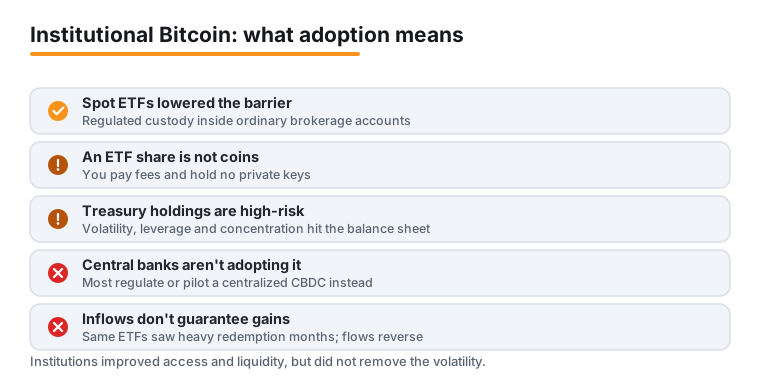
- Access and legitimacy: exposure now sits inside ordinary brokerage and advisory accounts, with regulated custody and daily reporting.
- Flows cut both ways: the same vehicles that absorbed large inflows have also seen heavy redemption months. ETF demand is not a one-way ratchet, and net flows can turn negative quickly during volatility.
- You still hold a security, not coins: an ETF share is a claim on a fund, not self-custodied Bitcoin. There are fees, and you do not control private keys.
Spot ETFs for other assets have followed, but Bitcoin remains the largest and most liquid. The arrival of these products is the clearest single signal that traditional finance now treats Bitcoin as an investable asset class, even as opinions on its long-term value remain divided.
Corporate treasuries
A second strand of institutional adoption is companies holding Bitcoin directly as a treasury reserve asset, in place of, or alongside, cash and short-term instruments. The pioneer and by far the largest holder is the firm formerly known as MicroStrategy, now operating as Strategy, which has accumulated well over 800,000 BTC funded through a mix of cash, convertible debt and equity issuance. Its scale means it accounts for a large share of all corporate Bitcoin holdings on its own.
Public companies collectively are reported to hold somewhere in the region of 1.1 to 1.2 million BTC as of 2026, a meaningful fraction of the roughly 21 million coins that will ever exist, though tracking estimates vary by source. Beyond Strategy, the field has broadened to include Bitcoin miners that retain part of what they produce (such as MARA), and a number of dedicated treasury vehicles in different markets, including Japan's Metaplanet and newer entrants like Twenty One Capital. Again, treat specific holdings figures as approximate and verify against company filings.
The rationale typically offered is some combination of treating Bitcoin as a long-duration store of value, a hedge against currency debasement, and a way to differentiate the company. The risks are equally clear and should not be glossed over:
- Volatility on the balance sheet: large price swings flow into reported financials, and accounting treatment for digital assets has evolved, affecting how gains and losses appear.
- Leverage: firms that fund purchases with debt amplify both upside and downside, and face refinancing risk if conditions tighten.
- Concentration: a treasury heavily weighted to one volatile asset ties the company's fortunes to Bitcoin's price to a degree some shareholders may not want.
For most operating businesses, holding Bitcoin as a treasury asset remains a deliberate, high-risk strategic choice rather than standard practice. Companies considering it generally seek tailored accounting, tax and legal advice first.
Central banks & Bitcoin
Central banks sit at the heart of the tension Bitcoin creates. Their core job is monetary and financial stability, achieved through tools such as setting interest rates and managing the money supply. Bitcoin, by design, sits outside that control: it has a fixed issuance schedule and no central issuer. That makes the relationship less a partnership than a set of competing responses, which broadly fall into three camps.
Regulate and integrate. Many advanced economies have chosen to bring crypto inside the regulatory perimeter rather than ban it. The European Union's Markets in Crypto-Assets (MiCA) framework, fully applicable since the end of 2024, is the most comprehensive example, setting rules for issuers and service providers across the bloc, with further refinement under discussion. Other major jurisdictions have moved toward clearer licensing, custody and disclosure standards. The aim is consumer protection and financial-stability oversight without prohibition.
Hold or reserve. A newer and more striking development is governments treating Bitcoin as a reserve-style asset. In the United States, an executive order in March 2025 directed the creation of a Strategic Bitcoin Reserve built initially from coins already forfeited to the government; the US is among the largest known state holders, with public estimates around 300,000-plus BTC, and the policy framework around it was still being defined in 2026. Several US states have separately explored their own holdings. These initiatives remain early and politically contested.
Issue an alternative. Most central banks' main strategic answer is not to hold Bitcoin but to research or pilot a central bank digital currency (CBDC) - a state-issued digital form of national currency. A CBDC is the opposite of Bitcoin in spirit: centrally controlled and fully sovereign. The El Salvador episode illustrates the limits of the most aggressive approach: having made Bitcoin legal tender in 2021, the country removed that mandatory status in 2025 as part of an agreement with the International Monetary Fund, while still permitting voluntary private use.
The practical takeaway is that there is no single official stance. Treatment of Bitcoin and crypto varies widely by country and changes frequently, so anyone operating across borders should confirm the current rules with official regulators and qualified local advisers rather than relying on general summaries.
Frequently asked questions
What does "institutional adoption" of Bitcoin actually mean?
It refers to large, professional participants - asset managers, funds, advisers, public companies and in some cases governments - gaining exposure to Bitcoin, usually through regulated vehicles such as spot ETFs, qualified custodians or direct treasury holdings. It is distinct from retail adoption by individuals, and it tends to bring more capital, more oversight and more mainstream infrastructure.
Is buying a spot Bitcoin ETF the same as owning Bitcoin?
Not exactly. A spot ETF holds Bitcoin in custody and aims to track its price, but what you own is a share in a fund, not the coins themselves. You do not control private keys, you pay a management fee, and you rely on the fund and its custodian. The trade-off is convenience and regulated access versus the self-custody and direct control of holding Bitcoin yourself.
Why would a company hold Bitcoin in its treasury?
Companies that do so usually frame it as a long-term store of value and a hedge against currency debasement, or as a way to differentiate themselves. The risks are significant: price volatility flows into reported financials, debt-funded purchases add leverage, and a large allocation concentrates the company's fortunes in one volatile asset. It remains a high-risk strategic choice rather than common practice, and firms generally take professional accounting, tax and legal advice first.
Are central banks adopting Bitcoin?
Mostly no, at least not as their own currency. Central banks' primary response has been to regulate crypto markets and, in many cases, to research or pilot their own central bank digital currencies, which are centrally controlled - the opposite of Bitcoin's design. A small number of governments have begun treating Bitcoin as a reserve-style asset, but this is early and varies by jurisdiction. Always verify the current position with official sources.
Is institutional interest a guarantee that Bitcoin's price will rise?
No. Institutional involvement has improved access and liquidity, but it does not remove volatility - the same ETFs that saw large inflows have also recorded heavy redemption months. Adoption trends and prices can move independently and can reverse. This page does not offer price predictions or investment advice; do your own research and consult a qualified professional before making decisions.
Last updated: 2026-06.