AI & Crypto: Hype vs Reality
Artificial intelligence and cryptocurrency are two of the most heavily marketed ideas in technology, so it is no surprise that combining them produces a lot of noise. Promotional articles promise trading bots that never lose, models that see the future, and tokens that turn idle hardware into passive income. Some of this is grounded in real engineering; much of it is exaggeration designed to sell a product or pump a coin.
This guide separates what AI genuinely does well in crypto from what is overstated. It covers how machine learning is actually used in trading, what predictive analytics can and cannot deliver, how to think about "AI tokens" and projects, and the specific risks that come with trusting an algorithm with your money. The goal is to leave you better equipped to evaluate claims rather than to repeat them. Nothing here is financial, legal, or tax advice; treat it as background for your own research.
AI in crypto trading
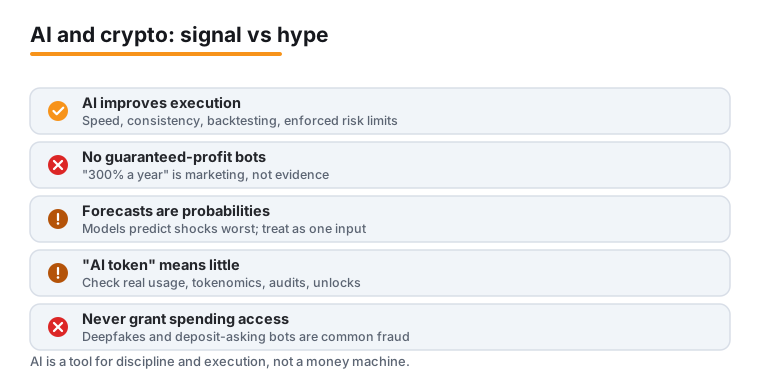
The most common real-world use of AI in crypto is in trading and execution. Here, "AI" usually means machine-learning models trained on historical price data, order-book activity, on-chain metrics, and sometimes text such as news headlines or social posts. These systems are used to score short-term probabilities, classify market conditions, size positions, and route orders. The genuine advantages are concrete and worth understanding.
What AI does well
- Speed and scale. Software can monitor hundreds of markets simultaneously and act in milliseconds. In fast, fragmented crypto markets that trade 24/7, this is a real edge over manual trading.
- Consistency. A rules-based or model-driven system executes the same plan every time. It does not panic-sell at 3 a.m. or chase a pump out of fear of missing out. Removing emotional, discretionary decisions is one of the most defensible benefits.
- Pattern detection in large datasets. Models can surface statistical relationships across many variables that a person would struggle to track. This is useful for flagging unusual conditions, not for revealing secret patterns "invisible to human eyes."
- Backtesting and risk controls. Strategies can be tested against historical data and wired to automatic stop-losses, position limits, and exposure caps that enforce discipline.
What it does not do
AI does not guarantee profit, and any source promising figures like "300% in the first year" should be treated as marketing, not evidence. Markets are adversarial and partly random; an edge that worked last quarter can decay as conditions change or as other participants adopt the same approach. Backtests routinely overstate performance because they are tuned on past data (a problem called overfitting). Many retail "AI trading bots" sold online are simple rule sets dressed up in AI language, and some are outright scams. The most credible framing is that AI is a tool that can improve execution and discipline, not a money machine.
Predictive analytics
Predictive analytics is the part of AI that markets like to dramatize as "forecasting the future." In practice it means using statistical and machine-learning techniques to estimate probabilities about what might happen next, based on the data the model has seen. It is closer to a weather forecast than a crystal ball: useful for stating that conditions favour a particular outcome, never a certainty.
Data these models use
- Market data: historical prices, volatility, trading volume, and order-book depth.
- On-chain data: wallet flows, exchange inflows and outflows, active addresses, and network activity unique to public blockchains.
- Sentiment and text: news, social media, and developer activity, processed with natural-language models to gauge mood and attention.
- Macro indicators: interest-rate expectations, liquidity conditions, and correlations with traditional assets.
Why honest caution matters
Crypto is volatile, relatively young, and prone to sudden shocks from regulation, exchange failures, or large holders moving funds. Those events are exactly the ones models predict worst, because there is little historical precedent to learn from. Sentiment data is also easy to manipulate with coordinated posting and bots. A well-built predictive system can tilt the odds and help with risk management, but treating its output as a reliable price prediction is how people lose money. This guide does not make price predictions, and you should be skeptical of any tool or article that does. Use forecasts as one input among many, and verify the underlying data yourself where you can.
AI tokens & projects
Beyond trading, a fast-growing category of crypto projects positions itself at the intersection of AI and blockchain. These are often grouped as "AI tokens," though the label covers very different ideas. As of early 2026 the sector spans hundreds of projects with a combined market value in the tens of billions of dollars, and it is highly volatile; figures move quickly, so check a current data source such as a major market tracker before relying on any number.
Main categories
| Type | What it aims to do | Example focus |
|---|---|---|
| Decentralized compute | Pool spare GPUs to run AI and rendering workloads, paying contributors in tokens | GPU and rendering networks |
| Decentralized machine learning | Coordinate and reward independent models that compete to provide useful intelligence | Open ML networks |
| AI agents | Autonomous software that can transact, negotiate, or perform tasks on-chain | Autonomous-agent platforms |
| Data and infrastructure | Supply, label, or verify data and provide AI tooling for other apps | Data marketplaces, AI-focused layer-1s |
How to evaluate them
A token being labelled "AI" tells you almost nothing about whether the product works or whether the token is needed for it to function. Ask practical questions: Is there a working product with real usage, or only a roadmap? Does the token have a genuine role (paying for compute, securing the network) or is it mainly a speculative chip? Who holds the supply, and how much unlocks over time? Is the team and code public and audited? Many AI tokens trade on narrative and react sharply to unrelated news from large AI companies, which means prices can run far ahead of fundamentals. We name categories rather than recommend specific coins, and nothing here is a recommendation to buy any asset.
Risks & hype
The same qualities that make AI useful also create new risks, and the marketing around it tends to hide them. Understanding the failure modes is the most valuable thing a reader can take away.
Technical and market risks
- Overfitting and model decay. A model tuned to past data often performs far worse live, and edges erode as markets change.
- Black-box opacity. If you cannot explain why a system made a trade, you cannot tell whether it is skilful or simply lucky until losses appear.
- Correlated failure. When many traders run similar models, they can buy and sell together, amplifying crashes and flash moves.
- Bad or manipulated data. Models are only as good as their inputs; spoofed volume, wash trading, and bot-driven sentiment can poison them.
Scams and security
AI is a popular wrapper for fraud. "AI trading" platforms promising guaranteed returns, deepfake celebrity endorsements, and bots that ask for deposits or wallet access are common ways people are robbed. At the same time, AI genuinely helps on the defensive side: exchanges and wallet providers use anomaly detection to flag unusual logins, suspicious transactions, and likely account takeovers, and to learn a user's normal behaviour so that legitimate activity is not constantly interrupted. This is a real and growing application, though it protects platforms and accounts rather than guaranteeing the safety of any individual asset. Basic precautions still matter most: keep keys in self-custody where appropriate, use hardware wallets and strong authentication, and never grant an unknown tool spending permissions.
The regulatory layer
Rules now apply to both halves of this topic and are tightening. In the EU, the MiCA framework moves toward full enforcement in 2026 (its transition period is set to end on 1 July 2026), broader crypto tax-reporting requirements are coming into force, and separate AI legislation is being phased in; other jurisdictions are advancing their own regimes. Automated trading, AI-driven advice, and AI tokens can all fall within these regimes. Because details vary by country and change frequently, do not rely on a summary like this one: confirm your obligations with official regulators and a qualified professional. This is general information, not legal, tax, or financial advice.
Frequently asked questions
Can AI predict the price of Bitcoin or other cryptocurrencies?
No tool can reliably predict prices. AI can estimate probabilities from historical and current data, which is useful for risk management, but crypto is volatile and reacts to events that models cannot anticipate. Treat any forecast as one input, never a guarantee, and be skeptical of products that claim certainty.
Are AI trading bots worth using?
It depends entirely on the bot and the user. A well-built system can improve speed and enforce discipline, but many retail bots are simple rules marketed as AI, and some are scams promising guaranteed returns. Be cautious, understand the strategy, start small, and never give a tool unrestricted access to your funds.
What is an "AI token" and is it the same as owning AI?
An AI token is a cryptocurrency tied to a project that touches AI, such as decentralized compute, machine-learning networks, or AI agents. Holding one is not the same as owning a stake in AI broadly; it is a speculative crypto asset whose value depends on the specific project's adoption, tokenomics, and the wider market. Evaluate each on its fundamentals.
Does AI make my crypto wallet safer?
AI helps on the defensive side. Exchanges and wallet providers use it to detect anomalies, flag suspicious logins and transactions, and reduce fraud. It is a useful layer but not a guarantee. Basic security habits, such as hardware wallets, strong authentication, and careful management of permissions, still matter most.
Do AI trading or AI tokens face regulation?
Increasingly, yes. Crypto services, automated trading, AI-driven advice, and AI-related tokens can fall under crypto rules such as the EU's MiCA, tax-reporting frameworks, and emerging AI laws, with significant changes landing in 2026. Requirements differ by jurisdiction and change often, so verify your situation with official sources and a qualified professional.
Last updated: 2026-06.