Bitcoin Basics: a Beginner’s Guide
Bitcoin is digital money that no bank or government runs. It was launched in 2009 by a person or group using the name Satoshi Nakamoto, with one idea: let people send money over the internet directly to each other, the way you hand someone cash, with no company in the middle. Seventeen years later, bitcoin is the oldest and largest cryptocurrency. By most estimates several hundred million people around the world now own some crypto, and since early 2024 you can even get bitcoin exposure through regulated funds at an ordinary stock broker.
None of that means you should buy it. It means it is worth understanding. This guide explains bitcoin the way you would explain it to a friend: what it is, how you hold it, what it costs, what goes wrong, and how to start carefully if you decide to. It is educational content, not financial advice.
What is bitcoin? Start with a notebook
Imagine a notebook that lists every payment a group of people has ever made to each other. Page after page: who paid, who got paid, how much. Normally a bank keeps that notebook, and you trust the bank to keep it honest. Bitcoin's big idea is to remove the bank. Instead, thousands of computers around the world each keep an identical copy of the notebook. Anyone can read it. Nobody can secretly edit it, because a faked entry in one copy would not match the others, and the network would reject it.
That notebook is real. It is called the blockchain, and a bitcoin is simply an entry in it saying that a certain address owns a certain amount. There is no physical coin anywhere, and no coin file on your computer either. There is only the shared record.
Three basics worth knowing from day one:
- Bitcoin vs bitcoin. Capital B usually means the network and its rules. Lowercase b means the money itself, also written as BTC.
- You can buy a tiny piece. Each bitcoin splits into 100 million units called satoshis. Ten dollars buys you some bitcoin. A whole coin is never required.
- The supply is capped. The rules allow only 21 million bitcoin to ever exist, and every computer on the network enforces that cap. Nobody can print more, which is why people compare it to digital gold.
You can see the live price and market data on our bitcoin price page.
What the blockchain does, in three sentences
One: the blockchain is that shared notebook, a public list of every bitcoin transaction ever made, grouped into pages called blocks, with a new page added roughly every ten minutes. Two: each new page is mathematically sealed to the page before it, so changing anything on an old page would break the seal on every page after it, and the thousands of computers holding copies would spot the fake at once. Three: the result is a money record that everyone can check and nobody can quietly rewrite, which is what lets two strangers send value across the internet without trusting a bank, a company, or each other.
Who adds the pages? Specialized computers called miners compete for the job. The winner adds the next block and earns brand new bitcoin as a reward. That reward is cut in half about every four years, an event called the halving. The most recent halving happened in April 2024, and the next one is expected around 2028. That slow squeeze is why the supply creeps toward 21 million and then stops, around the year 2140.
A wallet holds keys, not coins
Here is the thing that surprises most beginners: a bitcoin wallet does not contain bitcoin. The coins never leave the blockchain. What a wallet holds is your keys.
- Your address is like a mailbox slot. You share it freely so people can send you bitcoin.
- Your private key is the only key that opens the mailbox. Whoever holds it can spend the coins. It is a secret, and it stays a secret.
- Your seed phrase is a list of 12 or 24 ordinary words your wallet shows you once, when you set it up. It is a master backup that can rebuild your keys on any new device. It is also the most dangerous thing to mishandle, because anyone who reads those words can take everything.
This is what the saying "your keys, your coins" means in plain words. If you hold the keys yourself, you truly own the bitcoin. No company can freeze it or lose it for you. But there is also no password reset and no support line. You carry all the responsibility.
The alternative is letting an exchange hold the keys, which is how your coins sit right after you buy them. That feels like a bank account: convenient, familiar, recoverable if you forget a password. The trade is trust. If the exchange is hacked or goes broke, your coins are caught in that failure. Many people use both: an exchange for buying, their own wallet for storing. Our guide to bitcoin wallets walks through the options, from phone apps for small amounts to hardware wallets, small offline devices, for larger ones.
How people actually get bitcoin
There are a few honest ways to get bitcoin, and one famous dishonest one.
Buying it. This is how almost everyone starts. You open an account at a cryptocurrency exchange, a website or app where people trade regular money for crypto. Regulated exchanges ask you to prove your identity, just like a bank. Then you connect a bank account or card and buy any amount. Our step-by-step buying guide covers the details, and the official bitcoin.org getting started page is a good neutral companion.
Earning it. Some freelancers and small businesses accept bitcoin as payment. It works, though you need a wallet first, and getting paid in bitcoin is usually taxable income.
Through a fund. Since early 2024, regulated bitcoin funds, called ETFs, have traded on US stock exchanges, with similar products elsewhere. You buy a share in a normal brokerage account and a custodian holds the coins. Simple, but you cannot send or spend anything: it is price exposure, not bitcoin in your hand.
Mining. Forget it as a beginner. Mining is now an industrial business, and a home computer has no realistic chance.
And the dishonest one: "free bitcoin." Sites, ads, and messages offering free coins, doubled coins, or unclaimed bitcoin with your name on it are nearly always scams. Strangers on the internet do not give money away. Treat every such offer as a trap.
What it costs in real numbers
Two different fees confuse beginners, charged by different parties at different moments.
1. The platform fee, when you buy. The exchange charges for the trade. On a standard exchange this is often somewhere between 0.1% and 1% of the purchase. Instant-buy buttons and debit card purchases cost more, commonly 1.5% to 4%. So a 100 dollar card purchase can lose 3 or 4 dollars to fees, while the same purchase by bank transfer might cost well under a dollar. Many platforms also build a little extra into the price itself, called a spread, so the only fair comparison is how much bitcoin you actually received for your 100 dollars.
2. The network fee, when you send. Moving bitcoin from one address to another costs a fee that goes to miners. It depends on how busy the network is, not on how much you send. On a quiet day it can be well under a dollar. On a busy day it can be several dollars or more. Sending a million dollars can cost the same as sending ten. For small everyday payments there is the Lightning Network, a faster layer built on top of bitcoin where fees are usually a fraction of a cent.
Holding costs nothing. There is no monthly fee for keeping bitcoin in a wallet. The other cost to remember is tax: in many countries, selling or spending bitcoin at a profit is a taxable event. Our crypto taxes guide explains the basics and why keeping simple records from day one saves pain later.
What can go wrong
Bitcoin itself has run without a major failure since 2009. Almost everything that goes wrong happens around it, to people. These are the classic ways.
Forgetting the seed phrase. If you hold your own keys and lose both the device and the seed phrase backup, the coins are gone forever. Not frozen. Gone. A famous example: a man in Wales threw out an old hard drive holding the keys to thousands of coins, then spent years begging to dig up the landfill. Your version would be quieter: a phone dies, and the words were never written down.
Sending to the wrong address. Bitcoin payments are final. There is no fraud department and no chargeback. Mistype an address, or let malware silently swap the address you pasted, and the money belongs to someone else. The protective habit: check the first and last characters of every address, and send a small test amount first when the sum matters.
The patient "friend." A wrong-number text or a dating app match turns into weeks of friendly chat. Eventually they mention their crypto profits and offer to show you the platform. The site looks professional and your balance grows. You may even withdraw a small profit once, which is part of the script. Then you put in more, withdrawals freeze, and the site demands a tax payment to release your funds. There were never any investments. Losses to this one scam pattern run into billions of dollars a year.
The fake support agent. You post in a forum that your wallet app is misbehaving. Minutes later a polite "support agent" messages you with a fix: just verify your wallet by entering your 12 words on their site. No real company will ever ask for your seed phrase. Anyone who does is a thief.
The giveaway. A livestream or post that appears to come from a celebrity or a big company promises to send back double any bitcoin you send in. Nothing ever comes back.
For more patterns, see our guide to crypto scams and fraud and the FTC's plain-English page on cryptocurrency and scams. In the US, you can report incidents to the FBI at IC3.gov.
What bitcoin is not
Clearing up a few myths prevents expensive mistakes, so let us be blunt.
It is not a guaranteed investment. Bitcoin's price has fallen by more than half several times in its history, sometimes within months. It can do so again. Anyone who promises you returns, any returns at all, is either lying or selling something. Nobody knows the future price: not analysts, not influencers, not this site.
It is not anonymous. This surprises people in both directions. Transactions show addresses instead of names, but every transaction is public, permanent, and traceable, and regulated exchanges verify who you are. Specialists connect addresses to people for a living. The image of bitcoin as untraceable criminal money is mostly a movie idea; the ledger never forgets, and that has put plenty of criminals in prison.
It is not "too late," and you are not "guaranteed to be early." Those are opposite sales pitches, and both should make you suspicious. The truth sits in the middle. Bitcoin is no longer a tiny experiment, so expecting it to multiply your money a thousand times is not realistic. It has also survived every crash, ban headline, and obituary since 2009, so calling it a fad that already died does not match reality either. Decide on facts, not on fear of missing out.
It is not a normal payment app. There is no company behind the network, no helpline, and nobody to call when you make a mistake. The freedom and the missing safety net are the same feature.
Should you buy any? Both sides, calmly
Why some thoughtful people buy a little. The supply is fixed, which appeals to people worried about ordinary money losing value to inflation. Bitcoin has the longest track record in crypto and has recovered from repeated severe crashes so far. Access is easier than ever, through exchanges and, since 2024, through regulated funds. And a small purchase is cheap tuition: nothing teaches you how this all works faster than moving twenty dollars of it yourself.
Why some equally thoughtful people do not. The price swings hard, and watching savings drop 30% in a month is miserable even if it later recovers. Bitcoin pays no interest and produces no earnings; its price is purely what the next person will pay. Rules and taxes differ by country and keep changing. And nobody needs bitcoin. Skipping it entirely is a perfectly reasonable financial life.
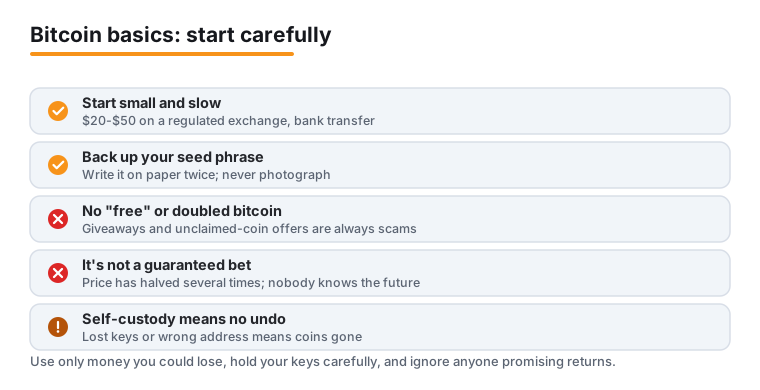
If you do decide to buy, the boring approach is the one that survives. Use only money you could lose entirely without it changing your life. Keep it a small slice of your overall savings. Buy slowly, on a schedule, instead of all at once. And ignore anyone who promises anything. If you are unsure, wait. Bitcoin trades every day of the year, and the cost of learning more first is close to zero.
First steps if you decide to try
If you have read this far and want to try with a small amount, here is a sensible first month.
- Set your number. Choose an amount you could lose entirely without it hurting. For learning, 20 to 50 dollars is plenty.
- Pick a well-known, regulated exchange that operates legally in your country. Expect to upload an ID; that is normal and required by law in most places.
- Secure the account before funding it. Use a unique password and turn on two-factor authentication, the extra login code from your phone.
- Buy your small amount, by bank transfer if you can, since cards usually cost more. Note exactly how much bitcoin you received for your money.
- Set up a wallet of your own and write the seed phrase on paper, twice, stored in two separate private places. Never photograph it, never type it into any website, never tell anyone.
- Send a small test from the exchange to your wallet and watch it confirm on the blockchain. That ten-minute experience teaches more than ten articles.
- Keep simple records: date, amount, price, fees. Future you, at tax time, says thank you.
- Then stop and sit for a month. Watch how the price moves and notice how the drops feel. That lesson tells you whether this belongs in your life at all.
Frequently asked questions
Can I buy less than one bitcoin?
Yes, and almost everyone does. Each bitcoin divides into 100 million units called satoshis, so you can buy 10 or 20 dollars worth as easily as a whole coin. A fraction behaves exactly like a whole coin, just smaller.
What if I lose my phone?
Your bitcoin is not stored on the phone, so the coins themselves are safe on the blockchain. If they sit on an exchange, log in from another device, the way you would with email. If they are in your own wallet app, install the wallet on a new phone and restore it with your seed phrase. This is exactly why the paper backup matters: lose the phone and the seed phrase together, and self-held coins are gone for good.
Can Bitcoin be hacked?
The Bitcoin network itself has never had its ledger hacked in more than fifteen years of nonstop operation. What gets hacked is everything around it: exchange accounts with weak passwords, people tricked into revealing seed phrases, fake apps and websites. In practice, the safety of your bitcoin depends far more on your habits than on the technology.
Do I have to pay taxes on bitcoin?
Often yes. In many countries, including the US, selling, spending, or trading bitcoin at a profit is a taxable event, while simply buying and holding usually is not. Rules differ by country and change over time, so keep records of every purchase and sale, and ask a tax professional before you sell.
How much money do I need to start?
Less than a dinner out. Most exchanges let you buy 5 or 10 dollars of bitcoin. Fees take a bigger bite out of tiny purchases, though, so 20 to 50 dollars is a practical learning amount. There is no reason to start with more.
How is bitcoin different from the money in my banking app?
The number in your banking app is a promise from the bank, and the bank can reverse payments, freeze accounts, and restore access when you forget a password. Bitcoin is more like cash: you hold it directly, payments are final, and no company stands behind it. You are more free and less protected at the same time. That is the whole bitcoin trade-off.
Last updated: 2026-06.