Cryptocurrency Explained: the Basics
Cryptocurrency is digital money that runs on a shared, public network of computers rather than through a single bank or government. Instead of trusting one institution to keep the books, it relies on cryptography and a worldwide community of participants to agree on who owns what. The first and best known example, Bitcoin, launched in 2009; today there are thousands of cryptocurrencies, and the largest are traded on regulated exchanges and held by individuals, companies, and funds around the world.
This guide explains, in plain language, what cryptocurrency actually is, how the technology works, why people think it matters, and how a beginner can get started safely. It is educational only and is not financial, legal, or tax advice. Crypto prices are highly volatile and the rules differ sharply from one country to the next, so verify anything that affects your money with an official or professional source before you act.
What is cryptocurrency?
A cryptocurrency is money that exists only as records on a digital ledger, secured by cryptography and maintained by many independent computers at once. Unlike a bank balance, which the bank ultimately controls, a crypto balance is controlled by whoever holds the secret keys to it. Three ideas are worth separating: the coin or token is the unit you own, send, and receive (such as bitcoin, BTC, or ether, ETH), usually divisible into tiny fractions; the blockchain is the shared, public record of every transaction, which stops people spending coins they do not have or spending the same coins twice; and the network is the worldwide set of computers that store that record and check transactions against agreed rules.
The defining feature of most cryptocurrencies is that they are decentralized: no single company, bank, or country runs them, unlike the digital money in your banking app, which a central institution issues and controls.
The main types you will encounter
Although there are thousands of cryptocurrencies, most fall into a few broad groups:
- Bitcoin (BTC) is the original and largest. Its software caps the total supply at 21 million coins, a limit enforced by the network's rules rather than anyone's promise, so it is often compared to a digital version of gold.
- Ethereum (ETH) and other smart-contract platforms do more than move money: they run small programs called smart contracts that power applications such as lending, trading, and digital collectibles. Coins built on them are usually called tokens.
- Stablecoins, such as those pegged to the US dollar, aim to hold a steady value by being backed, ideally one-for-one, by reserves like cash and short-term government debt. They are widely used for payments and for moving in and out of trades, so the issuer's reserves matter a great deal.
- Altcoins is a catch-all for the thousands of smaller coins, from serious projects to purely speculative tokens. Many have failed or lost almost all their value, so they carry far higher risk.
One common myth is worth dispelling: cryptocurrency is generally pseudonymous, not anonymous. Transactions are tied to public addresses rather than your name, yet every one is permanently visible and can often be traced.
How it works
Sending cryptocurrency is a bit like sending an email that carries value: it moves directly from sender to recipient, at any hour, across borders, without a bank approving it. A few pieces work together to make that work safely.
Wallets, keys, and addresses
You do not store crypto as a file on your phone; what you hold is a pair of cryptographic keys. A private key is a secret number that proves ownership and authorizes spending, while a public address is what you share so others can pay you, and a wallet app manages both. The crucial rule for beginners: whoever controls the private key controls the coins. Lose it and the funds are gone; if someone else gets it, they can take everything, and no central authority can reverse a confirmed transaction.
The blockchain and confirmations
When you send crypto, your transaction is broadcast and bundled with others into a block added to the chain. Each block links to the one before it, so altering an old record would mean redoing all the work piled on top of it across the network, which is impractical. Once your transaction is in a block it has one "confirmation," and each later block adds another, so larger payments are treated as settled after several. Because the ledger is public, anyone can verify a payment independently rather than taking a bank's word for it.
How networks agree: mining and staking
For a decentralized network to work, thousands of strangers must agree on one version of history without a referee, using a consensus mechanism. Bitcoin uses proof of work: computers called miners compete to solve a hard puzzle, and the winner adds the next block and earns newly issued coins plus fees, which is also how new bitcoin are created. That reward halves on a fixed schedule (the halving), dropping to 3.125 BTC per block in April 2024, with the next expected around 2028. Many newer networks, including Ethereum since 2022, instead use proof of stake, which has validators lock up coins as collateral and uses far less electricity, addressing a common environmental criticism of mining.
Nodes, fees, and speed
Keeping everyone honest are the nodes: computers that each store a full copy of the blockchain and independently reject any block that breaks the rules, so no single party can quietly change them. Senders attach a fee to have a transaction included, which rises when a network is busy and falls when it is quiet, and to make small, fast, cheap payments practical, developers build extra layers such as Bitcoin's Lightning Network on top of the main chain. Different cryptocurrencies make different trade-offs between speed, cost, and decentralization.
Why it matters
Cryptocurrency has grown from a niche experiment into a global market worth trillions of dollars, with major financial institutions now offering related products. Whether or not you ever buy any, it raises genuine questions about how money and finance could work. Here is why people pay attention, alongside the limits of each claim.
- Money without a middleman. Crypto lets people hold and transfer value directly, peer to peer, without a bank approving the payment, though in practice most people still use exchanges and apps that act as new intermediaries.
- Borderless and always on. A transaction can be sent globally, day or night, with no banking hours. This matters most for remittances, the money workers send home across borders, which through traditional services can carry high fees and delays. Crypto and stablecoins can make some transfers cheaper and faster, though converting to and from local currency and price swings still add friction.
- Financial inclusion. With only a phone and an internet connection, someone without a bank account can in principle hold and move money, and in places with unstable currencies some people use dollar-pegged stablecoins to try to preserve savings, accepting that this puts security entirely in their own hands.
- A fixed-supply alternative. Because Bitcoin's supply is capped and predictable, some hold it as a hedge against the inflation of traditional currencies, which central banks can expand, though its own price is volatile and can be a poor store of value over short periods.
- A platform for new applications. Smart-contract networks like Ethereum enable services such as lending, trading, and digital ownership that run without a central operator, an area often called decentralized finance, which remains early, experimental, and prone to hacks.
The flip side is just as important. Prices are highly volatile, confirmed transactions are irreversible, and scams and theft are common with no authority to recover stolen funds, while the collapse of major firms in recent years shows the businesses around crypto can fail even when the networks keep running. None of this is a reason to buy or avoid crypto; it is context to weigh for yourself, ideally with advice from a licensed professional.
Getting started
Getting started is straightforward if you take it one step at a time and prioritize security over speed.
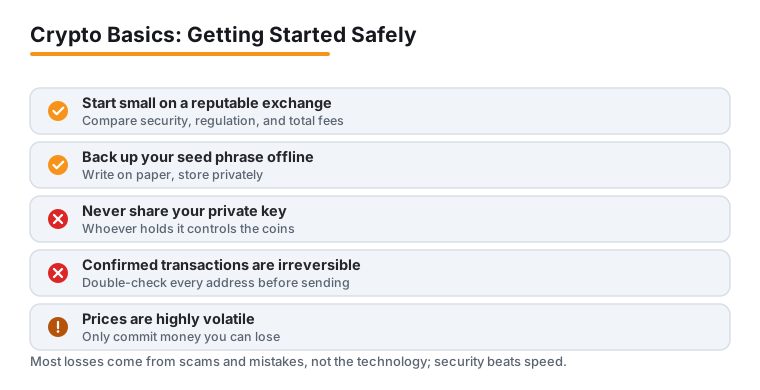
- Learn before you buy. Understand that prices swing sharply and transactions are irreversible, only commit money you can afford to lose, and be skeptical of anyone promising guaranteed returns.
- Choose a reputable exchange. Most beginners buy through a regulated exchange. Compare platforms on security track record, regulatory standing in your country, and fees, and read independent reviews rather than advertising. Expect to verify your identity, since licensed platforms are generally required to collect it.
- Make a small first purchase. You can buy a fraction of a coin, so a small amount lets you learn how buying, holding, sending, and receiving work without much at stake.
- Understand custody and get a wallet. Coins left on an exchange are controlled by that exchange. Moving them to a wallet where you hold the private keys (self-custody) gives you full control and full responsibility. A software wallet (a phone or desktop app) suits everyday use; a hardware wallet (a device that keeps keys offline) is the stronger choice for larger amounts.
- Back up your recovery phrase. Your wallet will show a list of words, called a seed phrase, that can restore your funds. Write it on paper, store it offline and privately, and never type it into a website or share it; anyone who has those words can take your crypto.
Turning crypto back into cash
To convert crypto into ordinary money, the usual route is to send the coins to a regulated exchange, sell them for your local currency, and withdraw to your bank account. Compare the total cost rather than a single number, since some platforms add a spread, network fees, or withdrawal charges on top of a low headline fee, and the rate depends on the market at the moment you sell. Bank withdrawals and identity checks can also be slow the first time. Selling or spending crypto can be a taxable event in many countries, so keep records and consult a qualified professional and your local tax authority rather than relying on guidance written for another country.
Staying safe
Most losses in crypto come from scams and mistakes, not flaws in the technology. Double-check every address before sending, since transfers cannot be reversed; be wary of unsolicited "investment" offers and impersonators; and remember that no legitimate service will ever ask for your seed phrase.
Frequently asked questions
Is cryptocurrency the same as Bitcoin?
No. Bitcoin is one cryptocurrency, the first and largest, while "cryptocurrency" refers to the whole category of digital currencies that run on blockchain networks. There are thousands of others, including Ethereum, dollar-pegged stablecoins, and many smaller and far riskier coins.
Do I have to buy a whole coin?
No. Most cryptocurrencies divide into very small fractions; bitcoin, for example, splits into 100 million units called satoshis, so you can buy a fraction worth whatever amount you choose. Many people start with a modest sum simply to learn how the process works.
Is cryptocurrency anonymous?
Not really; most cryptocurrencies are pseudonymous. Transactions are linked to public addresses rather than your name, but every transaction is permanently visible on the blockchain, and regulated exchanges typically verify your identity when you buy or sell. With analysis, activity can often be traced back to individuals.
What happens if I lose my wallet or private key?
If you control your own keys and lose both the wallet and its recovery (seed) phrase, the coins are effectively gone, since no central authority can restore access, which is why backing up that phrase offline is essential. Coins held on an exchange are recovered through that exchange's own account-recovery process instead.
Is cryptocurrency legal, and is it regulated?
It depends entirely on where you live. Many countries permit crypto and are building rules for exchanges, stablecoins, and taxation, while a few restrict or ban it. Regulation is evolving quickly, so check the current position with your national financial regulator or a qualified professional rather than assuming what applies elsewhere applies to you.
Last updated: 2026-06.