Ethereum Smart Contracts & DeFi Explained
Ethereum smart contracts are the engine behind most of decentralized finance (DeFi), and together they have reshaped how people lend, trade, save, and move money without banks or brokers sitting in the middle. A smart contract is simply a program that lives on the Ethereum blockchain and runs exactly as written. Bundle thousands of these programs together and you get an open financial system that anyone with an internet connection can use.
This guide explains what smart contracts actually are, how DeFi protocols use them, how gas fees and staking work in practice, and where the real risks lie. It is written for newcomers but does not dumb things down. Nothing here is financial, legal, or tax advice; treat it as background reading and verify anything important with official sources before you act.
What smart contracts are
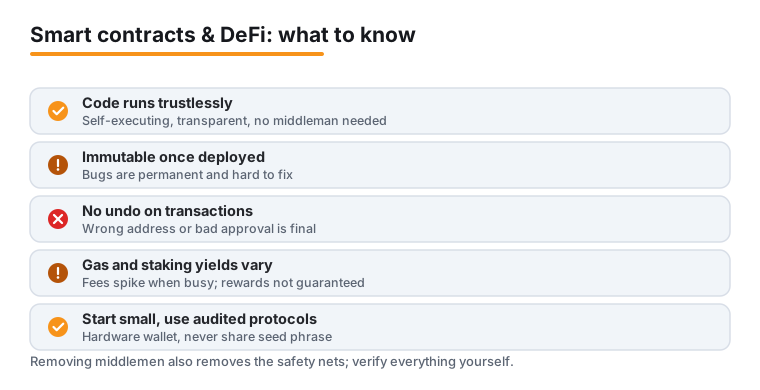
A smart contract is a piece of code deployed to a blockchain that automatically carries out its instructions when specific conditions are met. The terms of the agreement are written directly into the code, so once the contract is live it runs on its own, the same way every time, without a company or person needing to approve each step. The popular analogy is a vending machine: you insert the correct payment, the machine releases the product, and no cashier is involved. Smart contracts apply that logic to far more complex tasks.
Ethereum, launched in 2015, was the first blockchain built specifically to run this kind of programmable code through its Ethereum Virtual Machine (EVM). That is the main reason it became the home of smart contracts, whereas Bitcoin, launched in 2009, was designed primarily as digital money with deliberately limited scripting. Several characteristics make Ethereum contracts powerful:
- Self-executing: the code enforces the rules automatically once conditions are satisfied, removing the need for a trusted intermediary.
- Transparent: contract code and every transaction it processes are recorded on a public ledger that anyone can inspect.
- Immutable: once deployed, a contract generally cannot be altered, which builds trust but also means bugs are hard to fix.
- Permissionless: anyone can interact with a public contract without asking for approval or opening an account.
Because of these traits, smart contracts are described as "trustless": you do not have to trust the other party, only the code and the network running it. That property is what makes everything below possible, from lending markets to cross-border payments to charitable giving.
How DeFi uses them
Decentralized finance, or DeFi, is the collection of financial services built entirely from smart contracts rather than from banks and brokerages. Instead of an institution holding your money and processing requests, code holds the funds and executes the rules. Most of the well-known building blocks have direct equivalents in traditional finance:
- Lending and borrowing: protocols such as Aave and Compound let users deposit crypto to earn interest, or borrow against collateral, with rates set automatically by supply and demand.
- Trading and swapping: decentralized exchanges like Uniswap let people trade tokens directly against pooled liquidity rather than through an order book run by a company.
- Liquidity pools and yield: users supply pairs of tokens to a pool and earn a share of trading fees, a practice often called yield farming.
- Stablecoins: systems such as MakerDAO issue tokens pegged to the US dollar, backed by crypto collateral locked in smart contracts.
These contracts are composable, meaning one protocol can plug into another like building blocks, so a single transaction might borrow funds, swap them, and deposit the result elsewhere. The same machinery extends well beyond trading. In practice, builders have used Ethereum smart contracts for cross-border payments that settle in minutes instead of days and skip several layers of correspondent-bank fees; for financial inclusion projects aimed at unbanked and underbanked people, such as microloans or weather-triggered crop insurance that pays out automatically; and for transparent philanthropy, where donations are released only as project milestones are verified on-chain. The common thread is that a transparent, automated contract replaces a slow, opaque intermediary.
It is worth being clear-eyed: many of these use cases are still maturing, real-world adoption varies widely by region, and outcomes depend heavily on local rules and infrastructure. The technology removes some friction, but it does not by itself guarantee a good result.
Gas fees & staking
Running code on a shared global computer is not free, and securing that computer requires participants with something at stake. Two concepts cover this: gas and staking.
Gas fees
Every action on Ethereum, from a simple transfer to a complex DeFi interaction, consumes computational effort measured in units called gas. You pay for that gas in ether (ETH), and prices are usually quoted in gwei, a tiny fraction of one ETH. Since the EIP-1559 upgrade, each transaction fee has two parts:
- Base fee: a price set automatically by the network that rises when blocks are busy and falls when they are quiet. This portion is burned (removed from circulation) rather than paid to anyone.
- Priority fee (tip): an optional amount you add to incentivise validators to include your transaction sooner.
The more complex the contract you call, the more gas it uses and the higher the fee. Network upgrades have changed the picture dramatically: improvements introduced with Dencun (2024) and the later Pectra and Fusaka upgrades pushed most activity onto cheaper Layer 2 networks and reduced base-layer fees, so routine fees in 2026 have often been a small fraction of a US cent on Layer 2s. Fees still spike when the network is congested, however, so always check a live gas tracker and a wallet's fee estimate before confirming, and note that exact figures move constantly.
Staking
Since an event called "the Merge" in September 2022, Ethereum has been secured by proof of stake rather than the energy-intensive proof of work that Bitcoin still uses. Validators lock up ETH as collateral and are rewarded for honestly proposing and confirming blocks; misbehaviour can cost them part of their stake, a penalty known as slashing. There are several ways to participate:
- Solo staking: running your own validator requires 32 ETH and some technical setup, giving you full control and the full reward.
- Liquid staking: services such as Lido or Rocket Pool let you stake much smaller amounts and receive a token representing your staked ETH, which you can then use elsewhere in DeFi.
- Exchange staking: many centralized platforms stake on your behalf for a fee, with no minimum, in exchange for custody of your funds.
Staking rewards in recent periods have typically fallen in a low single-digit annual percentage range, but the rate varies with network conditions and the method you choose. Treat any specific yield figure you see as an estimate, not a guarantee, and confirm current rates and lock-up terms with the provider before committing.
Risks & limitations
Smart contracts remove middlemen, but they also remove the safety nets that come with them. There is usually no customer support line, no chargeback, and no regulator to reverse a mistake. Understanding the risks is essential before putting in money you cannot afford to lose.
- Code bugs and exploits: a contract does exactly what its code says, including its mistakes. Flaws have let attackers drain large sums, and because contracts are immutable, errors can be permanent. Favour protocols that have been independently audited and battle-tested over time, though audits reduce risk rather than eliminate it.
- Irreversible transactions: if you send funds to the wrong address or approve a malicious contract, there is generally no way to undo it. Double-check addresses and review the permissions you grant.
- Scams and phishing: fake websites, fraudulent tokens, and deceptive approval requests are common. The trustless design that protects you from intermediaries does nothing to protect you from your own clicks.
- Market and stablecoin risk: crypto prices are volatile, and even assets designed to hold a steady value can lose their peg under stress. Collateralised loans can be liquidated quickly if prices move against you.
- Custody risk: with self-custody, losing your private keys or seed phrase means losing your funds permanently. With custodial services, you are trusting a third party to keep them safe.
- Regulatory and tax uncertainty: rules for DeFi and crypto differ by country and continue to evolve. Activities like staking or earning yield may have tax consequences where you live.
A few habits reduce the danger: start small, stick to well-established protocols, use a hardware wallet for meaningful amounts, never reuse or share your seed phrase, and be sceptical of offers promising outsized returns. None of this is financial, legal, or tax advice. Because regulations and figures change frequently, verify the current status of any protocol, fee, or rule with official and primary sources before you rely on it.
Frequently asked questions
What is the difference between Ethereum and a smart contract?
Ethereum is the blockchain network and platform; a smart contract is an individual program that runs on it. Think of Ethereum as the operating system and smart contracts as the apps installed on it. Ether (ETH) is the network's native currency, used to pay the gas fees that power those contracts.
Do I need to know how to code to use DeFi?
No. Writing or deploying a smart contract requires programming knowledge, but using one does not. Most people interact with DeFi through a wallet and a user-friendly app that handles the technical details. You should still understand what each action does before approving it, since transactions are usually irreversible.
Why are Ethereum gas fees sometimes high and sometimes nearly free?
Gas fees rise and fall with demand. When many people transact at once, the network's automatically calculated base fee climbs; when activity is quiet, it drops. Recent upgrades and the shift of most activity to cheaper Layer 2 networks have made routine fees very low much of the time, but they can still spike during congestion. Always check a live estimate before confirming a transaction.
Is staking ETH safe?
Staking carries real risks even though it is a core part of how Ethereum operates. Validators can lose part of their stake through penalties called slashing, staked funds may be locked or take time to withdraw, and liquid-staking or exchange services add their own counterparty and smart-contract risks. Rewards are not guaranteed and vary with network conditions. Research the method and provider, and verify current terms before committing.
How is Ethereum different from Bitcoin for these uses?
Bitcoin was built mainly as digital money and a store of value, with intentionally limited scripting, so it is not designed to host the complex smart contracts that power DeFi. Ethereum was built from the start to run programmable contracts, which is why nearly all DeFi, lending, and tokenization activity is built on it or on networks connected to it. The two are often seen as complementary rather than direct competitors.
Last updated: 2026-06.