Stablecoins and the GENIUS Act: What It Means for You
Stablecoins are the quiet giant of crypto. These digital dollars now add up to roughly $322 billion, and the United States is finishing its first federal rulebook for them: the GENIUS Act. Final regulations are due by July 18, 2026, and the law switches on within months after that. If you hold USDT or USDC, or your bank is about to offer you a digital dollar of its own, the new rules will change what sits behind those tokens, who may issue them, and what happens if an issuer fails. This guide explains it in plain language: what the law gives you, what it does not (no, stablecoins are still not FDIC-insured), and what to check before you keep serious money in them. It is educational content, not financial advice.
What stablecoins are and how big they have become
A stablecoin is a crypto token designed to always be worth one dollar. The company behind it holds a pool of real assets, called the reserve, and promises to swap each token back for a dollar. Unlike Bitcoin, a stablecoin is not supposed to move in price at all. It is a dollar that travels on a blockchain: it settles in seconds, works on weekends, and can be sent anywhere.
Two coins dominate. Tether's USDT holds roughly 59 percent of the market, around $189 billion. Circle's USDC holds about 24 percent, around $77 billion. The whole market reached a record of roughly $322 billion in late May 2026. For scale, that is more than the official foreign exchange reserves of 95 countries, including the UK and Canada, as CoinDesk reported. And even after filtering out bots and high-frequency trading, stablecoins moved about $9 trillion in the year to October 2025, by Andreessen Horowitz's count.
What do people actually do with them? Most of the volume is still crypto trading: parking money between trades and moving funds between exchanges. The growing rest is more ordinary: sending money abroad for cents instead of wire fees, holding dollars in countries where the local currency keeps sliding, and paying remote workers.
The weak spot has always been trust. A stablecoin is only as good as its reserve, and until 2025 no US federal law said what that reserve must contain, who may issue a coin, or who checks the books. That is the gap the GENIUS Act fills.
The GENIUS Act in one minute
The GENIUS Act, short for Guiding and Establishing National Innovation for U.S. Stablecoins, was signed into law on July 18, 2025. It is the first federal framework for payment stablecoins, meaning coins issued for payments and redeemable at a fixed dollar value. The full text is on Congress.gov.
The core rule is simple: once the law is fully in force, only a licensed company called a permitted payment stablecoin issuer, or PPSI, may issue payment stablecoins in the United States. There are three ways to become one:
- a subsidiary of an insured bank or credit union, approved by its banking regulator;
- a nonbank company approved and supervised by the OCC, the federal regulator of national banks;
- a state-regulated issuer with up to $10 billion outstanding, if its state's rules are certified as matching the federal standard.
Everyone else must stop issuing for the US market. The law also settles an old argument: a permitted payment stablecoin is officially neither a security nor a commodity, which ends years of legal guesswork. Before this, US stablecoin oversight was a patchwork of state money transmitter licenses and a few state trust charters. If you want the bigger picture of how different countries handle crypto, our crypto regulation overview covers it.
Key dates: from proposed rules to the 2028 cutoff
2026 is the year the machinery gets built. Here is the timeline that matters:
- July 18, 2025: the GENIUS Act becomes law.
- March 2, 2026: the OCC's proposed rules, announced in late February, appear in the Federal Register. They cover applications, capital, liquidity and risk management for federally regulated issuers (OCC Bulletin 2026-3). Comments closed May 1, 2026.
- April 10, 2026: the FDIC publishes its proposal for stablecoin issuers that are subsidiaries of FDIC-supervised banks, covering reserves, redemption, capital, risk management and the custody of stablecoins by banks (Federal Register). Comments closed June 9, 2026.
- April 2026: Treasury's FinCEN and OFAC jointly propose anti-money-laundering and sanctions rules for issuers. Comments also closed June 9, 2026.
- July 18, 2026: the statutory deadline for the primary regulators to issue final regulations.
- Effective date: the law switches on at the earlier of January 18, 2027, or 120 days after the final rules land. So the realistic window is late 2026 to mid-January 2027.
- July 18, 2028: the hard stop. From this date, exchanges, brokers and custodians (the law calls them digital asset service providers) may no longer offer or sell stablecoins from non-permitted issuers to people in the US.
One piece is lagging: as of early June 2026 the Federal Reserve had not yet published its own proposed rule, and the FinCEN rule would only take effect 12 months after it is finalized. Expect the system to phase in through 2027 rather than flip on one day.
What permitted issuers must do: 1:1 reserves, redemption, monthly reports
For coins issued under the law, the protections are concrete. Every permitted issuer must:
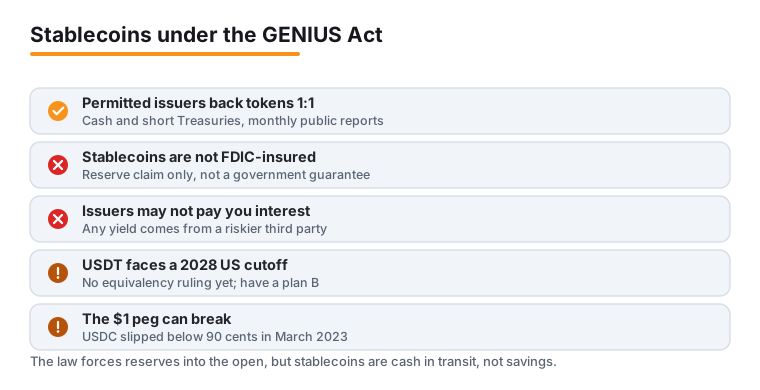
- Back every token 1:1. Reserves may only be safe, liquid assets: US currency, deposits at insured banks, Treasury bills with 93 days or less to maturity, certain overnight repurchase agreements and government money market funds. No corporate bonds, no crypto, no loans.
- Keep reserves separate. Customer reserves cannot be mixed with company money or pledged for the issuer's own borrowing.
- Publish a monthly report. The composition of the reserve goes public every month, examined by a registered accounting firm, with the CEO and CFO certifying it personally.
- Redeem at par. Issuers must publish a clear redemption policy, disclose any fees, and honor redemptions promptly.
- Put holders first in a failure. If a permitted issuer goes bankrupt, stablecoin holders have a priority claim on the reserve assets, ahead of other creditors.
A small worked example. Say you hold 2,500 tokens of a permitted stablecoin. Somewhere there must be at least $2,500 in cash or short-term Treasuries, held in segregated accounts, and once a month you can read exactly what that pool contains. If the issuer collapses, your claim on the $2,500 comes before the claims of its landlord and its lenders. The Senate Banking Committee fact sheet lists exactly these items as the law's core consumer protections: full reserve backing, monthly disclosure, strict marketing rules and first claim on the reserves in a bankruptcy.
What you do not get: interest and FDIC insurance
Two misunderstandings cause the most pain, so let's be blunt.
Permitted issuers may not pay you interest. The law forbids issuers from paying any yield or reward just for holding their coin. The FDIC's April 2026 proposal goes further: if an issuer arranges for an affiliate to pay yield on its behalf, the FDIC would presume that breaks the law unless the issuer proves otherwise. Why so strict? Congress wanted stablecoins to be payment tools, not unregulated savings accounts that pull deposits out of banks. An interest-bearing coin would also start to look like an investment contract, the legal test we explain in our guide to crypto and securities law.
Note that the ban is on issuers. Exchanges and apps can still run their own reward programs on stablecoin balances (Coinbase's USDC rewards are the best-known example), and banks are lobbying to close that gap. If someone pays you yield, the company paying is the one you are trusting. Lending coins out through DeFi adds smart contract risk and borrower risk on top.
Stablecoins are not FDIC-insured. Issuers are explicitly banned from marketing coins as insured, as backed by the full faith and credit of the US government, or as legal tender. There is no $250,000 deposit insurance behind your USDC or USDT. The 1:1 reserve rule plus the priority claim is your protection. It is real, but unlike deposit insurance it is not a government guarantee, and getting paid out of a bankruptcy takes time.
Stronger identity checks are on the way
In April 2026, Treasury's FinCEN and OFAC proposed a rule treating permitted stablecoin issuers as financial institutions under the Bank Secrecy Act, the same law that governs banks, as announced by the U.S. Treasury. Issuers would need full anti-money-laundering programs: verifying customers, monitoring transactions, filing suspicious activity reports, and running sanctions screening with the technical ability to freeze or block tokens when legally ordered.
What this changes for a normal user:
- Opening a direct account with an issuer, to mint or redeem coins, will require bank-grade identity checks, not just an email address.
- Large or unusual transfers may trigger questions or delays, much as they do at a bank.
- Addresses tied to sanctioned entities can be frozen. Tether and Circle already freeze addresses at law enforcement request, but this becomes a formal legal duty.
If you only touch stablecoins through a regulated exchange, little changes day to day: exchanges already run the KYC checks we describe in our guide to crypto compliance and licensing. The proposed rule would take effect 12 months after it is finalized, so expect this layer to land in 2027.
USDT, USAT and the foreign issuer question
Now the part most readers actually care about: what happens to USDT, the biggest stablecoin on earth?
Tether is not a US company (it is headquartered in El Salvador), so USDT counts as a foreign payment stablecoin under the law. Foreign coins may keep serving the US market only if the Treasury Secretary determines that the issuer's home country regulates stablecoins in a way comparable to the GENIUS Act, and the issuer registers with the OCC and holds enough reserves to meet US redemptions. As of June 2026, no such determination covering USDT had been announced.
Tether's answer was to launch a second coin. USAT, introduced in January 2026, is a US-regulated dollar stablecoin issued through Anchorage Digital Bank, a federally chartered crypto bank supervised by the OCC, with Cantor Fitzgerald acting as reserve custodian. USAT and USDT are separate tokens with separate reserves: one is built for the US rulebook, the other keeps serving the rest of the world.
What it means in practice: if the equivalency decision never comes, US exchanges would have to stop offering USDT by July 18, 2028. The law restricts what service providers may sell; it does not make holding USDT in your own wallet a crime. Still, a coin that US platforms cannot touch becomes harder to sell at a good price inside the US, which is why this single Treasury decision is the one to watch. If you hold a lot of USDT, have a plan B: know in advance which permitted coin you would switch to, and remember that the switch itself is a taxable trade.
Banks and card networks are building on the same rails
The clearest sign that stablecoins are going mainstream is who is adopting them. Visa and Mastercard now support settlement in USDC, meaning the money owed between banks on card transactions can move over a blockchain. JPMorgan runs JPMD, a deposit token; Citi offers Citi Token Services for corporate payments; and a group of the largest US banks is planning a shared tokenized deposit network targeted for 2027.
A tokenized deposit, in one phrase, is your ordinary bank balance represented on a blockchain: it stays a deposit, can carry deposit insurance, and never leaves the banking system. A stablecoin is a token from a reserve-backed issuer that anyone with a wallet can hold. Banks prefer the first; crypto users tend to prefer the second. Both will likely coexist, and for you the labels matter less than the protections attached to each.
The near-term effects are practical: more checkouts and remittance apps that accept digital dollars, faster settlement behind the scenes, and more fee competition. Stablecoins have quietly taken over the payments job people once expected Bitcoin to do. Bitcoin keeps the savings role; the buying-coffee job increasingly belongs to digital dollars.
A practical checklist before you hold serious money in stablecoins
Steps you can take today, in order:
- Know your issuer. USDC is issued by Circle, a US company. USDT is issued offshore by Tether; USAT is its US sibling. If you cannot name the issuer of a coin, do not hold the coin.
- Read one monthly reserve report. Ten minutes on the issuer's transparency page tells you what backs your money: the share in Treasury bills, in cash, and in anything exotic. Under the new rules these reports become mandatory and standardized for US-issued coins.
- Treat stablecoins as cash in transit, not savings. No deposit insurance, no interest from the issuer. For an emergency fund, an insured bank account still wins.
- Ask who pays any yield. If an app offers 8 percent on stablecoins, the issuer is not paying it. Find out who is, and what they do with your coins to earn it.
- Mind the real costs. Redeeming directly with Tether requires a verified account (a $150 verification fee), a 100,000 USDT minimum, and a withdrawal fee of 0.1 percent or $1,000, whichever is greater. Normal users simply sell or swap on an exchange for a small trading fee instead. Circle redeems USDC at no charge, but only for approved business accounts.
- Keep records. In the US, swapping USDT for USDC, or spending a stablecoin at a shop, is a taxable disposal even if the gain is a few cents.
Common mistakes to avoid: assuming the FDIC will make you whole (it will not), confusing exchange risk with issuer risk (a coin can be perfectly fine while the exchange holding yours fails), and treating the $1 peg as unbreakable. Even USDC slipped below 90 cents for a weekend in March 2023 when one of its reserve banks failed. It recovered fully, but only after some holders panicked and sold at a loss. The lesson is not that stablecoins are doomed; it is that the calm written on the label still depends on what sits in the reserve, which is exactly what the GENIUS Act forces into the open.
Frequently asked questions
Are stablecoins FDIC-insured under the GENIUS Act?
No. The GENIUS Act does not extend deposit insurance to stablecoins, and it explicitly bans issuers from marketing coins as FDIC-insured or government-backed. Your protection is the 1:1 reserve requirement plus a priority claim on those reserves if the issuer fails. That is real protection, but it is not a government guarantee, and payouts from a bankruptcy take time.
Is it still legal to hold and use USDT in the United States?
Yes. Nothing changes for holders today, and the law does not criminalize keeping a coin in your own wallet. The pressure point is July 18, 2028: from that date, US exchanges and custodians may not offer stablecoins from non-permitted issuers. Unless Treasury rules that Tether's home regime is equivalent, USDT could become hard to buy or sell on US platforms after that.
When exactly do the new stablecoin rules start?
The primary regulators must issue final rules by July 18, 2026. The law then takes effect on the earlier of January 18, 2027, or 120 days after those final rules are issued. So the realistic start is between late 2026 and mid-January 2027, with the separate anti-money-laundering rule following about 12 months after it is finalized.
Can I still earn interest on my stablecoins?
Not from the issuer: the GENIUS Act bans permitted issuers from paying yield just for holding their coins. Exchanges and DeFi platforms can still offer rewards or lending income, but then you are taking that platform's risk on top of the coin's. Always identify who pays the yield and how they earn it before committing money.
What happens to my money if a stablecoin issuer goes bankrupt?
For coins issued under the GENIUS Act, reserves are kept separate from company assets and holders stand first in line to be repaid from them. That makes a total loss much less likely than before. But repayment through a bankruptcy can be slow, and the coin's market price will likely fall below $1 while it plays out, as past depegs have shown.
Do I owe taxes when I spend or swap stablecoins?
Usually yes, at least on paper. The IRS treats stablecoins as property, so selling, swapping or spending one is a disposal you should record, even when the gain or loss is a cent or two. The GENIUS Act did not change tax treatment. Our crypto taxes guide explains how to keep the paperwork manageable.
Last updated: 2026-06.