Home › Crypto Regulation › El Salvador
Bitcoin & Cryptocurrency Regulation in El Salvador
Quick answer — El Salvador, 2026
- Legal: Legal to own and use, Bitcoin no longer legal tender, acceptance voluntary
- Tax: Reported Bitcoin capital gains exemption, 0 percent for licensed providers, paid in dollars
- Buying: Via CNAD-licensed or BCR-registered providers, international exchanges, P2P
El Salvador holds a unique place in cryptocurrency history as the first country to adopt Bitcoin as legal tender, a status granted in September 2021. That experiment has since been substantially reshaped. In January 2025 the Legislative Assembly amended the Bitcoin Law (Decree No. 199, published in the Official Gazette on 30 January 2025), removing the characterization of Bitcoin as currency and making acceptance voluntary. The reform was closely tied to a roughly USD 1.4 billion financing arrangement with the International Monetary Fund (IMF). The US dollar remains the country's official currency, while the government has reframed its approach around holding Bitcoin in a strategic reserve rather than pushing it for everyday payments.
This page explains the legal and regulatory landscape for Bitcoin and other digital assets in El Salvador as of 2026, covering legal status, the regulators, the key laws, licensing of exchanges and service providers, taxation, AML and KYC rules, buying and using crypto, mining, recent developments, consumer protection, and how to verify everything against official sources. The information here is general and current as of 2026; it is NOT legal, tax, or financial advice. Crypto rules in El Salvador have changed significantly and may change again, so always confirm the current position with the named official regulators, principally the Comision Nacional de Activos Digitales (CNAD), and with a qualified local professional before acting. For broader context see our overview of crypto regulation.
On this page: Legal status · Who regulates it · Taxes · How to buy · Mining
Is Bitcoin and crypto legal in El Salvador?
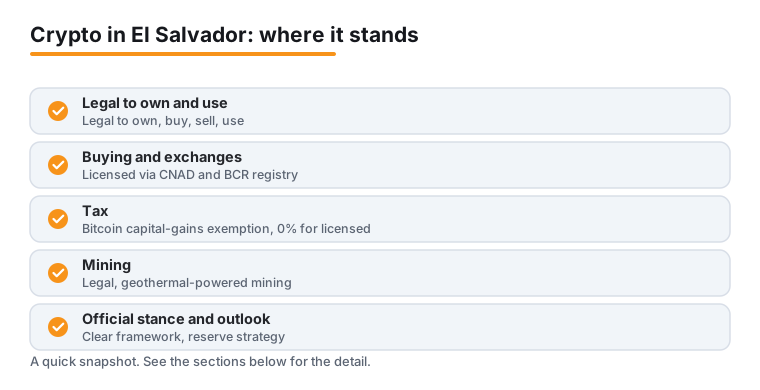
Yes. Owning, buying, selling, and using Bitcoin and other cryptocurrencies is legal in El Salvador. What changed is Bitcoin's special status. Between 2021 and 2025, Bitcoin was legal tender alongside the US dollar, which generally required businesses to accept it. A reform of the Bitcoin Law passed on 29 January 2025 (approved by a 55 to 2 vote and published as Decree No. 199) removed that mandatory status; under the law the changes took effect roughly 90 days after publication, during 2025. The IMF Executive Board approved the associated Extended Fund Facility on 26 February 2025, enabling an initial disbursement of about USD 113 million.
The current position can be summarized as follows:
- The US dollar is the official currency. El Salvador adopted the dollar in 2001, and it remains the legal and practical basis for prices, salaries, government obligations, and taxes.
- Bitcoin use is voluntary. Private businesses may choose to accept Bitcoin, but they are no longer obligated to. Many continue to price exclusively in dollars.
- Government use has been scaled back. Bitcoin can no longer be used to pay taxes or settle obligations owed to the state, and the state-run Chivo wallet has been wound down.
The headline takeaway: crypto remains fully legal to use and hold, but El Salvador is no longer a place where you can expect merchants to accept Bitcoin by default.
Who regulates crypto in El Salvador?
Oversight is shared among three official bodies, each with a distinct role:
- Comision Nacional de Activos Digitales (CNAD) - the National Commission of Digital Assets. CNAD was created in 2023 under the Digital Assets Issuance Law and is the primary regulator for the broader digital-asset ecosystem. It authorizes, regulates, and supervises digital-asset service providers, token issuers, and certifiers, and reports supervising large volumes of assets (heavily concentrated in stablecoins such as Tether). Its official site is cnad.gob.sv.
- Banco Central de Reserva (BCR) - the Central Reserve Bank. The BCR administers the registry of Bitcoin Service Providers under the Bitcoin Law and its regulation, and oversees capital adequacy, liquidity, and risk matters relevant to financial institutions. Its official site is bcr.gob.sv, and the Bitcoin provider registry is published at registrobitcoin.bcr.gob.sv.
- Superintendencia del Sistema Financiero (SSF) - the Office of the Superintendent of the Financial System. The SSF supervises the wider financial system and is associated with transparency, compliance, and investor-protection functions that intersect with regulated financial activity.
Because more than one law and more than one body are involved, the right regulator to consult depends on the activity. For digital-asset issuance and most service-provider questions, CNAD is the starting point; for Bitcoin Service Provider registration under the Bitcoin Law, the BCR is the relevant authority.
Key laws and frameworks
El Salvador's crypto framework rests on several distinct instruments rather than a single code:
- The Bitcoin Law (2021), as amended in 2025. The original law made Bitcoin legal tender. The 2025 amendment (Decree No. 199) removed the concept of Bitcoin as currency, ended mandatory acceptance, removed the state's role in guaranteeing convertibility, and barred the use of Bitcoin to pay taxes and state obligations.
- The Bitcoin Law Regulation. Implementing rules that, among other things, establish the obligations of Bitcoin Service Providers, including conducting operations with high standards of integrity, maintaining accounting records, running anti-money-laundering programs, and adopting cybersecurity measures.
- The Digital Assets Issuance Law (Ley de Emision de Activos Digitales, commonly LEAD), in force since 2023. This created CNAD and a dedicated regime for issuing and providing services around digital assets, including licensing of Digital Asset Service Providers and favorable tax treatment for qualifying licensed activity.
- Investment banking legislation (2025). A law allowing large financial institutions to offer services denominated in Bitcoin and other digital assets to sophisticated investors, with high capital and client-eligibility thresholds (set by the law itself). Article 23 of Decree No. 376 requires minimum share capital of fifty million US dollars, paid in dollars at incorporation, updated every two years by the Superintendencia against the consumer price index, with 180 calendar days allowed to adjust after each update. Article 4 defines a Sophisticated Investor as a natural or legal person meeting set criteria including free disposal of at least 250,000 US dollars in cash or easily liquidated assets. Article 24 requires a capital fund to risk-weighted assets ratio of at least eight percent, and Article 40 lets these banks apply to act as digital-asset service providers, digital-asset issuers and Bitcoin service providers.
El Salvador is not part of the European Union and is therefore not governed by the EU's MiCA framework; its rules are domestic. The reform El Salvador committed to under the IMF programme has not been tabled. The Legislative Assembly's published register of decrees shows no crypto or digital-asset instrument in 2025 after the October money laundering law, and none at all in 2026 across the 126 decrees issued between 8 January and 2 July 2026. The IMF programme's second and third reviews were both still incomplete in late July 2026, with pension reform rather than crypto reported as the blockage.
Licensing and registration of exchanges and service providers
There are two main authorization tracks, and which one applies depends on the activity and the governing law:
- Bitcoin Service Provider (BSP) registration with the BCR. Under the Bitcoin Law and its regulation, any individual or company providing Bitcoin-related services, such as custodians, exchange houses, payment processors, and wallet providers, must register with the BCR's Registry of Bitcoin Service Providers. Registered providers must meet integrity, record-keeping, AML, and cybersecurity obligations. The BCR's public register listed 283 Bitcoin service providers when checked in August 2026, of which 31 carried the status PROVEEDOR OPERANDO and 252 PROVEEDOR NO OPERANDO. The register notes on every entry that registration with the BCR does not constitute authorisation to operate, and that the authorisation to operate is issued by CNAD.
- Digital Asset Service Provider (DASP) license with CNAD. Under the Digital Assets Issuance Law, businesses offering services such as exchange, custody, brokerage, or token issuance generally need a license from CNAD. The Salvadoran model does not allow free commercialization of digital assets: prior authorization from the regulator is required. This licensing path is a major reason El Salvador has marketed itself to crypto businesses; CNAD's public register listed 82 digital-asset service provider registrations in August 2026, running to PSAD-0092 dated 10 July 2026, with 27 of them registered during 2026, and firms including Tether and Bitfinex Securities have taken up licenses.
Specific figures for minimum capital, fees, processing timelines, and ongoing reporting are cited differently across private advisory sources and can change. Do not rely on third-party summaries for a business decision; confirm the current requirements directly with CNAD or the BCR and with a qualified local lawyer.
Crypto taxation in El Salvador
El Salvador has marketed itself as a low-tax jurisdiction for digital assets, but the details depend on whether you are an individual, a foreign investor, or a licensed business, and tax matters should always be confirmed with the tax authorities or a qualified local professional.
- Bitcoin capital gains. The exemption was re-enacted, not merely preserved. Article 3 of Decree No. 199 rewrote Article 5 of the Bitcoin Law to read, in full, that exchanges in Bitcoin shall not be subject to capital gains tax. The 2025 reform deleted only the trailing words comparing Bitcoin to any legal-tender currency. The exemption is specific to Bitcoin exchanges, so gains on other crypto-assets fall back on the ordinary 10 percent capital gains rate unless they are digital assets covered by the Digital Assets Issuance Law.
- Licensed digital-asset businesses. The Digital Assets Issuance Law provides favorable treatment for qualifying licensed activity, set out in Article 36 of the law. Article 36(b) exempts the nominal value and the yields or income from digital assets from every class of levy, tax, duty, rate and contribution, and exempts the capital gain or ordinary income from the sale or any other transfer of digital assets from any taxation. Article 36(c) exempts registered issuers, certifiers and digital-asset service providers from VAT, income tax and municipal taxes on their digital-asset activity, while Article 36(e) withholds those benefits where digital assets are exchanged for goods or services outside the activities listed in Article 19. The exact scope is defined by the law and by the terms of each license.
- Currency of settlement. Taxes and state obligations are paid in US dollars, not in Bitcoin, following the 2025 reform.
Because tax treatment is fact-specific and has shifted with the legal changes, this page does not state rates or thresholds for individuals. For a general primer see our guide to crypto taxes, and confirm your obligations locally before transacting.
AML and KYC rules
Anti-money-laundering (AML) and know-your-customer (KYC) requirements apply to regulated crypto activity in El Salvador, which is why licensed and registered platforms ask users to verify their identity.
- Bitcoin Service Providers registered with the BCR must, under the Bitcoin Law Regulation, maintain anti-money-laundering programs, keep proper accounting records, and operate with high standards of integrity and adequate cybersecurity.
- Digital Asset Service Providers licensed by CNAD are expected to apply customer due diligence, transaction monitoring, and suspicious-activity reporting as part of their compliance obligations.
- International alignment. AML is no longer a plan. Decree No. 426 of 7 October 2025, published in the Diario Oficial on 9 October 2025, replaced the 1998 money laundering law and at Article 7 numeral 9 names digital-asset service providers and Bitcoin service providers as obligated subjects. CNAD supervises the digital-asset providers, the SSF also supervises them whenever they carry out operations with Bitcoin, and those entities must follow technical rules issued by the BCR through its Comite de Normas. Article 25 requires digital-asset transactions to be reported to the UIF within five business days, with the reporting thresholds still to be fixed in the law's reglamento.
For users, the practical effect is straightforward: expect identity verification when you open accounts, deposit, or withdraw on regulated platforms, and be prepared to provide identification and sometimes proof of address.
Buying and using crypto in practice
Residents and visitors can buy, sell, and hold cryptocurrency through several channels:
- Licensed and registered local providers. Businesses authorized by CNAD as digital-asset service providers, or registered with the BCR as Bitcoin Service Providers, can legally offer exchange and custody services from within El Salvador.
- International exchanges. Many global platforms are accessible to Salvadoran users, subject to each platform's own country availability and verification rules.
- Peer-to-peer trades. Direct trades between individuals remain possible but carry higher counterparty risk.
A practical starting sequence: choose a reputable, authorized platform and check its fees and supported assets; complete KYC identity verification; fund the account in US dollars by a supported method; place a small initial order while you learn the platform; and move meaningful holdings to a wallet you control, ideally a hardware wallet, while safeguarding your recovery phrase and never sharing it. Keep records of purchases, sales, and transfers to support any reporting obligations.
On spending: because Bitcoin is no longer legal tender, merchants are not obliged to accept it or to convert it at any set rate. During the legal-tender era, tourist-facing areas such as El Zonte (often called Bitcoin Beach) were known for accepting Bitcoin, but acceptance is now voluntary and uneven. Carry dollars and treat crypto acceptance as a bonus rather than a guarantee.
Bitcoin mining in El Salvador
Bitcoin mining is legal in El Salvador, and the country is notable for having explored state-linked mining powered by renewable energy. Its most distinctive asset is geothermal power from its volcanic geology, which the government has promoted as a relatively clean and inexpensive energy source for mining.
- Energy is the core advantage. Geothermal and other renewable sources are the main reason El Salvador has been discussed as a mining location, potentially reducing both costs and the carbon footprint often associated with mining.
- State involvement. The government has backed Bitcoin mining tied to geothermal energy as part of its broader Bitcoin strategy, though the current scale and ongoing role of these projects should be verified against current official statements.
- Regulatory specifics are still developing. Detailed mining-specific permits and tax treatment are best confirmed directly with the relevant authorities before committing capital.
For individuals, mining at scale requires significant electricity, hardware, and cooling, so it is generally a commercial undertaking. Anyone considering it should confirm permitting, electricity arrangements, and reporting obligations locally.
Recent developments (2025-2026)
The defining recent change was the January 2025 Bitcoin Law reform that ended Bitcoin's mandatory legal-tender status, tied to El Salvador's roughly USD 1.4 billion arrangement with the IMF. Several related developments have followed:
- From retail push to reserve strategy. The government reframed its approach away from encouraging everyday spending and toward holding Bitcoin as a long-term treasury asset. By late June 2026 trackers put the national Bitcoin reserve at roughly 7,700 coins, worth on the order of USD 460 million at the time, up from about 5,968 coins recorded at the start of the IMF program in December 2024.
- IMF disagreement over daily buys. The government has publicly described adding roughly one Bitcoin per day, but the IMF program includes a performance criterion setting a zero ceiling on new voluntary public-sector Bitcoin purchases during the program. The IMF has stated that the rise in the Strategic Bitcoin Reserve Fund reflects consolidation of coins already held across government wallets (reported to include a BANDESAL cold-storage address) rather than net new market purchases, and that total government-controlled holdings have not increased. This accounting dispute is a live issue for future program reviews.
- Institutional focus. 2025 legislation opened a path for large investment banks to offer Bitcoin and digital-asset services to sophisticated investors, signaling a shift from retail adoption toward institutional and high-net-worth activity.
- Digital-asset firms relocating. Under the Digital Assets Issuance Law, CNAD has authorized a growing set of Digital Asset Service Providers, reported at more than 70 by 2026. Notable licensees include Tether, which announced moving its headquarters to El Salvador, and Bitfinex Securities, which has operated a licensed securities business from the country. In May 2026 the exchange Bitso brought its MXNB stablecoin under the CNAD framework.
- Maturing digital-asset regime. The Digital Assets Issuance Law passed its two-year mark in early 2026. Reported activity has broadened beyond payments toward tokenization of real-world assets such as real estate and receivables, and further CNAD secondary rules on areas such as stablecoins, custody, and Travel Rule compliance are expected.
- Further reform expected. Under the IMF program, El Salvador committed to submit legislation overhauling the regulation and supervision of crypto-asset activities and markets, developed with IMF technical assistance, so the framework remains in flux.
For the latest on regulatory direction generally, see our regulation hub.
Consumer risks and protection
El Salvador's experience illustrates both the promise and the unpredictability of national crypto policy. Several risks deserve attention:
- Policy change. The 2025 reversal of legal-tender status shows the rules can shift materially; future governments or external agreements could alter the framework again.
- Market volatility. Bitcoin's price can swing sharply, affecting both individual holders and the value of the national reserve. Never invest more than you can afford to lose.
- Adoption gap. Everyday merchant acceptance never became universal, and many businesses price only in dollars, so do not assume you can spend crypto easily.
- Scams and security. Fraudulent schemes, fake apps, and phishing are real threats. Use reputable providers that are licensed by CNAD or registered with the BCR, and be cautious of unauthorized operators.
On the protection side, the licensing and registration regimes are intended to bring service providers under supervision, impose AML and cybersecurity standards, and provide a route for the authorities to identify and act against unauthorized activity. If something goes wrong with a regulated provider, the relevant regulator (CNAD for digital-asset providers, the BCR for Bitcoin Service Providers, and the SSF for wider financial-system matters) is the appropriate point of contact.
Official sources and how to verify
This page is general information as of 2026 and is NOT legal advice. Crypto rules in El Salvador are evolving, so verify the current position directly with the named official regulators before acting:
- Comision Nacional de Activos Digitales (CNAD) - the primary digital-asset regulator and the place to confirm DASP licensing, issuance rules, and the current legal framework: cnad.gob.sv.
- Banco Central de Reserva de El Salvador (BCR) - the central bank and administrator of the Bitcoin Service Provider registry: bcr.gob.sv, with the registry at registrobitcoin.bcr.gob.sv.
When checking whether a platform is authorized, look it up against the BCR's Bitcoin Service Provider registry or confirm its CNAD authorization rather than trusting a company's own marketing claims. For background reading, see our overview of crypto regulation and our guide to crypto taxes. For decisions with legal or tax consequences, consult a qualified professional licensed to advise in El Salvador.
What is changing: El Salvador in August 2026
Nothing in El Salvador's crypto statute book changed in 2026. The Legislative Assembly's own register of decrees issued in 2026 lists 126 instruments, numbered 495 to 620 and dated between 8 January and 2 July 2026, and not one of them concerns Bitcoin, digital assets or money laundering. The same register for 2025 does list the Bitcoin Law reform and the money laundering law, which confirms that crypto instruments appear there when they exist. The last three crypto-relevant laws all date from 2025 and all are already in force.
What moved instead was everything underneath the statute book:
- The BCR's register of Bitcoin service providers holds 283 entries, of which 31 are marked PROVEEDOR OPERANDO and 252 PROVEEDOR NO OPERANDO. That is up from the roughly 181 registered and 20 operating figures previously reported, but the proportion actually trading is still about one in nine.
- CNAD's register of digital-asset service providers carries 82 registrations running to PSAD-0092, dated 10 July 2026. Twenty seven of them were registered during 2026, against 24 in 2025, 18 in 2024 and 11 in 2023.
- The Chivo wallet has not been shut. CHIVO, S.A. de C.V. sits at number one in the BCR register with the status PROVEEDOR OPERANDO, and holds CNAD registration PSAD-0078 granted on 26 March 2026. The IMF described negotiations to sell it as well advanced in December 2025, and completion has not been confirmed.
- The state's own payments push is dollar-only. The BCR launched Pay, a free instant dollar transfer service built on its Transfer365 infrastructure and keyed to the national DUI identity number, reporting close to 10,000 active users by April 2026, with an extension across the private financial system announced for May 2026. Pay does not handle Bitcoin.
The reserve keeps growing on the government's own numbers. The National Bitcoin Office's public tracker showed 7,734.37 BTC worth about 497 million US dollars in early August 2026, a rise of 8.00 BTC over the preceding seven days, logged as a series of 1.0000 BTC treasury entries.
The constraint on everything else is the IMF. The Extended Fund Facility's second and third reviews are both still incomplete, and the principal blockage reported is pension reform, not Bitcoin: the government missed a 10 February 2026 deadline to present pension legislation. IMF deputy managing director Dan Katz said on 23 July 2026 that great progress was being made towards completing the upcoming reviews. The same report notes that El Salvador has continued daily Bitcoin purchases even though the programme expects holdings to stay unchanged. Markets have priced the delay: a March 2026 report by the financial consultancy EMFI put the implied probability of the delays continuing through the year at 50 percent, and bond pricing at the end of July implied roughly an 85 percent probability of another stepped-up coupon payment in October 2026.
The legislative pipeline: what is coming and roughly when
El Salvador has no crypto bill before parliament. What it does have is a set of secondary instruments that existing laws require, with statutory deadlines that have now passed. This is where the next concrete change will come from.
| Instrument | Stage | What it would do | Timing |
|---|---|---|---|
| Reglamento of the 2025 anti-money-laundering law (Article 60 of Decree 426) | Required by statute, publication not confirmed | Sets the reporting thresholds and report content for digital-asset transactions under Article 25, in line with FATF standards. Until it exists, the value above which a crypto transaction must be reported to the UIF is undefined. | Due within 90 days of the law taking effect, so around mid-January 2026. Deadline passed. |
| Updated supervisory normativa (Article 55 of Decree 426) | Required by statute, publication not confirmed | Obliges supervisory and regulatory bodies, including CNAD and the BCR Comite de Normas, to align their rulebooks with the new supervisory split over digital-asset and Bitcoin service providers. | Due within six months of entry into force, so around April 2026. Deadline passed. |
| UIF instructivos and other authorities' technical rules (Article 56 of Decree 426) | Required by statute, publication not confirmed | Operational detail on customer due diligence, suspicious-activity reporting and compliance-officer duties for obligated subjects, including crypto firms. | UIF: six months from publication, around April 2026. Other authorities: nine months, around July 2026. |
| CNAD normativa on stablecoins, custody, cross-border providers and the FATF Travel Rule | Anticipated by practitioners, not announced by CNAD | Would replace reliance on the 2023 stablecoin public-offering regulation and give custodians and cross-border providers a dedicated standard. | No date published. CNAD's legal framework page still lists only its 2023 instruments. |
| IMF-linked strengthening of crypto-asset regulation and supervision | Committed, no bill tabled | Promised under the Extended Fund Facility, to strengthen regulation and supervision of crypto-asset activities and markets. | Absent from the Assembly's decree register for 2025 and 2026. Tied to a programme whose second and third reviews are still open, with a fourth review due September 2026. |
Meanwhile the transitional rules apply: the reglamento made by executive decree of 21 January 2000 and the existing UIF instructivo stay in force until the new ones are approved, so crypto firms are currently complying with pre-crypto anti-money-laundering machinery.
What the official registers actually show
Two separate public registers matter, and the relationship between them is not what most summaries describe. The BCR's register carries an explicit note on every entry: the provider is registered with the Banco Central de Reserva, that registration does not amount to authorisation to operate, and the authorisation to operate is issued by the Comision Nacional de Activos Digitales. The SSF confirms in its own public guidance that the BCR list is where supervised Bitcoin service providers are identified.
- BCR Bitcoin service provider register. 283 entries, 31 with the status PROVEEDOR OPERANDO. The operating providers include CHIVO, S.A. de C.V., Binance Services El Salvador, OKX Fintech, Ditobanx El Salvador, IBEX Mercado SV, Athena Holdings El Salvador, Fintech Americas, Bitpoint El Salvador, OpenNode, Inc. and Crypto Trading and Investment. The service categories used are custodians of Bitcoin, digital exchange houses, Bitcoin digital wallets and payment processors.
- CNAD digital-asset service provider register. 82 registrations numbered to PSAD-0092. Named holders include Binance Services El Salvador (PSAD-0002, 10 November 2023), Tether International (PSAD-0028, 16 August 2024), Bitfinex Derivatives El Salvador (PSAD-0040, 6 January 2025), OKX Fintech (PSAD-0052, 23 May 2025), CHIVO (PSAD-0078, 26 March 2026) and two further Bitfinex entities, BFXNA and BFXWW El Salvador (PSAD-0082 and PSAD-0083, both 23 April 2026).
- Issuances. CNAD had authorised 29 digital-asset issuances between January 2024 and February 2026 on EFE's count of the public register: 4 in 2024, 21 in 2025 and 4 in the first weeks of 2026, weighted towards tokenised real estate, agricultural commodities and hospitality infrastructure rather than payments.
The practical point for a buyer is that several large international exchanges hold Salvadoran registrations, so buying through a locally registered venue is realistic rather than theoretical. Check the provider against both registers before depositing, and treat a BCR registration on its own as insufficient.
Crypto tax: two statutory exemptions and the rates behind them
El Salvador's low-tax reputation rests on two specific statutory provisions, not on a general policy. Both survive in 2026.
- Bitcoin. Article 5 of the Bitcoin Law, as rewritten by Decree 199, reads in full: exchanges in Bitcoin shall not be subject to capital gains tax. The 2025 reform deleted only the trailing comparison to legal-tender currencies. The exemption itself was re-enacted, not repealed.
- Digital assets under LEAD. Article 36(b) of Decree 643 exempts the nominal value and the yields or income from digital assets from every class of levy, tax, duty, rate and contribution, and exempts the capital gain or ordinary income from the sale or any other transfer of digital assets from any taxation. The article opens by naming acquirers of digital assets alongside issuers, certifiers and registered service providers, so it is not confined to licensed firms. Article 36(c) then exempts registered issuers, certifiers and digital-asset service providers from VAT, income tax and municipal taxes on their digital-asset business. That is the source of the 0 percent figure quoted in marketing material. Article 36(e) is the limit: the benefits do not apply where digital assets are exchanged for goods or services outside the activities listed in Article 19.
Outside those two regimes the ordinary Salvadoran rates apply, and they are not zero:
- Capital gains are taxed at a flat 10 percent, except where the asset is sold within twelve months of acquisition, in which case the gain is taxed as ordinary income.
- Corporate income tax is 30 percent, reduced to 25 percent where taxable income is 150,000 US dollars or less, with a 1.75 percent monthly advance payment on accrued gross revenue credited against the annual liability.
- VAT (IVA) is 13 percent.
Whatever is owed is settled in dollars. Decree 199 repealed Article 4 of the Bitcoin Law, which had allowed tax contributions to be paid in Bitcoin, and rewrote Article 12 so that the State's own monetary obligations must be paid in the currencies in which they were contracted.
Frequently asked questions
Is Bitcoin still legal tender in El Salvador in 2026?
No. Bitcoin was legal tender from 2021 until the January 2025 reform of the Bitcoin Law (Decree No. 199) removed its mandatory status, with the changes taking effect during 2025. Bitcoin remains legal to own and use, but acceptance by businesses is voluntary, and the US dollar is the official currency.
Who regulates cryptocurrency in El Salvador?
Oversight is shared. The Comision Nacional de Activos Digitales (CNAD), created under the 2023 Digital Assets Issuance Law, is the primary regulator for digital-asset service providers and issuers. The Banco Central de Reserva (BCR) administers the Bitcoin Service Provider registry under the Bitcoin Law, and the Superintendencia del Sistema Financiero (SSF) supervises the wider financial system. Verify current details at cnad.gob.sv and bcr.gob.sv.
Why did El Salvador remove Bitcoin's mandatory legal-tender status?
The change was closely linked to a roughly USD 1.4 billion financing arrangement with the International Monetary Fund, which sought to limit public-sector exposure to Bitcoin's volatility. The 2025 reform ended mandatory acceptance, removed the characterization of Bitcoin as currency, barred using Bitcoin to pay taxes, and wound down government-run infrastructure such as the Chivo wallet.
Do crypto exchanges need a license in El Salvador?
Generally yes, and the track depends on the activity. Bitcoin Service Providers such as exchanges, custodians, wallets, and payment processors must register with the BCR under the Bitcoin Law and its regulation. Businesses offering broader digital-asset services or token issuance generally need a Digital Asset Service Provider license from CNAD under the Digital Assets Issuance Law. Confirm the exact, current requirements with CNAD or the BCR.
How is crypto taxed in El Salvador?
El Salvador has marketed favorable conditions, including a reported preservation of the Bitcoin capital-gains exemption and 0% treatment for qualifying licensed digital-asset businesses under the Digital Assets Issuance Law, but treatment depends on your status and the activity, and taxes are settled in US dollars. Because the rules are fact-specific and have shifted with the legal changes, confirm your obligations with the tax authorities or a qualified local tax professional before transacting.
Can tourists pay with Bitcoin in El Salvador?
Sometimes, but not everywhere. During the legal-tender era, places such as El Zonte (Bitcoin Beach) and various tourist-facing businesses accepted Bitcoin. Since acceptance is now voluntary, expect to pay in US dollars and treat Bitcoin acceptance as a bonus rather than a guarantee. Carry dollars and confirm before assuming a merchant takes crypto.
How much Bitcoin does El Salvador hold in 2026?
By late June 2026 public trackers put the national reserve at roughly 7,700 coins, worth on the order of USD 460 million at the time, up from about 5,968 coins at the start of the IMF program in December 2024. The IMF has said the increase reflects consolidation of coins already held across government wallets rather than net new purchases, since the program sets a zero ceiling on new voluntary public-sector Bitcoin buying. Reserve figures change with the market, so check current data before relying on any number.
Did Tether move to El Salvador?
Yes. Tether, the issuer of the USDT stablecoin, announced relocating its headquarters to El Salvador and holds authorization under the country's digital-asset regime overseen by CNAD. It is one of more than 70 Digital Asset Service Providers reported as registered with CNAD by 2026, alongside firms such as Bitfinex Securities. Confirm any provider's current status directly with CNAD before transacting.
Can I still get a low crypto tax rate in El Salvador?
El Salvador markets favorable tax treatment, and the Digital Assets Issuance Law is widely described as providing 0% income, capital gains, and VAT treatment for qualifying licensed digital-asset activity. Whether any exemption applies to you depends on your status, whether the activity is licensed, and the current law, which has shifted with the 2025 reforms. Taxes are settled in US dollars, not Bitcoin. Confirm your position with the tax authorities or a qualified local professional before acting.
Has El Salvador passed any new crypto law in 2026?
No. The Legislative Assembly's public register of decrees issued in 2026 contains 126 instruments, numbered 495 to 620 and dated between 8 January and 2 July 2026, and none of them concerns Bitcoin, digital assets or money laundering. The framework in force is four laws: the 2021 Bitcoin Law as amended by Decree No. 199 of 29 January 2025, the Digital Assets Issuance Law (Decree No. 643 of 11 January 2023), the Investment Banking Law (Decree No. 376 of 7 August 2025) and the anti-money-laundering law (Decree No. 426 of 7 October 2025). The next concrete change is expected to come from secondary rules under Decree No. 426 rather than from a new statute.
Who actually authorises a crypto business in El Salvador, the BCR or CNAD?
CNAD. The BCR's own Bitcoin service provider register states on every entry that registration with the Banco Central de Reserva does not constitute authorisation to operate, and that the authorisation to operate is issued by the Comision Nacional de Activos Digitales. In practice a Bitcoin-facing business appears in the BCR register and needs CNAD authorisation on top of it, while a broader digital-asset business registers directly with CNAD as a PSAD. Check both registers before dealing with any provider, and note that only 31 of the 283 entries in the BCR register were marked as operating in August 2026.
Is the Chivo wallet still running in 2026?
Yes. CHIVO, S.A. de C.V. appears first in the BCR's Bitcoin service provider register with the status PROVEEDOR OPERANDO, offering a Bitcoin digital wallet, payment processing and dollar send and receive, and it holds CNAD registration PSAD-0078 granted on 26 March 2026. El Salvador committed under the IMF programme to unwind public participation in Chivo. The IMF described sale negotiations as well advanced in December 2025, but completion has not been confirmed. Separately the central bank launched Pay in 2026, a free instant payment service that works only in US dollars and does not handle Bitcoin.
What tax do I pay if I sell a crypto-asset that is not Bitcoin and not covered by the Digital Assets Issuance Law?
The ordinary Salvadoran rules apply. Capital gains are taxed at a flat 10 percent, except where the asset is sold within twelve months of acquisition, in which case the gain is taxed as ordinary income. Corporate income tax is 30 percent, or 25 percent where taxable income is 150,000 US dollars or less, and VAT is 13 percent. The 0 percent treatment people associate with El Salvador comes from two specific provisions: Article 5 of the Bitcoin Law, which exempts Bitcoin exchanges from capital gains tax, and Article 36 of the Digital Assets Issuance Law, which exempts gains and income from digital assets covered by that law. Neither is a general crypto exemption, and taxes are settled in dollars.
Do crypto exchanges in El Salvador have to report my transactions?
Yes. Under Article 7 numeral 9 of Decree No. 426 of October 2025, digital-asset service providers and Bitcoin service providers are obligated subjects under the anti-money-laundering law. Article 25 requires them to report digital-asset transactions by a client to the Financial Investigation Unit within five business days, whether in a single event or accumulated over a month where the transactions appear linked. Suspicious operations are reported separately under Article 24, within twenty four hours of the provider completing its analysis, and the provider has up to fifteen business days from spotting an unusual operation to complete that analysis, extendable once. The monetary threshold for routine reporting is to be set in the law's reglamento, which had not been confirmed as published at the time of writing. Providers must also keep records for at least fifteen years.
Facts reviewed: 5 August 2026. Page updated: 5 August 2026.
Related guides
More countries in the region
Practical guides