Home › Crypto Regulation › Guatemala
Bitcoin & Cryptocurrency Regulation in Guatemala
Quick answer — Guatemala, 2026
- Legal: Legal to own and use, not legal tender
- Tax: No crypto-specific tax; assessed under existing SAT rules
- Buying: Via global exchanges and P2P marketplaces; no licensed local regime yet
Guatemala has not banned cryptocurrency, but as of 2026 it has also not granted it any formal legal status, and the country still operates without a dedicated, enacted digital-asset law. The quetzal (GTQ) remains the only legal tender, and the central bank, Banco de Guatemala, has repeatedly stated that virtual currencies are not money, are not backed by the State, and cannot be forced on anyone as a means of payment. At the same time, Guatemala has become one of the most active markets in Latin America for crypto cash machines and is home to grassroots Bitcoin communities, while remittances worth close to a fifth of GDP give crypto strong real-world utility.
This guide explains what is known about Bitcoin and cryptocurrency regulation in Guatemala as of 2026: the legal status of crypto, which authorities are involved, how tax and buying work in practice, the AML framework, and the pending legislation that could reshape the sector. It is general information as of 2026 and is NOT legal, tax, or financial advice. Guatemala's crypto rules are in active transition, so always verify the current position with the named official regulator or a licensed Guatemalan professional before acting. For broader context see our overview of crypto regulation.
On this page: Legal status · Who regulates it · Taxes · How to buy · Mining
Is Bitcoin and crypto legal in Guatemala?
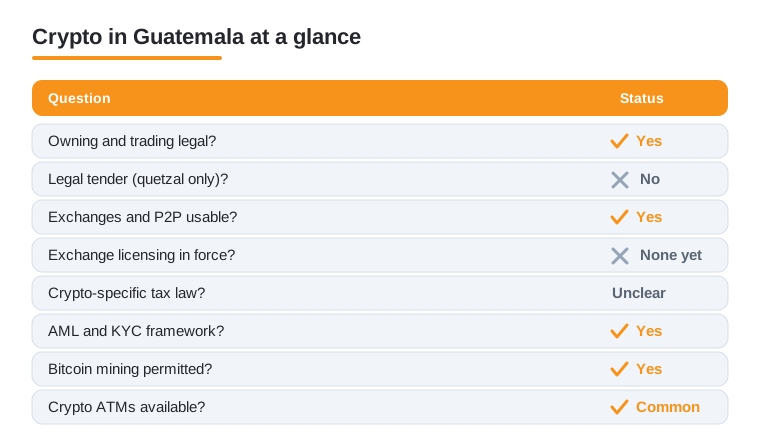
Yes. Owning, buying, selling, and using Bitcoin and other cryptocurrencies is legal in Guatemala. No law prohibits individuals from holding crypto or trading it peer-to-peer, and merchants are free to accept it voluntarily if they choose.
However, legal to use is not the same as legal tender. Under Guatemala's Monetary Law (Ley Monetaria), the quetzal is the country's sole monetary unit and only the Banco de Guatemala may issue notes and coins within the national territory. On that basis the central bank has been consistent and public: virtual currencies are not legal tender in Guatemala, are not issued or backed by the State, are not treated as foreign currency (divisas), carry no government guarantee, and cannot be imposed on anyone as a mandatory means of payment for goods and services. The president of the Banco de Guatemala, Alvaro Gonzalez Ricci, has publicly described crypto as investment assets rather than money and has said that, because these assets are highly volatile, their use should be regulated to protect Guatemalans.
This contrasts sharply with neighbouring El Salvador, which adopted Bitcoin as legal tender. Guatemala has taken a far more cautious route: it neither endorses nor forbids crypto, leaving a largely unregulated space that the government is now working to formalise. Anyone who uses crypto in Guatemala today does so at their own risk.
Who regulates crypto in Guatemala?
As of 2026 there is no single dedicated crypto regulator. Several existing institutions touch the sector under their general mandates, and the pending crypto bill would formalise this division of labour:
- Banco de Guatemala (Banguat, the central bank) manages monetary policy, defends the quetzal as the only legal tender, and issues public advisories warning that crypto is not state-backed.
- Junta Monetaria (Monetary Board) sets monetary and financial policy and would guide any official position on digital assets.
- Superintendencia de Bancos (SIB) is the banking supervisor. It is positioned to become the primary licensing and supervisory authority for crypto service providers if dedicated legislation passes.
- Intendencia de Verificacion Especial (IVE) is Guatemala's financial intelligence unit (FIU), housed within the SIB, responsible for anti-money-laundering and counter-terrorist-financing oversight and suspicious-transaction reporting, broadly aligned with FATF standards.
- Superintendencia de Administracion Tributaria (SAT) is the tax authority that administers any tax due on crypto-related income or gains.
Note that the central bank and SIB have, in past advisories, jointly warned the public that crypto has no legal validity as payment and does not meet domestic security standards. Until a crypto law is enacted, these advisories and the institutions' general powers are the main reference points.
Key laws and frameworks
Guatemala still has no comprehensive, enacted, crypto-specific statute. The relevant legal anchors today are general: the Monetary Law (Ley Monetaria), which makes the quetzal the only legal tender, and the country's anti-money-laundering regime. That AML regime was overhauled in June 2026 by Decree 15-2026, which for the first time defines virtual-asset service providers as obligated subjects supervised by the IVE (see the AML and KYC section below). So while Guatemala still lacks a dedicated crypto-market statute, crypto businesses are now captured by AML law. There is no local equivalent of the EU's MiCA regulation, and Guatemala is not an EU member, so MiCA does not apply here.
The most important development is Bill 6538, a draft Cryptocurrency Law (Ley de Criptomonedas) presented to the Congress of the Republic in 2025 and reportedly sponsored by congresswoman Shirley Rivera. Reported aims of the roughly 15-article proposal include: permitting the voluntary use, exchange, and custody of crypto-assets while keeping the quetzal as the only legal tender; requiring all crypto platforms, wallets, and service providers operating in Guatemala to register with and be supervised by the SIB; imposing transparency, cybersecurity, and user-protection standards; mandating know-your-customer (KYC) checks and suspicious-transaction reporting to the IVE; and addressing taxation, with reported exemptions for small personal trades. Officials have indicated that, if Congress enacts the bill, the SIB could publish secondary (implementing) rules around mid-2026.
As with any pending legislation, the final text, scope, and timing can change, and the bill may not pass at all. Treat the details above as provisional rather than settled law, and confirm the current status with the Superintendencia de Bancos.
Licensing and registration of exchanges and VASPs
As of 2026 there is no enacted licensing or registration regime that crypto exchanges or virtual-asset service providers (VASPs) must satisfy to serve Guatemalan users, because the dedicated framework in Bill 6538 has not yet taken effect. In practice, Guatemalans access crypto through a mix of channels:
- Global centralized exchanges that allow account creation with identity verification and bank or card funding where supported.
- Peer-to-peer (P2P) marketplaces, popular where direct fiat on-ramps are limited, letting buyers and sellers transact in quetzales.
- Regional and remittance-focused platforms used to convert between crypto and local currency.
If Bill 6538 is enacted, this would change significantly: the draft would require every crypto platform, wallet provider, and service provider operating in the country to register with the SIB and submit to supervision covering transparency, cybersecurity, user protection, KYC, and AML reporting. Until then, the only checks most users encounter are the KYC and AML procedures that reputable international exchanges already apply as a matter of their own compliance, regardless of Guatemalan law.
Crypto and Bitcoin tax in Guatemala
Guatemala does not have a tax regime written specifically for cryptocurrency. In practice, crypto activity is assessed under the country's existing tax rules administered by the SAT, and the treatment of any given transaction can depend on its nature (for example, trading profits, business income, or a casual disposal) and on your individual circumstances.
Because there is no crypto specific tax rule and no published SAT criterion on virtual assets, the general rates of Decree 10-2012 apply according to how a transaction is classified: 10 percent on capital gains, 5 percent then 7 percent under the Regimen Opcional Simplificado sobre Ingresos, 25 percent under the Regimen sobre las Utilidades de Actividades Lucrativas, and 12 percent IVA on taxable supplies. Those are general rates, not a ruling on crypto; the open question is the classification of your activity, not the rate, and no official Guatemalan guidance confirms which one applies to a given crypto disposal. What is reasonable to assume is that income or gains realised from crypto may be taxable like other income, and that businesses dealing in crypto should keep careful records of transactions, valuations, and counterparties.
Bill 6538 has produced no traceable committee report since it was presented on 12 May 2025, so none of its proposed tax treatment is in force and no date has been set for a vote. Until clearer guidance exists, anyone with meaningful crypto holdings or activity should consult a qualified Guatemalan accountant or tax lawyer and check the SAT tax portal. For general background see our guide to crypto taxes. This section is informational only and is not tax advice.
AML and KYC rules
Guatemala has a long-standing anti-money-laundering and counter-terrorist-financing framework overseen by the IVE, the financial intelligence unit housed within the SIB and broadly aligned with FATF standards. Regulated financial institutions must perform customer due diligence, retain records, and report suspicious transactions to the IVE.
In June 2026 Congress approved a new anti-money-laundering law, Decree 15-2026 (Ley Integral para la Prevencion y Represion del Lavado de Dinero u Otros Activos y del Financiamiento del Terrorismo), approved by Congress on 2 June 2026 with 147 votes in favour, one against and twelve deputies absent, out of 160. It repeals the two older statutes that had governed this area for about 25 years, Decree 67-2001 (against money laundering) and Decree 58-2005 (against terrorist financing), and unifies them into a single framework aligned with FATF (GAFI) recommendations. Importantly for this page, Decree 15-2026 for the first time brings virtual-asset service providers (proveedores de servicios de activos virtuales) into Guatemalan law as obligated subjects before the IVE. Reported coverage includes crypto exchange, custody of virtual assets, transfers of crypto-assets, trading platforms, and the issuance or offering of virtual assets, whether the provider is local or foreign. Article 128 sets entry into force at three months after publication, that is 17 September 2026, and Article 127 requires the Superintendencia de Bancos, through the IVE, to draft the implementing regulation and submit it to the President within six months of entry into force, that is by 17 March 2027 (reglamento), so the exact day-to-day obligations will depend on that secondary rulebook.
This is a meaningful change from the earlier position: crypto-related AML and KYC duties no longer depend solely on the pending Bill 6538, because Decree 15-2026 already names virtual-asset providers as obligated subjects that must apply customer due diligence and report suspicious activity to the IVE once the law is in force. Bill 6538 would have added a separate licensing and supervision regime under the SIB, but reporting suggests the new AML law has, in practice, taken priority over that draft. In the meantime, most KYC that Guatemalan users encounter still comes from the international exchanges they use rather than from a fully operational domestic crypto rulebook. You can read about the IVE on the SIB IVE page, and legislative records for Decree 15-2026 can be checked through the Congreso de la Republica. Because the day-to-day rules depend on the IVE's forthcoming implementing regulations, confirm the current detail before relying on it.
Buying and using crypto in practice
For someone starting from scratch, a typical path looks like this:
- Choose a platform. Pick a reputable global exchange that serves Guatemala, or a P2P marketplace that supports quetzal trades. Compare fees, supported payment methods, and security features.
- Verify your identity. Most platforms require KYC documentation such as a national ID (DPI) or passport. This is standard and is likely to become a legal expectation if Bill 6538 passes.
- Fund your account. Depending on the platform, you may deposit via bank transfer, card, or a P2P trade in cash or local currency.
- Buy and withdraw to your own wallet. After purchasing, consider moving holdings to a wallet you control rather than leaving them on the exchange, especially for larger amounts. A hardware wallet offers the strongest protection.
- Keep records. Save transaction details and valuations in case they are needed for tax purposes.
Cashing out works in reverse: sell on an exchange or via P2P, or use a crypto ATM to obtain quetzales. Because crypto is not legal tender, accepting it remains entirely voluntary for merchants, and there is no domestic deposit guarantee, so always double-check fees and the exchange rate before confirming any transaction.
Crypto ATMs and remittances
One of the more striking facts about Guatemala is its scale of crypto cash machines. The country has emerged as a notable regional hub for crypto cash-out points, driven by a partnership announced in August 2024 between the local exchange Coincaex and 5B, an operator of a large existing ATM network in Guatemala. Reporting has put the number of enabled 5B machines at more than 2,700, placing Guatemala among the countries in the Americas with the most terminals for turning crypto into cash. An important nuance is that these 5B machines are one-way (cash-out) terminals: they cannot be used to insert cash and buy crypto, only to withdraw local currency, which fits Guatemala's heavy reliance on remittances. In practice a Coincaex user generates a withdrawal authorization code (reportedly delivered by WhatsApp) and presents it at a 5B ATM to collect quetzales, so a recipient can turn an incoming crypto transfer into cash in hand without needing a bank account. Fees and limits vary by operator and machine and are typically higher than online exchange rates, so check the terms displayed on the terminal first. Live ATM locations can be looked up on public mapping services such as Coin ATM Radar.
Remittances are central to Guatemala's economy, accounting for close to a fifth of GDP, with most funds sent by Guatemalans living in the United States. Using Bitcoin or stablecoins for remittances can lower costs by cutting out intermediaries, speed up settlement, and improve access for recipients without bank accounts, who can cash out via P2P or the ATM network. The trade-offs are price volatility (often mitigated by using stablecoins), on-ramp and off-ramp fees, and the need for basic digital literacy. For many households the technology is a genuine improvement, but it should be approached with these risks in mind.
Bitcoin mining in Guatemala
Bitcoin mining is not prohibited in Guatemala, and there is no dedicated mining law. In principle anyone can run mining hardware, subject to the same electricity costs, import duties, and business obligations that apply to any other activity.
The practical challenges are economic and infrastructural rather than legal. Guatemala's electricity can be relatively expensive and grid reliability is uneven in parts of the country, which limits the appeal of large-scale, energy-intensive mining. On the other hand, Guatemala has significant renewable generation, particularly hydropower, which has prompted discussion about whether surplus or stranded renewable energy could one day support more sustainable mining, though this remains aspirational rather than an established industry. Anyone considering mining should evaluate local power tariffs, cooling needs, hardware import costs, and the tax treatment of any rewards, and confirm current rules with local authorities.
Recent developments (2025-2026)
Two threads define the current moment. First, the proposed Cryptocurrency Law, Bill 6538, presented to Congress in 2025, would for the first time create a formal framework: voluntary use of crypto with the quetzal kept as the only legal tender, mandatory registration and supervision of crypto providers by the SIB, KYC and IVE reporting, and reported tax provisions including exemptions for small personal trades. Officials suggested the SIB could issue secondary rules around mid-2026 if the bill is enacted, but as of 2026 the bill has not been confirmed as passed, and its final form could change.
Second, and more concretely, in June 2026 Congress approved a new anti-money-laundering law, Decree 15-2026 (reportedly 147 votes), which repeals Decree 67-2001 and Decree 58-2005 and unifies them into one FATF-aligned framework. Unlike the earlier position, this law explicitly names virtual-asset service providers as obligated subjects before the IVE, covering exchange, custody, transfers, trading platforms, and issuance of crypto-assets, whether local or foreign. It was published in the Diario de Centro America on 17 June 2026 and takes effect on 17 September 2026 under Article 128, and Article 127 gives the Superintendencia de Bancos, acting through the IVE, six months from that date to draft the implementing regulation and submit it to the President, so it is due by 17 March 2027, and that this AML law took priority over Bill 6538. This means the first hard, enacted crypto obligations in Guatemala come from AML law rather than from a dedicated crypto statute. Because both threads are evolving, the safest approach is to track announcements from the IVE, the SIB, and the Banco de Guatemala directly rather than relying on secondary summaries.
Consumer risks and protection
Guatemala's crypto environment is defined by a gap between active grassroots usage and an as-yet-incomplete legal framework. The main risks for users today are the absence of crypto-specific consumer protection, unclear and potentially evolving tax obligations, price volatility, the usual threats of scams and fraud in a lightly regulated space, and regulatory uncertainty while draft laws move through Congress. Because crypto is not legal tender and carries no state guarantee, there is no domestic deposit insurance: if a platform fails or a P2P counterparty acts in bad faith, recourse can be difficult.
Sensible precautions include using established platforms with strong security records, enabling two-factor authentication, verifying counterparties carefully on P2P, not leaving large balances on any single service, and keeping the bulk of holdings in a wallet you control. Treat crypto as a high-risk asset and never invest more than you can afford to lose. The outlook points toward formalisation rather than prohibition: if Bill 6538 is enacted with sensible implementing rules, it could legitimise the sector and improve protections while preserving the quetzal as the only legal tender. This is general information, not legal, tax, or financial advice.
Official sources and how to verify
Because Guatemala's crypto rules are in transition, always confirm the current position with the official authorities rather than third-party summaries. The most authoritative sources are:
- Banco de Guatemala (Banguat) for the central bank's position, the legal-tender status of the quetzal, and public advisories on virtual currencies.
- Superintendencia de Bancos (SIB) for banking supervision, public warnings on crypto, and any future licensing of crypto service providers.
- Intendencia de Verificacion Especial (IVE) for anti-money-laundering rules and reporting obligations.
- Superintendencia de Administracion Tributaria (SAT) for tax registration, filing, and any future crypto tax guidance.
To track the status of Bill 6538 and any new crypto rules, monitor the Congress of the Republic and the SIB. For more on this site, see our regulation hub. This page is general information as of 2026 and is NOT legal advice; verify with the named official regulators before acting.
What changes on 17 September 2026
The headline development since this page was last reviewed is that Guatemala's new anti money laundering law now has fixed dates rather than approximate ones. President Bernardo Arevalo sanctioned Decree 15-2026 on 17 June 2026 and it was published in the Diario de Centro America the same day. Article 128 sets entry into force at three months after publication, which is 17 September 2026. Nothing in the decree makes Bitcoin legal tender; the quetzal keeps that status alone.
Congress passed the text on 2 June 2026 by 147 votes, with one against and twelve deputies absent, out of 160. It began as initiative 6593, a 126 article draft delivered to Congress by the President on 28 July 2025, and repeals Decree 67-2001 and Decree 58-2005, the two statutes that had governed this area for roughly 25 years. The driver was external: Guatemalan reporting describes the update as fundamental to avoid Guatemala being included in the grey list before the next GAFILAT evaluation.
| Date | What happens |
|---|---|
| 28 July 2025 | Initiative 6593 delivered to Congress, 126 articles |
| 2 June 2026 | Congress approves Decree 15-2026, 147 votes in favour, 1 against, 12 absent |
| 17 June 2026 | Sanctioned by the President and published in the Diario de Centro America |
| 17 September 2026 | Law enters into force under Article 128. Virtual asset service providers count as personas obligadas and must register with the Superintendencia de Bancos through the IVE |
| 17 March 2027 | Article 127 deadline for the Superintendencia de Bancos, through the IVE, to draft the reglamento and submit it to the President |
| 17 March 2027 | Article 121 deadline for sociedades anonimas to register their administrators |
| 17 September 2027 | Article 120 deadline for sociedades anonimas to update their shareholder registry |
| February 2027 | GAFILAT review of Guatemala, per La Hora |
Read the gap in that table carefully. From 17 September 2026 the statutory duties bite, but the regulation explaining how to comply is not due for a further six months. Providers face obligations before the operational detail exists.
What virtual asset service providers must actually do
Decree 15-2026 is the first Guatemalan statute to name proveedores de servicios de activos virtuales. Article 2, literal i, defines one as an individual or legal person that, habitually and as its line of business, provides third parties with virtual asset exchange, custody or administration services. Article 3 sorts personas obligadas into four groups and places virtual asset providers in the third, alongside real estate intermediaries, vehicle dealers, art and jewellery dealers and corporate service providers. Prensa Libre lists the covered activities as crypto exchange, custody of virtual assets, transfers of crypto assets, trading platforms, and the issuance or offering of virtual assets. CriptoNoticias reports the duty applies regardless of whether the provider is local or not.
- Register with the Superintendencia de Bancos through the Intendencia de Verificacion Especial under Article 5. Failing to register does not excuse the remaining duties. Entities already registered under the previous regime only update their data, under Article 117.
- Apply know your customer procedures and verify identity. Guatemala's state news agency reports that users of exchange platforms must verify identity with the identity document, proof of address and the origin of funds.
- File suspicious transaction reports to the IVE.
- Keep a daily register of cash transactions of US$10,000 or more, under Article 31.
- Retain documentation for a minimum of five years, under Article 34.
- Appoint a compliance officer belonging to senior management, maintain a prevention manual with policies to mitigate financial crime, and run periodic internal and external audits.
- Identify the beneficial owner behind corporate customers.
This is an anti money laundering registration duty, not a licence to operate an exchange. There is still no prudential or market conduct authorisation for crypto platforms in Guatemala, and no public register of licensed exchanges. Penalties are reported inconsistently: LexLatin puts administrative fines at US$500 to US$300,000, doubled where the obligated person tried to obstruct the IVE, and separately US$10,000 to US$625,000 for legal entities responsible for the offence with cancellation of legal personality on reoffending, while CriptoNoticias gives the same US$500 floor but a US$500,000 ceiling. Treat the ceiling as unsettled until the gazette text is checked.
Supervision runs through the IVE. La Hora reports a phased rollout: banks update data first, while cooperatives, crypto providers and real estate firms receive guidance and training from the IVE. It quotes FUNDESA director Juan Carlos Zapata warning that without covering crypto any compliance effort would have a structural hole that the criminal economy would exploit, and that GAFILAT will not assess whether the law exists on paper but whether the system works.
The dedicated crypto bill has not moved
Guatemala still has no crypto specific statute. Initiative 6538, the draft Ley de Criptomonedas, was presented to Congress on 12 May 2025 by deputy Shirley Rivera of the Vamos bloc. It was analysed on 10 June 2025 by the Congress Foro Presidencial para la Transformacion Digital, chaired by deputy Jorge Mario Villagran, with the Banco de Guatemala, the Ministerio Publico, the Superintendencia de Bancos, the SAT and technology sector participants. Since then no committee report, floor vote or published timetable could be found; sources describe the bill only as under review by the relevant legislative commissions.
Two things point the same way. Industry voices argued against speed: Francis Sanchinelli of the Blockchain association told Prensa Libre that legislating without an adequate technical diagnosis can be counterproductive, and Osmo chief executive Piero Coen cautioned that not every digital asset can be considered money. And Decree 15-2026 has now absorbed the money laundering question that gave the bill much of its urgency. As a check on whether anything was missed, Prensa Libre's cryptocurrency section carries no Guatemalan legislative crypto story at any point in 2026. On the evidence available in August 2026, the honest position is that the bill is sitting in committee with no scheduled next step.
What tax actually applies to crypto today
There is no crypto specific tax rule in Guatemala and no published SAT criterion on virtual assets could be located. What applies instead are the ordinary rates of the Ley de Actualizacion Tributaria, Decree 10-2012. The rate is not the hard part; the classification is. Whether a disposal is a capital gain or income from a lucrative activity determines which line below you land on.
| Basis | Rate | When it tends to be the relevant one |
|---|---|---|
| Ganancias de capital | 10 percent, under Articles 83 and 89 | An occasional disposal of an asset outside a trade or business |
| Regimen Opcional Simplificado sobre Ingresos | 5 percent up to Q30,000 of monthly income, then Q1,500 fixed plus 7 percent on the excess | A registered taxpayer taxed on gross receipts |
| Regimen sobre las Utilidades de Actividades Lucrativas | 25 percent on taxable income | Companies and habitual traders taxed on net profit |
| Pequeno Contribuyente | 5 percent on gross income | Small registered taxpayers below the annual ceiling for the regime |
| IVA | 12 percent | Taxable supplies of goods and services |
These are the general rates, not a ruling on crypto. The two sources above address real estate and general business taxation and neither mentions virtual assets. Until SAT publishes a criterion on virtual assets, the classification of a specific transaction is the point to settle with a Guatemalan adviser, and it is where two taxpayers with identical trades can end up on different rates.
Frequently asked questions
Is Bitcoin legal tender in Guatemala?
No. The quetzal is Guatemala's only legal tender under the Monetary Law, and only the Banco de Guatemala may issue national currency. Bitcoin and other cryptocurrencies are legal to own and use voluntarily, but they are not money in the legal sense, are not state-backed, and cannot be forced on anyone as payment. This differs from El Salvador, which adopted Bitcoin as legal tender.
Who regulates cryptocurrency in Guatemala?
No single dedicated crypto regulator exists yet. The Banco de Guatemala and the Monetary Board oversee monetary policy, the Superintendencia de Bancos (SIB) is positioned to license and supervise crypto service providers if proposed legislation passes, the IVE (within the SIB) handles anti-money-laundering oversight, and the SAT administers tax. The draft Cryptocurrency Law, Bill 6538, would consolidate supervision of crypto providers under the SIB if it is enacted.
Has Guatemala passed a crypto law?
Not as of 2026. Bill 6538, a draft Cryptocurrency Law presented to Congress in 2025, would create a formal framework requiring crypto providers to register with the SIB and apply KYC and AML controls, while keeping the quetzal as the only legal tender. Officials suggested the SIB could publish secondary rules around mid-2026 if it passes, but the bill has not been confirmed as enacted and its final text could change. Verify the current status with the SIB.
Do I have to pay tax on crypto in Guatemala?
Guatemala has no tax rules written specifically for crypto, so activity is assessed under existing tax law administered by the SAT, and treatment can depend on your circumstances. Because official crypto-specific figures are not clearly established, you should not rely on any specific rate or threshold and should consult a qualified Guatemalan tax professional and check the SAT portal. This is not tax advice.
Are crypto exchanges licensed in Guatemala?
Not yet. As of 2026 there is no enacted licensing or registration regime for crypto exchanges or VASPs, so Guatemalans typically use global exchanges and P2P marketplaces. If Bill 6538 is enacted, every crypto platform, wallet, and service provider operating in the country would have to register with and be supervised by the SIB, with KYC and IVE reporting obligations.
Can I use Bitcoin for remittances to Guatemala?
Yes, and it is one of the most common real-world uses of crypto in the country. With remittances near a fifth of GDP, crypto and stablecoin transfers can reduce fees and speed up delivery compared with some traditional services, and recipients can cash out via P2P or the country's crypto ATM network, many of which are one-way cash-out machines. Be mindful of volatility, on-ramp and off-ramp fees, and the need for basic digital literacy.
Does Guatemala's new 2026 anti-money-laundering law cover crypto?
Yes. Decree 15-2026, the new anti-money-laundering and counter-terrorist-financing law approved by Congress in June 2026, replaces Decree 67-2001 and Decree 58-2005 and, for the first time in Guatemalan law, names virtual-asset service providers as obligated subjects supervised by the IVE. Reported coverage includes crypto exchange, custody, transfers, trading platforms, and the issuance of virtual assets, whether the provider is local or foreign. The law takes effect on 17 September 2026, three months after its publication on 17 June 2026, and the implementing regulation is due by 17 March 2027, six months after entry into force, so the precise obligations will depend on that secondary rulebook. Confirm the current detail with the IVE and the SIB.
How do the 2,700-plus Bitcoin ATMs in Guatemala work?
They are cash-out points rather than buy-crypto machines. Following a partnership announced in August 2024 between the local exchange Coincaex and the ATM operator 5B, more than 2,700 existing 5B machines were enabled so that a Coincaex user can withdraw quetzales in cash. The user generates a withdrawal authorization code (reportedly delivered by WhatsApp) and presents it at a 5B ATM. Because these terminals are one-way, they cannot be used to insert cash and buy Bitcoin. Fees and limits vary, so check the terms before withdrawing.
Who is the head of Guatemala's central bank on crypto?
The Banco de Guatemala (Banguat) is led by its president, Alvaro Gonzalez Ricci, who has publicly stated that cryptocurrencies are not legal money in Guatemala and are better understood as volatile investment assets, and that their use should be regulated to protect the public. The quetzal remains the country's only legal tender.
When does Guatemala's new anti money laundering law take effect?
Decree 15-2026 was published in the Diario de Centro America on 17 June 2026 and takes effect on 17 September 2026, three months after publication, under Article 128. Its implementing regulation is due by 17 March 2027 under Article 127.
Do crypto exchanges have to register in Guatemala?
From 17 September 2026, yes. Decree 15-2026 makes proveedores de servicios de activos virtuales personas obligadas that must register with the Superintendencia de Bancos through the Intendencia de Verificacion Especial, and CriptoNoticias reports the duty applies whether or not the provider is based in Guatemala. This is an anti money laundering registration, not an operating licence, and Guatemala still has no prudential or market conduct authorisation regime for crypto platforms.
What tax rate applies to crypto profits in Guatemala?
There is no crypto specific rate and no published SAT guidance on virtual assets. Under Decree 10-2012, capital gains are taxed at 10 percent, the Regimen Opcional Simplificado sobre Ingresos charges 5 percent up to Q30,000 of monthly income and Q1,500 plus 7 percent above that, the Regimen sobre las Utilidades de Actividades Lucrativas charges 25 percent of taxable income, and IVA is 12 percent. Those are general rates. Which one applies depends on how SAT classifies your activity, so confirm with a Guatemalan adviser.
What has to be reported to the IVE and above what amount?
Obligated persons must keep a daily register of cash transactions of US$10,000 or more under Article 31, file suspicious transaction reports to the IVE, and retain documentation for at least five years under Article 34. Reported administrative fines start at US$500; sources disagree on the ceiling, with LexLatin reporting US$300,000 and CriptoNoticias US$500,000, so treat the top of the range as unsettled.
Is Guatemala on the FATF grey list?
No source located in this review shows Guatemala among the FATF jurisdictions under increased monitoring. Guatemalan reporting in June 2026 described Decree 15-2026 as fundamental to avoid Guatemala being included in the grey list ahead of the next GAFILAT evaluation, which Prensa Libre places in 2027 and La Hora reports as February 2027.
Has Guatemala passed a dedicated cryptocurrency law?
No. Initiative 6538, the draft Ley de Criptomonedas, was presented on 12 May 2025 by deputy Shirley Rivera and analysed on 10 June 2025 by the Congress Foro Presidencial para la Transformacion Digital with Banguat, the SIB, the SAT and the Ministerio Publico. No committee report, vote or timetable has been traceable since, and as of August 2026 it remains in committee.
Facts reviewed: 13 August 2026. Page updated: 13 August 2026.
Related guides
More countries in the region
Practical guides