Home › Crypto Regulation › Costa Rica
Bitcoin & Cryptocurrency Regulation in Costa Rica
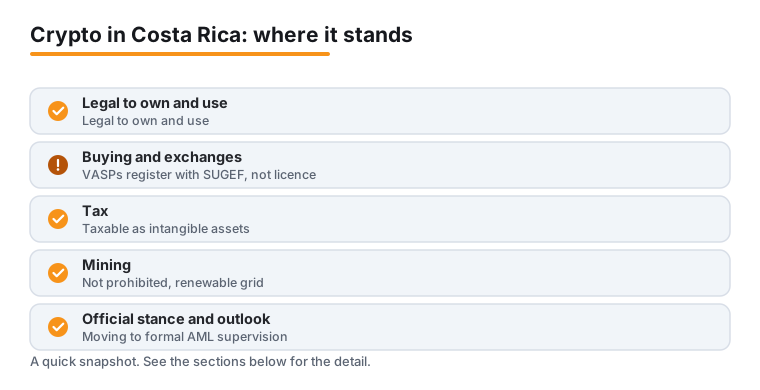
Quick answer — Costa Rica, 2026
- Legal: Legal to own and use, not legal tender, VASPs must register with SUGEF
- Tax: Taxable gains under 15 percent capital gains rate, outcomes fact-specific
- Buying: Via international, regional, P2P platforms, or ATMs after KYC
Costa Rica is, in practice, one of Central America's more crypto-tolerant jurisdictions. Owning, buying, selling and using Bitcoin and other digital assets is legal, but cryptocurrencies are not legal tender and carry no state backing. For years the country relied only on its existing financial, anti-money-laundering and tax rules. That has now changed: the reform was enacted and published in the official gazette (La Gaceta) as Legislative Decree No. 10961, which amends Law No. 7786 by adding Article 15 quater to bring crypto businesses under formal anti-money-laundering supervision. The framework is adopted but not yet in force. Law 10961 was published in La Gaceta No. 113, Alcance No. 78, on 19 June 2026, and its closing clause, "Rige tres meses a partir de su publicación", sets the effective date at 19 September 2026. Article 4 allows up to three months for the CONASSIF implementing regulation without stating when that period starts, and no regulation had appeared as of early August 2026.
This page explains, in plain language, where Costa Rica stands on crypto legality, who regulates the sector, how taxes generally apply, and the practical rules around exchanges, registration, mining and investing. It is general information as of 2026 and is not legal, tax or financial advice. Rules are evolving, so always confirm the current position with official sources such as the Banco Central de Costa Rica (BCCR), SUGEF and the Direccion General de Tributacion before acting, and consider speaking with a licensed Costa Rican professional. For broader context, see our overview of crypto regulation.
On this page: Legal status · Who regulates it · Taxes · How to buy · Mining
Is Bitcoin and crypto legal in Costa Rica?
Yes. Buying, holding, selling and using Bitcoin and other cryptocurrencies is legal for individuals and businesses in Costa Rica. There is no prohibition on private crypto activity, and people are free to agree among themselves to transact in digital assets.
What crypto is not is legal tender. The Costa Rican colón is the only official currency, and the Banco Central de Costa Rica (BCCR) has stated in official communiqués that crypto-assets are not recognised as legal tender and have no state backing. The central bank does not prohibit their use, treating operations with these assets as carried out under the principle of autonomy of will and without legal coverage. The practical consequences are important:
- No merchant, employer or service provider is obligated to accept crypto as payment, though many choose to.
- Crypto held in private wallets or on exchanges is not covered by the deposit guarantees or consumer protections that apply to bank accounts and the colón.
- If you are paid in crypto or accept it voluntarily, you bear the price and counterparty risk yourself.
In short, Costa Rica neither bans crypto nor endorses it as currency. It treats digital assets as private property that you may use at your own risk.
Who regulates cryptocurrency in Costa Rica?
Costa Rica does not have a single dedicated crypto regulator. Oversight is shared among several public bodies:
- Banco Central de Costa Rica (BCCR): Sets monetary policy and has clarified that cryptocurrencies are not legal tender and are not regulated as an official means of payment.
- SUGEF (Superintendencia General de Entidades Financieras): The supervisor of banks and other financial entities, and the body designated to register and supervise crypto businesses for anti-money-laundering purposes under the new law.
- CONASSIF (Consejo Nacional de Supervisión del Sistema Financiero): The financial-system supervisory council that issues regulations under which SUGEF operates.
- Dirección General de Tributación (DGT), within the Ministerio de Hacienda: The tax authority that determines how crypto is taxed.
- Unidad de Inteligencia Financiera (UIF) of the Instituto Costarricense sobre Drogas: Receives suspicious-transaction reports.
There is no crypto-specific consumer-protection agency, so users carry significant responsibility for vetting the platforms they use.
Crypto laws and frameworks in Costa Rica
Costa Rica does not have a comprehensive, crypto-specific code. Instead, digital assets are governed by existing rules plus a newly approved anti-money-laundering reform:
- Law No. 7786 (Anti-Money-Laundering / Counter-Terrorist-Financing law): Costa Rica's AML/CFT framework, which imposes know-your-customer (KYC) and reporting duties on regulated activities. This is the law being amended to cover Virtual Asset Service Providers (VASPs).
- BCCR communiqués: Establish that crypto is not legal tender and not an official means of payment.
- DGT tax criteria: Treat crypto-assets as intangible assets for tax purposes (see the taxation section below).
The central development is a legislative reform first introduced as Bill 22.837 (filed in 2021), which was later replaced in the legislative process. The successor measure, tracked under legislative file No. 25.340, has been enacted and published in the official gazette (La Gaceta) as Legislative Decree No. 10961. It amends Law No. 7786 by adding Article 15 quater, which subjects VASPs to AML supervision by SUGEF. The published text closes with "Rige tres meses a partir de su publicación", so the reform takes effect on 19 September 2026. Its Article 4 separately grants "un plazo de hasta tres meses para la debida reglamentación de esta ley" but does not say when that period begins, so the CONASSIF deadline cannot be fixed to a date from the statute alone. As of early August 2026 no CONASSIF regulation and no draft for consultation had been published, so the due-diligence threshold, the exclusions and the registration mechanics are still unknown. Readers should still verify the current status directly with the official sources named below rather than relying on any single secondary summary.
Licensing and registration of crypto exchanges and VASPs
Under Article 15 quater of Law No. 7786, added by Legislative Decree No. 10961, Virtual Asset Service Providers (VASPs), meaning exchanges, custodians, transfer services and similar businesses, must register with SUGEF. The law is explicit that this registration is not a licence or government authorisation to operate: it is an anti-money-laundering compliance checkpoint, not a seal of approval or guarantee of soundness.
Now that the text is public, the main compliance pillars for registered VASPs are clearer. They must:
- Identify customers and beneficial owners and apply know-your-customer (KYC) and due-diligence measures.
- Apply additional controls for politically exposed persons (PEPs) and for risks from new products, services and technologies.
- Keep transaction records and make them available, and apply controls over virtual-asset transfers.
- Report suspicious transactions, including attempted transactions, confidentially and without delay to the Financial Intelligence Unit (UIF).
The reform also adds an enforcement hook on the banking side: regulated financial institutions and other supervised entities are barred from maintaining business relationships with VASPs that, where required, are not registered with SUGEF. In practice this makes registration a condition of access to the formal financial system. The published text sets fines of 5% to 50% of the total transaction amount where a provider fails to record, on the supervisor's form, incoming or outgoing transactions equal to or above US$10,000, and fines of two to one hundred base salaries for the other listed failures, which include refusing to register with SUGEF and maintaining a business relationship with a provider whose registration is not current. The 2026 base salary is 462,200 colones, so that second band runs from 924,400 to 46,220,000 colones. Fines fall due within eight business days of notification and carry a 3% monthly surcharge if unpaid. CONASSIF must issue detailed implementing regulations within about three months after the reform enters into force. No standalone crypto operating licence exists before 19 September 2026, and none is created after it either: Costa Rica has an AML registration duty, not a licensing regime. Businesses must still meet general corporate, AML and tax obligations. Anyone planning to operate an exchange or money-transfer service should seek local legal advice and confirm registration requirements with SUGEF before launching.
Crypto taxation in Costa Rica
Crypto can be taxable in Costa Rica depending on how it is used. The Dirección General de Tributación (DGT) has treated crypto-assets as intangible assets for tax purposes, since they are not legal tender. Reflecting positions the DGT has set out (including a 2019 classification and a later official ruling, oficio MH-DGT-OF-0460-2023 of 23 August 2023):
- Personal holdings: Where a gain is taxable, it is generally captured under the tax on capital income and capital gains, calculated as the difference between the disposal price and the acquisition cost (including related fees). The standard capital-gains rate under this regime is 15%. In practice, though, outcomes for individuals are fact-specific. Under Costa Rica's territorial system, foreign-source gains are generally outside scope, and a one-off, non-habitual disposal by an individual may fall outside the capital-gains charge, which is aimed more at habitual activity. So a single personal sale will not always trigger tax; confirm your own position before assuming it does.
- Business activity: Virtual assets linked to a business activity are subject to corporate income tax, and fees charged for exchange, verification or organisation services involving virtual assets can be subject to corporate income tax and VAT.
Costa Rica uses a broadly territorial tax system, which can make individual outcomes fact-specific. The country also signed the multilateral competent authority agreement for automatic exchange of information under the Crypto-Asset Reporting Framework (CARF) on 26 November 2024, pointing toward greater cross-border tax transparency for crypto over time; Costa Rica is in the later implementation group, with first exchanges of crypto-asset information expected by 2028. Because treatment varies by situation and is evolving, confirm your obligations with the DGT or a qualified Costa Rican tax professional. For general background see crypto taxes. This is not tax advice.
AML and KYC rules
Anti-money-laundering and counter-terrorist-financing rules are the backbone of Costa Rica's crypto oversight. They flow from Law No. 7786 and the 2026 reform that extends that law to VASPs.
In practice this means:
- Identity verification is standard. Reputable exchanges and crypto businesses require ID and, for larger amounts, additional documentation such as proof of funds.
- Due diligence on beneficial owners. VASPs must identify not just account holders but the real people behind transactions and entities.
- Suspicious-activity reporting. Covered businesses must report suspicious transactions to the Financial Intelligence Unit (UIF) of the Instituto Costarricense sobre Drogas, confidentially and promptly.
- FATF alignment. Even before the new law, banks and payment providers in Costa Rica applied AML/KYC standards aligned with international (FATF) expectations, so crypto users have routinely faced verification.
For everyday users, the main effect is that opening accounts and moving larger sums will involve identity checks and record-keeping.
Buying and using crypto in practice
Costa Ricans can buy crypto through international exchanges, regional platforms, peer-to-peer marketplaces, a growing number of local services and Bitcoin ATMs. There is no government-run exchange and no requirement to use a particular platform.
A typical, lawful path looks like this:
- 1. Choose a reputable platform. Pick a well-established exchange or trusted local/P2P service that serves Costa Rica and offers strong security.
- 2. Complete verification. Provide the identity documents needed to satisfy KYC/AML checks.
- 3. Fund your account. Deposit colones (or supported currencies/stablecoins) by bank transfer, card or another supported method.
- 4. Place your order and review fees. Check the exchange rate and fees before confirming.
- 5. Secure your crypto. For meaningful amounts, withdraw to a wallet you control, ideally a hardware wallet, and back up your recovery phrase offline.
- 6. Keep records. Save transaction details and values for tax and compliance purposes.
Bitcoin ATMs exist, concentrated in San José and tourist areas, and are convenient for small or in-person purchases, though usually at higher fees and spreads than online exchanges. Crypto and stablecoins are also used as an alternative to traditional remittance channels; Costa Rica does not impose hard foreign-exchange controls that block ordinary transfers, but transfer and exchange businesses are subject to AML/KYC duties, and large or frequent transfers may trigger documentation. Always confirm a provider's legitimacy before sending money.
Bitcoin mining in Costa Rica
Bitcoin mining is not prohibited in Costa Rica, and the country has a genuine natural advantage: its electricity grid is powered overwhelmingly by renewable sources, chiefly hydropower, with significant geothermal, wind and solar capacity. This makes low-carbon mining technically feasible in a way that is rare globally.
However, prospective miners should be realistic:
- Power access is the real constraint, not legality. The national utility manages the grid, and securing reliable, cost-effective industrial power for mining can be difficult. Connection terms, tariffs and any approvals should be confirmed directly with the relevant authorities and the power provider.
- Costs and policy can shift. Electricity pricing and rules for large industrial consumers may change, affecting profitability.
- Tax and customs apply. Mining hardware imports and mining revenue can carry tax and customs implications; treat mining as a taxable activity and plan accordingly.
Claims that Costa Rica offers blanket tax breaks or dedicated incentives specifically for crypto mining should be verified carefully, as there is no broad, crypto-specific incentive regime confirmed in law. The renewable grid is a real differentiator; guaranteed subsidies are not.
Recent developments (2025-2026)
The most significant change is regulatory. After years of debate, Costa Rica moved from an unsupervised model toward formal AML oversight of crypto businesses:
- July 2025: The Legislative Assembly approved a crypto-regulation bill (originating from the long-running Bill 22.837 effort) in first debate, signalling intent to bring VASPs under SUGEF supervision.
- May 2026: Legislative file No. 25.340, filed on 11 December 2025, passed first debate on 7 May 2026 and was approved unanimously in second debate on 25 May 2026. The Executive signed it in San José on 9 June 2026.
- June 2026: The reform was enacted and published in La Gaceta as Legislative Decree No. 10961, adding Article 15 quater to Law No. 7786. It requires VASPs to register with SUGEF and meet AML/KYC duties, and bars regulated financial institutions from dealing with VASPs that are not registered where required. It takes effect on 19 September 2026, three months after publication, and CONASSIF has up to three months to issue the implementing regulation, a period the law does not tie to a stated start date.
- November 2024: Costa Rica signed the multilateral competent authority agreement for automatic exchange of crypto-asset tax information under the Crypto-Asset Reporting Framework (CARF) on 26 November 2024, with first exchanges of information expected by 2028.
Because legislative status can change quickly and secondary sources sometimes conflict, treat the above as a snapshot and verify the current legal position with the official regulators before relying on it.
Consumer risks and protection
Costa Rica's stance is best described as permissive and now moving toward AML supervision, but still light on consumer protection. That creates specific risks:
- Limited recourse: If a platform fails or funds are stolen, protections are far weaker than for regulated bank deposits, which carry no crypto guarantee.
- SUGEF registration is not approval: the law says so in terms, "La inscripción ante la Superintendencia no representa una autorización de operación". Appearing on SUGEF's registry means a firm has filed anti-money-laundering paperwork, not that the government endorses it or guarantees your funds.
- Regulatory change: Reporting thresholds, VASP obligations and tax treatment may tighten as reforms and CARF take effect.
- Fraud and scams: Fake exchanges, phishing and 'guaranteed return' schemes target crypto users here as elsewhere.
- Volatility: Crypto prices can fall sharply; invest only what you can afford to lose and keep detailed records.
The outlook points toward more formalisation rather than prohibition: Costa Rica appears far more likely to supervise crypto businesses for AML purposes than to ban activity or adopt crypto as legal tender. The safest approach is to use reputable providers, keep good records, and verify the current legal and tax position with official sources before making significant moves.
Official sources and how to verify
This guide is general information as of 2026 and is not legal, tax or financial advice. Because Costa Rica's crypto rules are evolving, you should verify the current position directly with the named official regulators before acting. The primary official sources are:
- Banco Central de Costa Rica (BCCR): monetary policy and statements on the status of crypto-assets.
- SUGEF (Superintendencia General de Entidades Financieras): supervision and registration of financial entities and, under the new law, VASPs.
- Ministerio de Hacienda / Dirección General de Tributación: tax administration and crypto tax treatment.
For wider context across countries, see our regulation hub. When in doubt, consult a licensed Costa Rican lawyer or tax adviser for guidance on your specific situation.
What is changing on 19 September 2026
Costa Rica's crypto anti-money-laundering law is adopted but not yet in force. The text published in La Gaceta No. 113, Alcance No. 78, of 19 June 2026 closes with the clause "Rige tres meses a partir de su publicación", which fixes the effective date at 19 September 2026.
Article 4 of the same law, headed "Reglamentación", reads in full: "Se otorga un plazo de hasta tres meses para la debida reglamentación de esta ley." It does not say when that three-month period begins. Costa Rican reporting and local counsel read it as running from publication, which would put the CONASSIF text due at about the same time the law takes effect; at least one international firm reads it as three months after entry into force. On either reading, no CONASSIF regulation and no draft for public consultation had been published as of early August 2026, and neither the SUGEF site nor the CONASSIF site carried anything on virtual assets or Law 10961. Until that regulation appears, the due-diligence threshold, the scope of covered activities, and the registration deadline and forms are all unknown.
| Date | Step |
|---|---|
| 11 December 2025 | Expediente 25.340 filed in the Legislative Assembly |
| 7 May 2026 | Approved in first debate |
| 25 May 2026 | Approved unanimously in second debate |
| 9 June 2026 | Signed by the Executive in San José |
| 19 June 2026 | Published as Decreto Legislativo N.º 10961 |
| 19 September 2026 | Law takes effect |
The legislative dates are recorded on the Assembly file for expediente 25.340; the approval, signature and publication dates appear in the gazette text itself.
What Law 10961 requires, and who it does not cover
Article 15 quater defines a virtual asset service provider as any natural or legal person who, as a business, for themselves or on behalf of a third party, does any of four things: exchanges between virtual assets and legal tender or between forms of virtual assets; transfers virtual assets; provides custody, deposit, administration or control of virtual assets; or participates in and provides financial services related to the issuance, marketing, offering or sale of virtual assets. Buying, holding or self-custodying your own crypto is not carrying on that business, so an ordinary individual is not a registrable subject. The law also states that a virtual asset is not thereby recognised as legal tender in the country or as a foreign currency by the Banco Central de Costa Rica.
- Registration is not a licence. The published text says "La inscripción ante la Superintendencia no representa una autorización de operación". SUGEF will keep a single centralised registry of providers and may publish the lists.
- Due diligence applies once a transaction reaches a threshold CONASSIF sets by regulation, based on applicable international standards. That figure does not yet exist.
- Incoming and outgoing virtual-asset transfers carry the same obligations CONASSIF sets for cross-border transfers, plus the information required by the FATF international standard, and immediate freezing and transaction bans for persons designated by international bodies.
- Entities under Article 14, and those registered under Articles 15, 15 bis, 15 ter and 15 quater, may not maintain business relationships with providers that are not properly registered with SUGEF. That is what makes registration a practical condition of banking access rather than a formality.
- Where the virtual-asset activity falls within a field already regulated or supervised by another superintendency, the provider must also submit to that regulator.
- Providers contribute to SUGEF's supervision costs under the parameters of Articles 174 and 175 of Law 7732.
The sanctions in the published text are specific. For persons under Articles 15 bis, 15 ter and 15 quater, fines run from 5% to 50% of the total transaction amount where a provider fails to record, on the supervisor's form, incoming or outgoing transactions equal to or above US$10,000, including cross-border transfers, and for failing to record the multiple transactions covered by Article 23. Fines of two to one hundred base salaries, as defined in Article 2 of Law 7337, apply to the other listed failures, which include refusing to register with SUGEF and maintaining a business relationship with a provider whose registration is not current. The 2026 base salary was set at 462,200 colones, so that band runs from 924,400 to 46,220,000 colones. Fines fall due within eight business days of notification and carry a 3% monthly surcharge if unpaid, and the proceeds go to a special account of the Instituto Costarricense sobre Drogas. El Financiero reports the same US$10,000 trigger and fine bands.
What else is in the pipeline, and what is not
Law 10961 is an anti-money-laundering reform, not a crypto market law. Costa Rica still has no statute covering licensing, custody standards, stablecoin issuance or investor protection, and the bill that would have created one is dead: expediente 23.415, the Ley de Mercado de Criptoactivos, filed on 24 October 2022 and sent to the Comisión de Ciencia, Tecnología y Educación, is recorded with the status "Rechazado".
- A private-sector draft framework law promoted by lawyer Stephanie Sánchez with the Asociación Blockchain de Costa Rica ran a public consultation from 15 May to 15 June 2026. Reporting does not settle its name: the consultation coverage calls it the Ley Marco de Activos Digitales, creating an Intendencia de la Industria Descentralizada, while coverage dated 8 June 2026 calls it the Ley Marco de Soberanía Digital y Tecnologías Emergentes, creating a body called CNAD-CR. Both accounts agree it covers self-custody, digital-asset classification, DAOs, decentralised finance and smart contracts, and that it would not make Bitcoin legal tender or displace the Banco Central's monetary authority. Its promoters say it will go to the Legislative Assembly, but no expediente number had been published as of early August 2026, so it is a draft rather than a bill and has no committee timetable.
- The pressure behind all of this is external. Costa Rica is inside GAFILAT's fifth-round mutual evaluation: GAFILAT ran a preparation course for Costa Rican anti-money-laundering authorities from 24 to 27 February 2026 and made a high-level visit on 3 and 4 March 2026. The CONASSIF rules are therefore more likely to be written to satisfy FATF Recommendation 15 than to be light touch. No on-site visit date or plenary adoption date for Costa Rica's evaluation report has been published.
- On tax transparency, Costa Rica's signature of the CARF multilateral competent authority agreement on 26 November 2024 is confirmed in the OECD signatory list dated 3 March 2026, which does not itself state a first-exchange year.
Frequently asked questions
Is Bitcoin legal tender in Costa Rica?
No. The Costa Rican colón is the only legal tender. The Banco Central de Costa Rica has stated that crypto-assets are not legal tender and have no state backing, so no one is required to accept Bitcoin as payment, even though using it voluntarily is legal.
Who regulates cryptocurrency in Costa Rica?
There is no single dedicated crypto regulator. The Banco Central de Costa Rica (BCCR) handles monetary matters and has clarified crypto's non-legal-tender status, SUGEF is the financial supervisor designated to register and supervise crypto businesses for anti-money-laundering purposes under Law No. 7786, and the Dirección General de Tributación handles tax. A 2026 reform, published as Legislative Decree No. 10961, formally requires Virtual Asset Service Providers to register with SUGEF.
Do crypto exchanges need a licence in Costa Rica?
Under the 2026 reform, Virtual Asset Service Providers must register with SUGEF, but that registration is explicitly not a licence or government authorisation to operate. It is an anti-money-laundering compliance requirement, and registered firms must apply KYC and report suspicious transactions. There is no standalone crypto operating licence; confirm current requirements with SUGEF before launching a service.
Do I have to pay tax on crypto in Costa Rica?
Crypto can be taxable depending on what you do with it. The Dirección General de Tributación treats crypto-assets as intangible assets (see its oficio MH-DGT-OF-0460-2023): business-related crypto activity can be subject to corporate income tax and VAT. Where a capital gain is taxable, the standard rate under the capital-income and capital-gains regime is 15%. For individuals, outcomes are more fact-specific: under the territorial system, foreign-source gains are generally outside scope, and a one-off, non-habitual personal sale may fall outside the capital-gains charge, so a single sale will not always be taxed. Because treatment varies, confirm your obligations with the DGT or a qualified tax professional. This is not tax advice.
What changed for crypto regulation in Costa Rica in 2026?
The anti-money-laundering reform (tracked under legislative file No. 25.340, succeeding the earlier Bill 22.837 effort) was enacted and published in La Gaceta as Legislative Decree No. 10961. It adds Article 15 quater to Law No. 7786, bringing Virtual Asset Service Providers under SUGEF supervision, requiring them to register and meet KYC and suspicious-transaction reporting duties, and barring regulated financial institutions from dealing with VASPs that are not registered where required. A deferred period of about three months applies before it takes effect, with CONASSIF implementing regulations due within about three months after that. Verify the current status with the official regulators, as details may evolve.
Is crypto mining allowed in Costa Rica?
Yes, mining is not prohibited, and Costa Rica's largely renewable electricity grid makes low-carbon mining feasible. The main obstacles are practical: securing reliable, cost-effective industrial power, plus tax and customs implications on hardware and revenue. There is no confirmed crypto-specific subsidy or tax-break regime, so verify power terms and tax treatment with the relevant authorities.
What is the capital-gains tax rate on crypto in Costa Rica?
Where a crypto gain is taxable under the capital-income and capital-gains regime, the standard rate is 15%, applied to the difference between the disposal price and the acquisition cost. The Dirección General de Tributación set out its approach in oficio MH-DGT-OF-0460-2023, treating crypto-assets as intangible assets. Outcomes still depend on the facts: under the territorial system, foreign-source gains are generally outside scope, and a one-off personal sale may fall outside the charge. Confirm your own position with the DGT or a tax professional. This is not tax advice.
Will Costa Rica share my crypto data with other tax authorities?
It is moving that way. Costa Rica signed the multilateral competent authority agreement under the Crypto-Asset Reporting Framework (CARF) on 26 November 2024, which provides for automatic exchange of crypto-asset information between tax authorities. Costa Rica is in the later implementation group, with first exchanges of information expected by 2028. Over time this means crypto activity handled through reporting providers is likely to become more visible to the tax authority, so keeping accurate records is sensible.
When does Costa Rica's crypto law take effect?
On 19 September 2026. Decreto Legislativo N.º 10961 was published in La Gaceta No. 113, Alcance No. 78, on 19 June 2026, and its closing clause reads "Rige tres meses a partir de su publicación". Article 4 gives up to three months for the CONASSIF implementing regulation but does not say when that period starts, so its deadline cannot be pinned down from the statute alone. Until the regulation appears, the due-diligence threshold and the registration procedure have not been set.
Do I have to register with SUGEF if I just hold Bitcoin in my own wallet?
No. Article 15 quater applies to a person who, as a business, exchanges virtual assets, transfers them, holds them in custody for others, or provides financial services related to their issuance or sale. Buying, holding or self-custodying your own crypto is not one of those business activities, so an individual holder is not a registrable subject. The exchange or platform you use may well be.
What are the penalties for an unregistered crypto business in Costa Rica?
Under the published text of Law 10961, refusing to register with SUGEF carries a fine of two to one hundred base salaries. With the 2026 base salary set at 462,200 colones, that is 924,400 to 46,220,000 colones. Failing to record, on the supervisor's form, incoming or outgoing transactions of US$10,000 or more carries a fine of 5% to 50% of the total transaction amount. Fines are payable within eight business days of notification and attract a 3% monthly surcharge if unpaid. Separately, banks and other supervised entities are barred from maintaining business relationships with unregistered providers, which in practice cuts off banking access.
Does Costa Rica have a comprehensive crypto market law?
No. Law 10961 is an anti-money-laundering reform only. It creates no licensing regime, no custody or stablecoin rules and no investor-protection framework, and it changes nothing about tax. The bill that would have created a market framework, expediente 23.415 (Ley de Mercado de Criptoactivos), is recorded as rejected. A private-sector draft framework law went through public consultation from 15 May to 15 June 2026, but as of early August 2026 it had not been filed in the Legislative Assembly and had no file number.
Facts reviewed: 3 August 2026. Page updated: 3 August 2026.
Related guides
More countries in the region
Practical guides