Crypto Regulation: a Global Overview
There is no single law governing cryptocurrency. Instead, there are dozens of overlapping national rulebooks, regional frameworks, and tax regimes that change from one year to the next and often contradict one another across borders. An activity that is licensed and ordinary in one country can be a criminal offence a short flight away. That patchwork is the defining feature of crypto regulation, and it is why a clear mental model matters more than memorising any particular statute.
This guide gives a global overview built for that reality. It explains how the regulatory landscape is structured, how different jurisdictions classify crypto assets, how enforcement and outright bans work in practice, and where the rules appear to be heading as major frameworks come into full force. The aim is to help you reason about any jurisdiction rather than to list rules that will be out of date within months. Crypto law moves quickly and varies enormously by country; nothing here is legal, tax, or financial advice, and you should confirm your own obligations with official regulators and a qualified professional before acting.
The global landscape
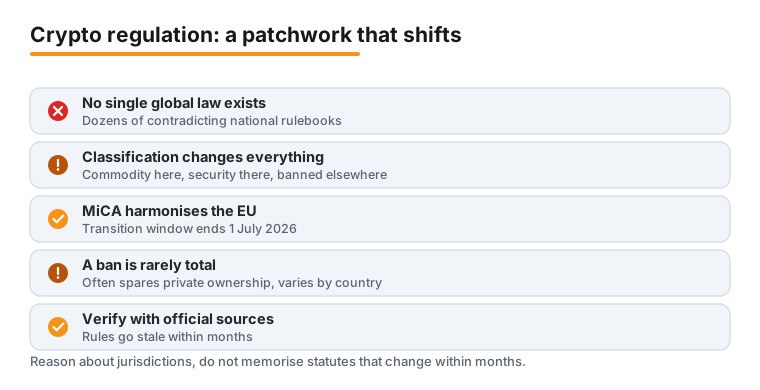
The most important thing to understand about crypto regulation is that it is fragmented by design. Cryptocurrency networks are global and run continuously, but the authority to regulate money, securities, and financial crime sits with individual nation states. Each government weighs the same set of trade-offs differently: the promise of financial innovation and investment against concerns about consumer protection, money laundering, capital flight, and loss of control over monetary policy. The result is a spectrum rather than a single position.
It helps to picture jurisdictions along a rough scale, while remembering that most sit somewhere in the middle and shift over time:
| Stance | What it typically looks like | Illustrative examples |
|---|---|---|
| Permissive and structured | Crypto is legal, exchanges are licensed, and there are clear rules for tax, custody, and consumer protection | The European Union, Japan, Switzerland, Singapore, the United Arab Emirates |
| Active but still settling | Crypto is legal and widely used, but oversight is split across agencies or evolving through new legislation | The United States, United Kingdom, Australia, Brazil, South Africa |
| Restrictive or hostile | Heavy limits, banking bans, or near-total prohibition of trading and mining | China; partial bans across parts of North Africa |
| Legal tender experiments | Bitcoin granted legal-tender or special national status | El Salvador (the best-known early example) |
Several themes cut across the whole map. Regions are far from uniform internally: Europe has moved toward a single harmonised framework, while Asia ranges from welcoming hubs to outright bans, and Africa and Latin America contain both enthusiastic adopters and strict prohibitions. Adoption is frequently strongest where it solves a concrete problem, such as high remittance fees, limited access to banking, or unstable local currencies, which is part of why interest is intense across parts of Latin America, Sub-Saharan Africa, and Southeast Asia. And almost everywhere, the technology and the market have moved faster than legislators, leaving regulators to catch up after the fact rather than ahead of it. The examples above are illustrative of broad direction only; specific rules within each country change often, so verify the current position with official sources.
How crypto is classified
Almost every regulatory question begins with classification: what, legally, is a given crypto asset? The answer determines which agency has authority, which rules apply, and what a business must do to operate. The difficulty is that crypto assets do not fit neatly into the legal categories built for traditional finance, and different jurisdictions reach different conclusions about the same token.
The common classifications you will encounter include:
- A commodity or property. Treated like a digital asset or raw asset rather than a financial security. This framing is common for assets such as Bitcoin in several jurisdictions and typically brings tax consequences when you sell or trade.
- A security. If a token resembles an investment in a common enterprise with profits expected from others' efforts, regulators may treat it like a stock or investment contract, triggering registration and disclosure rules. Whether a given token is a security is one of the most contested questions in the field.
- A means of payment or e-money. Some frameworks treat certain tokens, particularly stablecoins, as payment instruments subject to reserve, redemption, and licensing requirements.
- Legal tender. A rare category in which a government formally recognises a cryptocurrency for settling debts, as El Salvador did with Bitcoin. This remains the exception, not the norm.
- Banned or unrecognised. In restrictive jurisdictions, crypto may have no legal standing for payments at all, even where simply holding it is not itself a crime.
Why classification is so contested
The same asset can be a commodity in one country, a security in another, and effectively prohibited in a third. The United States has illustrated how fraught this can be, with authority historically divided between the securities regulator and the commodities regulator and the boundary tested case by case; recent federal legislation has begun to draw clearer lines for stablecoins, with broader market-structure rules under debate. The European Union, by contrast, has pursued a single harmonised rulebook (MiCA) that defines distinct categories of crypto asset across all member states. Because classification drives everything else and is still actively disputed, never assume a token is treated the same way in two different places. Confirm the local classification before relying on it, especially for anything resembling an investment product.
Enforcement & bans
Having rules on paper is different from enforcing them, and this is where the global picture becomes most uneven. Enforcement ranges from licensing and routine supervision at one end to criminal prosecution and comprehensive bans at the other. Understanding the main tools regulators use helps explain why the same word, "regulation," can mean very different things in different countries.
How enforcement usually works
- Licensing and registration. Exchanges, custodians, and other service providers must register, meet capital and security standards, and submit to oversight. Operating without a licence is the most common violation regulators pursue.
- Anti-money-laundering and "Travel Rule" obligations. Following standards set by the Financial Action Task Force (FATF), most major jurisdictions now require crypto businesses to verify customer identities and to attach sender and recipient information to qualifying transfers. FATF revised these standards again in 2025, and a large majority of surveyed jurisdictions have passed or are passing implementing legislation, though coverage and enforcement remain uneven worldwide.
- Taxation. Many countries treat disposals of crypto as taxable events. India, for example, applies a flat tax on gains plus a transaction-level withholding, and international tax-reporting standards are expanding so that authorities can share account information across borders.
- Investor-protection actions. Regulators bring cases over unregistered securities offerings, fraud, market manipulation, and misleading promotion.
How bans work
Outright bans are less common than headlines suggest, and they come in degrees. A government may ban banks from servicing crypto businesses, prohibit trading and exchanges, outlaw mining, or restrict advertising, without necessarily criminalising private ownership. China is the most prominent example of a far-reaching prohibition: authorities have repeatedly reaffirmed that essentially all crypto-related activity, including trading, mining, and exchange operation, is illegal, and recent measures extended that stance explicitly to stablecoins. Several North African countries have also imposed bans of varying scope. A recurring lesson is that bans rarely eliminate activity outright; they tend to push it underground or offshore, which is one reason a growing number of governments now favour regulated frameworks over prohibition. Because the line between "restricted" and "banned" differs by country and can change suddenly, always check the current legal status with official sources before transacting, and never assume that what is legal at home is legal abroad.
Where rules are heading
After years of reacting case by case, major jurisdictions are now building comprehensive frameworks, and the direction of travel is fairly consistent: more structure, more disclosure, and tighter focus on stablecoins, consumer protection, and cross-border reporting. A few developments are shaping the landscape going into 2026.
- The EU's comprehensive rulebook. The Markets in Crypto-Assets Regulation (MiCA) created a single licensing and conduct regime across the European Union. Its core provisions applied from late 2024, and a transitional period for existing service providers is set to end on 1 July 2026, after which firms serving EU clients are expected to hold full authorisation. MiCA is widely watched as a template other regions may borrow from.
- US federal legislation taking shape. The United States enacted its first major federal crypto statute, a framework for payment stablecoins (the GENIUS Act, signed in 2025), requiring full reserve backing and regular disclosure from issuers. Broader "market-structure" legislation to divide oversight of other tokens between the securities and commodities regulators has advanced in Congress but, as of early 2026, was still working through the legislative process rather than settled law.
- Global AML and tax convergence. The FATF Travel Rule and the OECD's crypto-asset reporting standards are pushing jurisdictions toward common expectations on identity checks and automatic exchange of tax information, narrowing the gaps that once let activity slip between regimes.
- Stablecoins and central bank digital currencies. Regulators are paying particular attention to stablecoins as they approach mainstream payments, while many central banks separately explore their own digital currencies, a related but distinct policy track.
- Sustainability and mining. The energy footprint of mining continues to influence policy in some regions, feeding into disclosure requirements and local restrictions.
The broader signal is that crypto is moving from a largely unregulated frontier toward integration into mainstream financial rules. That tends to favour clarity and institutional participation, but it also raises compliance costs and can squeeze out smaller or non-compliant operators. None of this removes the need for personal diligence. Frameworks differ by jurisdiction, implementation dates slip, and legislation under debate can change before it becomes law, so treat every date and rule above as a starting point to verify, not a final answer. This guide is general information only and is not legal, tax, or financial advice.
Frequently asked questions
Is cryptocurrency legal?
In most countries, owning and trading cryptocurrency is legal, though it is regulated and taxed to varying degrees. A minority of jurisdictions impose heavy restrictions or near-total bans, and a small number have granted certain cryptocurrencies special or legal-tender status. Because the rules differ sharply by country and change often, confirm the current legal status in your own jurisdiction with official sources before transacting.
Why are crypto rules so different from one country to another?
Cryptocurrency is global, but the power to regulate money, securities, and financial crime belongs to individual governments. Each weighs innovation and investment against concerns such as consumer protection, money laundering, and monetary control, and each reaches a different balance. There is no global regulator that can impose a single standard, which is why the landscape is a patchwork that shifts over time.
What is MiCA and who does it affect?
MiCA, the Markets in Crypto-Assets Regulation, is the European Union's harmonised framework for crypto assets and service providers. It sets common rules on licensing, disclosure, and stablecoins across all member states. Its main provisions applied from late 2024, with a transitional window for existing providers set to end on 1 July 2026. It primarily affects businesses serving EU clients, though its influence is being felt well beyond Europe.
Does a ban on cryptocurrency mean owning it is a crime?
Not necessarily. Bans come in degrees. A government may prohibit exchanges, bar banks from servicing crypto businesses, outlaw mining, or restrict advertising without criminalising private ownership itself. The scope varies by country and can change suddenly, so never assume a ban covers everything, and check the specific legal position with official sources before acting.
How is crypto taxed?
It depends entirely on your jurisdiction. Many countries treat selling or trading crypto as a taxable event and tax the gains, and some apply transaction-level withholding or reporting requirements. International standards for sharing crypto account information across borders are also expanding. Tax treatment is complex and country-specific, so consult official tax authorities and a qualified professional. This is not tax advice.
Last updated: 2026-06.