Home › Crypto Regulation › Singapore
Bitcoin & Cryptocurrency Regulation in Singapore
Quick answer — Singapore, 2026
- Legal: Legal to own and trade, not legal tender
- Tax: No general capital gains tax, business trading taxed as income
- Buying: Via MAS-licensed platforms with KYC and knowledge assessment
Singapore is one of the world's most closely watched cryptocurrency jurisdictions. It has not banned crypto, but it has not left it unregulated either. Instead the city-state built a licensing-led framework that lets serious businesses operate while pushing hard on anti-money-laundering controls and consumer protection. Bitcoin and other digital tokens are legal to own and trade, service providers must be licensed, and the rules tightened sharply through 2024, 2025 and into 2026. This guide explains the current state of crypto regulation in Singapore: the legal status, the regulator, the key laws, licensing and registration of exchanges, taxation, AML and KYC, buying and using crypto in practice, mining, recent developments, consumer risks, and how to verify everything against official sources. For wider context see our overview of crypto regulation and the country pages on the regulation hub.
This article is general information current as of 2026 and is not legal, tax or financial advice. Rules change frequently and outcomes depend on your circumstances. Always verify the current position with the Monetary Authority of Singapore (MAS) and the Inland Revenue Authority of Singapore (IRAS), or a qualified professional, before acting.
On this page: Legal status · Who regulates it · Taxes · How to buy · Mining
Legal status of Bitcoin and crypto in Singapore
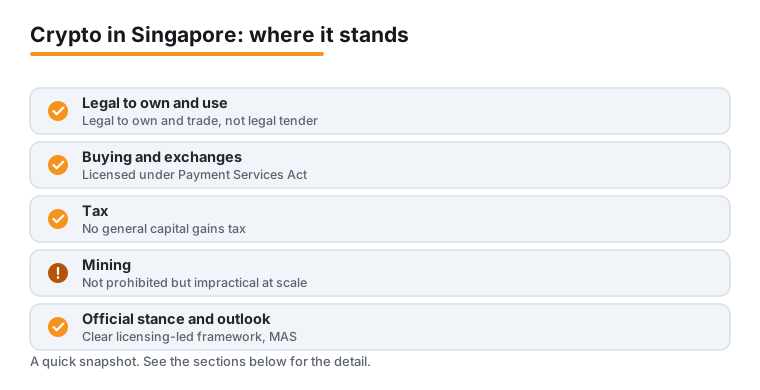
Yes, Bitcoin and other digital tokens are legal to own, buy, sell and hold in Singapore. The country chose regulation over prohibition: individuals can use crypto freely, and businesses can build products around it, provided the regulated parts of the activity are licensed and supervised.
What is controlled is the business of providing crypto services. Any platform offering exchange, transfer, custody or related digital-token services to people in Singapore must be licensed. Operating such a service without authorisation is an offence, and the regulator repeatedly warns the public against using unlicensed venues, including offshore platforms that solicit Singapore users.
Crypto is not legal tender in Singapore. Only the Singapore dollar is. Bitcoin is treated as a "digital payment token," a form of property that can be transferred and exchanged, not as official money that anyone is obliged to accept.
Who regulates crypto: the Monetary Authority of Singapore (MAS)
The single most important authority is the Monetary Authority of Singapore (MAS), which is both the country's central bank and its integrated financial regulator. MAS licenses and supervises crypto service providers, issues the binding rules and guidelines, runs public alerts about unlicensed operators, and drives Singapore's wider digital-asset policy.
Tax matters are handled separately by the Inland Revenue Authority of Singapore (IRAS), which sets out how income tax and Goods and Services Tax (GST) apply to digital tokens.
You can confirm current rules and check whether a firm is licensed on the official MAS website at mas.gov.sg, and review tax guidance on the official IRAS website at iras.gov.sg.
Key laws and frameworks
Singapore's framework rests on a small number of statutes administered by MAS.
- Payment Services Act 2019 (PS Act): the core law for crypto. It brings "digital payment token" (DPT) services, such as buying, selling, transferring and custody of tokens, under licensing, with anti-money-laundering, custody and consumer-protection obligations. Related Payment Services Regulations set out the detailed rules.
- Financial Services and Markets Act 2022 (FSMA): a broader law that, among other things, created the Digital Token Service Provider (DTSP) regime targeting Singapore-incorporated firms and individuals that provide token services only to customers outside Singapore.
- Securities and Futures Act (SFA): where a token behaves like a security or capital-markets product (for example certain investment tokens or token offerings), it can fall under securities rules in addition to, or instead of, the PS Act.
Note that Singapore is not in the European Union and is not covered by the EU's MiCA regulation. It runs its own regime. Because the precise obligations depend on the exact activity and the rules keep evolving, firms should take current legal advice and check the MAS website directly.
Licensing and registration of exchanges and VASPs
Any exchange, broker or wallet provider serving Singapore residents must hold the appropriate licence under the Payment Services Act and follow MAS rules. Digital payment token services are typically licensed under a Major Payment Institution licence, and providers must verify customers, monitor transactions and meet capital, custody and audit requirements.
On 30 June 2025, MAS brought the Digital Token Service Provider (DTSP) regime under the FSMA into force. Singapore-incorporated entities and individuals operating from Singapore that provide token services solely to customers outside Singapore must hold the relevant licence or stop. MAS has stated that it will generally not issue such licences, because these cross-border-only models carry elevated money-laundering risk and cannot be effectively supervised, and there was no transitional period. Operating without a required licence carries penalties of up to S$250,000 in fines and up to three years' imprisonment, and MAS said there would be no grace period. Applicants under the DTSP regime must also meet a minimum base capital of S$250,000.
Before using any platform, confirm its status on MAS's official register of financial institutions rather than relying on the platform's own marketing. See the MAS Guidelines on Licensing for Digital Token Service Providers for the official position.
Crypto and Bitcoin tax in Singapore
Singapore is widely regarded as tax-friendly for crypto, but the picture is more nuanced than "tax-free," and it depends on whether you are investing or running a business. For background see our guide to crypto taxes.
Singapore has no general capital gains tax. Individuals who buy and hold digital tokens as a personal investment and later sell them generally are not taxed on the gain. However, IRAS draws a clear line: where someone is trading tokens as a business, or in a frequent, business-like manner (assessed using IRAS's "badges of trade"), those profits can be treated as income and taxed. Crypto received as payment for goods or services, or as business revenue, is generally taxable too.
On Goods and Services Tax (GST), supplies of qualifying "digital payment tokens" have been treated as exempt since 1 January 2020, so exchanging such tokens for fiat or for other digital payment tokens does not by itself attract GST. This is an important update from older descriptions that treated Bitcoin as taxable "goods."
Areas such as staking rewards and DeFi yield are less settled, and the classification of your activity changes the outcome. The rates that apply where your activity is taxable are published by IRAS: personal income tax is progressive with a top rate of 24 percent from YA 2024, corporate income tax is a flat 17 percent of chargeable income, and the standard GST rate is 9 percent, although qualifying digital payment token exchanges have been GST-exempt since 1 January 2020. Confirm your position on the official IRAS pages, including IRAS guidance on digital payment tokens, and keep thorough records of every transaction.
AML, KYC and the FATF travel rule
Anti-money-laundering and know-your-customer rules are central to Singapore's approach. Licensed digital payment token service providers must verify customer identity, screen and monitor transactions, keep records and report suspicious activity. Expect to provide identification, and sometimes proof of source of funds, when you sign up to a regulated platform.
The binding requirements are set out in MAS Notice PSN02 on the prevention of money laundering and countering the financing of terrorism for digital payment token services. It implements the Financial Action Task Force (FATF) standards, including the "travel rule" for transfers, which requires providers to collect, verify and pass on originator and beneficiary information for value transfers above the applicable threshold. The DTSP framework that began on 30 June 2025 was explicitly aligned with the FATF's enhanced standards for virtual asset service providers.
The official rules are published as MAS Notice PSN02 on the MAS website.
Buying and using crypto in practice
Buying crypto in Singapore is legal and straightforward for individuals, but the platforms are heavily regulated. The standard route is a MAS-licensed exchange or payment institution. A typical process looks like this:
- Choose a licensed platform: confirm the provider holds the appropriate Payment Services Act licence (or is formally exempt) by checking the MAS financial institutions register. Avoid unlicensed offshore sites.
- Open and verify your account: complete identity verification (KYC), which is mandatory on licensed platforms. Retail users must also pass a customer knowledge assessment, sometimes called a risk-awareness quiz, showing they understand risks such as volatility and possible total loss before they can start trading.
- Fund the account: deposit Singapore dollars by bank transfer or other supported methods. Note that providers are barred from accepting locally issued credit cards from retail customers.
- Buy and secure: place your order, review fees and spread, then decide whether to keep assets in regulated custody or move them to a personal wallet, and keep records for tax.
Since the October 2024 customer-asset rules, retail customers' tokens must be held on statutory trust and segregated, improving the odds of recovery if a provider fails. Public crypto ATMs are effectively unavailable: after MAS guidance in January 2022 against promoting crypto to the public, operators withdrew their machines, so an online licensed platform is the mainstream on-ramp.
Bitcoin mining in Singapore
Bitcoin mining is not prohibited in Singapore, but it is impractical at scale and not a meaningful part of the market. The country has high electricity prices, a hot and humid climate that raises cooling costs, very limited land, and a power grid focused on dense urban demand rather than spare capacity for energy-intensive computing. Those conditions make large proof-of-work mining hard to run profitably.
There is no special licence simply to mine for your own account, but a commercial operation would still sit within Singapore's wider rules, including business registration, corporate tax, and electricity and environmental requirements. Singapore places strong emphasis on sustainability and decarbonising its energy mix, which further discourages power-hungry mining. On mined coins IRAS is specific: an individual who mines is prima facie treated as undertaking the activity as a hobby, so gains from sale of the mined tokens are treated as capital gains and are not taxable and mining expenses are not deductible, unless he shows a habitual and systematic effort to make a profit. A company that mines is regarded as carrying on a business of mining, may claim deduction on its mining expenses from the date it commences business, and is taxed on profits at the point of disposal of the tokens. In short, Singapore matters far more as a regulatory model and a trading and corporate hub than as a place to plug in mining rigs.
Recent developments in 2025 and 2026
The rules have moved quickly and the direction is steady tightening for retail combined with an institutional push.
- October 2024 retail safeguards: amendments to the Payment Services Regulations came into operation on 4 October 2024, requiring providers to hold retail customers' tokens on statutory trust and restricting them from offering lending or staking of those tokens to retail users. Margin, leverage and trading incentives for retail customers are also restricted.
- 30 June 2025 DTSP regime: the Digital Token Service Provider framework under the FSMA took effect, with MAS signalling it will rarely license firms that serve only overseas clients.
- Stablecoins: MAS set out a framework for single-currency stablecoins in August 2023 (pegged to the Singapore dollar or major currencies, fully reserved and redeemable). At the Singapore FinTech Festival on 13 November 2025, MAS Managing Director Chia Der Jiun said MAS was preparing draft stablecoin legislation, prioritising sound reserve backing and redemption reliability. MAS had already told Parliament on 24 September 2025 that it was working on legislative amendments to formalise the framework and would issue a public consultation later that year. As at 3 August 2026 no stablecoin bill had been introduced in Parliament, so the 2023 framework still has no legal force and no token can lawfully be described as an MAS-regulated stablecoin.
- Tokenisation and wholesale CBDC: at the same November 2025 event, MAS said it would trial issuing tokenised MAS Bills to Primary Dealers, settled using a wholesale central-bank digital currency, after DBS, OCBC and UOB completed interbank transactions using a live Singapore dollar wholesale CBDC. This sits alongside initiatives such as Project Guardian.
As at 3 August 2026 none of this had reached the statute book. Parliament's Bills Introduced register shows 14 bills for 2026, the most recent introduced on 7 July 2026, with no stablecoin or Payment Services bill among them, and the 2026 Acts Supplement contains no Act touching crypto, stablecoins or payment services.
Consumer risks and protection
Singapore deliberately treats retail crypto as a high-risk activity rather than a consumer product to be marketed. The protective measures, including statutory-trust custody, bans on retail lending and staking, restrictions on incentives and public advertising, and a customer risk-awareness step before trading, exist precisely because MAS considers these products high-risk for ordinary consumers.
The underlying risks remain the familiar ones. Crypto is highly volatile and can lose value quickly; platforms can be hacked or fail despite the rules; and scams promising guaranteed or high returns are widespread. There is also access risk: because MAS limits retail marketing and has tightened cross-border rules, some products and offshore-only models available elsewhere are restricted or unavailable here.
Sensible practice: use a MAS-licensed platform, complete identity checks, never invest more than you can afford to lose, secure your holdings, understand the tax treatment of your activity, and verify claims against official sources rather than social-media hype. If a service is not authorised, do not proceed until you have confirmed its status with MAS.
Official sources and how to verify
Because crypto rules in Singapore change frequently, always confirm the current position with primary, official sources rather than secondary summaries.
- Monetary Authority of Singapore (MAS) for licensing, the register of regulated firms, notices and policy: mas.gov.sg, with the DTSP licensing guidelines and AML/CFT Notice PSN02.
- Inland Revenue Authority of Singapore (IRAS) for tax: iras.gov.sg, including guidance on digital payment tokens.
For broader context, see our crypto regulation overview and other country guides on the regulation hub. This article is general information current as of 2026 and is not legal, tax or financial advice; verify anything material with MAS, IRAS or a qualified professional before you act.
Singapore crypto regulation: the position on 3 August 2026
No new crypto law took effect in Singapore in 2026. The framework that governs a reader today is the same one that applied in mid 2025: the Payment Services Act 2019 for digital payment token services, the Digital Token Service Provider regime under the Financial Services and Markets Act 2022 for firms serving only overseas customers, and the Securities and Futures Act 2001 where a token behaves like a security.
That is a checked statement rather than an assumption. Four primary registers were read on 3 August 2026:
- Singapore Statutes Online shows the Payment Services Act 2019 current as at 3 August 2026 with no 2026 amendment. The word stablecoin does not appear anywhere in the Act.
- The 2026 Acts Supplement lists the 17 Acts passed in 2026. None concerns crypto, stablecoins or payment services. The only financial-sector Act is the Securities and Futures (Amendment) Act 2026, and the Bill as introduced on 7 April 2026 does not mention digital tokens, cryptoassets or stablecoins at all. It creates a regime for sponsored depositary receipts. The one catch-all statute of the year, the Statutes (Miscellaneous Amendments) Act 2026, amends construction, planning, pandemic and professional-registration legislation and touches neither the Payment Services Act nor the Financial Services and Markets Act.
- Parliament's Bills Introduced register shows exactly 14 bills for 2026, the most recent introduced on 7 July 2026. No stablecoin bill and no Payment Services amendment bill is among them.
- The 2026 Subsidiary Legislation Supplement contains no instrument made under the Payment Services Act or the Financial Services and Markets Act.
What did move in 2026 was enforcement. On 20 May 2026 MAS revoked the Major Payment Institution licence of Bsquared Technology Pte Ltd with effect from 14 May 2026, about sixteen months after licensing it on 1 January 2025. An onsite inspection in 2025 found significant weaknesses in risk management practices and conflict of interest policies, a failure to meet the MAS Guidelines on Outsourcing in arrangements with related entities, and information given to MAS that was false or misleading in material particulars on multiple occasions, from the licence application through to the inspection itself.
On 3 August 2026 the MAS Financial Institutions Directory returned 38 results for Major Payment Institutions licensed for Digital Payment Token Service, and none for Standard Payment Institutions. The directory cautions that a firm may hold more than one licence, so that figure counts licences rather than necessarily distinct companies. That register, not a platform's own marketing, is the check to run before depositing money.
What crypto legislation is coming in Singapore, and when
Two measures are genuinely in the pipeline. Neither is law yet, and one has slipped past the timing MAS signalled.
Stablecoin legislation. MAS finalised the policy on 15 August 2023, but it has never been given legal force. Under the MAS response to the public consultation, a single-currency stablecoin pegged to the Singapore dollar or any G10 currency and issued in Singapore could be labelled an MAS-regulated stablecoin. A non-bank issuer whose stablecoin in circulation exceeds S$5 million would need a Major Payment Institution licence for a new regulated activity called Stablecoin Issuance Service, would need base capital of the higher of S$1 million or 50 percent of annual operating expenses, and would have to return par value within five business days of a redemption request. MAS told Parliament on 24 September 2025 that it was working on legislative amendments to formalise the framework and would issue a public consultation later that year. As at 3 August 2026 no bill has been introduced. Until one passes, no token can lawfully be described as an MAS-regulated stablecoin, and stablecoin issuers are supervised only as ordinary digital payment token service providers.
Bank capital rules for crypto. MAS had intended the Basel cryptoasset standards to apply from 1 January 2026. In its response of 9 October 2025 it deferred them to 1 January 2027 or later, after respondents argued Singapore would be implementing ahead of other jurisdictions, which could lead to regulatory arbitrage. In the meantime any bank with cryptoasset exposures, or intending to take them on, must notify and engage MAS on the appropriate prudential treatment. MAS then consulted again in Consultation Paper P009-2026, published 17 April 2026 and closed 18 May 2026, on allowing cryptoassets on permissionless blockchains to be classified as lower risk Group 1 assets where safeguards are met, capped during the interim period at 2 percent of Tier 1 capital for locally incorporated banks and 0.2 percent of total assets in the Singapore branch for bank branches. No response had been published as at 3 August 2026.
Separately, on 25 June 2026 MAS announced a Future of Finance Institute, initially focused on artificial intelligence and tokenisation, building on Project Guardian and Project Orchid. This is industry development work rather than regulation, and it changes nothing for people holding or buying crypto.
The tax rates that actually apply to crypto in Singapore
Singapore has no general capital gains tax, so the useful question is never what the crypto tax rate is. It is whether your activity counts as investment or as trade. If it is investment, the rate is zero. If IRAS assesses the disposal as revenue in nature under the badges of trade, ordinary income tax rates apply, and those rates are published.
| Situation | Rate | Published by |
|---|---|---|
| Individual holding tokens as a personal investment, gain on sale | No tax. Singapore has no general capital gains tax. | IRAS e-Tax Guide on digital tokens |
| Individual assessed as trading, or receiving crypto as income | Personal income tax, progressive, top rate 24 percent from YA 2024 | IRAS individual income tax rates |
| Company trading or mining tokens | Corporate income tax, flat 17 percent of chargeable income, applying to both local and foreign companies | IRAS corporate income tax rate |
| Exchanging qualifying digital payment tokens for fiat or for other such tokens | Exempt from GST since 1 January 2020. The standard GST rate is otherwise 9 percent. | IRAS current GST rates |
Using digital payment tokens to pay for anything other than fiat currency or other digital payment tokens is disregarded as a supply for GST purposes, so GST is charged only on the goods or services themselves.
On mining, the position is more settled than the page previously suggested. The IRAS Income Tax Treatment of Digital Tokens guide, published on 30 January 2026, states that an individual who mines is prima facie treated as undertaking the activity as a hobby, so gains from sale of the mined payment tokens are treated as capital gains and are not taxable, and mining expenses are not deductible. That flips if the individual shows a habitual and systematic effort to make a profit, in which case he may be treated as carrying on a vocation of a miner and taxed on the proceeds. A company is regarded as carrying on a business of mining, may claim deduction on its mining expenses on an incurred basis from the date it commences business, and is taxed on profits at the point of disposal of the tokens. In every case tax falls at disposal, not at the moment a token is successfully mined, because no income is derived by merely holding the token.
Frequently asked questions
Is cryptocurrency legal in Singapore?
Yes. Owning, buying, selling and using crypto such as Bitcoin is legal. Businesses that provide exchange, transfer or custody services to people in Singapore must be licensed and supervised by the Monetary Authority of Singapore. Crypto is not legal tender, however; only the Singapore dollar is.
Who regulates crypto in Singapore?
The Monetary Authority of Singapore (MAS) is the central bank and the financial regulator. It licenses crypto service providers mainly under the Payment Services Act 2019, oversees a Digital Token Service Provider regime under the Financial Services and Markets Act 2022, and can apply securities rules under the Securities and Futures Act where a token behaves like a security. Tax is handled by the Inland Revenue Authority of Singapore (IRAS).
Do I pay tax on crypto in Singapore?
Singapore has no general capital gains tax, so individuals who hold digital tokens as a personal investment generally are not taxed on the gain when they sell. But profits from trading tokens as a business, or in a frequent business-like way, and crypto received as income, can be taxable. Supplies of qualifying digital payment tokens have been GST-exempt since 1 January 2020. Rates and treatment can change, so confirm your position with IRAS or a tax professional.
Do crypto exchanges need a licence in Singapore?
Yes. Platforms serving Singapore residents must hold the appropriate licence under the Payment Services Act, typically a Major Payment Institution licence for digital payment token services, and follow MAS rules on KYC, AML, custody and consumer protection. Separately, since 30 June 2025 firms that operate from Singapore but serve only overseas customers fall under the FSMA Digital Token Service Provider regime, which MAS will rarely license. Always verify a provider's status on the MAS register before using it.
What changed for crypto users in Singapore in 2024 to 2026?
From 4 October 2024, providers must hold retail customers' tokens on statutory trust and cannot offer retail lending or staking of those tokens. On 30 June 2025 the Digital Token Service Provider regime took effect for firms serving only overseas clients. MAS finalised a single-currency stablecoin framework in August 2023 and said in September and November 2025 that it was drafting legislation to give it legal force, but no stablecoin bill had been introduced in Parliament as at 3 August 2026. MAS also deferred the Basel cryptoasset capital standards for banks to 1 January 2027 or later, and on 20 May 2026 revoked the Major Payment Institution licence of Bsquared Technology Pte Ltd for serious regulatory breaches.
Where can I buy Bitcoin in Singapore, and are there ATMs?
Through a platform licensed under the Payment Services Act. Verify a provider's status on the MAS register, complete identity verification, fund your account in Singapore dollars, and keep records. Public crypto ATMs are effectively unavailable after MAS guidance in January 2022, so a licensed online platform is the mainstream way to buy. Avoid unlicensed or offshore sites that solicit Singapore users.
Do I have to pass a test before trading crypto in Singapore?
On MAS-licensed retail platforms, yes. Before you can start trading digital payment tokens, you must complete a customer knowledge assessment, sometimes called a risk-awareness quiz, that checks you understand risks such as price volatility, lack of intrinsic value and the possibility of losing your money. This requirement follows the retail customer-protection rules that MAS phased in from October 2024. The exact format depends on the platform.
Can a Singapore company serve only overseas crypto customers without a licence?
No. Since 30 June 2025, a firm or individual incorporated or operating from Singapore that provides digital token services solely to customers outside Singapore must hold a Digital Token Service Provider licence under the Financial Services and Markets Act 2022. MAS has said it will generally not grant such licences and that there is no grace period. Operating without the licence can bring fines of up to S$250,000 and up to three years' imprisonment.
Has Singapore passed a stablecoin law yet?
No. MAS finalised the policy framework for single-currency stablecoins on 15 August 2023 and told Parliament on 24 September 2025 that it was working on legislative amendments and would consult publicly later that year. As at 3 August 2026 no stablecoin bill had been introduced in Parliament, whose Bills Introduced register shows 14 bills for 2026, the most recent introduced on 7 July 2026. Until a bill is passed the framework has no legal force, and no token can lawfully be described as an MAS-regulated stablecoin. MAS has published no target date for introducing the bill.
What tax rate would I pay on crypto profits in Singapore?
If you hold tokens as a personal investment there is no tax on the gain, because Singapore has no general capital gains tax. If IRAS assesses your activity as revenue in nature under the badges of trade, or you receive crypto as income, ordinary rates apply: personal income tax is progressive with a top rate of 24 percent from YA 2024, and companies pay a flat 17 percent of chargeable income, whether local or foreign. GST is 9 percent generally, but exchanging qualifying digital payment tokens for fiat or for other such tokens has been exempt from GST since 1 January 2020.
How many crypto platforms are actually licensed in Singapore?
On 3 August 2026 the MAS Financial Institutions Directory returned 38 results for Major Payment Institutions licensed for Digital Payment Token Service, and none for Standard Payment Institutions. The directory notes that a firm may hold more than one licence, so treat that as a count of licences rather than of distinct companies. Check the directory yourself before using a platform, because holding a licence for one payment activity does not mean a firm is permitted to handle digital payment tokens. MAS revoked one such licence, that of Bsquared Technology Pte Ltd, with effect from 14 May 2026.
Is Bitcoin mining taxed in Singapore?
It depends who mines. IRAS treats an individual miner as pursuing a hobby by default, so gains from sale of the mined tokens are treated as capital gains and are not taxable, and mining expenses are not deductible. That changes if the individual shows a habitual and systematic effort to make a profit, in which case he may be treated as carrying on a vocation of a miner and taxed. A company that mines is regarded as carrying on a business of mining, may claim deduction on its mining expenses from the date it commences business, and is taxed on profits at the point of disposal of the tokens. Tax falls at disposal, not when the token is mined, because no income is derived by merely holding it.
Can banks in Singapore hold crypto?
Not freely. MAS had planned to apply the Basel cryptoasset capital standards from 1 January 2026 but deferred them to 1 January 2027 or later in its response of 9 October 2025. In the meantime any bank with cryptoasset exposures, or intending to take them on, must notify and engage MAS on the appropriate prudential treatment. A further consultation, P009-2026, ran from 17 April to 18 May 2026 on letting cryptoassets on permissionless blockchains count as lower risk Group 1 assets where safeguards are met, capped at 2 percent of Tier 1 capital for locally incorporated banks and 0.2 percent of total assets in the Singapore branch. No response had been published as at 3 August 2026.
Facts reviewed: 5 August 2026. Page updated: 5 August 2026.