Home › Crypto Regulation › Brunei
Bitcoin & Cryptocurrency Regulation in Brunei
Quick answer — Brunei, 2026
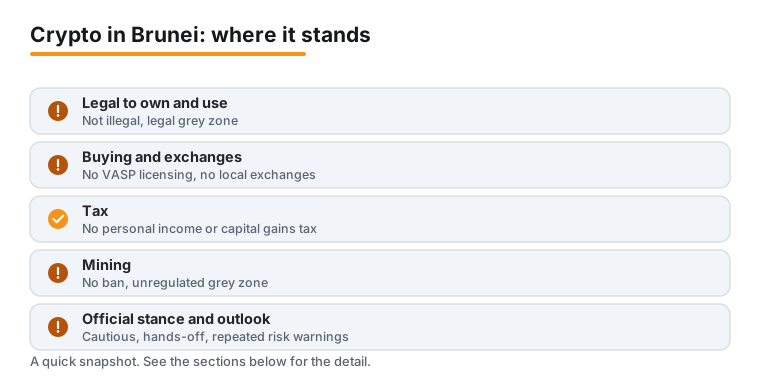
- Legal: Legal to own and trade, unregulated grey zone, not legal tender
- Tax: No personal income or capital gains tax
- Buying: No local licensed exchanges, use international or P2P platforms
Brunei Darussalam takes a cautious, hands-off stance toward Bitcoin and other cryptocurrencies. As of 2026 there is no dedicated crypto law, no licensing regime for virtual asset service providers (VASPs), and no recognition of digital assets as money. At the same time, personal ownership and trading of crypto have not been criminalised. The practical result is a legal grey zone: individuals can hold and trade Bitcoin, but they do so without consumer protection, deposit insurance, or a locally regulated marketplace.
The financial regulator is the Brunei Darussalam Central Bank (BDCB), which has issued repeated public warnings that cryptocurrencies are not legal tender and are not regulated by any authority in Brunei. This guide explains where things stand across legal status, the regulator, key laws, exchange licensing, tax, AML/KYC, buying and using crypto, mining, recent developments, and consumer protection. It is general information as of 2026 and is NOT legal, tax or financial advice; always verify the current position with the BDCB and a qualified local professional before acting. See also our overview of crypto regulation.
On this page: Legal status · Who regulates it · Taxes · How to buy · Mining
Legal status of Bitcoin and crypto in Brunei
Holding, buying and selling cryptocurrency is not illegal in Brunei for individuals. There is no statute that bans personal ownership of Bitcoin, and the BDCB has cautioned against, rather than prohibited, crypto activity. However, crypto is not recognised as legal tender, and no business is obliged to accept it as payment. The Brunei dollar (BND), pegged at par to the Singapore dollar, remains the only legal tender.
The central bank has repeatedly stated that cryptocurrencies are not issued, backed or regulated by any authority in Brunei. Anyone using crypto therefore does so entirely at their own risk: there is no recourse to a regulator if a platform fails, an investment turns out to be a scam, or funds are lost.
- Legal to own and trade? Yes for individuals, with no specific prohibition.
- Legal tender? No. Only the Brunei dollar is legal tender.
- Regulated? No dedicated crypto or VASP framework exists as of 2026.
- Consumer protection? None for crypto activities; holdings are not covered by deposit insurance.
The regulator: Brunei Darussalam Central Bank (BDCB)
The financial regulator is the Brunei Darussalam Central Bank (BDCB), the institution formerly known as Autoriti Monetari Brunei Darussalam (AMBD). The body was established under the Autoriti Monetari Brunei Darussalam Order, 2010 (S 103/2010) and began operations on 1 January 2011. It was renamed BDCB on 26 June 2021 by an amendment order that changed the name inside the 2010 legislation rather than replacing it. There is no separate central bank act of 2021: the founding statute remains in force and is cited in current Brunei legislation as the Brunei Darussalam Central Bank Order, 2010 (S 103/2010).
BDCB formulates and implements monetary policy, issues the currency, and regulates and supervises banks and other financial institutions. It does not regulate cryptocurrencies. Instead, it has issued public advisories making clear that crypto is not legal tender, is not under BDCB oversight, and carries significant risks including high volatility, cybersecurity exposure, and fraud. The bank also maintains a public BDCB Alert List of entities that are suspicious or not licensed or regulated by BDCB. The official website is bdcb.gov.bn.
Key laws and frameworks
Brunei has not enacted a comprehensive cryptocurrency or digital-asset law, so there is no MiCA-style framework as exists in the EU. What applies instead is a set of general financial and criminal statutes:
- Brunei Darussalam Central Bank Act 2021 establishes BDCB and its supervisory powers over the financial sector.
- Criminal Asset Recovery Order, 2012 (with later amendments) underpins asset-recovery and money-laundering enforcement.
- Anti-Terrorism Order, 2011 and the Anti-Terrorism (Terrorist Financing) Regulations, 2013 (as amended) address terrorism financing.
- General financial-services licensing, fraud and consumer-protection principles can also apply to crypto-touching activity.
One crypto-specific provision does exist. The Criminal Asset Recovery (Amendment) Order, 2023, gazetted on 27 February 2023 as No. S 5, inserted the five FATF virtual asset service activities into the definition of "financial institution" in section 2 of the Criminal Asset Recovery Order, 2012, and added a statutory definition of "virtual asset". Anyone exchanging virtual assets for fiat or for other virtual assets, transferring them, holding them in custody, or providing financial services for a token issuance is therefore already a financial institution for anti-money-laundering purposes, owing customer due diligence, record keeping and suspicious transaction reporting, and inspectable by BDCB under the new section 25A. What does not exist is a licence to apply for. Businesses should obtain legal advice before launching any crypto venture in Brunei. Primary legislation can be checked through the Attorney General's Chambers at agc.gov.bn.
Licensing and registration of exchanges (VASPs)
There is no BDCB licensing or registration regime for cryptocurrency exchanges or virtual asset service providers (VASPs) in Brunei. Brunei's 2023 mutual evaluation (conducted through the FATF/APG process) noted that the virtual asset sector was unregulated, with no locally incorporated VASPs.
Because the activity is unsupervised domestically, residents who want to trade crypto typically use international exchanges or peer-to-peer (P2P) marketplaces. There is no domestic authority that approves, audits or supervises these platforms, and no local body can compel a foreign platform to return funds. The absence of a licensing framework is a key reason the central bank urges caution before dealing in crypto.
A VASP licensing framework has been decided in principle but not enacted. Brunei's 2023 mutual evaluation records that Brunei has not decided to prohibit virtual assets, and has decided instead to implement a licensing and regulatory framework through three named routes: amending the Money Changing and Remittance Businesses Act, Chapter 174 to cover virtual asset exchanges, using the Securities Markets Order, 2013 for security tokens, and using the Notice on Requirements for Payment Systems for payment-related activity. As of August 2026 only the second and third are in force, and BDCB's own money services page still lists Chapter 174 with no virtual asset provisions. Brunei's documented virtual asset work is narrower than a supervision consultation. The FIU completed a money laundering and terrorist financing risk assessment on virtual assets and VASPs in late 2020, finalised in January 2021, which recommended establishing a licensing and regulatory framework. The Criminal Asset Recovery Order was then amended with effect from 27 February 2023 to treat virtual asset businesses as financial institutions. BDCB has published no consultation paper on virtual asset supervision. No operational registration or licensing regime for crypto businesses exists as of August 2026. BDCB has published no consultation paper, no draft order and no target date for one, and its Annual Report 2025, published on 26 June 2026, does not use the words virtual asset, VASP, crypto, stablecoin, token, tokenisation or CBDC anywhere in its text. For an explanation of how licensing regimes work elsewhere, see our crypto regulation guide.
Crypto and Bitcoin tax in Brunei
Brunei is a low-tax jurisdiction. It does not levy personal income tax on individuals, and it has no capital gains tax and no value-added tax or GST. In practice this means that, under the current general tax framework, an individual's gains from buying and selling crypto are not subject to a dedicated personal income or capital gains charge.
This does not place all crypto activity outside the tax system. Companies in Brunei are subject to corporate income tax (a headline rate of 18.5 percent, with a higher petroleum income tax for oil and gas), so a business that earns profits from crypto-related trading, services or mining could face corporate tax depending on how the activity is structured. Companies with gross sales or turnover not exceeding BND 1 million are exempt from corporate income tax. There is no crypto-specific tax guidance, which leaves uncertainty for businesses.
The absence of a charge on individual gains reflects Brunei's broader tax policy rather than a crypto-specific exemption, and tax policy can change. Confirm your exact position, especially for business or large transactions, with the Revenue Division of the Ministry of Finance and Economy at mofe.gov.bn and a qualified Brunei tax adviser. For general principles, see our guide to crypto taxes.
AML and KYC rules
Brunei's anti-money-laundering (AML) and counter-financing-of-terrorism (CFT) framework does not merely reach crypto activity by implication. Since 27 February 2023 it names it: the Criminal Asset Recovery (Amendment) Order, 2023 defines a virtual asset as "a digital representation of value that can be digitally traded, or transferred, and can be used for payment or investment purposes but does not include digital representations of physical currencies, securities and other financial assets", and treats businesses dealing in virtual assets as financial institutions. The framework is administered through BDCB and its Financial Intelligence Unit (FIU), supported by the Criminal Asset Recovery Order, 2012 and the anti-terrorism financing legislation.
Regulated entities, including banks, money services businesses and other designated non-financial businesses and professions, must carry out customer due diligence, monitor transactions and file suspicious transaction reports with the FIU. International exchanges used by Brunei residents typically apply their own KYC, requiring identity verification and often proof of address, in line with global FATF standards. Users should keep clear records of their transactions and avoid platforms of unknown provenance. BDCB's AML/CFT overview is published at bdcb.gov.bn/aml-cft.
Buying and using crypto in practice
Because there are no locally licensed exchanges, buying crypto in Brunei generally means using a reputable international exchange or a P2P marketplace. Practical considerations include:
- Account funding. Linking a Brunei bank account or card to an offshore exchange is subject to the bank's own policies; some banks restrict crypto-related transactions.
- KYC. Reputable platforms require identity verification and may ask for proof of address.
- No local recourse. If an offshore platform freezes funds, is hacked, or collapses, Brunei authorities cannot help recover assets.
- P2P risk. Direct trades carry counterparty and fraud risk; use escrow features and verified counterparties where possible.
- Custody. For larger holdings, a private wallet (a hardware wallet for long-term storage) reduces reliance on a single platform.
Crypto is not legal tender, so no merchant is required to accept it, and everyday payment use is limited. Due diligence on the platform, its security record, jurisdiction and reputation, is essential before depositing funds.
Bitcoin mining in Brunei
Brunei has no specific law that bans or licenses cryptocurrency mining, so the activity sits in the same unregulated grey zone as trading. The bigger constraints are practical rather than legal. The hot, humid tropical climate raises the cost and complexity of cooling mining hardware, and electricity is supplied largely from natural gas. Brunei has emphasised energy efficiency and emissions-reduction goals, so large, energy-hungry operations could attract scrutiny on those grounds, and the central bank has explicitly cautioned about the risks of crypto mining.
For anyone considering mining as a business, the key questions are commercial viability (electricity cost, cooling, hardware), how profits would be treated under corporate tax, and whether general energy, business-licensing or environmental rules apply. Brunei is not positioned as a mining hub and offers no targeted mining incentives. Professional advice is recommended before committing capital.
Recent developments (2025-2026)
Brunei's core position has not changed: as of 2026 there is still no dedicated crypto law, no VASP licensing regime, and no recognition of crypto as legal tender. BDCB maintains an Alert List of unlicensed or suspicious entities, last updated on 22 July 2026 and carrying 330 entities. Its most recent crypto-specific press release remains the one dated 1 November 2022 on the risks in cryptocurrencies, crypto mining and related scams; the earliest is dated 22 December 2017 and reminded the public that cryptocurrency is not legal tender in Brunei Darussalam and is not regulated. Separately, on 30 July 2026 BDCB warned the public about AI-generated videos that misuse its name and impersonate a senior government official to promote an investment scheme, stating that it has not assessed, approved or endorsed the scheme and that it does not offer or endorse financial products at all.
Groundwork for future rules has been laid, though nothing binding has taken effect. Brunei's National Anti-Money Laundering Council endorsed a virtual asset risk assessment. Brunei's 2023 mutual evaluation and its commitments through the FATF and APG processes create pressure to formalise AML/CFT rules for the sector over time. The external pressure is real but slow-moving, and it can be dated. Brunei's 2023 mutual evaluation rated Recommendation 15, which covers new technologies and virtual assets, as partially compliant, and the 1st Enhanced Follow-Up Report of June 2024 did not re-rate it. Because 36 Recommendations were then rated compliant or largely compliant, Brunei ceased to be required to file follow-up reports with re-rating requests and now files progress reports only. BDCB records that Brunei submitted its 2nd Enhanced Follow-Up Report on 1 June 2025, and the next mutual evaluation is scheduled for 2030 or 2031. That is the next hard external deadline for closing the virtual asset gap.
On the regional front, in November 2025 Brunei hosted the 8th Southeast Asia Cryptocurrencies Working Group Meeting in Bandar Seri Begawan, organised with the United Nations Office on Drugs and Crime (UNODC). Officials and experts discussed emerging trends in digital finance, including decentralised finance (DeFi), stablecoins and AI-enabled fraud, alongside taxation, licensing and consumer protection. This signals that Brunei is monitoring international and ASEAN developments, and clearer rules around AML/CFT, investor protection and possibly licensing could emerge over time. Brunei went further in 2026. From 27 to 31 July 2026 the Ministry of Finance, with BDCB, hosted the APG Annual Meeting and Technical Assistance Forum at The Empire Brunei, drawing more than 380 delegates, and Brunei took up the APG Rotating Co-Chair role for the 2026 to 2028 term. Brunei also co-chairs the APG Mutual Evaluation Committee for 2025 to 2028 alongside New Zealand. The published outcomes of that meeting cover non-conviction-based forfeiture, responses to cybercrime and a new typologies project on trade-based money laundering. They announce no Brunei virtual asset rule, which is itself the answer to when licensing arrives: not yet, and not on any published schedule. A summary of the meeting is published by UNODC.
Consumer risks and protection
The central risk in Brunei is the lack of a regulatory framework. Users get the freedom to transact but none of the safeguards: no licensing of platforms, no consumer redress, and no deposit protection. The main hazards are:
- No protection. Crypto is unregulated, so there is no compensation scheme or regulator to turn to if things go wrong.
- Volatility. Prices can rise or fall dramatically over short periods; losses can be substantial.
- Scams. BDCB has repeatedly warned about fraudulent schemes; unsolicited offers and guaranteed returns are red flags. Check the BDCB Alert List before dealing with any platform.
- Cybersecurity and custody. Exchanges can be hacked, and self-custody requires careful key management.
The prudent approach is to assume crypto activity is unsupervised, use only reputable platforms, never invest more than you can afford to lose, and consider independent financial advice before committing funds. This article does not give investment recommendations or price predictions.
Official sources and how to verify
Because Brunei's position is evolving and largely interpretive, always confirm the current rules with primary official sources rather than relying on third-party summaries. The most relevant are:
- Brunei Darussalam Central Bank (BDCB) for the regulator's position, advisories and the Alert List: bdcb.gov.bn and the AML/CFT overview at bdcb.gov.bn/aml-cft.
- Ministry of Finance and Economy (MOFE), Revenue Division for tax matters: mofe.gov.bn.
- Attorney General's Chambers for the text of the laws: agc.gov.bn.
For broader context, see our regulation hub and the crypto regulation guide. This page is general information as of 2026 and is not legal, tax or financial advice; verify your specific situation with the BDCB and a qualified Brunei professional before acting.
What is changing: Brunei in August 2026
Between the last review of this page and August 2026, Brunei enacted no new crypto law and published no consultation. Three facts are more useful to a reader than the phrase "regulatory grey zone":
- Crypto businesses are already regulated entities for anti-money-laundering purposes. The Criminal Asset Recovery (Amendment) Order, 2023, gazetted on 27 February 2023 as No. S 5, placed the five FATF virtual asset service activities inside the definition of "financial institution" in the Criminal Asset Recovery Order, 2012. There is no licence to apply for, but the AML duties already apply.
- There is still no VASP licensing regime and no published timetable for one. BDCB's Annual Report 2025, published on 26 June 2026, does not use the words virtual asset, VASP, crypto, stablecoin, token, tokenisation or CBDC anywhere in its text.
- The next firm external date is 2030 or 2031, when Brunei's next FATF-style mutual evaluation is scheduled. That is the deadline against which the virtual asset gap will next be measured.
What did happen in 2026 was diplomacy and consumer warnings rather than rulemaking. The Ministry of Finance, with BDCB, hosted the 2026 Asia/Pacific Group on Money Laundering Annual Meeting at The Empire Brunei from 27 to 31 July 2026, and BDCB's Alert List was last updated on 22 July 2026 and now carries 330 entities.
The legislative pipeline: what is enacted, what is decided, what is missing
Brunei's plan is not secret. In its 2023 mutual evaluation Brunei told assessors it had decided to license virtual asset activity through three named instruments. Only some of those are in force.
| Instrument | Status, August 2026 | What it means in practice |
|---|---|---|
| Criminal Asset Recovery (Amendment) Order, 2023 (No. S 5) | In force since 27 February 2023 | Virtual asset service providers count as financial institutions under the Criminal Asset Recovery Order, 2012: customer due diligence, record keeping, suspicious transaction reports, and BDCB inspection under the new section 25A. |
| Securities Markets Order, 2013 (S 59/2013) | In force | Issuing security tokens is a regulated securities activity and can only be done under a Capital Market Services Licence. Tokens that are not securities fall outside it. |
| Notice on Requirements for Payment Systems, PSO/N-1/2020/1 | Takes effect 20 November 2020, Amendment No. 1 effective 18 June 2021 | Operating a payment system requires BDCB approval and an annual fee. The Notice's definition of "money" excludes any digital payment token, so a crypto-only rail sits outside the regime. |
| Amendment of the Money Changing and Remittance Businesses Act, Chapter 174 | Decided in principle in 2023. Not enacted. No draft, consultation or date published. | This is the missing piece: the instrument that would create an actual exchange licence, with market entry rules, fit and proper tests and sanctions for unlicensed operators. |
| BDCB Guidelines on FinTech Regulatory Sandbox, Amendment No. 3 | Announced 21 May 2026 | Widens sandbox testing to qualified financial institutions alongside FinTech companies. Does not mention virtual assets either way. |
The picture is mixed rather than blank. The 2023 mutual evaluation says that "a very narrow range of VASP activity are regulated under the MCRBA, PSSO and SMO and related CARO obligations", while also recording that the Money Changing and Remittance Businesses Act "does not explicitly extend to VA/VASPs" and that "Brunei plans to amend the MCRBA to explicitly capture VASP activities". The honest summary: Brunei has built the anti-money-laundering half of a virtual asset framework and almost none of the licensing half. The same report puts it bluntly, recording that "Supervision of VASPs has not commenced and no action has been taken to identify and sanction persons or entities providing VA services without a licence". BDCB's money services regulatory page still lists only Chapter 174 and the 2008 licence fee amendment regulations, with no virtual asset provisions.
What the Criminal Asset Recovery Order already requires of crypto businesses
Since 27 February 2023, section 2 of the Criminal Asset Recovery Order, 2012 has treated as a "financial institution" any person who conducts business of one or more of the following activities or operations for or on behalf of another person:
- exchange between virtual assets and fiat currency;
- exchange between one or more forms of virtual assets;
- transfer of virtual assets;
- safekeeping or administration of virtual assets, or of instruments enabling control over virtual assets;
- participation in and provision of financial services related to an issuer's offer or sale of a virtual asset.
The same amendment defines "virtual asset" as "a digital representation of value that can be digitally traded, or transferred, and can be used for payment or investment purposes but does not include digital representations of physical currencies, securities and other financial assets" (Criminal Asset Recovery (Amendment) Order, 2023). That is the FATF wording, adopted almost verbatim.
The APG confirmed the effect a year later, noting that section 2 of CARO had been "amended to expand the definition of FI to cover VASP businesses", and that "this expanded definition then provides for BDCB to inspect these FIs under section 25A (b) of CARO" (1st Enhanced Follow-Up Report, June 2024).
Two things this does not do. It creates no licence, so a Brunei crypto business cannot become authorised even if it wants to. And it imposes nothing on an individual who simply buys or holds crypto for themselves.
Brunei's FATF scorecard and the dates that matter
Brunei's 3rd round mutual evaluation report was adopted by the APG in July 2023 and reflects measures in place as at November 2022. The relevant score is Recommendation 15, which covers new technologies and virtual assets.
- Recommendation 15 was rated partially compliant in 2023 and was not re-rated in the 1st Enhanced Follow-Up Report of June 2024, which re-rated only R.10, 16, 18, 19, 22, 26, 27 and 28. R.15 remains the open item.
- That report records that Brunei "has 36 Recommendations rated C/LC and is no longer required to file a follow-up report with re-rating requests", and "should continue to file progress reports without re-rating requests". That removes much of the external pressure to legislate quickly.
- BDCB's Annual Report 2025 states that Brunei submitted its 2nd Enhanced Follow-Up Report to the APG on 1 June 2025. It is not published on the APG's Brunei document page, where the most recent item remains the June 2024 report.
- Brunei's next mutual evaluation is scheduled for 2030 or 2031, again per the Annual Report 2025.
- Brunei was selected as Co-Chair of the APG Mutual Evaluation Committee for the 2025 to 2028 term alongside New Zealand, and the APG Plenary endorsed Brunei as incoming APG Rotating Co-Chair for the 2026 to 2028 term, with the role commencing in mid-2026.
The underlying risk picture is small, which helps explain the pace. The FIU completed a virtual asset risk assessment in late 2020, finalised in January 2021. It identified indications of natural persons conducting services relating to virtual assets based on six suspicious transaction reports received from 2018 to 2020, found that no locally incorporated legal persons or foreign incorporated entities conducting VASP activity were identified, and rated virtual asset and VASP activity medium-low for money laundering and medium-low for terrorist financing (Mutual Evaluation Report, 2023). The same report notes the assessment recommended establishing a licensing and regulatory framework.
Tax, in the Revenue Division's own words
Brunei's Revenue Division states the position directly. Corporate income tax "shall be levied and paid for each year of assessment at the rate of 18.5% of the chargeable income of every company", and "currently, NO tax is levied on" three things: unincorporated companies, meaning sole proprietorships or partnerships registered as Business Names; personal income, meaning any earning by an individual from employment, self-employment, dividends or interest; and capital gains, meaning a profit from the sale of property or an investment (Ministry of Finance and Economy, Corporate Tax FAQ).
The practical consequences for crypto:
- An individual selling crypto at a profit has no Brunei personal income tax or capital gains tax charge under the current framework.
- A crypto trading business run as a sole proprietorship or partnership is also outside the charge, because unincorporated businesses are not taxed. This is the point most summaries miss.
- A company is taxed at 18.5 percent of chargeable income. Companies with gross sales or turnover not exceeding BND 1 million are exempted (PwC Worldwide Tax Summaries, last reviewed 3 August 2026). A newly incorporated company is exempt on its first BND 100,000 of chargeable income for the first three consecutive years of assessment, and otherwise the first BND 100,000 is charged at 25 percent of the applicable rate and the next BND 150,000 at 50 percent. Profits of companies engaged in the exploration and production of oil and gas are taxed at 55 percent (Revenue Division, Income Tax).
- Companies must submit their complete income tax return by 30 June every year, and section 56A(1a) of the Income Tax Act requires records to be kept for seven years from the year of assessment.
There is still no crypto-specific tax guidance. The Revenue Division's published public rulings run from PR 01/2017 to PR 01/2021 and none of them addresses digital assets, cryptocurrency, virtual assets or tokens.
Frequently asked questions
Is cryptocurrency legal in Brunei?
There is no law that bans individuals from owning or trading cryptocurrency in Brunei, so personal use is not illegal as of 2026. However, crypto is not legal tender, is not regulated by the Brunei Darussalam Central Bank (BDCB), and carries no consumer protection. It sits in a legal grey zone where use is tolerated but unsupervised.
Who regulates crypto in Brunei?
The financial regulator is the Brunei Darussalam Central Bank (BDCB), formerly Autoriti Monetari Brunei Darussalam (AMBD), renamed under the BDCB Act 2021. BDCB does not regulate cryptocurrencies and has issued repeated public warnings about their risks. There is no dedicated crypto-specific law or VASP licensing regime. You can verify the current position at bdcb.gov.bn.
Do I pay tax on crypto gains in Brunei?
Brunei has no personal income tax and no capital gains tax for individuals, so individual gains from crypto are generally not subject to a dedicated personal tax charge under the current framework. Companies are subject to corporate income tax (headline rate 18.5 percent), which may apply to business or mining profits. There is no crypto-specific tax guidance, so verify your position with the Ministry of Finance and Economy and a qualified tax adviser.
Can I buy Bitcoin in Brunei?
Yes. Because there are no locally licensed exchanges or VASPs, residents typically use reputable international exchanges or peer-to-peer marketplaces, complete identity verification, and fund accounts where their bank permits. Since these platforms are not supervised by BDCB, there is no local recourse if something goes wrong, so platform due diligence is essential.
Are crypto exchanges licensed in Brunei?
No. As of 2026 there is no BDCB licensing or registration regime for cryptocurrency exchanges or virtual asset service providers. Brunei's 2023 mutual evaluation noted the virtual asset sector was unregulated with no locally incorporated VASPs. BDCB maintains an Alert List of unlicensed or suspicious entities, which you should check before using any platform.
Is crypto mining allowed in Brunei?
There is no law that bans or licenses crypto mining in Brunei, so it sits in the same unregulated grey zone as trading. The main constraints are practical: a hot, humid climate makes cooling costly, electricity comes largely from natural gas, and BDCB has cautioned about the risks of crypto mining. Brunei is not a mining hub and offers no targeted incentives. Seek professional advice before committing capital.
Is Brunei planning to regulate crypto or introduce VASP licensing?
A framework is being developed but is not yet in force as of 2026. BDCB held a workshop on virtual assets in December 2023 and has run consultations, and the National Anti-Money Laundering Council endorsed a virtual asset risk assessment. No operational VASP licensing regime exists yet and no start date has been confirmed, so verify the current position with BDCB.
Does Brunei have a value-added tax or GST on crypto purchases?
No. Brunei does not levy a value-added tax or goods and services tax, so buying crypto is not subject to a consumption tax on that basis. Brunei also has no personal income tax and no capital gains tax. Companies remain subject to corporate income tax at a headline rate of 18.5 percent, with an exemption for those whose turnover does not exceed BND 1 million. Confirm your position with the Ministry of Finance and Economy and a qualified tax adviser.
Is there any Brunei law that specifically mentions cryptocurrency?
Yes, one. The Criminal Asset Recovery (Amendment) Order, 2023, gazetted on 27 February 2023 as No. S 5, defines a virtual asset and treats businesses that exchange, transfer, hold in custody or provide financial services around virtual assets as financial institutions under the Criminal Asset Recovery Order, 2012. That brings customer due diligence, record keeping, suspicious transaction reporting and BDCB inspection powers under a new section 25A. It creates no licence and imposes nothing on individuals who simply hold crypto.
When will Brunei license crypto exchanges?
There is no published date. Brunei told FATF-style assessors in its 2023 mutual evaluation that it had decided to implement a licensing and regulatory framework for virtual assets by amending the Money Changing and Remittance Businesses Act, Chapter 174, alongside the Securities Markets Order, 2013 and the Notice on Requirements for Payment Systems. As of August 2026 the Chapter 174 amendment has not been enacted and no draft, consultation paper or commencement date has been published. The next fixed external date is Brunei's mutual evaluation, scheduled for 2030 or 2031.
Are security tokens treated differently from Bitcoin in Brunei?
Yes. The 2023 mutual evaluation records that the issuance of security tokens is regulated under the Securities Markets Order, 2013 and can only lawfully be performed under a Capital Market Services Licence, with the operation of securities exchanges, clearing houses and trading facilities restricted to licensed market operators. Tokens that are not securities, including ordinary payment tokens, fall outside that regime. The same report notes that none of Brunei's laws comprehensively cover VASP activities that do not involve security tokens.
Do I pay tax if I trade crypto as a sole trader in Brunei?
Under the current framework, no. The Ministry of Finance and Economy states that no tax is levied on unincorporated companies, meaning sole proprietorships or partnerships registered as Business Names, nor on personal income, nor on capital gains. Corporate income tax at 18.5 percent applies only to companies, and companies with gross sales or turnover not exceeding BND 1 million are exempted. There is no crypto-specific public ruling, so confirm your position with the Revenue Division and a qualified adviser.
What did the July 2026 APG meeting in Brunei mean for crypto rules?
Brunei hosted the 2026 Asia/Pacific Group on Money Laundering Annual Meeting and Technical Assistance Forum from 27 to 31 July 2026 at The Empire Brunei, with more than 380 delegates, and took up the APG Rotating Co-Chair role for 2026 to 2028. The published outcomes covered non-conviction-based forfeiture, responses to cybercrime, preparations for the global fifth round of evaluations and a new typologies project on trade-based money laundering. No Brunei virtual asset rule or licensing timetable was announced.
Can a Brunei fintech test a crypto product with the regulator?
The only route is BDCB's FinTech Regulatory Sandbox. The Guidelines were amended on 21 May 2026, as Amendment No. 3, to let qualified financial institutions collaborate with FinTech companies in testing and to clarify which solutions are suitable for testing. Neither the press release nor BDCB's sandbox page mentions virtual assets, crypto or tokens, so eligibility for a crypto use case is not stated either way and would need to be raised with BDCB directly.
Facts reviewed: 12 August 2026. Page updated: 12 August 2026.