Home › Crypto Regulation › Cambodia
Bitcoin & Cryptocurrency Regulation in Cambodia
Quick answer — Cambodia, 2026
- Owning and trading: legal and tolerated for individuals, but Bitcoin is not legal tender and commercial services need a license.
- Tax: a 20% capital gains tax can apply to crypto gains, classified as intangible assets.
- How to buy: use an SERC-licensed platform where available and complete identity (KYC) verification.
Cambodia has moved from one of Southeast Asia's most restrictive crypto stances to one of its most actively evolving frameworks. For years crypto sat in a legal grey zone after a 2018 joint warning from the central bank, the securities regulator, and the police effectively banned unlicensed activity. That posture has changed sharply. On 26 December 2024 the National Bank of Cambodia (NBC) issued a Prakas (regulatory instruction) allowing supervised banks and payment institutions to handle certain categories of crypto-assets with prior approval, and on 30 December 2025 the Securities and Exchange Regulator of Cambodia (SERC) issued Prakas No. 093, a full licensing regime for digital-asset businesses. The result is a country where holding and using crypto is tolerated within defined rules, while unlicensed commercial services remain off-limits.
This guide explains the current rules for individuals and businesses in Cambodia as of 2026: legal status, the regulators, key laws, licensing of exchanges, taxation, AML and KYC, buying and using crypto in practice, mining, recent developments, consumer risks, and how to verify the latest position with official sources. This is general information as of 2026 and is NOT legal, tax, or financial advice; Cambodia's crypto rules are changing quickly, so always confirm the current position with the NBC, the SERC, or the General Department of Taxation, or a qualified local professional, before acting. See also our overviews of crypto regulation and crypto taxes.
On this page: Legal status · Who regulates it · Taxes · How to buy · Mining
Is Bitcoin and crypto legal in Cambodia?
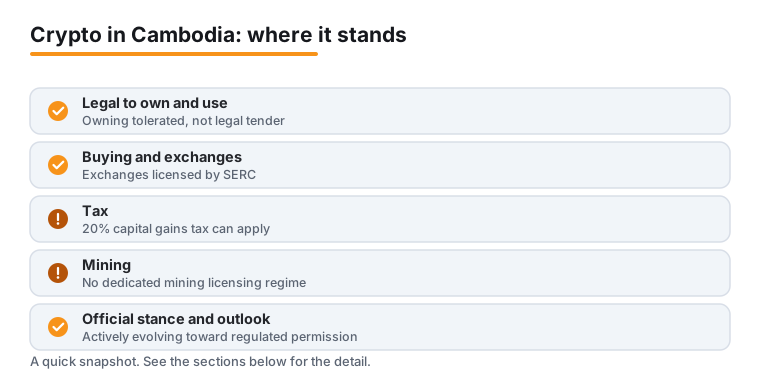
Holding and using cryptocurrency is not a crime in Cambodia for ordinary individuals, but the country does not treat Bitcoin as legal tender, and the commercial side of the market is gated behind licensing. That distinction is the key to understanding Cambodia.
In 2018 the National Bank of Cambodia, the Securities and Exchange Commission of Cambodia (now the SERC), and the General-Commissariat of National Police issued a joint statement warning against the unauthorized propagation, buying, selling, trading, and settlement of cryptocurrencies without a license from competent authorities. Because no agency was granting such licenses at the time, it operated as a de facto ban and kept the market in a cautious grey area for several years.
The position has since shifted toward regulated permission rather than blanket prohibition. The NBC now allows supervised institutions to engage with defined categories of crypto-assets under prior approval, and the SERC has built a licensing framework for digital-asset businesses. In short:
- Personal ownership and use: generally tolerated; Bitcoin is treated as a private asset, not money issued or backed by the state.
- Commercial services (exchanges, custody, brokerage, lending): require a license from the SERC or prior approval from the NBC.
- As payment or legal tender: not recognized; merchants are not obliged to accept crypto, and the SERC's digital-asset rules explicitly exclude payment use.
The safest reading is that crypto is legal to hold but tightly regulated to operate as a business.
Who regulates crypto in Cambodia?
Cambodia's crypto oversight is split between two main authorities, and knowing which one governs an activity matters.
National Bank of Cambodia (NBC) is the central bank and the monetary and supervisory authority. It is the sole issuer of the Khmer riel and licenses, regulates, and supervises banks and financial institutions. The NBC governs how banks and payment institutions may engage with crypto-assets and operates Bakong, the country's blockchain-based national payment system.
Securities and Exchange Regulator of Cambodia (SERC) is the securities and capital-markets authority, operating under the Non-Bank Financial Services Authority (also referred to as the Financial Services Authority). The SERC treats digital assets as a form of security for investment purposes and licenses digital-asset service providers. It also runs a Fintech Regulatory Sandbox under which Cambodia's first licensed digital-asset exchange operates.
Tax matters fall to the General Department of Taxation (GDT), which operates under the Ministry of Economy and Finance. Detailed implementing rules from each body are still being rolled out, so the regulatory picture remains a moving target. You can confirm the regulators directly via the National Bank of Cambodia and the Securities and Exchange Regulator of Cambodia.
Key laws and frameworks
Three instruments define the current landscape.
NBC Prakas B7-024-735 on Transaction Related to Crypto-assets (26 December 2024). This replaced the old de facto ban with a permission-based system for supervised institutions. It classifies crypto-assets into two broad groups:
| Category | What it covers | Treatment for banks |
|---|---|---|
| Group 1a | Tokenized securities (digital representations of traditional financial instruments) | Banks and payment institutions may engage, with NBC approval; exposure not exceeding 5% of Common Equity Tier 1 (CET1) capital |
| Group 1b | Qualifying stablecoins backed by reference assets | Permitted with NBC approval; exposure not exceeding 3% of CET1 capital |
| Group 2 | Unbacked crypto-assets, including Bitcoin and most major cryptocurrencies | Banks generally may not hold these for their own account; client-facing services only with specific NBC approval |
Commercial banks that take on crypto-asset exposure must also file a quarterly report to the NBC on the nature and value of that exposure.
SERC Prakas No. 093 on the Issuance of Licence and the Management of Digital Asset Business (30 December 2025). Issued by the Non-Bank Financial Services Authority, it sets out licensing and conduct rules for Digital Asset Service Providers, Digital Asset Agents, and related persons operating for investment purposes. It explicitly excludes payment transactions involving digital assets.
Bakong is the NBC's blockchain-based national payment and transfer system, widely used domestically and sometimes described as a tokenized-deposit or central-bank-digital-currency-style platform. It is state-run infrastructure and is distinct from open, decentralized cryptocurrencies like Bitcoin. You can read the NBC crypto Prakas directly via the NBC Prakas on Transaction Related to Crypto-assets (PDF).
Licensing and registration of exchanges (DASPs)
Under SERC Prakas No. 093, no person may act as, or hold themselves out as, a Digital Asset Service Provider (DASP) without a valid and active DASP license from the SERC. The regime is detailed and capital-intensive.
- License validity: an initial license is valid for two years; on renewal it is valid for three years, with renewal applications due at least 60 days before expiry.
- Minimum capital: approximately KHR 40 billion (about USD 10 million) for activities such as trading, borrowing or lending, and management; approximately KHR 4 billion (about USD 1 million) for digital-wallet activities.
- Sandbox testing: applicants must successfully test their IT systems, business models, and services in the SERC's regulatory sandbox environment.
- Conduct rules: fair-dealing, disclosure, and AML/CFT obligations apply.
For individuals, the practical landscape looks like this:
- Licensed local platforms: the preferred route as the regime matures, offering clearer legal standing and local compliance.
- International exchanges: many Cambodians have historically used large global platforms, but these may operate outside Cambodia's licensing perimeter and apply their own access and verification rules.
- Peer-to-peer and informal channels: common but higher-risk, with weaker consumer protection and greater exposure to fraud.
Because the framework is new, confirm whether a platform holds a current SERC license before transacting.
Crypto and Bitcoin tax in Cambodia
Cambodia now has a capital gains tax that can reach crypto, though no published General Department of Taxation instruction names digital assets as a class of capital, and PwC's summary of Cambodian tax developments, last reviewed 2 April 2026, contains no reference to cryptocurrency. On 18 July 2025 the Ministry of Economy and Finance issued Prakas No. 496 on Capital Gains Tax, introducing a flat 20% rate on gains from defined capital assets.
- Rate: 20% of the gain, generally the difference between the sale price and the acquisition cost.
- Phased rollout: after repeated postponements, the tax applies from 1 January 2026 to assets such as securities (including shares), leases, intellectual property, goodwill, and foreign currency, with immovable property (land and buildings) deferred further to 1 January 2027.
- Crypto treatment: the General Department of Taxation has been reported to classify cryptocurrencies as intangible assets rather than legal tender, which can bring crypto gains within the capital gains framework. Treatment can still depend on how an activity is characterized (for example, trading versus business income).
- Scope: the tax can apply to residents on worldwide gains and to non-residents on Cambodian-sourced gains.
- Compliance certificate: for assets whose transfer requires official registration, the General Department of Taxation issues a Capital Gains Tax Compliance Certificate after the tax is paid, and reporting has described that certificate as needed to validate the transfer of ownership.
This is an area where mistakes are costly and the rules are still settling. Keep detailed records of acquisitions, disposals, and transfers, and consult the General Department of Taxation or a qualified Cambodian tax adviser. See our general crypto taxes guide for background. Nothing here is tax advice.
AML and KYC rules
Anti-money-laundering (AML) and counter-terrorism-financing (CFT) compliance is a core condition of the regulated framework. Banks, payment institutions, and licensed crypto businesses must adhere to Cambodia's AML/CFT legal framework.
- Client due diligence (KYC): reputable and licensed platforms verify customer identity before allowing trading, deposits, or withdrawals. Expect to provide valid identification.
- Suspicious transaction reporting: regulated providers must monitor activity and report suspicious transactions to the relevant authorities.
- Provider obligations: under SERC Prakas No. 093, DASPs must satisfy AML/CFT and fair-dealing requirements as a licensing condition.
- Foreign-exchange context: Cambodia's economy is heavily dollarized and subject to currency and reporting rules, so converting between crypto, the riel, and US dollars can intersect with banking and AML checks.
For users, the practical takeaway is that anonymity is shrinking: licensed services will ask for identity verification, and informal channels carry higher fraud and compliance risk.
Buying and using crypto in practice
Cambodians do buy and trade crypto, but the rules around who can offer services are stricter than in many neighboring markets. A careful, compliance-aware approach reduces both legal and financial risk.
- Choose a reputable platform. Favor exchanges that hold a current SERC license where available, or well-established international platforms, and check what is permitted for Cambodian users.
- Complete identity verification. Expect KYC and AML checks and have valid identification ready. Tourists and short-term visitors may face extra hurdles tied to local banking, SIM, and verification requirements, so do not assume the same access you have at home.
- Understand funding. Learn how the platform handles riel and US-dollar deposits and how that interacts with Cambodia's banking and exchange-control rules.
- Start small, check fees and rates, and confirm details before buying.
- Secure your holdings. Consider a wallet you control, use strong security (a hardware wallet for larger amounts), and protect your recovery phrase.
- Keep records of purchases, sales, and transfers for possible tax reporting.
Using crypto for everyday payment is not recognized and merchants are not required to accept it; for transfers, Cambodia's own Bakong rails already provide fast, low-cost domestic payments. Confirm the current legal and licensing status before transacting, as the framework is evolving.
Bitcoin mining in Cambodia
Bitcoin mining is energy-intensive, and Cambodia's power sector is a central constraint. The country imports a significant share of its electricity and has faced periods of supply pressure, so large-scale mining raises real questions about grid strain, cost, and sustainability.
There is no widely publicized, dedicated mining-licensing regime in Cambodia, which leaves miners in an uncertain position. Anyone considering mining should weigh several factors:
- Electricity: cost and reliability are the make-or-break variables; mining competes with households and industry for limited supply.
- Legal standing: because mining is not clearly carved out in regulation, operators should seek guidance on how it interacts with NBC and SERC rules, business licensing, and import rules for hardware.
- Environmental and community impact: energy demand, emissions, and land use are increasingly scrutinized.
In practice, Cambodia is not a leading mining destination, and the combination of power constraints and regulatory ambiguity makes large operations risky without professional legal and energy advice.
Recent developments (2025-2026)
Cambodia's framework filled in quickly across 2025 and into 2026.
- NBC crypto Prakas in force: the 26 December 2024 Prakas opened a permission-based path for supervised banks and payment institutions to engage with Group 1 assets.
- Capital gains tax: MEF Prakas No. 496 (18 July 2025) set a 20% capital gains tax which, after repeated delays, applies from 1 January 2026 (immovable property deferred to 2027), with implications for crypto gains classified as intangible assets.
- SERC licensing regime finalized: Prakas No. 093 (30 December 2025) established the DASP licensing framework, including capital thresholds and sandbox testing.
- Unlicensed exchanges blocked: in early December 2024 the Telecommunication Regulator of Cambodia (TRC) restricted access to 16 crypto-exchange websites, including Binance, Coinbase, and OKX, for operating without a SERC license. Mobile apps for some of these platforms reportedly remained reachable.
- First licensed exchange: Royal Group Exchange (RGX), backed by the local conglomerate Royal Group, has been reported as Cambodia's first licensed digital-asset exchange, operating within the SERC's Fintech Regulatory Sandbox. SERC signed a memorandum of understanding with Binance in 2022 to help develop the sandbox framework. Sandbox-licensed platforms have been reported as barred from exchanging digital assets for fiat such as the riel or US dollars.
The dated position is now: the Law on Combating Technology-based Fraud in force since 6 April 2026, the 20% capital gains tax live for five classes of capital since 1 January 2026 and reaching immovable property on 1 January 2027, and the further National Bank regulations on prior approval and licensing of cryptoasset service providers that the December 2024 Prakas said would follow, and continued emphasis on backed assets and state-run rails like Bakong, with Bitcoin and other unbacked crypto tolerated for individuals but kept at arm's length from the banking core. The implementing detail is now published: Prakas No. 1130 MEF.Prk.GDT and Instruction No. 022, both dated 31 December 2025, set the calculation and declaration rules, and the five non-property classes of capital have been taxable since 1 January 2026 and verify with the regulators.
Consumer risks and protection
Cambodia's direction of travel is toward regulated engagement rather than prohibition, but consumer protections remain thinner than in mature markets. Keep these risks in mind:
- Rule changes: implementing regulations are still being issued, so requirements and permitted activities can shift.
- Unlicensed services: using providers that are not licensed by the SERC carries legal and counterparty risk and weak recourse if something goes wrong.
- Scams and fraud: the region has seen significant crypto-related fraud and investment scams; be skeptical of guaranteed returns and unsolicited offers.
- Volatility and loss: Bitcoin and other crypto-assets can lose value rapidly, and self-custody mistakes can mean permanent loss.
- Limited redress: dispute resolution and compensation mechanisms are less developed than in larger markets.
If you choose to participate, only commit money you can afford to lose, use licensed platforms where possible, secure your holdings carefully, and verify the provider's status with the SERC. This article is informational only and not legal, tax, or financial advice.
Official sources and how to verify
Crypto law in Cambodia is evolving, so always confirm the current position with primary sources rather than relying on secondary summaries. The most authoritative references are:
- National Bank of Cambodia (NBC) for banking, payment, and crypto-asset rules and for Bakong: nbc.gov.kh, including the Prakas on Transaction Related to Crypto-assets (PDF).
- Securities and Exchange Regulator of Cambodia (SERC) for digital-asset licensing and the DASP framework: serc.gov.kh.
- General Department of Taxation (GDT) for tax treatment and filing: tax.gov.kh.
For broader context, see our crypto regulation hub and the full country regulation directory. This is general information as of 2026 and is not legal advice; verify the latest rules with the named regulators or a qualified Cambodian professional before acting.
What changed between January and August 2026
Three developments since this page was last reviewed change the practical answer for a reader in Cambodia, and none of them appear above.
- A criminal statute aimed at online scam operations is now in force. The Law on Combating Technology-based Fraud passed the National Assembly on 30 March 2026, was approved by the Senate on 3 April 2026, and was promulgated by Royal Decree on 6 April 2026, taking effect immediately (Fresh News, The Block).
- The 20% capital gains tax actually started. Notification No. 34236 of 30 October 2025 postponed all six classes of capital to 1 January 2026. Lease, investment asset, goodwill, intellectual property and foreign currency have been taxable since that date, while immovable property was deferred again to 1 January 2027 (Rajah & Tann, PwC).
- The licensing perimeter is now split explicitly. Prakas No. 093 applies to digital asset business for investment purposes and expressly excludes payment transactions involving digital assets conducted in Cambodia, which remain with the National Bank of Cambodia (Kaohoon International).
Two things could not be confirmed as having moved. No public source could be found naming a company that holds a full Digital Asset Service Provider licence under Prakas No. 093, as distinct from operating inside the SERC Fintech Regulatory Sandbox, and the SERC website did not respond to automated retrieval, so its register could not be checked. Separately, the National Bank has not been confirmed to have issued the further regulations that the December 2024 Prakas said would set the conditions and procedures for prior approval and licensing to act as a cryptoasset service provider (DFDL).
On the wider compliance picture, the FATF plenary of 17 to 19 June 2026 added Bosnia and Herzegovina and Iraq to the list of jurisdictions under increased monitoring and removed Algeria and Namibia. Cambodia appears in neither group in the plenary outcomes (ComplyAdvantage).
The Law on Combating Technology-based Fraud, in force since April 2026
Cambodia's first dedicated technology-fraud statute is now law. It belongs on this page because it targets the online scam industry that crypto trade press reports as monetising through crypto payment rails, and because it reaches the people who run and staff those operations rather than ordinary holders.
| Stage | Date |
|---|---|
| Passed by the National Assembly, with all 112 members present voting in favour | 30 March 2026 |
| Approved unanimously by the Senate | 3 April 2026 |
| Promulgated by Royal Decree by Acting Head of State Samdech Techo Hun Sen | 6 April 2026 |
| In force, the Royal Decree stating the law takes effect immediately | 6 April 2026 |
Legislative dates from Fresh News, attendance figure from The Block. Penalties are tiered (The Block, Decrypt, Fresh News):
- Individual scammers: 2 to 5 years in prison and fines up to about USD 125,000.
- Those directing a scam operation: 5 to 10 years and fines up to about USD 250,000.
- Cases involving violence, trafficking or forced labour: up to 20 years.
- Operations that result in one or more deaths: 15 to 30 years, or life imprisonment.
What it does not do: it does not change the legality of owning or trading digital assets, and it is not a licensing law. Reporting on the promulgated text does not show cryptocurrency named in the statute itself. It sits alongside the SERC and National Bank regimes rather than inside either of them.
Capital gains tax: the 2026 timetable, and where crypto actually sits
This page already names Prakas No. 496 and the 20% rate. What it does not carry is the chain of instruments that decides when the tax bites and how the gain is calculated.
| Instrument | Date | Effect |
|---|---|---|
| Prakas No. 496 MEF.PRK on Capital Gains Tax | 18 July 2025 | Creates a flat 20% tax on the net gain across six classes of capital: immovable property, leases and subleases, investment assets, goodwill, intellectual property and foreign currency |
| Notification No. 34236 | 30 October 2025 | Postpones all six classes to 1 January 2026 |
| Prakas No. 1130 MEF.Prk.GDT | 31 December 2025 | Clarifications, including deductible costs on share transfers and withholding tax on retained earnings for share transfers by non-residents |
| Instruction No. 022 | 31 December 2025 | Worked calculation examples, deductible costs on immovable property transfers and fair market value methods |
| In force | 1 January 2026 | Lease, investment asset, goodwill, intellectual property and foreign currency |
| In force | 1 January 2027 | Immovable property, after a further deferral |
Returns must be filed and the tax paid within three months of the date the gain is realised (PwC, Andersen). Sources for the instruments above: Rajah & Tann, KPMG and DFDL.
The deduction rules matter. The option to deduct a standard 80% of total sales proceeds applies to immovable property, which does not enter the regime until 1 January 2027. For the five classes live from 1 January 2026, only actual documented costs are deductible (Andersen).
Now the part to state plainly. None of the six classes of capital is defined to include digital assets. The investment asset class is described as shares, bonds and securities. PwC's summary of Cambodian tax developments, last reviewed 2 April 2026, contains no reference to digital assets or cryptocurrency, and neither Prakas No. 1130 nor Instruction No. 022 mentions them. There is no published rule confirming that a disposal of Bitcoin or a stablecoin falls inside the capital gains net. Anyone realising a material crypto gain should obtain a written position from the General Department of Taxation rather than assume either inclusion or exclusion. Sellers of shares in Cambodian companies, including holding vehicles used by crypto businesses, are clearly in scope from 1 January 2026.
Licence mechanics and the fines that back them
Prakas No. 093 sets out considerably more than the capital thresholds (DFDL, Rajah & Tann, HBS Law):
- Two licences exist. A Digital Asset Service Provider licence is held by the company. A Digital Asset Agent licence is held by the individuals a provider employs to carry out permitted activities.
- Four activity classes are named, plus other related activities determined by SERC: digital asset trading business; digital asset wallet business, covering safeguarding for customers and deposit, withdrawal and transfer between wallets, addresses or storage locations; digital asset borrowing and lending; and digital asset management.
- A business guarantee deposit of 15% of the minimum capital is paid into SERC's account on top of the capital itself.
- A provider licence runs for two years, then three years on each renewal. Renewal applications are due at least 60 days before expiry for providers and at least 30 days before expiry for agents.
- Any person conducting a digital asset business without a SERC licence is deemed to have conducted a securities business without a licence, and faces administrative sanctions such as written warnings, public notification with an order to rectify, restriction, suspension or withdrawal of a licence, along with monetary fines.
- The draft was approved by the Non-Bank Financial Services Authority Council on 24 December 2025 (SERC press release) and is reported as running to nine chapters and 63 clauses (CoinGeek).
On the banking side, the National Bank's cryptoasset Prakas carries conduct rules and riel-denominated fines that are easy to miss (Fintech News Singapore):
- A licensed cryptoasset service provider may not use customer assets for its own purposes, may not promote specific cryptoassets, and may not offer services that encourage cryptoassets as payment for goods and services. It may still advertise its own services.
- Fines reach KHR 500,000,000 per violation, with daily fines of KHR 1,000,000 for reporting failures and KHR 3,000,000 for broader non-compliance.
Read together, the two regimes decide which regulator a Cambodian crypto business answers to before it applies. Investment-facing activity goes to SERC under Prakas No. 093. Payment-facing activity, and anything done by or through a bank, goes to the National Bank under Prakas B7-024-735.
Frequently asked questions
Is cryptocurrency legal in Cambodia?
Owning and using crypto as an individual is generally tolerated, and Cambodia has shifted from a 2018 de facto ban to a permission-based regime. However, Bitcoin is not legal tender, and commercial services such as exchanges, custody, and lending require a license from the SERC or prior approval from the National Bank of Cambodia. This is general information as of 2026, not legal advice; verify the current rules with the regulators before acting.
Who regulates crypto in Cambodia?
Two authorities lead. The National Bank of Cambodia (NBC) governs how banks and payment institutions may handle crypto-assets and runs the Bakong payment system, while the Securities and Exchange Regulator of Cambodia (SERC), under the Non-Bank Financial Services Authority, licenses digital-asset businesses and treats digital assets as a form of security for investment. Tax matters fall to the General Department of Taxation (GDT).
Can banks in Cambodia hold or offer Bitcoin?
Under the NBC's Prakas of 26 December 2024, supervised banks and payment institutions may engage with Group 1 assets (tokenized securities and qualifying stablecoins) with NBC approval, subject to exposure limits: Group 1a (tokenized securities) exposure must not exceed 5% of Common Equity Tier 1 (CET1) capital, and Group 1b (stablecoins) exposure must not exceed 3% of CET1 capital. Bitcoin sits in Group 2 (unbacked crypto), which banks generally cannot hold for their own account; client-facing services are possible only with specific NBC approval.
Do crypto exchanges need a license in Cambodia?
Yes. Under SERC Prakas No. 093 (30 December 2025), no person may operate as a Digital Asset Service Provider without a valid SERC license. Requirements include minimum capital of roughly KHR 40 billion (about USD 10 million) for activities such as trading, lending, and management (about KHR 4 billion, or USD 1 million, for digital-wallet activities), sandbox testing, and AML/CFT compliance. Initial licenses last two years, then three years on renewal.
How is crypto taxed in Cambodia?
Cambodia introduced a 20% capital gains tax via Ministry of Economy and Finance Prakas No. 496 (18 July 2025), which after repeated delays applies from 1 January 2026 (immovable property deferred to 2027). The General Department of Taxation has been reported to treat crypto as an intangible asset rather than legal tender, which can bring crypto gains within this framework, though treatment can depend on the activity. Keep detailed records and consult the GDT or a qualified Cambodian tax adviser. This is not tax advice.
What is Bakong, and is it the same as Bitcoin?
No. Bakong is the National Bank of Cambodia's blockchain-based national payment and transfer system, widely used across the country and sometimes described as a tokenized-deposit or CBDC-style platform. It is state-run infrastructure and is distinct from open, decentralized cryptocurrencies like Bitcoin.
Are Binance and Coinbase available in Cambodia?
In early December 2024 the Telecommunication Regulator of Cambodia (TRC) restricted access to 16 crypto-exchange websites, including Binance, Coinbase, and OKX, because they were operating without a license from the Securities and Exchange Regulator of Cambodia. Reporting noted that mobile apps for some platforms remained reachable at the time. Because the licensing framework and enforcement are still developing, check the current status and whether a platform holds a SERC license before using it. This is general information as of 2026, not legal advice.
Can a licensed Cambodian platform swap crypto directly for riel or US dollars?
Reporting on the platforms operating under the SERC's Fintech Regulatory Sandbox has described them as able to trade digital assets but not to exchange those assets directly for fiat currency such as the Cambodian riel or US dollars. Prakas No. 093 was issued on 30 December 2025 and is the operative rulebook: a provider licence runs two years, then three years on each renewal, a business guarantee deposit of 15% of minimum capital is paid to SERC, and the Prakas covers investment activity only, expressly excluding payment transactions involving digital assets, which stay with the National Bank of Cambodia, so confirm the current position with the platform and the SERC before transacting.
Is crypto legal in Cambodia in August 2026?
Yes, within a licensed perimeter. Digital asset business for investment purposes requires a licence from the Securities and Exchange Regulator of Cambodia under Prakas No. 093 of 30 December 2025. Banks and payment institutions operate under National Bank of Cambodia Prakas B7-024-735 of 26 December 2024, which lets them engage with tokenised securities and stablecoins with prior approval and within exposure limits of 5% and 3% of Common Equity Tier 1 capital, while prohibiting them from issuing cryptoassets or engaging with Group 2 unbacked cryptoassets such as Bitcoin. Holding crypto is not itself an offence. Providing services without the relevant licence is.
When did Cambodia's anti-scam law take effect, and does it affect ordinary crypto holders?
The Law on Combating Technology-based Fraud passed the National Assembly on 30 March 2026, with all 112 members present voting in favour, was approved unanimously by the Senate on 3 April 2026, and was promulgated by Royal Decree on 6 April 2026, taking effect immediately. It creates offences for running technology-based fraud operations, with sentences of 2 to 5 years for individual scammers, 5 to 10 years for those directing an operation, up to 20 years where violence or trafficking is involved, and 15 to 30 years or life imprisonment where an operation results in one or more deaths. It does not change the legality of owning or trading digital assets, it is not a licensing law, and reporting on the promulgated text does not show cryptocurrency named in the statute itself.
Do I pay capital gains tax on crypto in Cambodia?
The 20% capital gains tax under Prakas No. 496 of 18 July 2025 has applied since 1 January 2026 to leases, investment assets, goodwill, intellectual property and foreign currency, with immovable property following on 1 January 2027. Digital assets are not named as a class of capital in Prakas No. 496, Prakas No. 1130 or Instruction No. 022, and the investment asset class is described as shares, bonds and securities. There is therefore no published rule putting a Bitcoin or stablecoin disposal inside the tax. Returns are due within three months of realising a gain, so anyone with a material disposal should get a written position from the General Department of Taxation rather than assume.
What does it cost to get a Cambodian digital asset licence?
Prakas No. 093 sets minimum capital of KHR 40 billion, about USD 10 million, for trading, borrowing and lending, and management activities, and KHR 4 billion, about USD 1 million, for digital wallet services. On top of that, a business guarantee deposit of 15% of the minimum capital is paid into SERC's account. A provider licence is valid for two years, then three years on each renewal, with renewal applications due at least 60 days before expiry for providers and at least 30 days for agents.
Facts reviewed: 12 August 2026. Page updated: 12 August 2026.