Home › Crypto Regulation › Myanmar
Bitcoin & Cryptocurrency Regulation in Myanmar
Quick answer — Myanmar, 2026
- Legal: Effectively banned, not legal tender, no licensed providers
- Tax: No clear crypto tax regime, general income rules may apply
- Buying: No lawful on-ramp, informal P2P and offshore only
Myanmar is one of the most restrictive countries in Asia for digital assets. The Central Bank of Myanmar (CBM), the country's monetary authority, has repeatedly stated that buying, selling, exchanging, transferring or holding cryptocurrencies is prohibited, that crypto is not recognised as legal tender, and that no financial institution in the country is licensed to offer crypto services. The most recent renewal of this warning came in a CBM notification dated 16 November 2025. Despite the ban, informal usage persists, driven by a banking system under strain, currency controls, a large diaspora sending remittances, and ongoing armed conflict.
This page explains where Myanmar crypto regulation stands as of 2026: the legal status of Bitcoin and other tokens, who regulates the space, the laws used for enforcement, taxation, anti-money-laundering rules, and the practical realities of buying, mining and moving crypto. This article is general information as of 2026 and is NOT legal, tax or financial advice; because the position is hostile and enforcement is unpredictable, always verify the current rules directly with the Central Bank of Myanmar or a qualified local professional before acting. See also our broader guide to crypto regulation and the main regulation hub.
On this page: Legal status · Who regulates it · Taxes · How to buy · Mining
Is Bitcoin and crypto legal in Myanmar?
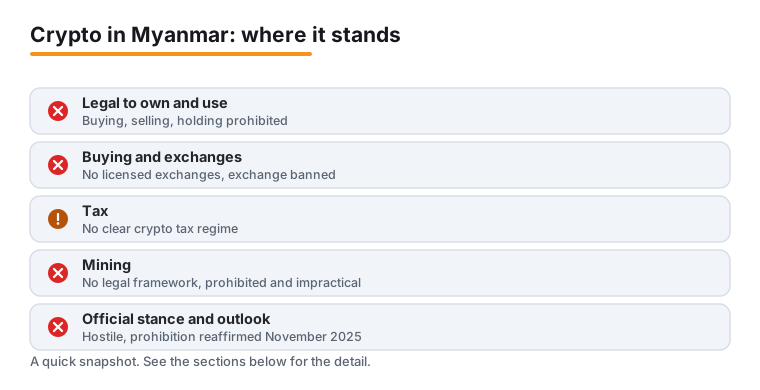
No. Cryptocurrency is effectively banned in Myanmar. The Central Bank of Myanmar has issued repeated public notifications making clear that crypto is not recognised as legal tender and that buying, selling, exchanging, transferring or otherwise dealing in digital currencies is prohibited. The CBM first announced the prohibition through state newspapers on 3 May 2019, reinforced it with a notification in May 2020, issued a stronger public warning on 24 May 2024, and renewed the warning again on 16 November 2025, reiterating that all online and offline cryptocurrency transactions are strictly prohibited and that no financial institution in Myanmar is authorised to deal in digital currencies. In its warnings the CBM cites money laundering, scams, tax evasion, hacking and financial losses from price volatility and weak regulation as the reasons for the prohibition.
It helps to separate the legal position from the practical reality. Owning Bitcoin is treated differently from operating a licensed exchange or offering crypto payment services, and many residents still interact with crypto through informal peer-to-peer and offshore channels. But because the official position treats such activity as outside the law, users carry real legal and financial risk: no consumer protection, no recourse if funds are lost or frozen, and the possibility of enforcement action including account closure and prosecution. Treat crypto in Myanmar as banned and high-risk, not as a normal, regulated investment.
Who regulates crypto in Myanmar?
The Central Bank of Myanmar (CBM) is the principal authority. It sets monetary policy, supervises banks and licenses financial and payment-service providers, and it is the body that has declared crypto prohibited and that enforces that position. The CBM has published its cryptocurrency announcement directly on its official site (see the CBM cryptocurrency announcement page).
There is no dedicated crypto licensing regulator in Myanmar, because the official approach is prohibition rather than supervision. Instead, enforcement is shared across the bodies that administer the financial system: the CBM itself, the police and prosecutors acting under criminal and anti-money-laundering powers, and the Myanmar Financial Intelligence Unit (MFIU) for suspicious-transaction reporting and money-laundering investigations. The CBM has also formed a high-level committee to study a state-issued digital kyat (a CBDC), which is a centralised government instrument and is not the same thing as decentralised cryptocurrency.
Crypto laws and frameworks in Myanmar
Myanmar does not have a dedicated, comprehensive crypto law that licenses and supervises the industry. Instead the framework is built from CBM prohibitions plus general financial and criminal statutes that are used for enforcement. The key elements as of 2026 are:
- CBM cryptocurrency notifications: the 2019 announcement, the 2020 notification (CBM Notification No. 9/2020, dated 15 May 2020), the 24 May 2024 warning and the 16 November 2025 renewal. These establish that crypto is prohibited and not authorised through any bank.
- Central Bank of Myanmar Law: the statute under which the CBM exercises its monetary and supervisory authority and grounds its prohibition.
- Financial Institutions Law: governs who may provide financial and payment services and underpins the position that licensed institutions cannot deal in crypto.
- Anti-Money Laundering Law: used against unlicensed money movement, including crypto-linked transfers and informal hundi remittances. Myanmar enacted a new Anti-Money Laundering Law (Law No. 16/2026) on 11 March 2026, replacing the 2014 law. The law runs to 16 chapters covering money-laundering offences, reporting obligations, cross-border transactions, penalties and counter-terrorist-financing; published summaries focus on customer due diligence, suspicious-transaction reporting and record-keeping rather than naming crypto or virtual-asset service providers (VASPs) directly.
A separate state-side development is the CBM's formation, by Notification No. 16/2025 dated 24 June 2025, of the Central Committee for the Issuance of Central Bank Digital Currency, chaired by the CBM Governor, to research and potentially launch a digital kyat. A CBDC is a centralised, state-issued digital form of the national currency and is the opposite of a decentralised cryptocurrency like Bitcoin; its existence signals interest in controlled digital money, not in liberalising private crypto.
Licensing and registration of exchanges (VASPs)
There is no exchange or VASP licensing regime in Myanmar. Because crypto trading and exchange are prohibited outright, the CBM does not issue licences or registrations for crypto exchanges, brokers, custodians or payment processors, and it has stated that no domestic financial institution is authorised to engage in cryptocurrency-related services. This is the opposite of the approach in jurisdictions that license VASPs under a defined regime; Myanmar offers no legal on-ramp comparable to those frameworks.
The practical consequence is that any platform marketed as a licensed or regulated crypto exchange operating from inside Myanmar should be treated with strong suspicion. There is no authority that grants such a licence, so a claim of local regulatory approval cannot be genuine. Residents who acquire crypto generally do so through offshore platforms or informal peer-to-peer channels, which sit outside the regulated system and offer no consumer protection or legal recourse.
Crypto and Bitcoin tax in Myanmar
Myanmar does not have a clear, published tax regime specifically for cryptocurrency. Because crypto trading is prohibited, there is no recognised licensed market through which gains would normally be declared, and the tax treatment of any informal crypto activity is uncertain.
That uncertainty does not mean income is exempt. The Union Taxation Law 2026 (Law No. 18/2026), enacted 15 March 2026 and in effect from 1 April 2026, sets a general capital gains tax rate of 10 percent, personal income tax of 0 to 25 percent, and progressive rates of 3 to 30 percent on income from undisclosed sources. None of these are crypto provisions, but the undisclosed sources schedule is the one that applies when unexplained value appears in a taxpayer's affairs, and undeclared flows can also be used as evidence of offences under the Anti-Money Laundering Law 2026. Given the prohibition, attempting to report crypto activity could itself draw scrutiny.
We deliberately do not state specific crypto tax rates, thresholds or filing rules for Myanmar, because no verified, crypto-specific schedule is publicly established and the rules can change. If you have a tax question involving digital assets connected to Myanmar, consult a qualified Myanmar tax adviser or lawyer and rely on official guidance rather than general online summaries. For background on how crypto is taxed in other countries, see our crypto taxes guide. This section is informational only and is not tax advice.
AML and KYC rules
Anti-money-laundering enforcement is the main legal lever used against crypto activity in Myanmar. The CBM and prosecutors act under the Anti-Money Laundering Law and the Financial Institutions Law against unlicensed currency conversion and unauthorised money transfers, including transfers using stablecoins such as Tether (USDT) through informal hundi networks. Reported enforcement measures include closing bank accounts and pursuing criminal proceedings; in 2024 the CBM was reported to have closed more than 200 bank accounts linked to digital-currency transactions in a single week.
Banks and other obliged institutions apply customer due diligence (KYC), suspicious-transaction reporting and record-keeping under the AML framework, and reporting has reportedly been tightened to flag crypto-linked transfers, including monitoring of mobile-money flows above modest thresholds. The new Anti-Money Laundering Law (Law No. 16/2026, enacted 11 March 2026) restates and updates these compliance obligations for banks, financial institutions and designated non-financial businesses. Because crypto exchange is prohibited, there is no separate AML or KYC regime for licensed crypto firms; instead, AML rules are applied to capture crypto activity within the broader financial system.
Buying and using crypto in practice
There is no licensed, lawful way to buy or use Bitcoin inside Myanmar. Domestic crypto exchanges are not authorised, banks are not permitted to deal in crypto, and using crypto as a means of payment is prohibited. That means there is no regulated on-ramp comparable to what exists in countries with crypto licensing regimes, and no Bitcoin ATMs or money-services kiosks operate on a lawful basis.
In reality, people who acquire crypto in Myanmar generally do so through informal peer-to-peer trades or offshore platforms, often via contacts in the diaspora. Each route carries significant risk:
- Legal risk: the activity is prohibited and may intersect with AML and anti-fraud enforcement, including account closure and prosecution.
- Counterparty and fraud risk: peer-to-peer deals rely on trust, scams are common, and there is no official recourse if you are cheated.
- Custody risk: if you hold your own coins, losing your keys or being hacked means losing the funds permanently.
- Access risk: offshore platforms may restrict or block users, and funds can become inaccessible.
For these reasons this page does not provide a step-by-step purchasing guide for Myanmar. The responsible position is to recognise that buying and using crypto in Myanmar is prohibited and high-risk, to verify the current rules with official sources, and to understand that you would be operating without legal protection.
Crypto and Bitcoin mining in Myanmar
Bitcoin mining uses specialised computers to validate transactions and earn newly issued coins, and it consumes large amounts of electricity. In Myanmar, mining sits in a difficult position: it is not supported by any clear legal framework, and because crypto activity is prohibited it carries the same legal exposure as trading. On top of that, the country faces chronic electricity shortages, grid instability and frequent power cuts that make large-scale, reliable operations hard to sustain.
Energy is the central practical constraint. Mining at scale needs cheap, stable power, and Myanmar's grid struggles to meet existing demand, so any energy-intensive activity competes with households and industry for scarce supply. Renewable build-out, financing and grid integration remain limited. For these combined reasons, regulatory, infrastructural and economic, Myanmar is not a practical or low-risk environment for crypto mining, and anyone considering it should weigh the prohibition, unreliable power, equipment and import costs, and the lack of legal protection.
Remittances and cross-border use
Remittances are a major part of Myanmar's economy. Many citizens work abroad, and a significant share of the population is unbanked or underbanked, so moving money home efficiently matters enormously. Traditional channels can be slow and expensive, with high fees, multiple intermediaries and exposure to currency controls, which is exactly why some people look at Bitcoin and stablecoins for cross-border transfers.
In practice for Myanmar, several cautions apply. Crypto trading and exchange are prohibited, so using crypto to move money can fall outside the law and routinely intersects with anti-money-laundering enforcement; authorities have specifically targeted USDT-based informal hundi transfers. The hard part is off-ramping, converting crypto back into usable local currency, which depends on informal peer-to-peer networks that carry counterparty and fraud risk. Bitcoin's value can also move sharply between sending and receiving unless a stablecoin is used, and even then conversion and access risks remain. Informal channels offer no recourse if a transfer is lost, stolen or scammed. Crypto remittances do happen informally, but they are not a sanctioned or protected channel in Myanmar; treat them as high-risk and understand the legal exposure first.
Recent developments (2024 to 2026)
The direction of travel has been toward firmer enforcement of the existing ban rather than liberalisation:
- 24 May 2024: the CBM issued a stronger public warning against the sale, purchase, exchange or transfer of unregulated digital currencies, signalling readiness to close accounts and pursue legal action under the Central Bank of Myanmar Law, the Financial Institutions Law and the Anti-Money Laundering Law. Reports described more than 200 crypto-linked bank accounts being closed in a single week.
- 24 June 2025: the CBM issued Notification No. 16/2025 forming the Central Committee for the Issuance of Central Bank Digital Currency, tasked with researching and planning a phased digital-kyat (CBDC) rollout.
- 16 November 2025: the CBM renewed its warning, urging the public not to buy, sell, transfer or hold digital assets and reiterating that no financial institution is authorised to provide crypto services.
- 11 March 2026: Myanmar enacted a new Anti-Money Laundering Law (Law No. 16/2026), replacing the 2014 law and updating compliance obligations that can be applied to crypto-linked money movement.
Digital money has also become entangled with the wider conflict, with both state-aligned and opposition-aligned digital-currency initiatives reported. The near-term picture now has dates on it. Private crypto remains prohibited, and the Anti-Online Scam Law approved by parliament on 28 July 2026 and reported enacted on 31 July 2026 adds criminal penalties of 10 years to life for digital currency fraud, although no law number or commencement date has been published. Myanmar also remains on the FATF list of high-risk jurisdictions subject to a call for action as of 19 June 2026, subject to enhanced due diligence rather than countermeasures. The digital kyat committee formed under CBM Notification No. 16/2025 is still working on a legal framework and a phased rollout plan with no published launch date, so anyone engaging with crypto in connection with Myanmar should monitor official CBM announcements closely.
Consumer risks and protection
The central risk in Myanmar is the combination of an explicit prohibition with unpredictable enforcement. Because crypto is banned, there is no licensed venue, no investor or consumer protection, and no official recourse if you are scammed, hacked, or have funds frozen. Users face real legal exposure, including bank-account closure and possible prosecution, and authorities themselves cite money laundering, fraud and volatility as reasons for the ban. Practical hurdles compound this: an unstable banking system, currency controls, unreliable electricity, and the difficulty of converting crypto to and from local currency through informal channels only.
If you choose to engage despite the prohibition, basic precautions reduce, but do not eliminate, the danger: be sceptical of any platform claiming local licensing (none exists), never share private keys or seed phrases, beware peer-to-peer counterparties and "guaranteed return" schemes, and never commit money you cannot afford to lose. There is no government compensation scheme and no regulator to appeal to if things go wrong. Bitcoin is highly volatile everywhere, and in Myanmar the legal and access risks sit on top of that. This page does not give investment advice or price predictions.
Official sources and how to verify
Crypto policy in Myanmar can shift, and enforcement is unpredictable, so always confirm the current position against primary sources before acting. The most authoritative starting points are:
- Central Bank of Myanmar (official website) for monetary policy, financial-institution licensing and official notifications.
- CBM cryptocurrency announcement page, which hosts the central bank's own statement on digital currency.
- CBM notification on Hundi money transfers, the official statement on enforcement against informal cross-border transfers often linked to crypto.
- Myanmar Financial Intelligence Unit (MFIU), the government body responsible for anti-money-laundering supervision and suspicious-transaction reporting.
- DFDL legal alert on the Anti-Money Laundering Law 2026 and other reputable law-firm analyses (for example Tilleke and Gibbins) that summarise the CBM notifications and the AML framework.
For background reading, see our crypto regulation guide and the main regulation hub. This article is general information as of 2026 and is NOT legal, tax or financial advice; verify the current rules with the Central Bank of Myanmar and a qualified local professional before taking any action.
What is changing: Myanmar crypto law as of August 2026
Myanmar now has a law that names cryptocurrency. On 28 July 2026 the Pyidaungsu Hluttaw, Myanmar's combined parliament sitting in joint session, approved the Anti-Online Scam Bill in its entirety, after the text had been discussed and amended in both the Pyithu Hluttaw and the Amyotha Hluttaw. It was jointly drafted by the Ministry of Home Affairs and the Ministry of Legal Affairs. On 3 August 2026 Myanmar state-aligned media reported that the Pyidaungsu Hluttaw enacted the Anti-Online Scam Law on 31 July 2026. DVB reports the law comprises 12 chapters and 63 sections. See One News Myanmar, Cointelegraph and DVB.
What the law punishes, as reported:
- Imprisonment of 10 years to life, together with a fine, for establishing an online fraud centre, for committing digital currency fraud, and for recruiting, organising or trafficking people to commit online fraud.
- Imprisonment of 10 years to life, or the death penalty, where violence, torture, unlawful detention or cruel treatment is used against a person for the purpose of committing online fraud. Where the offence results in a person's death, the sentence is death.
- Imprisonment of 3 to 7 years plus a fine of MMK 50 million to MMK 100 million for identity fraud committed to obtain money or property.
- Imprisonment of 1 to 3 years plus a fine of MMK 10 million to MMK 50 million for distributing false information, for false SIM registration, and for buying or selling bank accounts registered under false names or inaccurate personal information.
- Formation of a 21 member Central Committee for the Anti-online Scam, chaired by the Union Minister for Home Affairs. Prosecution for any offence under the law requires the prior approval of the Central Committee or a Regional Committee.
- Procedures reported from the draft for freezing suspicious accounts, confiscating proceeds or equipment linked to scams, and information sharing among banks, telecommunications providers, state agencies and foreign governments, per crypto.news.
Read this carefully before assuming it changes your position. It is a fraud and organised crime statute aimed at the scam compounds along the Thai and Chinese borders. It does not legalise crypto, it does not create a licensing route, and it does not create a new standalone offence of owning coins. What it adds is a dedicated criminal law under which crypto activity can be charged, sitting on top of the Central Bank prohibition that was already there. The clause on buying and selling bank accounts under false names is the one most likely to touch ordinary informal users, because that is how peer to peer USDT settlement in Myanmar is commonly arranged.
Two things remain unverified. No official law number has appeared in any publicly accessible English-language record, and no commencement date has been published. Cointelegraph reported on 28 July 2026 that it was not stated whether the bill had received presidential assent or when it would take effect, and crypto.news reported on 29 July 2026 that the final enacted text had not been publicly released, so the detailed provisions above are drawn from reporting on the draft and from state media summaries rather than from a published statute.
The legislative pipeline and what happens next
Myanmar has no crypto licensing bill, no consultation and no announced digital asset framework. What it has is a short list of instruments with dates attached. This is the pipeline as it stands in August 2026.
| Instrument | Stage | Timing | What it means in practice |
|---|---|---|---|
| Anti-Online Scam Law | Approved by parliament 28 July 2026, reported enacted 31 July 2026 | No law number and no commencement date published | Digital currency fraud is a named criminal offence carrying 10 years to life. Prosecution needs prior approval from the Central Committee or a Regional Committee. |
| Anti-Money Laundering Law 2026 (Law No. 16/2026) | In force since 11 March 2026 | No implementing rules published in any summary reviewed | The statute Myanmar authorities actually charge under, since there is no crypto law. Its published summaries do not mention virtual assets or VASPs. |
| FATF call for action listing | Reaffirmed 19 June 2026 | Next FATF plenary October 2026, with no Myanmar deadline stated | Enhanced due diligence by foreign banks on Myanmar-linked payments. The FATF does not call for countermeasures against Myanmar, unlike Iran and North Korea. |
| Digital kyat, CBM Notification No. 16/2025 | Committee formed 24 June 2025 | No pilot or launch date published | The committee is mandated to supervise development of a legal and regulatory framework and a phased rollout plan. This is the only documented place where digital currency legislation is being prepared. |
| Crypto exchange or VASP licensing | Nothing drafted, nothing announced | No timing | No route exists to license an exchange, broker or custodian in Myanmar. Any claim of local approval is false. |
On the international side, at its plenary held from 17 to 19 June 2026 the FATF kept Myanmar on the list of high-risk jurisdictions subject to a call for action, alongside Iran and North Korea. The published Myanmar entry is two sentences: Myanmar will remain on the list until its full action plan is completed, and members and other jurisdictions should apply enhanced due diligence measures proportionate to the risk arising from Myanmar. The FATF does not call for countermeasures against Myanmar, unlike North Korea and Iran, and it sets no deadline or review date for Myanmar in that statement. See the FIAU Malta republication of the 19 June 2026 FATF public statements. In practice this means Myanmar-linked payments continue to face heavy correspondent bank friction, which hits diaspora remittances directly, but nothing about that status changed in June 2026.
The tax rates that actually exist, and why none of them are crypto rules
Myanmar has no crypto tax regime and no published ruling applying any tax to digital assets. That is the honest answer and it has not changed. What has changed is that the rates for the current tax year are now set and can be named. The Union Taxation Law 2026 (Law No. 18/2026) was enacted on 15 March 2026 and applies from 1 April 2026, the start of financial year 2026 to 2027, per DFDL.
- General capital gains tax: 10 percent. Oil and gas: 40 to 50 percent.
- Personal income tax: 0 to 25 percent.
- Income from undisclosed sources: progressive rates of 3 to 30 percent.
- SME income tax exemption threshold: raised from MMK 15 million to MMK 20 million a year.
None of these are crypto provisions. The DFDL summary of the law does not mention cryptocurrency or digital assets at all, and no Myanmar authority has published guidance applying these rates to coin disposals. They matter because they are the only rates in existence, and because the 3 to 30 percent undisclosed sources schedule is the provision that applies when unexplained value turns up in a taxpayer's affairs. There is no lawful way to declare a crypto gain while trading is prohibited, so the practical exposure is not a tax bill on a declared gain but an assessment on undisclosed income alongside action under the Anti-Money Laundering Law. This is general information and not tax advice.
Frequently asked questions
Is cryptocurrency legal in Myanmar in 2026?
No. Cryptocurrency is effectively banned. The Central Bank of Myanmar prohibits buying, selling, exchanging, transferring or holding digital assets, does not recognise crypto as legal tender, and confirms that no financial institution is licensed to offer crypto services. The CBM first announced this in May 2019 and has renewed the warning since, most recently on 16 November 2025. Holding crypto is treated differently from operating an exchange, but all crypto activity carries legal and financial risk with no consumer protection.
Who regulates crypto in Myanmar?
The Central Bank of Myanmar (CBM, cbm.gov.mm) is the primary authority, acting under the Central Bank of Myanmar Law, the Financial Institutions Law and the Anti-Money Laundering Law. There is no dedicated crypto licensing regulator, because the official approach is prohibition rather than supervision. The CBM has also formed a committee (Notification No. 16/2025, dated 24 June 2025) to study a state-issued digital kyat (a CBDC), which is separate from, and not the same as, decentralised crypto.
Can crypto exchanges get a licence in Myanmar?
No. Because crypto trading and exchange are prohibited, the CBM does not license or register crypto exchanges, brokers, custodians or other virtual-asset service providers, and it has stated that no domestic financial institution is authorised to provide crypto services. Any platform claiming local regulatory approval to operate a crypto exchange from inside Myanmar should be treated as not genuine, because no such licence exists.
How is crypto taxed in Myanmar?
There is no clear, published crypto-specific tax regime in Myanmar, partly because crypto trading is prohibited and there is no licensed market. General income and business tax principles could in theory apply to any gains, and undeclared value flows can draw scrutiny. We do not state specific rates or thresholds because none are verified. Consult a qualified Myanmar tax professional. This is not tax advice.
What happens if you trade crypto in Myanmar?
You risk enforcement under the Anti-Money Laundering Law and the Financial Institutions Law. The CBM has warned that the sale, purchase, exchange or transfer of unregulated digital currencies can trigger bank-account closure and legal action, which may include fines, imprisonment or both. In 2024 it was reported to have closed more than 200 crypto-linked accounts in a single week, with enforcement particularly targeting USDT-based informal money transfers.
How do people in Myanmar buy crypto if it is banned?
There is no lawful, licensed way to buy crypto in Myanmar. Banks cannot deal in it and no domestic exchange is authorised. Reporting describes an informal underground market where residents acquire coins through peer-to-peer trades and offshore platforms, often via diaspora contacts, frequently using Tether (USDT). These channels sit outside the law, offer no consumer protection or recourse, and intersect with anti-money-laundering enforcement that has closed accounts and pursued cases against USDT-linked hundi transfers. This is not a recommendation to do so; it is high-risk and prohibited.
Where can I check the official rules for crypto in Myanmar?
Start with the Central Bank of Myanmar's official website (cbm.gov.mm), including its cryptocurrency announcement page, for the primary notifications, and supplement with reputable law-firm analyses such as DFDL and Tilleke and Gibbins. Because the position can change and enforcement is unpredictable, verify the current rules with the CBM and a qualified local lawyer before acting. This page is general information as of 2026 and is not legal advice.
Did Myanmar pass a crypto law in 2026?
Yes, but not the kind that legalises anything. The Pyidaungsu Hluttaw approved the Anti-Online Scam Bill on 28 July 2026 and Myanmar state-aligned media reported the Anti-Online Scam Law enacted on 31 July 2026. It is the first Myanmar statute to name digital currency fraud, punishable by 10 years to life imprisonment, with the death penalty where violence used to force someone into online fraud work causes death. It is an organised crime and fraud law aimed at scam compounds, not a licensing or market framework. No official law number and no commencement date had been published in any accessible record as of early August 2026, and the final enacted text has not been publicly released.
Does the Anti-Online Scam Law make owning crypto a crime in Myanmar?
It does not create a new standalone offence of holding coins. Buying, selling, exchanging, transferring and holding crypto were already prohibited by Central Bank of Myanmar notifications dating to May 2019 and May 2020, most recently reaffirmed on 16 November 2025, and enforcement runs through the Anti-Money Laundering Law and the Financial Institutions Law. What the new law adds is dedicated criminal penalties for digital currency fraud and for running scam operations. The clause on buying or selling bank accounts registered under false names or inaccurate personal information, carrying 1 to 3 years imprisonment and a fine of MMK 10 million to MMK 50 million, is the one most likely to reach ordinary informal peer to peer users. Prosecution under the law requires prior approval of the Central Committee or a Regional Committee.
Is Myanmar on the FATF blacklist?
Yes. At its plenary held from 17 to 19 June 2026 the FATF kept Myanmar on the list of high-risk jurisdictions subject to a call for action, alongside Iran and North Korea. The published entry says Myanmar will remain on the list until its full action plan is completed and calls on members and other jurisdictions to apply enhanced due diligence measures proportionate to the risk arising from Myanmar. Unlike Iran and North Korea, Myanmar is not subject to a FATF call for countermeasures, and the June 2026 statement sets no deadline or review date for Myanmar. For readers this means Myanmar-linked payments face heavy correspondent bank friction, and that position is unchanged.
What tax rates apply in Myanmar if there is no crypto tax?
The Union Taxation Law 2026 (Law No. 18/2026) was enacted on 15 March 2026 and applies from 1 April 2026. It sets general capital gains tax at 10 percent, personal income tax at 0 to 25 percent, and progressive rates of 3 to 30 percent on income from undisclosed sources. The SME income tax exemption threshold rose from MMK 15 million to MMK 20 million a year. None of these are crypto rules and no Myanmar authority has published guidance applying them to digital assets, but the undisclosed sources schedule is the provision that bites when unexplained value appears. This is general information, not tax advice.
Facts reviewed: 3 August 2026. Page updated: 3 August 2026.