Home › Crypto Regulation › Malaysia
Bitcoin & Cryptocurrency Regulation in Malaysia
Quick answer — Malaysia, 2026
- Legal: Legal to own and trade, not legal tender; most tokens regulated as securities
- Tax: No general capital gains tax; active trading and mining taxed as income
- Buying: Via SC-registered Digital Asset Exchanges, funded in ringgit after KYC
Malaysia takes a regulated, securities-led approach to digital assets. Owning, buying, selling and trading Bitcoin and other cryptocurrencies is legal, but the activity sits inside a formal framework run by two authorities. The Securities Commission Malaysia (SC) regulates most crypto assets as securities and registers the exchanges that trade them, while Bank Negara Malaysia (BNM), the central bank, handles monetary policy and anti-money-laundering oversight. Crucially, no cryptocurrency is legal tender in Malaysia, and the ringgit (MYR) remains the only recognised currency.
This guide explains the current legal status of crypto in Malaysia, who the regulators are, the key laws and frameworks, how exchanges are registered, how crypto is taxed, the AML and KYC rules, and the main risks to weigh before investing. It reflects the position as of 2026 and is general information only, not legal, tax or financial advice. Malaysia's crypto rules are evolving, including a liberalised listing framework that took effect on 20 May 2026, so always verify specifics with the named official regulators or a licensed professional before acting. For broader context, see our overview of crypto regulation.
On this page: Legal status · Who regulates it · Taxes · How to buy · Mining
Is Bitcoin and crypto legal in Malaysia?
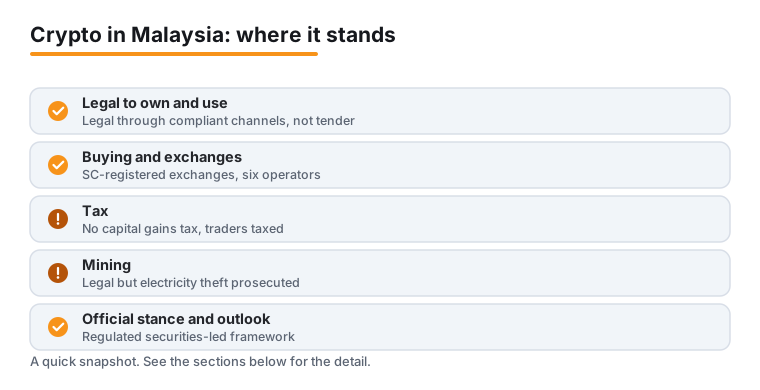
Yes. Buying, holding, selling and trading Bitcoin and other crypto assets is legal in Malaysia for individuals and businesses, provided you deal through channels that comply with the law. There is no ban on personal ownership, and the country hosts SC-registered digital asset exchanges where residents can trade approved tokens.
The key qualification is that crypto is not legal tender. In its Statement on Bitcoin, Bank Negara Malaysia stated that Bitcoin is not recognised as legal tender in Malaysia and that the central bank does not regulate the operations of Bitcoin, advising the public to be cautious of the associated risks. BNM has consistently held that privately issued digital assets are not suitable as a general payment instrument. No merchant is obliged to accept crypto, and using it to pay does not carry the legal status of paying in ringgit.
Instead, the Securities Commission treats most digital assets as securities, which brings them under capital-markets law. Because crypto is legal but regulated, the practical question for most people is not whether they can use it, but which rules apply: chiefly trading only through registered platforms, completing identity checks, and meeting any tax-reporting obligations on their activity.
Who regulates crypto in Malaysia?
Malaysia uses a dual-regulator model, and many crypto businesses must satisfy more than one authority.
- Securities Commission Malaysia (SC) is the lead regulator for digital assets. It prescribes most digital currencies and tokens as securities, registers Digital Asset Exchanges, oversees token offerings and custody, and publishes the Guidelines on Digital Assets. Its dedicated portal is the primary reference: sc.com.my/digital-assets.
- Bank Negara Malaysia (BNM), the central bank, focuses on monetary policy, financial stability and anti-money-laundering (AML) and counter-financing-of-terrorism (CFT) compliance. It does not recognise crypto as legal tender or as a payment instrument.
- Inland Revenue Board of Malaysia (LHDN / Lembaga Hasil Dalam Negeri) administers tax and has issued guidelines on the tax treatment of digital currency transactions.
The SC and BNM have at times issued joint clarifications on crypto policy to reduce public confusion, reflecting that responsibilities are split rather than overlapping. For investors, the SC is the authority whose registered lists and guidelines matter most day to day. See our general guide to crypto regulation for how this dual model compares with other countries.
Key laws and frameworks
The legal backbone of crypto regulation in Malaysia is capital-markets law rather than a single dedicated crypto statute.
- Capital Markets and Services Act 2007 (CMSA). The principal law governing securities and capital-market activity, under which the SC derives its powers over digital assets.
- Capital Markets and Services (Prescription of Securities) (Digital Currency and Digital Token) Order 2019. This order, which took effect in January 2019, prescribes certain digital currencies and tokens as securities when they display investment characteristics, bringing them under SC oversight. The order was amended in 2025 to support updated rules on offering and trading digital assets.
- SC Guidelines on Digital Assets and Guidelines on Recognised Markets. These set the operating conditions for Digital Asset Exchanges (DAX), Initial Exchange Offerings (IEO) and Digital Asset Custodians (DAC).
- Anti-Money Laundering, Anti-Terrorism Financing and Proceeds of Unlawful Activities Act 2001 (AMLA). Applies AML and CFT obligations to crypto service providers.
Importantly, BNM has stated that the guidelines issued do not promote digital assets as legal tender or as a general payment instrument. The current editions are the Guidelines on Digital Assets, issued 28 October 2020 and last revised 19 August 2024, and the Guidelines on Recognized Markets, whose digital asset exchange requirements were revised with effect from 20 May 2026.
Licensing and registration of exchanges (DAX)
The compliant way to trade crypto in Malaysia is through a Digital Asset Exchange (DAX) registered with the Securities Commission as a Recognised Market Operator (RMO). Operating an exchange, including a crypto ATM, without SC registration is unlawful, and the SC requires unauthorised operators to cease activity and return investor funds.
According to the SC's list of registered Digital Asset Exchanges, updated 20 July 2026, five operators are registered:
- HATA Digital Sdn Bhd
- Luno Malaysia Sdn Bhd
- MX Global Sdn Bhd
- SINEGY DAX Sdn Bhd
- Kinetic DAX Sdn Bhd
- Torum International Sdn Bhd
Registered exchanges may list only digital assets that meet SC criteria, so the selection is narrower than on many offshore platforms. The SC also recognises a defined set of Shariah-compliant digital assets, and from 30 March 2026 DAX operators offering Shariah-compliant digital currencies are required to obtain endorsement from the SC's Shariah Advisory Council. Because the registered list changes over time, always confirm an operator's status directly on the SC site before funding an account.
Crypto and Bitcoin tax in Malaysia
Malaysia does not levy a broad-based capital gains tax on most assets, and this shapes how crypto is treated. The Inland Revenue Board (LHDN) published updated Guidelines on the Tax Treatment of Digital Currency Transactions in December 2025. The core distinction is between gains that are capital in nature and gains that are revenue in nature:
- Long-term investors. Where someone buys and holds crypto as a genuine long-term investment, gains on eventual disposal are generally not taxed, because Malaysia has no general capital gains tax on such gains.
- Active traders. Where the activity looks like a trade or business, for example frequent transactions carried out with a profit-seeking intent, profits can be treated as taxable income. LHDN assesses this using the "badges of trade", such as frequency of dealings, profit motive, the nature of the asset and how long it is held.
- Other income. Crypto received from mining or accepted as payment in a business may be treated as taxable income at its fair ringgit value when received.
LHDN recommends the First-In-First-Out (FIFO) method for cost-basis calculations, and taxpayers are generally advised to keep records, including invoices and receipts, for at least seven years. Malaysian resident individual income tax is progressive. The first MYR 5,000 of chargeable income is taxed at 0 per cent, the band from MYR 5,001 to MYR 20,000 at 1 per cent, and the top marginal rate is 30 per cent on chargeable income above MYR 2,000,000. Whether you are taxed depends on your specific facts, not on the asset itself, so confirm your position with LHDN or a qualified adviser. See our broader explainer on crypto taxes. This section is general information, not tax advice.
AML, KYC and the Travel Rule
Crypto service providers in Malaysia are reporting institutions for anti-money-laundering purposes and must comply with the AMLA 2001 and the SC's AML/CFT guidelines for the capital market. In practice this means strong customer onboarding and monitoring obligations.
- Identity verification (KYC). Registered exchanges must verify a customer's identity before onboarding, so expect to provide official identification and personal details before trading or withdrawing.
- Customer due diligence. Providers conduct customer due diligence (CDD), enhanced due diligence (EDD) for higher-risk clients, and screening against sanctions lists and politically exposed persons (PEP) lists.
- Suspicious transaction reporting. Providers must file suspicious transaction reports and retain customer and transaction records, commonly for at least six years.
- FATF Travel Rule. Malaysia applies the Financial Action Task Force Travel Rule, which requires originator and beneficiary information to accompany in-scope transfers. Reporting indicates there is no de minimis threshold, so the requirement can apply regardless of transaction size.
These obligations sit on the service providers, but they directly affect users through identity checks and transfer information requirements. Dealing with platforms that ignore these rules is a strong warning sign.
Buying and using crypto in practice
The compliant route to buying crypto in Malaysia is through an SC-registered DAX, funded in ringgit, typically by bank transfer. A careful path looks like this:
- 1. Choose a registered exchange. Pick a DAX that appears on the SC's registered list, and compare fees, security record, supported tokens and custody arrangements.
- 2. Create and verify your account. Complete KYC by submitting identification and details, and enable two-factor authentication, preferably via an authenticator app rather than SMS.
- 3. Deposit ringgit and place an order. Fund the account by bank transfer, then buy with a market or limit order. Start small while you learn the platform.
- 4. Secure your holdings. For meaningful amounts, consider moving crypto to a wallet you control, such as a hardware (cold) wallet, and store the recovery phrase securely offline.
- 5. Keep records. Save transaction details and ringgit values in case they are needed for tax purposes.
Crypto is not legal tender, so merchants are not required to accept it as payment. Some people use Bitcoin or stablecoins for cross-border transfers; this intersects with the AML/CFT and Travel Rule expectations above, and the receiving country has its own rules. Crypto transactions are generally irreversible, so confirm addresses carefully, and remember that price volatility between sending and receiving is a real risk.
Bitcoin mining in Malaysia
Cryptocurrency mining is not, in itself, illegal in Malaysia. There is no specific ban on running mining hardware. The serious legal exposure comes from electricity theft, which is a separate and heavily enforced offence.
- Electricity theft is the red line. Tampering with or bypassing electricity meters to power mining rigs is prosecuted under the Electricity Supply Act, which carries severe penalties including substantial fines and imprisonment.
- Large-scale crackdowns. The national utility Tenaga Nasional (TNB) and authorities have intensified enforcement, identifying many premises tied to illegal power siphoning for mining and reporting very large estimated losses, using tools such as thermal-imaging drones and smart-meter monitoring.
- Cost factors. For legitimate operators, profitability depends heavily on electricity prices and reliable supply, and mining remains an industrial-scale activity rather than a casual one.
The takeaway is that mining itself is legal, but it must use lawfully supplied, properly metered and paid-for electricity, and operators should consider their tax and business obligations. Illegal power tapping is treated as a serious crime.
Recent developments (2025 to 2026)
Malaysia's framework is being actively modernised. Notable developments include:
- Liberalised listing framework in force. Following a 2025 public consultation, the SC issued revised Guidelines on Recognised Markets for Digital Asset Exchanges that took effect on 20 May 2026. Registered exchanges can now list qualifying digital assets without prior case-by-case SC concurrence, which is intended to speed up product launches, while more due-diligence responsibility shifts onto the operators.
- Stronger operator requirements and investor safeguards. The revised guidelines raise standards for operators' financial stability, shareholding and management, strengthen client-asset safeguards, and enhance the governance framework. DAX operators are also required to become members of the Financial Markets Ombudsman Service (FMOS), which gives users a formal dispute-resolution channel.
- Enforcement against unregistered platforms. In its media release of 20 May 2026 the SC said it had taken administrative action against four digital asset exchanges operating without registration, and that it worked with Google, from 14 April 2026, to limit unregistered DAX operators from promoting their services to Malaysians through online channels.
- Market growth. The SC reported that Malaysia's digital asset trading volume rose about 23 percent year on year to roughly MYR 17.14 billion in 2025.
- Digital-asset broking clarification. In early 2026 the SC clarified conditions under which Capital Markets Services Licence holders may offer digital-asset broking services, facilitating client access to registered exchanges while maintaining CMSA and AML/CFT compliance.
- Shariah endorsement. From 30 March 2026, DAX operators offering Shariah-compliant digital currencies must obtain endorsement from the SC's Shariah Advisory Council.
- Ringgit stablecoins and the BNM sandbox. A privately issued ringgit-backed stablecoin, MYRC by Blox, launched in public beta and is pegged 1:1 to the ringgit; it is not on the SC's registered DAX list and the SC has said it sits outside the securities regime, directing it to the central bank. Separately, Bank Negara Malaysia's Digital Asset Innovation Hub (DAIH), launched in June 2025, onboarded three pilots in 2026 to test ringgit stablecoins and tokenised deposits for wholesale and cross-border payments, with participants including Standard Chartered, Capital A, Maybank and CIMB. BNM has signalled it intends to provide clearer guidance on ringgit stablecoins and tokenised deposits by end of 2026. These are distinct from the research-stage Digital Ringgit central bank digital currency (CBDC), and as of 2026 privately issued ringgit stablecoins are not yet SC- or BNM-registered.
Two dates matter next. Budget 2027 is tabled on 9 October 2026, which is the normal vehicle for any change to crypto tax treatment, and Bank Negara Malaysia has said it will provide clearer guidance on ringgit stablecoins and tokenised deposits by end 2026.
Consumer risks and protection
Crypto is high risk, and Malaysian users face several specific hazards.
- Volatility and no deposit guarantee. Crypto can fall sharply, and holdings on platforms or in personal wallets are not covered by deposit-protection arrangements that apply to bank savings. Only consider money you can afford to lose entirely.
- Unlicensed operators. Dealing with platforms not registered by the SC, including offshore sites soliciting Malaysian users, generally leaves you outside Malaysian securities-law protection and exposed to fraud, custody and money-laundering risks. The SC regularly issues public alerts about unauthorised entities.
- Crypto ATMs. The SC has stated it has not authorised any crypto ATM operator and that running one amounts to operating an unregistered exchange. Treat any crypto ATM with caution.
- Scams and self-custody risk. Fake apps, unsolicited "investment managers", guaranteed-return schemes and urgency tactics are warning signs. Self-custody removes counterparty risk but makes you fully responsible for securing your keys, and lost keys mean permanent loss.
Before investing, review the SC's investor-education resources, verify any platform on the registered list, and consider speaking with a licensed financial adviser. This is general information, not financial advice.
Official sources and how to verify
Crypto rules change, and secondary articles (including this one) can fall out of date. For anything that affects money or legal exposure, confirm the current position directly with the named authorities:
- Securities Commission Malaysia (SC): the lead regulator's digital-assets portal and guidelines, plus the registered exchange list, at sc.com.my/digital-assets and the registered DAX list.
- Bank Negara Malaysia (BNM): the central bank's position, including its Statement on Bitcoin.
- Inland Revenue Board (LHDN): the tax authority's Guidelines on the Tax Treatment of Digital Currency Transactions.
To verify a claim: check whether the relevant order or guideline is the current version on the SC site, confirm an exchange appears on the SC's registered list before depositing, and read the latest LHDN guidance before filing. This article is general information as of 2026 and is not legal, tax or financial advice; readers should verify their situation with the Securities Commission Malaysia, Bank Negara Malaysia and the Inland Revenue Board, or a licensed professional. For more country guides, see our crypto regulation hub.
What changed since 30 June 2026
This page was last fact checked on 30 June 2026. Between then and 3 August 2026 one practical answer changed and several older items can now be pinned to named documents and dates.
- The register of exchanges went from six operators to five. The Securities Commission's list of registered Digital Asset Exchanges, marked as updated on 20 July 2026, names HATA Digital Sdn Bhd, Luno Malaysia Sdn Bhd, MX Global Sdn Bhd, SINEGY DAX Sdn Bhd and Kinetic DAX Sdn Bhd. Torum International Sdn Bhd is no longer on it. The SC's digital assets portal shows the same five. No SC media release explaining the removal was found in this check, so the register itself is the authority and the reason is not known.
- The anti money laundering statute was renamed. Bank Negara Malaysia's AML/CFT portal records that Act A1761 was gazetted on 14 May 2025 and came into force on 1 March 2026, making the law the Anti-Money Laundering, Anti-Terrorism Financing, Anti-Restricted Activity Financing and Proceeds of Unlawful Activities Act 2001. Crypto exchanges and custodians remain reporting institutions under it.
- Parliament's timetable for the rest of 2026 is fixed. The Dewan Rakyat calendar sets the 2027 Supply Bill for tabling on Friday 9 October 2026, with sittings running to 8 December 2026. Prime Minister and Finance Minister Anwar Ibrahim confirmed the early October timing on 23 July 2026.
- No crypto specific bill was tabled or passed in July 2026. The Dewan Rakyat did pass a Cybercrime Bill on 1 July 2026, but the reporting of it does not mention cryptocurrency or digital assets, and no commencement date was given. It is not crypto legislation.
What is coming next, and roughly when
Malaysia has no dedicated crypto act and none is before Parliament. What is actually moving is regulator level rulemaking, and parts of it have published dates. This is the state of the pipeline as at 3 August 2026.
| What | Stage | Timing | What it would mean in practice |
|---|---|---|---|
| Bank Negara Malaysia guidance on ringgit stablecoins and tokenised deposits | Announced, no draft published | BNM said on 11 February 2026 that it intends to give greater clarity by end 2026 | The first central bank rulebook for a ringgit stablecoin. Until it exists, holders of a privately issued ringgit stablecoin have no Malaysian protection on the peg or the reserves backing it. |
| Bursa Malaysia listing rules for digital currency ETFs | Consultation closed | Feedback closed 10 April 2026; final amendments not published as at 3 August 2026 | The last step before a crypto ETF can be listed and traded locally. Investors would have to sign a risk disclosure statement before buying. |
| BNM asset tokenisation policy work | Discussion paper, consultation closed | Paper published 30 October 2025, feedback closed 1 March 2026; no response paper yet | Aimed at banks and tokenised assets rather than retail crypto. Sets whether tokenised deposits get a formal framework. |
| Digital Asset Innovation Hub pilots | Live testing | Three initiatives onboarded, announced 11 February 2026 | Wholesale and business to business only. Standard Chartered Malaysia with Capital A on ringgit stablecoins for business to business settlement, and Maybank and CIMB on tokenised deposits for payments. Nothing retail facing comes out of these directly. |
| Budget 2027 | Scheduled, contents unknown | Tabled 9 October 2026 | The normal vehicle for any change to crypto tax treatment. No crypto measure has been announced or trailed. |
Sources for the above: Bank Negara Malaysia, 11 February 2026, The Edge Malaysia on the three pilots, Bernama, 13 March 2026, Allen and Gledhill on the BNM discussion paper and the Dewan Rakyat calendar.
Crypto ETFs in Malaysia: the rules exist, the product does not yet
Malaysia opened a route to locally listed crypto exchange traded funds in 2026, but nothing has been listed under it.
- The Securities Commission issued revised Guidelines on Exchange-Traded Funds on 2 March 2026, with the stated objective of facilitating the offering of digital currency ETFs and adding a preliminary application pack for the establishment, listing and quotation of ETF units.
- The SC referred to the digital currency ETF change in its 20 May 2026 media release, alongside the revised Recognized Markets guidelines.
- Bursa Malaysia then consulted on the listing rules. Per Bernama, 13 March 2026, the proposed amendments would require enhanced disclosure of material information in immediate announcements and annual reports, plus a risk disclosure statement signed by an investor before investing. Feedback closed on 10 April 2026.
- As at 3 August 2026 no digital currency ETF was found listed on Bursa Malaysia, and Bursa's finalised rule amendments were not located.
Separately, the SC has been testing tokenisation in the regulated market. Khazanah Nasional priced a RM100 million tokenised sukuk in collaboration with the SC, announced on 28 April 2026, with CIMB Group and Maybank among the institutions involved. That is institutional issuance, not something retail investors can buy on an exchange.
The actual tax numbers
The page correctly says Malaysia has no general capital gains tax on crypto. These are the rates that decide the bill when crypto activity is taxable.
- Income tax is the operative charge. The Ministry of Finance has confirmed that income from crypto activity such as trading, mining and exchange is subject to income tax under Section 4 of the Income Tax Act 1967, and that crypto trading platform services fall within service tax under the Service Tax Regulations 2018 (Ministry of Finance).
- Resident individual rates are progressive. The first MYR 5,000 of chargeable income is taxed at 0 per cent, the band from MYR 5,001 to MYR 20,000 at 1 per cent, and the top marginal rate is 30 per cent on chargeable income above MYR 2,000,000 (PwC Worldwide Tax Summaries).
- If you mine or trade through a company, the standard corporate income tax rate is 24 per cent for year of assessment 2026 (PwC Worldwide Tax Summaries).
- Malaysia's capital gains tax does not reach crypto held by individuals. The chargeable persons are companies, limited liability partnerships, trust bodies and co-operative societies, not individuals. The rate is 10 per cent on the net gain, with an alternative of 2 per cent of gross proceeds available for assets acquired before 1 January 2024, and the charge on unlisted Malaysian shares applies to disposals from 1 March 2024 after an initial exemption period. The assets in scope are unlisted shares in Malaysian incorporated companies, shares in certain property rich foreign companies, and foreign capital assets. Cryptocurrency is not addressed in that regime at all (EY tax alert).
- The Inland Revenue Board's Guidelines on the Tax Treatment of Digital Currency, second edition, issued 5 December 2025, distinguish trading activity taxed as business income from investment activity, require transactions to be valued in ringgit, and use first in first out for cost and gain calculations (chartered accountancy summary of the second edition).
This is general information, not tax advice. Your position depends on whether your activity is capital or revenue in nature.
Frequently asked questions
Is Bitcoin legal in Malaysia?
Yes. Owning, buying, selling and trading Bitcoin and other crypto assets is legal in Malaysia when done through compliant channels. However, crypto is not legal tender, so no business is required to accept it, and Bank Negara Malaysia has stated that Bitcoin is not recognised as legal tender. Most digital assets are regulated as securities by the Securities Commission Malaysia.
Who regulates cryptocurrency in Malaysia?
The Securities Commission Malaysia (SC) is the lead regulator and treats most digital assets as securities, registering Digital Asset Exchanges and setting which tokens can be listed. Bank Negara Malaysia (BNM), the central bank, handles monetary policy and anti-money-laundering oversight and does not recognise crypto as legal tender. The Inland Revenue Board (LHDN) administers tax.
Which crypto exchanges are licensed in Malaysia?
As of 26 June 2026, the SC's registered list of Digital Asset Exchanges included six operators: HATA Digital, Luno Malaysia, MX Global, SINEGY DAX, Kinetic DAX and Torum International. This list changes over time, and operators can be added or removed, so check the current registered list on the Securities Commission Malaysia website before funding any account.
Do I have to pay tax on crypto in Malaysia?
It depends on your activity. Malaysia has no general capital gains tax, so gains from genuine long-term investing are generally not taxed. But if you are treated as an active trader, profits can be taxed as income, and crypto from mining or business payments may also be taxable. LHDN's December 2025 guidelines apply the badges of trade and recommend the FIFO method, with records kept for at least seven years. Confirm your position with LHDN or a qualified tax adviser. This is not tax advice.
Are Bitcoin ATMs legal in Malaysia?
The Securities Commission has stated it has not authorised any crypto ATM operator, and that running a crypto ATM amounts to operating a Digital Asset Exchange, which requires SC registration. The SC has cautioned the public against using unauthorised crypto ATMs. Verify the current position with the SC before using any such machine.
Is Bitcoin mining legal in Malaysia?
Mining itself is not banned, but it must use lawfully supplied and properly metered electricity. Tapping or tampering with the power supply to run mining rigs is electricity theft, prosecuted under the Electricity Supply Act with severe penalties, and authorities have run large-scale crackdowns on illegal mining operations.
Are stablecoins regulated in Malaysia?
Privately issued ringgit stablecoins have no dedicated framework as at August 2026. Bank Negara Malaysia stated on 11 February 2026 that it intends to provide greater clarity on ringgit stablecoins and tokenised deposits by end 2026, informed by three initiatives running under its Digital Asset Innovation Hub. MYRC by Blox, a ringgit-backed stablecoin pegged 1:1 to the ringgit, launched in public beta but is not on the Securities Commission's registered Digital Asset Exchange list, and the SC has said it sits outside the securities regime. Bank Negara Malaysia's Digital Asset Innovation Hub onboarded pilots in 2026 to test ringgit stablecoins and tokenised deposits, and BNM has signalled clearer guidance by end of 2026. These are distinct from the research-stage Digital Ringgit CBDC. Verify the current position with the SC and BNM.
What changed for Malaysian crypto exchanges in 2026?
The SC's revised Guidelines on Recognised Markets for Digital Asset Exchanges took effect on 20 May 2026. Registered exchanges can now list qualifying digital assets without prior case-by-case SC concurrence, which is meant to speed up new listings, while operators take on more due-diligence responsibility. The revised rules also raise standards for operators' finances, shareholding and governance, strengthen client-asset safeguards, and require exchanges to join the Financial Markets Ombudsman Service. Confirm the current guidelines on the SC website.
Can I use offshore crypto exchanges in Malaysia?
Only exchanges on the SC's registered list are authorised to serve Malaysian investors. Offshore platforms that solicit Malaysian users without SC registration are operating outside Malaysian securities law, which leaves you without local regulatory protection. The SC has taken administrative action against unregistered exchanges and reportedly worked with technology companies including Google, from 14 April 2026, to limit unregistered operators from promoting their services to Malaysians. Check the SC registered list before using any platform.
How many crypto exchanges are registered in Malaysia right now?
Five. The Securities Commission's register, updated 20 July 2026, lists HATA Digital, Luno Malaysia, MX Global, SINEGY DAX and Kinetic DAX as registered Digital Asset Exchanges. Torum International, which was on earlier versions of the list, no longer appears, and the SC did not publish a media release explaining the removal, so the reason is not known. The SC also lists three registered digital asset custodians, CoKeeps, Gambit Custody and Jada Platform, and two registered IEO operators, Kapital DX and Pitch Platforms. Check the SC register before funding an account, because it changes.
Can I buy a Bitcoin or crypto ETF in Malaysia?
Not on Bursa Malaysia as at August 2026. The Securities Commission revised its Guidelines on Exchange-Traded Funds on 2 March 2026 to facilitate digital currency ETFs, and Bursa Malaysia consulted on the matching listing rules with feedback closing on 10 April 2026. The final Bursa rule amendments had not been published and no digital currency ETF had been listed as at 3 August 2026. When one does list, the proposed rules would require you to sign a risk disclosure statement before investing.
Is a new crypto law coming in Malaysia?
No dedicated crypto statute is before Parliament as at August 2026, and none has been announced. What is moving is regulator level rulemaking. Bank Negara Malaysia said on 11 February 2026 that it intends to provide clearer guidance on ringgit stablecoins and tokenised deposits by end 2026. Budget 2027 is tabled on 9 October 2026 and would be the normal vehicle for any change to crypto tax, though no crypto tax measure has been announced. Bursa Malaysia's digital currency ETF listing rules are also still outstanding after a consultation that closed in April 2026.
Did Malaysia's money laundering law change, and does it affect crypto?
Yes. Act A1761 was gazetted on 14 May 2025 and came into force on 1 March 2026. It renamed the statute to the Anti-Money Laundering, Anti-Terrorism Financing, Anti-Restricted Activity Financing and Proceeds of Unlawful Activities Act 2001 and widened it to cover restricted activity financing. It does not create crypto specific duties, but it is the Act under which Malaysian exchanges and custodians operate as reporting institutions, so their identity checks and suspicious transaction reporting sit under the new title.
Facts reviewed: 5 August 2026. Page updated: 12 August 2026.