Home › Crypto Regulation › Laos
Bitcoin & Cryptocurrency Regulation in Laos
Quick answer — Laos, 2026
- Legal: Not banned but not broadly legal, pilot-based, not legal tender
- Tax: No clear personal crypto tax regime, treatment uncertain
- Buying: Few licensed local platforms, many use international or P2P
Laos (the Lao People's Democratic Republic) occupies an unusual position among Southeast Asian crypto markets. Rather than banning digital assets or building a full legal framework, the government opened a controlled pilot (trial) program in 2021 that licensed a small number of companies to mine and trade cryptocurrency. Years later that pilot still defines the landscape: rules exist at the ministerial level, a limited group of operators is authorised, cryptocurrency is not legal tender, and most ordinary activity sits in a grey zone with little formal guidance.
This page explains the current state of cryptocurrency regulation in Laos as of 2026, covering legal status, the regulators involved, the key decisions and frameworks, exchange licensing, taxation, anti-money-laundering rules, mining, recent developments, consumer risks, and how to verify everything against official sources. It is written for residents and newcomers who want an accurate overview. For broader context see our guides on how crypto regulation works and the wider country regulation hub.
This article is general information as of 2026 and is not legal, tax, or financial advice. Laos's rules are evolving and largely discretionary. Always verify your specific situation with a qualified Lao professional and with the named official regulators, principally the Bank of the Lao PDR and the Ministry of Technology and Communications, before acting.
On this page: Legal status · Who regulates it · Taxes · How to buy · Mining
Legal status of Bitcoin and crypto in Laos
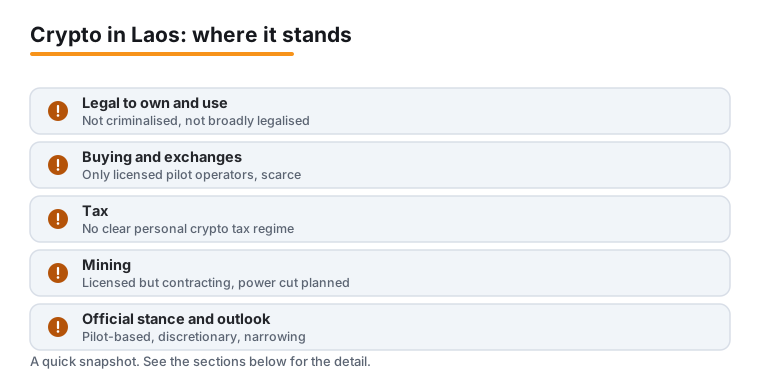
Owning and trading cryptocurrency in Laos is not criminalised, but it is also not broadly legalised or normalised. The country has no comprehensive statute governing digital assets. Instead, the sector operates under a government-authorised pilot program launched in 2021, shortly after China cracked down on crypto. Under that pilot a small group of licensed companies were permitted to mine and operate trading platforms; activity outside those approvals exists in a legal grey area.
Two points are essential:
- Cryptocurrency is not legal tender. The Lao kip is the only official currency. The Bank of the Lao PDR has stated that cryptocurrencies are not recognised as legal tender and cannot be used as an official means of payment. Merchants are not required to accept crypto.
- Holding crypto is not prohibited for individuals, but consumer protections, dispute mechanisms, and clear personal-use rules are largely absent. Many activities fall into a space the law simply does not address.
Because the framework rests on ministerial decisions and time-limited pilot authorisations rather than primary legislation, the rules can change with little notice. Treat the position as provisional and confirm it against the official sources listed at the end of this page.
Who regulates crypto in Laos
Laos has no single dedicated crypto regulator. Oversight is shared across several agencies that coordinate on the pilot:
- Bank of the Lao PDR (BOL), the central bank, which licenses and supervises cryptocurrency trading-platform businesses and handles monetary and financial-stability matters. Official site: Bank of the Lao PDR.
- Ministry of Technology and Communications (MTC), the lead coordinator for the pilot, responsible for the overarching digital-asset framework and for licensing mining operators. Official site: Ministry of Technology and Communications.
- Ministry of Finance, involved in fees and fiscal matters tied to authorised operators.
- Ministry of Energy and Mines and Electricite du Laos (EDL), central to mining, since operators must secure power-supply arrangements and energy approvals.
- Anti-Money Laundering Intelligence Office (AMLIO), the financial intelligence unit, on money-laundering and reporting matters.
This remains a ministerial-level, pilot-based regime rather than a settled body of law, so responsibilities can shift. Anyone running a crypto business should obtain current in-country legal advice and confirm which agency has authority over a given activity.
Key laws and frameworks
Laos does not regulate crypto through a single act of parliament. The relevant instruments are subordinate ministerial decisions issued for the pilot:
- Decision on Digital Asset Transactions No. 888/MTC, dated 9 November 2021, issued by the Ministry of Technology and Communications. This is the overarching framework. It establishes a multi-year trial, classifies digital assets as either cryptocurrency or digital tokens, and permits two business types under the pilot: crypto mining and crypto trading. Reporting indicates that crypto mining is reserved for Lao nationals and that a mining facility must use a minimum level of electrical power supplied by Electricite du Laos.
- Decision No. 777/BOL of 15 December 2021 on the trial operation of cryptocurrency trading platforms, which sits with the Bank of the Lao PDR and governs the licensing and operation of trading platforms.
These instruments are administrative and pilot-based, not permanent primary legislation, and details have changed over time. The exact decision numbers and current text should be confirmed with the issuing authorities, since unofficial summaries can be incomplete. The International Monetary Fund examined the regime in its 2023 Technical Assistance Report and recommended strengthening the legal and supervisory framework: see IMF Country Report No. 23/319.
Licensing and registration of exchanges (VASPs)
Laos does not have an open, fully regulated retail exchange market. Under the pilot, the Bank of the Lao PDR licenses cryptocurrency trading-platform businesses, and only authorised operators are meant to provide trading services domestically. The first licences in January 2022 went to two joint-venture companies: Lao Digital Asset Exchange (LDX), a venture involving the AIF Group and the Phongsupthavy Group, and Bitqik, linked to the Simuong Group. By late 2023 the government reported having approved around 15 companies for digital-asset business (covering mining and trading combined). Confirm the current licence status of LDX, Bitqik, or any other platform directly with the Bank of the Lao PDR, since approvals can be suspended or revoked.
The regime has been demanding and uneven in practice:
- Barriers to entry are high. Under the trading-platform decision (No. 777/BOL of 15 December 2021), a trading-platform licence carried a one-time royalty fee reported at around US$1 million payable to the Ministry of Finance, alongside technical-capability requirements such as a certified trading system, so the number of compliant platforms is limited.
- Reported ancillary charges include an application fee of around 20,000,000 kip, a licence fee of around 5,000,000 kip, and an annual operating fee set at about 0.1 percent of total revenue. The Bank of the Lao PDR is reported to decide in principle within 30 days of receiving a complete application. Treat these figures as indicative and confirm them with the central bank, as fee schedules can change.
- Authorities have moved against non-performing licensees. In late 2023 the government warned it would suspend, fine, or revoke licences of inactive operators, and reported tens of millions of dollars in outstanding fees, later offering a temporary fee reduction to encourage payment.
For ordinary residents the practical reality is that domestic licensed options are scarce, the legality of unlicensed local services is unclear, and many users rely on international exchanges or peer-to-peer arrangements that are not tailored to Lao law. Verify the current licence status of any platform with the Bank of the Lao PDR before depositing funds.
Crypto and Bitcoin tax in Laos
Laos has no tax rule written for cryptocurrency. Lao income tax works by naming an asset class and fixing a rate, usually on the sale price: shares are taxed at 2 percent of the selling price, property other than agricultural land at 2 percent, agricultural land at 1 percent, rental income at 10 percent, intellectual property royalties at 5 percent and dividends at 10 percent, while salary is taxed on a progressive scale running from 0 percent to a top rate of 25 percent. There is no separate tax on capital gains. Digital assets are not one of the named classes, so there is no default rate that automatically catches a crypto disposal, and there is no published exemption either. What can be said generally:
- Licensed pilot operators have faced fees and fiscal obligations tied to their authorisation (for example, charges associated with mining and trading-platform licensing). These apply to businesses, not ordinary holders.
- For individuals, the treatment of crypto profits, conversions to kip, and trading is not spelled out in accessible public guidance. General Lao tax principles such as income and business taxes could in principle apply depending on how authorities characterise the activity.
- Cross-border transfers and foreign-exchange rules administered by the central bank may also be relevant when converting crypto to or from kip.
Because the position is ambiguous and subject to change, do not assume crypto is tax-free in Laos and do not rely on figures from informal sources. Consult a qualified Lao tax adviser and the Ministry of Finance for your circumstances. For general background see our guide to crypto taxes. This section is informational only and not tax advice.
AML and KYC rules
Laos is a member of the Asia/Pacific Group on Money Laundering (APG), is subject to the Financial Action Task Force (FATF) standards, and has been on the FATF list of jurisdictions under increased monitoring, commonly called the grey list, since 21 February 2025. Its progress was reviewed again and it remained listed in the FATF statement of 19 June 2026, and the government's corresponding action plan runs from 2025 to 2027. Its most recent mutual evaluation, with the on-site visit in September 2022, identified significant gaps in the country's anti-money-laundering and counter-terrorist-financing framework, including weaknesses in offences, suspicious-transaction reporting, and customer-due-diligence obligations. The national financial intelligence unit is the Anti-Money Laundering Intelligence Office (AMLIO).
For users this means two things. First, formal AML and KYC supervision of crypto activity inside Laos is still developing and uneven. Second, reputable international exchanges that accept Lao users will apply their own KYC checks: expect to submit identity documents and, in some cases, proof of address and source of funds. You can read the country assessment via the FATF country page for Lao PDR. Keep clear records of your transactions in case of future compliance questions.
Buying and using crypto in practice
Given the limited domestic infrastructure, the steps below describe how residents typically approach buying crypto. They are practical guidance, not an endorsement of any method, and you should verify the legal status of each step for your situation.
- Choose a reputable platform. Favour established exchanges with strong security records and clear KYC processes, and check whether the service accepts Lao users and what funding methods it supports.
- Complete identity verification. Expect to submit ID documents to satisfy anti-money-laundering rules.
- Funding is often the hardest step. Bank transfers and card payments to crypto services can face restrictions, and converting between crypto and kip can run into banking and foreign-exchange constraints. Some users rely on peer-to-peer options, which carry counterparty risk.
- Secure your assets. For anything beyond small trading amounts, consider self-custody in a wallet you control, and use strong unique passwords and two-factor authentication.
- Using crypto to pay is not recognised. Because crypto is not legal tender, merchants are not obliged to accept it, and day-to-day payment use has no formal legal status.
Be wary of unofficial agents promising easy conversions or guaranteed profits. When in doubt, prioritise security and confirm current rules with the official sources below.
Bitcoin mining in Laos
Mining was the headline activity of the pilot. The country's large hydropower capacity, which underpins its ambition to be a regional electricity exporter, made it attractive to miners, especially after China's 2021 ban pushed operators to relocate. The government licensed a set of companies to mine, requiring MTC approval, energy-sector sign-off, and a power-supply agreement with Electricite du Laos. Under the framework, mining was reserved for Lao nationals and facilities had to meet a minimum power-usage threshold.
The trajectory since then has been one of contraction:
- Activity peaked early in the pilot and then fell sharply as energy economics and policy priorities shifted. Reporting indicates miners used roughly 150 megawatts by 2025, down about 70 percent from a 2021 to 2022 peak near 500 megawatts.
- In August 2023, Electricite du Laos reportedly stopped supplying electricity to some mining operations over mounting debts.
- In late 2025, senior officials signalled an intention to halt electricity supply to crypto miners around the first quarter of 2026, citing limited economic benefit and few jobs, and a desire to redirect power toward higher-value sectors such as AI data centres, electric vehicles, and electricity exports.
The practical takeaway for 2026 is that mining in Laos is a policy-dependent, contracting activity rather than a reliable opportunity. Anyone considering it must obtain proper licensing and a power agreement and should assume that access to electricity could be withdrawn. Confirm the current status directly with the relevant ministries before committing capital.
Recent developments (2025 to 2026)
The defining recent development is the planned end of subsidised power to crypto miners. In October and November 2025, Lao officials, including the Deputy Energy Minister, indicated that the country intends to stop supplying electricity to cryptocurrency mining around the first quarter of 2026, prioritising AI, electric vehicles, metal refining, and electricity exports. A previous attempt to cut supply was reportedly deferred because of unusually heavy rainfall that eased grid pressure. As of 3 August 2026 this remains unconfirmed in both directions. The October 2025 report quoted the deputy energy minister saying the country "might" stop supply entirely by the end of the first quarter of 2026, and no Lao government announcement or news report found in this review states that supply was actually cut off, or that the plan was dropped. Treat the electricity supply as something that can be withdrawn at short notice rather than as something that has already ended.
Alongside this, enforcement against under-performing licensees has continued since 2023, with warnings of suspension, fines, and licence revocation for inactive operators, and pressure over unpaid fees. International bodies, including the IMF, have noted that the framework for virtual assets and service providers remains unsettled. The overall direction in 2025 to 2026 is a narrowing rather than an expansion of crypto activity in Laos. Always check the latest position with the official sources below, as announcements are evolving.
Consumer risks and protection
Laos illustrates how quickly a crypto-friendly experiment can cool, and consumer protection in this area is weak. Key risks to keep in mind:
- Policy reversal. Rules rest on pilot authorisations and ministerial decisions that can change with little notice, as the planned 2026 mining power cut shows.
- Limited recourse. There is little formal protection if a platform fails, a dispute arises, or you are defrauded, especially when using foreign or peer-to-peer services.
- Conversion and liquidity friction. Moving between crypto and kip can be difficult and legally murky, which can trap value or push users toward informal channels.
- Volatility and scams. Price swings are a global feature of crypto, and fraudulent schemes target inexperienced users everywhere.
If you do hold crypto, only commit money you can afford to lose, use secure self-custody for meaningful holdings, keep records, and stay alert to scams. This section is informational only and not legal, tax, or financial advice.
Official sources and how to verify
Because the Lao framework is administrative and changes through ministerial decisions and announcements, always confirm the current position against primary official sources rather than informal summaries:
- Bank of the Lao PDR (BOL), the central bank, for trading-platform licensing, payment status, and foreign-exchange rules.
- Ministry of Technology and Communications (MTC), for the digital-asset pilot framework and mining licensing.
- IMF Country Report No. 23/319, the 2023 Technical Assistance Report on regulation and supervision of crypto assets in Lao PDR.
- FATF country page for Lao PDR, for the AML and CFT mutual-evaluation findings.
To verify a specific point: confirm whether a platform holds a current BOL licence, check the MTC for pilot conditions and mining approvals, and consult a qualified Lao lawyer or tax adviser. You can also explore our general resources on crypto regulation and the regulation hub. Remember that this page is general information as of 2026 and not legal advice; the authoritative position is whatever the Bank of the Lao PDR and the Ministry of Technology and Communications currently state.
What is true in August 2026
Nothing in Lao law changed the legal status of cryptocurrency between the last review of this page and 3 August 2026. Crypto is still not legal tender, holding it is still not a criminal offence, no act of parliament governs digital assets, and the 2021 ministerial decisions still define who may operate. Four concrete things did move, and they matter more than the absence of a statute.
- Laos is on the FATF grey list. The Financial Action Task Force added Lao PDR to its list of jurisdictions under increased monitoring on 21 February 2025, alongside Nepal. Lao PDR's progress was reviewed again and it remained listed in the FATF statement of 19 June 2026. The FATF country record for Lao PDR sets out the sequence.
- A licensed platform is trading, and it is promoting stablecoins. In December 2025 Tether and Bitqik, described as a licensed cryptocurrency exchange in Laos, announced a partnership on Bitcoin and stablecoin education, with quarterly events in Vientiane, Pakse, Vangvieng and Luang Prabang, a target of more than 10,000 people, and trading conducted primarily in USDT. Laotian Times covered the programme again on 7 January 2026. The description of Bitqik as licensed comes from the announcement itself, not from a published Bank of the Lao PDR list.
- Stablecoins now appear in Lao criminal cases. Vientiane police arrested 82 people on 12 June 2026 in Sikhottabong district over online fraud that directed victims to buy USDT and transfer between USD 100 and USD 10,000. A related crackdown followed an earlier operation in the same district on 26 May, and on 11 June police in Bokeo Province arrested 142 people in a separate scam network.
- Tax and financial intelligence data now flow between agencies. On 5 June 2026 the Anti-Money Laundering Intelligence Office, which sits under the Bank of the Lao PDR, signed a revised memorandum of understanding with the Tax Department of the Ministry of Finance covering money laundering, terrorist financing and tax evasion, citing AML law No. 64/NA and tax administration law No. 66/NA. The AMLIO website records the signing.
For macroeconomic context, the ASEAN+3 Macroeconomic Research Office reported on 17 July 2026 that it projects Lao growth of 4.6 percent in 2026 and inflation averaging 8.1 percent in 2026, easing to 7.0 percent in 2027.
The FATF grey list and the 2025 to 2027 action plan
This is the only reform programme in Lao financial regulation with a published set of commitments attached, so it is the best available answer to the question of what is coming.
Lao PDR made a high-level political commitment in February 2025 to work with the FATF and the Asia/Pacific Group on Money Laundering. The domestic action plan adopted to deliver it runs from 2025 to 2027, according to AMLIO. The nine agreed items are: enhancing understanding of money laundering and terrorist financing risks; improving risk based supervision of casinos, banks and reporting entities in special economic zones, including fit and proper checks; enhancing the quality and quantity of financial intelligence analysis and its dissemination to law enforcement; ensuring law enforcement agencies receive training and guidance on money laundering; demonstrating an increase in money laundering investigations and prosecutions, with an emphasis on crimes with a transnational element; developing a national confiscation policy; demonstrating that authorities identify, seize and confiscate proceeds and instrumentalities of crime; monitoring compliance with proliferation financing targeted financial sanctions; and addressing technical compliance deficiencies in Recommendations 6, 7 and 10.
Two points follow for anyone holding or trading crypto.
- Virtual assets are not in the action plan. Recommendation 15, the FATF standard requiring countries to license or register virtual asset service providers, does not appear among the nine items. A comprehensive Lao crypto law is therefore unlikely to arrive as a side effect of leaving the grey list, even though the mutual evaluation published in 2023 found significant gaps in exactly that area. That 2023 assessment found supervision and monitoring of the virtual asset sector had yet to commence and that Laos had not taken steps to identify and sanction unlicensed providers.
- The practical effect is banking friction, not a ban. Grey listing raises enhanced due diligence on Lao counterparties at foreign banks and payment firms. Expect more questions and slower processing when moving funds in or out, rather than any change to whether you may own crypto.
Separately from the grey list process, technical compliance with the FATF Recommendations is tracked through follow-up reports. The most recent published on the FATF site is the second enhanced expedited follow-up report by the Asia/Pacific Group, June 2025, which records 16 Recommendations rated compliant or largely compliant as at 1 June 2025 and found progress insufficient to warrant an upgrade of the rating for Recommendation 19.
The laws that do apply when there is no crypto statute
Laos has no crypto statute. Said once, that is the whole answer on primary legislation. What follows is what actually governs the space, with numbers, so a reader can look each one up.
| Instrument | Number and date | What it covers |
|---|---|---|
| Decision on Digital Asset Transactions | No. 888/MTC, 9 November 2021 | Ministry of Technology and Communications framework for the pilot. Classifies digital assets as cryptocurrency or digital tokens and permits mining and trading under licence. |
| Decision on the trial operation of cryptocurrency trading platforms | No. 777/BOL, 15 December 2021 | Bank of the Lao PDR licensing and operation rules for trading platforms. |
| Law on Anti-Money Laundering and Counter-Financing of Terrorism (Amended) | No. 64/NA, 1 July 2024 | The current AML and CFT statute. Not crypto specific and creates no VASP regime. |
| Decision on Customer Due Diligence Measures for Reporting Entities (amended) | No. 11, 29 May 2025 | The identity and due diligence checks reporting entities must apply. |
| Prime Minister's Decrees on freezing and seizing funds of listed persons | Nos. 553 and 554, both 4 September 2025 | Implement FATF Recommendation 6. Implementing guidance for Decree 553 was still in draft as at January 2026. |
| Law on Tax Administration (Amended) | No. 66/NA, 17 June 2019 | General tax administration. One of the two legal bases for the June 2026 data sharing arrangement between AMLIO and the Tax Department. |
| Instruction on value added tax for foreign digital goods, digital platforms and cross-border e-commerce | No. 0558/MoF, 14 February 2024, gazetted 26 March 2024 | Requires non-resident digital platform suppliers to register for Lao VAT and collect it from 1 August 2024. Does not name crypto. |
The AML instruments are published by the Anti-Money Laundering Intelligence Office, which operates under the Bank of the Lao PDR. Lao legislation generally can be searched in the Lao Official Gazette database, which lists the issuing agency, the signature date, the gazette publication date and whether an instrument is current. Searches of that database in August 2026 for digital asset, cryptocurrency and digital currency returned no data, so no crypto law and no draft crypto law is filed there. The only digital economy instrument it returns is Instruction No. 0558/MoF, recorded as current.
Tax: the rates Lao law actually sets, and the gap where crypto sits
Lao income tax works by naming an asset class or income type and fixing a rate, usually on the sale price rather than on the gain. Digital assets are not one of the named classes. That is the precise shape of the gap, and it cuts both ways: there is no default rate that automatically catches a crypto disposal, and there is no published exemption either.
The rates that do exist, as reviewed by PwC on 31 July 2026, are:
| Income or disposal | Rate |
|---|---|
| Sale of shares | 2 percent of the selling price |
| Sale of property other than agricultural land | 2 percent of the selling price |
| Sale of agricultural land | 1 percent of the selling price |
| Rental income | 10 percent |
| Intellectual property royalties | 5 percent |
| Dividends | 10 percent withholding |
| Interest on bank deposits and bonds | Not subject to personal income tax |
| Salary and personal income | Progressive, from 0 percent to a top rate of 25 percent |
| Enterprise profit tax | 20 percent |
| Value added tax | 10 percent |
There is no separate tax on capital gains in Lao PDR. Interest on loans from non-bank and financial institutions is taxed at 10 percent, and the progressive personal scale reaches 25 percent above 65,000,000 kip per month, or above 780,000,000 kip per year, per PwC as at 31 July 2026. For members of a multinational group whose actual rate falls below 15 percent, a minimum domestic profit tax applies.
On the business side the pilot decisions do set explicit crypto charges. Reported figures for a trading platform licence include a one-time fee of USD 1,000,000 per licence, an application fee of 20,000,000 kip, a licence fee of 5,000,000 kip, an annual operating fee of 0.1 percent of total revenue and a lump sum tax of 15 percent of the fees the platform collects from buyers and sellers, alongside registered capital of at least USD 10,000,000, Lao shareholders holding at least 51 percent and at least one manager holding Lao nationality. For mining, reported charges include a one-time royalty of USD 500,000 per licence and USD 100,000 per megawatt of contracted supply, paid to the state budget in four instalments per year, with an exemption on importation of electronic equipment used in mining. These figures come from a law firm summary published on 13 January 2025, so confirm them with the Bank of the Lao PDR and the Ministry of Finance before relying on them.
None of this tells an individual what happens when they sell crypto at a profit. There is no published Ministry of Finance guidance on that, and the honest position is that treatment would depend on how the authorities characterise the activity. What has changed is enforcement capability rather than rules: since 5 June 2026 the financial intelligence unit and the Tax Department share information under a formal memorandum of understanding, and on 24 June 2026 the Tax Department presented a national risk assessment covering tax crime and money laundering.
Frequently asked questions
Is cryptocurrency legal in Laos?
Crypto is not banned for individuals, but it is not broadly legalised either. The sector operates under a government pilot program that licenses a small number of companies to mine and trade. Cryptocurrency is not legal tender, and most activity outside the licensed pilot sits in a legal grey area. Verify the current position with the Bank of the Lao PDR and the Ministry of Technology and Communications.
Who regulates crypto in Laos?
There is no single agency. Oversight is shared: the Bank of the Lao PDR licenses and supervises trading platforms, the Ministry of Technology and Communications leads the pilot and licenses mining, the Ministry of Finance handles fiscal matters, and the Ministry of Energy and Mines with Electricite du Laos governs mining power. The Anti-Money Laundering Intelligence Office covers money-laundering reporting. The framework remains pilot-based rather than settled law.
What law governs crypto in Laos?
There is no single crypto statute. The main instrument is the Ministry of Technology and Communications Decision on Digital Asset Transactions No. 888/MTC of 9 November 2021, which set up a multi-year pilot for crypto mining and trading. A narrower decision (reported as No. 777) on trading platforms sits with the Bank of the Lao PDR. These are administrative, pilot-based measures, so confirm the current text and numbers with the issuing authorities.
Is Bitcoin mining still allowed in Laos?
Mining was licensed under the pilot using the country's hydropower, but the industry has contracted sharply. In late 2025, officials signalled plans to halt electricity supply to crypto miners around the first quarter of 2026, redirecting power to sectors seen as higher value such as AI and electric vehicles. Treat mining as a policy-dependent, shrinking activity and confirm current rules with the relevant ministries before investing.
Do I have to pay tax on crypto in Laos?
There is no clear, published personal crypto tax regime, and we do not state specific rates because reliable figures are not established. Do not assume crypto is tax-free; general income or business tax principles could apply depending on how authorities view your activity. Consult a qualified Lao tax adviser and the Ministry of Finance. This is general information, not tax advice.
How do I verify the current rules?
Check primary official sources rather than informal summaries: the Bank of the Lao PDR (bol.gov.la) for licensing and payment status, the Ministry of Technology and Communications (mtc.gov.la) for the pilot framework and mining, the IMF 2023 Technical Assistance Report (Country Report No. 23/319), and the FATF country page for Lao PDR for AML findings. For anything specific to your situation, consult a qualified Lao lawyer or tax adviser.
Which crypto exchanges are licensed in Laos?
Under the pilot, the Bank of the Lao PDR licensed trading platforms rather than opening the market to any exchange. The first two licences, issued in January 2022, went to Lao Digital Asset Exchange (LDX), a joint venture involving the AIF Group and the Phongsupthavy Group, and Bitqik, linked to the Simuong Group. By late 2023 around 15 companies had been approved across mining and trading combined. Approvals can be suspended or revoked, so confirm the current status of any platform with the Bank of the Lao PDR before depositing funds.
How much does a crypto trading-platform licence cost in Laos?
Reported figures are high and aimed at businesses, not individuals. The trading-platform decision required a one-time royalty of around US$1 million to the Ministry of Finance, plus technical-system requirements. Ancillary charges reported include an application fee of about 20,000,000 kip, a licence fee of about 5,000,000 kip, and an annual operating fee of roughly 0.1 percent of total revenue. Treat these as indicative and confirm current fees with the Bank of the Lao PDR, since schedules can change.
Will crypto mining stop in Laos in 2026?
In October 2025, the Deputy Energy Minister said the country might stop supplying electricity to crypto miners entirely by around the end of the first quarter of 2026, redirecting power to sectors such as AI data centres, metals refining, and electric vehicles. Miners were using about 150 megawatts, down roughly 70 percent from a 2021 to 2022 peak near 500 megawatts. An earlier cut was deferred after heavy rainfall boosted hydropower. As of mid-2026 this is framed as a plan, so check whether it has actually taken effect.
Is Laos on the FATF grey list?
Yes. The Financial Action Task Force added Lao PDR to its list of jurisdictions under increased monitoring on 21 February 2025, alongside Nepal. Its progress was reviewed again and it remained listed in the FATF statement of 19 June 2026, which says Lao PDR should continue implementing its action plan. The nine agreed items cover risk understanding, supervision of casinos, banks and reporting entities in special economic zones, financial intelligence analysis, law enforcement training, more money laundering investigations and prosecutions, a national confiscation policy, seizure of criminal proceeds, proliferation financing sanctions, and technical gaps in Recommendations 6, 7 and 10. The government's corresponding action plan runs from 2025 to 2027. FATF has not published an exit date. In practice the main effect for individuals is more scrutiny from foreign banks and payment firms on transfers involving Laos.
Is a crypto law coming in Laos, and when?
There is no published draft. Searches of the Lao Official Gazette database in August 2026 for digital asset, cryptocurrency and digital currency returned no data, and reporting on the National Assembly session of July 2026 described an agenda of railway expansion, education reform, poverty reduction, roads and water supply, with no digital asset legislation. The one reform programme with published commitments is the FATF action plan, and it does not include Recommendation 15, the standard that requires licensing or registration of virtual asset service providers. So a comprehensive crypto law is not scheduled and is unlikely to arrive as a by-product of leaving the grey list. The 2021 pilot decisions remain the framework.
What tax would I pay if I sell crypto in Laos?
There is no rate written for cryptocurrency. Lao income tax names specific asset classes and applies a fixed rate, generally to the sale price: 2 percent on share sales, 2 percent on property other than agricultural land, 1 percent on agricultural land, 10 percent on rental income, 5 percent on intellectual property royalties and 10 percent on dividends, with salary taxed progressively up to 25 percent and enterprise profit tax at 20 percent. There is no separate capital gains tax. Digital assets are not on that list, so nothing automatically applies and nothing is expressly exempt. Do not treat that silence as a zero rate. Since 5 June 2026 the Anti-Money Laundering Intelligence Office and the Tax Department have shared information under a formal memorandum of understanding, so the enforcement side has strengthened even though the rules have not changed. Consult a qualified Lao tax adviser.
Can I use USDT or other stablecoins in Laos?
Stablecoins are visible in Laos but they have no special legal status. In December 2025 Tether and Bitqik, described in the announcement as a licensed cryptocurrency exchange, launched an education programme across Vientiane, Pakse, Vangvieng and Luang Prabang, with Bitqik saying users trade and convert between crypto and fiat primarily using USDT. That description of Bitqik as licensed comes from the announcement itself, not from a published Bank of the Lao PDR list, and nothing in it indicates approval of the token by the central bank. Stablecoins are not legal tender, so merchants are not obliged to accept them. Note the other side of the same trend: on 12 June 2026 Vientiane police arrested 82 people over online scams that pushed victims to buy USDT and send between USD 100 and USD 10,000. Treat unsolicited approaches involving USDT transfers as a fraud signal.
Which Lao laws should I actually look up?
Seven instruments matter. Decision on Digital Asset Transactions No. 888/MTC of 9 November 2021 and Decision No. 777/BOL of 15 December 2021 set up the pilot for mining and trading. Law on Anti-Money Laundering and Counter-Financing of Terrorism (Amended) No. 64/NA of 1 July 2024 is the current AML statute, with the amended Customer Due Diligence Decision No. 11 of 29 May 2025 underneath it, and Prime Minister's Decrees Nos. 553 and 554 of 4 September 2025 on freezing funds of listed persons. Law on Tax Administration (Amended) No. 66/NA of 17 June 2019 governs tax administration. Ministry of Finance Instruction No. 0558/MoF of 14 February 2024 requires foreign digital platform suppliers to register for Lao VAT and collect it from 1 August 2024, though it does not name crypto. None of these creates a licensing regime for virtual asset service providers.
Facts reviewed: 3 August 2026. Page updated: 3 August 2026.