Home › Crypto Regulation › China
Bitcoin & Cryptocurrency Regulation in China
Quick answer — China, 2026
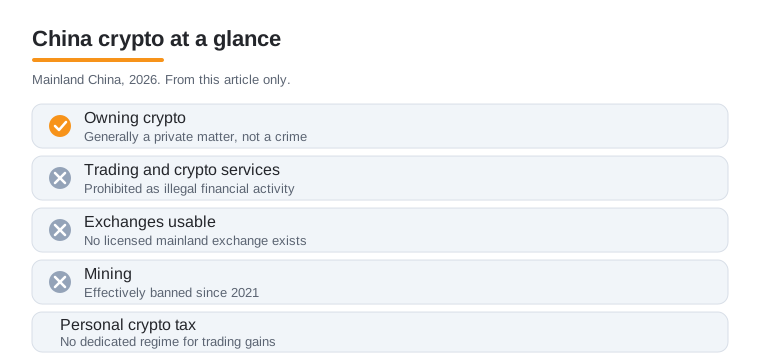
- In mainland China, trading crypto and offering crypto services are banned; Bitcoin is not legal tender. Merely owning it has been treated as a private matter.
- There is no clear personal tax regime, because the trading itself is prohibited.
- No licensed mainland exchange exists, so residents have no lawful way to buy with yuan. Hong Kong follows separate rules.
China operates one of the strictest cryptocurrency regimes in the world. In mainland China, Bitcoin and other private cryptocurrencies are not legal tender and cannot be lawfully traded. The businesses that once supported them, including exchanges, brokers, payment processors, and mining farms, have been driven out or pushed underground. The only digital money the state promotes is its own central bank digital currency (CBDC), the digital yuan (e-CNY). Policy is led by the People's Bank of China (PBOC) acting alongside a cluster of financial, securities, market, internet, and public-security regulators.
This guide explains how digital assets are treated in 2026: whether crypto is legal, who regulates it, the key official notices, the rules on exchanges and licensing, tax and AML/KYC exposure, mining, recent 2025 to 2026 developments such as the new ban on yuan-linked stablecoins and the framework for real-world-asset (RWA) tokenization, consumer risks, and how to verify everything against official sources. One distinction runs throughout: mainland China and the Hong Kong Special Administrative Region follow very different rules, and this page focuses on the mainland unless stated otherwise. This is general information as of 2026 and is NOT legal, tax, or financial advice; rules change and enforcement is active, so verify the current position with the People's Bank of China and other named regulators or with qualified local counsel. See also our overview of crypto regulation and the country regulation hub.
On this page: Legal status · Who regulates it · Taxes · How to buy · Mining
Is Bitcoin and crypto legal in China?
In mainland China, Bitcoin and other cryptocurrencies are not legal tender, and trading them or providing crypto services is prohibited. A series of official measures, most prominently a 2017 ban on initial coin offerings and domestic exchanges, a sweeping multi-agency notice in September 2021, and an updated notice in February 2026, classify virtually all crypto-related business activity as illegal financial activity.
One nuance is often misunderstood. Simply owning Bitcoin has generally been treated as a private matter rather than a crime, and some Chinese court rulings have recognised crypto as a form of virtual property. In an opinion published in November 2024 on the Shanghai High People's Court's official WeChat account, a district-court judge stated that individuals holding, buying, or selling cryptocurrency is not itself illegal and that digital assets have property attributes under Chinese law, while confirming that crypto-related business activity such as token issuance and trading remains prohibited. But the activities that make crypto usable, including buying and selling, converting to or from yuan, running a platform, matching trades, or settling them, are off-limits. Equally important, the legal system offers little protection: because contracts tied to prohibited crypto activity can be treated as void, courts will often decline to help if you are scammed or a counterparty disappears. In practice there is no lawful, regulated way to trade crypto inside the mainland.
Hong Kong is different. As a separate jurisdiction it has built a licensing regime for virtual-asset trading platforms and a framework for regulated stablecoin issuers. Those rules are evolving and do not extend automatically to the mainland.
Who regulates crypto in China
China's approach is a coordinated, multi-agency prohibition rather than a single licensing regulator. The central bank, the People's Bank of China (PBOC), leads policy and directs banks and payment firms to block crypto-related transactions. Its official website is pbc.gov.cn.
The key official notices have been issued jointly by a wide group of authorities, which gives a clear map of who enforces what:
- People's Bank of China (PBOC) - central bank and lead policymaker.
- China Securities Regulatory Commission (CSRC) - securities, token-issuance, and RWA oversight.
- State Administration of Foreign Exchange (SAFE), at safe.gov.cn - cross-border flows and capital controls.
- Ministry of Public Security and the Supreme People's Court and Supreme People's Procuratorate - criminal enforcement.
- Cyberspace Administration of China and the Ministry of Industry and Information Technology - websites, apps, and marketing.
- State Administration for Market Regulation and the banking and insurance supervisors - business registration and financial-institution conduct.
Because enforcement is deliberately shared across these bodies, there is no single crypto-licensing authority on the mainland to apply to.
Key laws and frameworks
China has no single dedicated crypto statute. Instead, the regime is built from administrative notices and circulars enforced across agencies, layered on top of existing banking, securities, anti-money-laundering, and foreign-exchange law.
The September 2021 notice
On 15 September 2021 the PBOC and nine other departments jointly issued the Notice on Further Preventing and Resolving the Risks of Virtual Currency Trading and Speculation. It confirmed that virtual currencies are not legal tender, declared crypto-related business activities (fiat-to-crypto and crypto-to-crypto exchange, acting as a counterparty, matching and pricing, token issuance, and derivatives) to be illegal financial activity, and for the first time stated clearly that overseas exchanges serving Chinese residents over the internet are also illegal. You can read the official English text on the People's Bank of China website.
The February 2026 notice
On 6 February 2026 the PBOC, together with seven other regulators, issued an updated notice (reported as the Notice on Further Preventing and Dealing with Cryptocurrencies and Related Risks, referred to in coverage as Notice No. 42 [2026]) that took immediate effect. It reaffirmed the ban and extended it explicitly to the issuance of yuan-linked (RMB) stablecoins, whether inside or outside China, while introducing a separate, approval-based pathway for real-world-asset (RWA) tokenization. These are administrative notices whose exact wording and scope matter, so confirm the current text against official PBOC publications. Informational only, not legal advice.
Licensing and registration of exchanges (VASPs)
There is no licence to obtain. Mainland China does not operate a registration or licensing regime for crypto exchanges or virtual-asset service providers, because the underlying activity is banned rather than authorised. The major global platforms that once operated in China withdrew or relocated after 2017 and 2021, and domestic banks and payment apps are instructed to block crypto-related transfers.
The September 2021 notice, Yinfa [2021] No. 237, barred market regulators from registering companies whose names or business scopes reference virtual currency, and prohibited internet firms from offering marketing, advertising, payment, or settlement support, including for offshore platforms that target Chinese residents. That notice was expressly repealed on 6 February 2026 by Yinfa [2026] No. 42, which is now the operative instrument and keeps the State Administration for Market Regulation among its eight issuing agencies. The practical result is that any service claiming to be a licensed or regulated mainland crypto exchange should be treated with strong scepticism.
By contrast, Hong Kong runs a separate, genuine licensing regime for virtual-asset trading platforms under its own law. Those rules are distinct from the mainland and should not be assumed to cover mainland residents; verify eligibility directly with licensed Hong Kong providers and regulators.
Crypto taxation in China
China does not publish a clear, dedicated personal tax regime for cryptocurrency trading the way some countries do, largely because the underlying trading activity is itself prohibited. There is no consumer-facing framework for individuals to declare ordinary crypto trading gains in the mainland, and you should not assume any specific rate, allowance, or threshold applies.
That absence does not make activity risk-free. Crypto can still intersect with tax and legal exposure, for example where gains are linked to a business, where funds move in ways that draw scrutiny under anti-money-laundering or capital-control rules, or where authorities pursue the proceeds of prohibited activity. There is still no unified judicial interpretation for virtual-currency disputes. On 27 May 2026 Liu Guixiang of the Supreme People's Court judicial committee said the court would research adjudication rules for virtual-currency and cross-border finance cases, but no draft text and no deadline have been published, so outcomes remain fact-specific.
Do not rely on tax figures you read online. Anyone with a real exposure in China should consult a qualified local tax professional or lawyer and confirm the current rules directly with the relevant authorities. For general background see our guide to crypto taxes. Informational only, not tax advice.
AML, KYC, and capital controls
Anti-money-laundering (AML) and foreign-exchange rules are central to how China enforces its crypto ban in practice. Financial institutions and payment companies are barred from opening accounts, transferring funds, settling, or otherwise servicing crypto transactions, and they are expected to monitor for and report suspicious activity. Banks apply standard know-your-customer (KYC) checks, and patterns consistent with crypto trading, such as unusual peer-to-peer transfers, can trigger scrutiny.
Two enforcement themes stand out. First, capital controls: the State Administration of Foreign Exchange (SAFE) monitors cross-border flows and treats the use of crypto to move money out of China as a foreign-exchange and AML concern; see safe.gov.cn. Second, frozen funds: bank accounts linked to crypto-related or over-the-counter (OTC) transfers, including funds later found to be tainted, have been frozen, and the 2026 notice specifically targets yuan-linked stablecoins partly on AML and capital-flight grounds. The realistic takeaway is that converting crypto to or from yuan exposes individuals to account freezes, administrative penalties, and, in serious cases, criminal liability.
Buying and using crypto in practice
There is no licensed, mainland-based exchange where residents can legally buy Bitcoin with yuan, and this section explains the landscape rather than a way around the rules. Domestic exchanges are banned, banks block crypto-related transfers, and OTC or peer-to-peer settlement is an active enforcement focus.
People sometimes attempt access through offshore exchanges, OTC dealers, or peer-to-peer arrangements. These routes carry real risks:
- Legal exposure: facilitating or settling trades can fall foul of the ban, and peer-to-peer fiat settlement has been a specific enforcement target.
- Frozen funds: accounts linked to crypto-related or tainted OTC transfers have been frozen.
- Fraud and counterparty risk: grey-market channels offer little recourse if you are scammed or a platform collapses.
- Capital controls: moving money to fund crypto can collide with strict foreign-exchange limits.
Note that the digital yuan (e-CNY) is not a substitute. It is a state-issued CBDC, not a decentralised cryptocurrency, and holding it is not the same as owning Bitcoin. For broader context on the rules, see our crypto regulation guide.
Bitcoin mining in China
China was once home to the majority of global Bitcoin mining, but in 2021 authorities moved to shut the industry down, citing financial-risk and energy concerns. Mining was effectively banned, large farms were closed, and operators relocated abroad, which briefly cut the global hashrate by roughly half and redistributed it to other countries.
The picture since has been more complicated. Despite the ban remaining officially in force, underground mining has persisted and, according to reporting in late 2025, China's share of global Bitcoin hashrate had rebounded to a meaningful level (estimates put it in roughly the 14 to 20 percent range, making it again around the world's third-largest mining hub), concentrated in power-rich regions such as Xinjiang and Sichuan. This activity operates outside the law. Beijing has shown no public sign of reversing the prohibition, and anyone considering mining inside the mainland should understand it remains illegal and exposed to enforcement, equipment seizure, and power cut-offs. The rebound reflects weak enforcement in places, not legalisation.
Recent developments (2025 to 2026)
Regulators have continued to close gaps rather than relax. The headline change is the 6 February 2026 notice, in which the PBOC and seven other regulators reaffirmed that crypto-related business activity is illegal and, for the first time, explicitly banned the issuance of yuan-linked (RMB) stablecoins anywhere in the world without approval, while extending scrutiny to offshore platforms serving residents and to peer-to-peer and OTC settlement.
The same framework treats real-world-asset (RWA) tokenization as a distinct category, opening an approval-based, infrastructure-controlled pathway overseen by bodies such as the CSRC and SAFE under a same-business, same-risk, same-rules principle, while keeping decentralised crypto prohibited. Senior officials, including PBOC governor Pan Gongsheng, have publicly stressed strict, total control over private crypto business. Meanwhile the state has pushed its CBDC hard: reported figures put e-CNY at about 3.48 billion transactions worth roughly 16.7 trillion yuan by the end of November 2025, and a new e-CNY management framework took effect on 1 January 2026 that shifts the e-CNY from digital cash toward an interest-bearing, deposit-style model held through commercial banks, as covered on China's government portal at english.www.gov.cn. Because these are fast-moving notices, verify the latest position against official sources.
Consumer risks and protection
The dominant risk for crypto users connected to mainland China is legal and financial exposure: prohibited activity, blocked or frozen funds, void contracts, and limited recourse through the courts. On top of that sit the universal risks: crypto prices are highly volatile, the market is still maturing, and individual projects can fail.
Scams to watch for
Restrictions and grey markets are fertile ground for fraud. Watch for fake or cloned trading platforms, OTC counterparties who vanish with funds, guaranteed-return schemes and Ponzi structures, phishing that targets wallet credentials or recovery phrases, and pig-butchering romance-investment scams. Never share a wallet seed phrase, treat unsolicited opportunities with suspicion, and remember that the lack of legal protection in this environment makes recovery after a scam especially hard. Because there is no mainland regulator that licenses crypto firms, there is also no official compensation or redress scheme to fall back on. This is not financial advice.
Official sources and how to verify
Crypto rules in China are set out in administrative notices that can be updated quickly, so always confirm the current position against primary official sources rather than informal guides. The most authoritative references are:
- People's Bank of China (PBOC), the lead regulator and publisher of the key notices: pbc.gov.cn. The official English text of the 2021 notice is available here.
- State Administration of Foreign Exchange (SAFE), for cross-border and capital-control matters: safe.gov.cn.
- The State Council and government portal, for policy announcements including the e-CNY: english.www.gov.cn.
This page is general information as of 2026 and is NOT legal, tax, or financial advice. Crypto rules are evolving and enforcement is active, so verify the current requirements directly with the People's Bank of China and the other named regulators, or consult qualified local counsel, before acting. For more, see our regulation hub.
What is changing: China's crypto-relevant legislation as of August 2026
Two bills touching digital money received first readings at the 23rd session of the 14th National People's Congress Standing Committee on 23 June 2026, days before this page was last reviewed. Neither legalises cryptocurrency. Both do the opposite of what a hopeful reader might assume: they give the digital renminbi explicit statutory status. Both were released for public comment on 26 June 2026, alongside six other bills, with a deadline of 25 July 2026. That deadline has passed, so as of early August 2026 they sit between first and second reading.
| Instrument | Stage | What it would do | Timing |
|---|---|---|---|
| Law on the People's Bank of China (draft revision) | First reading 23 June 2026; public comment closed 25 July 2026 | Eight chapters, 54 articles, reported as the first major update in 23 years. Clarifies the legal status of the digital renminbi and improves the macroprudential framework. Chinese financial media reporting on the draft states it carries forward a ban on privately manufacturing and selling token coupons and digital tokens, with confiscation of illegal gains and fines of up to five times the illegal amount. | Awaiting second reading. The Standing Committee's next regularly scheduled session is in late August 2026. No adoption date announced. |
| Finance Law (draft), also rendered Financial Law | First reading 23 June 2026; earlier consultation 20 March to 19 April 2026 | Eleven chapters, 95 articles. China's first fundamental and overarching financial statute. Outside analysis of the consultation draft reports that Article 12 recognises the legal status of the digital renminbi and Article 92 applies an effects-based extraterritoriality test. No reported provision creates a pathway for crypto or stablecoins. | Awaiting second reading. No adoption date announced. |
| Supreme People's Court rules for virtual-currency cases | Research announced only, 27 May 2026 | Would give courts unified adjudication rules for virtual-currency and cross-border finance disputes. | No draft, no consultation, no deadline published. |
Read together, the pipeline points one way. The mainland is not drafting a licensing regime, a crypto tax code, or a stablecoin framework. It is raising the digital renminbi to statute level. For holders, nothing in these bills changes the practical position. For exchanges and token issuers outside China, the provision worth watching is the draft Finance Law's extraterritoriality article, which grounds jurisdiction in effects on China's financial system rather than physical presence. Sources: Xinhua on the central bank bill, Xinhua on the draft financial law, the CSRC consultation notice, WilmerHale on Articles 12 and 92, Sina Finance on the token provision and penalty, NPC Observer on the comment period, and the Supreme People's Court statement.
The named rules that actually apply
There is no crypto-specific statute in mainland China. Here is what does apply, by name and document number.
- Yinfa [2026] No. 42 (银发〔2026〕42号), issued and effective 6 February 2026, organised in six numbered parts. The Chinese title is 关于进一步防范和处置虚拟货币等相关风险的通知. It was issued jointly by the eight bodies named in its title: the People's Bank of China, the National Development and Reform Commission, the Ministry of Industry and Information Technology, the Ministry of Public Security, the State Administration for Market Regulation, the National Financial Regulatory Administration, the China Securities Regulatory Commission and the State Administration of Foreign Exchange. It provides that without approval from the relevant departments, no unit or individual inside or outside China may issue RMB-pegged stablecoins outside China. It treats real-world-asset tokenization conducted on the mainland as suspected illegal financial activity that should be prohibited. It directs continued control and rectification of virtual currency mining. It provides that overseas units and individuals may not unlawfully provide virtual-currency related services to mainland subjects in any form. It also expressly repeals the September 2021 notice, Yinfa [2021] No. 237. Full text on the PBOC website.
- The approval route for overseas tokenization. Before conducting overseas real-world-asset tokenization backed by domestic assets, issuers must file documents with the China Securities Regulatory Commission to obtain approval. The filing documents include a filing report, a legal opinion and a complete set of issuance documents, and Chinese entities must comply with laws on outbound investment, foreign exchange administration, cybersecurity and data security. This is a corporate route with regulator sign-off, not a retail one. Charltons analysis.
- The Anti-Money Laundering Law (2024 revision), adopted 8 November 2024 and in force since 1 January 2025, seven chapters and 65 articles. This is the general statute requiring customer due diligence, record keeping and suspicious transaction reporting by financial institutions. It is not a crypto measure and does not name virtual currency, but it is the named legal basis for the bank-level checks this page already describes. China Justice Observer.
- The e-CNY management framework, effective 1 January 2026. Digital yuan held in commercial bank wallets is classified as a bank deposit liability, commercial banks must pay interest on wallet balances in line with prevailing deposit rate regulations, balances are protected by deposit insurance like ordinary deposits, and non-bank payment institutions must deposit 100 percent reserves against the digital yuan they manage. State Council announcement.
Tax: the 20 percent default, and what July 2026 changed
China publishes no crypto-specific tax rule for individuals, because the underlying activity is prohibited rather than licensed. That does not mean gains sit outside the tax code. The default category exists in primary law.
Article 3 of the Individual Income Tax Law of the People's Republic of China sets a flat rate: "For income from interest, dividends or bonuses, income from leasing of assets, income from transfer of assets, and incidental income, a flat tax rate of 20 percent shall apply." A disposal of crypto at a gain falls naturally into income from transfer of assets, and there is no published exemption for it. See the official English text on the State Taxation Administration's Guangdong portal. Note that no source states this rate has been applied to individual crypto gains, so treat it as the default category rather than a published crypto rule.
On 24 July 2026 the Ministry of Finance and the State Taxation Administration issued announcements applying that same 20 percent treatment to Chinese residents who move assets into offshore trusts, categorising the gain as income from transfer of property, with a three-month window for voluntary disclosure during which late-payment penalties are waived. Trusts operating longer than three years are not pursued retroactively for establishment-stage liabilities. This is not a crypto measure, but it is the clearest recent signal that the tax authority will reach offshore holdings using the existing 20 percent category. Xinhua report.
Separately, Hong Kong is legislating for automatic exchange of crypto account information. The Inland Revenue (Amendment) (Crypto-Asset Reporting Framework and Amended Common Reporting Standard) Bill 2026 was gazetted on 22 May 2026 and had its first reading in the Legislative Council on 3 June 2026. Subject to passage, crypto-asset service providers must register and report from 1 January 2027, amended Common Reporting Standard obligations start from 1 January 2028, and Hong Kong's first automatic exchange is due in 2028. Inland Revenue Department.
Frequently asked questions
Is Bitcoin legal in China?
In mainland China, trading Bitcoin and providing crypto services are prohibited, and crypto is not legal tender; only the renminbi, including the digital yuan, is. Merely owning Bitcoin has generally been treated as a private matter, and some courts have recognised it as virtual property, but there is no lawful, regulated way to trade it on the mainland, and contracts tied to prohibited crypto activity may be unenforceable. Hong Kong is a separate jurisdiction with its own licensing rules. Verify the current position with the People's Bank of China.
Who regulates cryptocurrency in China?
The People's Bank of China (PBOC), the central bank, leads policy and directs banks and payment firms to block crypto-related transactions (pbc.gov.cn). Enforcement is multi-agency, involving the securities regulator (CSRC), the foreign-exchange regulator (SAFE), public-security and judicial authorities, internet and market regulators, and others. There is no single crypto-licensing regulator on the mainland because the activity is banned rather than licensed.
Do crypto exchanges need a licence in China?
No. Mainland China has no licensing or registration regime for crypto exchanges or virtual-asset service providers, because running such a platform is itself prohibited. Domestic exchanges and token issuance are banned, and regulators will not register companies referencing virtual currency in their name or business scope. Hong Kong, by contrast, operates a separate licensing regime under its own law that does not automatically cover mainland residents.
What changed in China's 2026 crypto rules?
On 6 February 2026 the PBOC and seven other regulators issued Yinfa [2026] No. 42 (银发〔2026〕42号), whose Chinese title translates as the Notice on Further Preventing and Handling Risks Related to Virtual Currency and Similar Matters, effective the day it was issued. It reaffirmed the ban and, for the first time, provided that without approval from the relevant departments, no unit or individual inside or outside China may issue yuan-pegged (RMB) stablecoins outside China. It also created a distinct, approval-based pathway for real-world-asset (RWA) tokenization through designated infrastructure, while keeping decentralised crypto prohibited. The full text runs to six numbered parts and is published on the PBOC website as Yinfa [2026] No. 42, which also expressly repealed the September 2021 notice, Yinfa [2021] No. 237.
Can I mine Bitcoin in China?
No. Bitcoin mining was effectively banned in 2021 on financial-risk and energy grounds. Underground mining has nonetheless persisted and reportedly rebounded in 2025 to a meaningful share of global hashrate, concentrated in power-rich regions, but it operates outside the law. Yinfa [2026] No. 42 directs the National Development and Reform Commission and related departments to strictly control virtual currency mining and to continue rectification work, and enforcement includes equipment seizure and power cut-offs. It is not sanctioned or safe to rely on.
What is the digital yuan (e-CNY), and is it a cryptocurrency?
The e-CNY is China's central bank digital currency, a state-issued digital form of the renminbi, not a decentralised cryptocurrency like Bitcoin. The government actively promotes it as the sanctioned form of digital money, and a new e-CNY management framework that took effect on 1 January 2026 moves it toward an interest-bearing, deposit-style model held through commercial banks. This contrasts with its prohibition of private crypto and, since the February 2026 notice, yuan-linked stablecoins on the mainland.
Is it illegal to own Bitcoin in China?
Merely holding Bitcoin as an individual has generally not been treated as illegal on the mainland. In an opinion published in November 2024 on the Shanghai High People's Court's WeChat account, a district-court judge stated that individuals holding, buying, or selling cryptocurrency is not itself unlawful and that digital assets carry property attributes under Chinese law. What remains prohibited is crypto-related business activity, including running an exchange, token issuance, and trading services, and contracts tied to prohibited activity may be unenforceable. This is general information, not legal advice.
Are stablecoins allowed in China?
No. The 6 February 2026 notice explicitly banned the unapproved issuance of yuan-linked (RMB) stablecoins, whether issued inside China or by offshore firms serving Chinese users, on capital-control and monetary-sovereignty grounds. Other crypto business activity remains banned as well. The only digital form of the yuan the state sanctions is the e-CNY, its central bank digital currency. Confirm the current position on the official PBOC website.
Is a crypto law going through China's legislature right now?
No bill would legalise cryptocurrency. Two related bills received first readings at the National People's Congress Standing Committee on 23 June 2026: the Law on the People's Bank of China (draft revision), eight chapters and 54 articles, and the draft Finance Law, eleven chapters and 95 articles. Both give the digital renminbi explicit legal status. Chinese financial media reporting on the central bank draft says it carries forward a ban on privately manufacturing and selling token coupons and digital tokens, with confiscation of illegal gains and fines of up to five times the illegal amount, though that penalty detail comes from reporting rather than from published draft text. Public comment on both closed on 25 July 2026 and they now await a second reading. The Standing Committee's next regularly scheduled session is in late August 2026. No adoption date has been announced.
How much tax would I pay on crypto gains in China?
There is no crypto-specific tax rule, because the activity is banned rather than licensed. The default in primary law is Article 3 of the Individual Income Tax Law, which applies a flat 20 percent rate to income from transfer of assets, alongside interest, dividends and bonuses, leasing income and incidental income. A crypto disposal at a gain falls naturally into that category and no published exemption covers it, but no official source states that the rate has been applied to individual crypto gains. In July 2026 the Ministry of Finance and State Taxation Administration applied the same 20 percent treatment to Chinese residents transferring assets into offshore trusts, which shows the authority is willing to use that category for offshore holdings. This is general information, not tax advice.
Can a Chinese company tokenize real-world assets or issue tokens overseas?
Only through a narrow approval route. Yinfa [2026] No. 42 treats real-world-asset tokenization conducted in mainland China as suspected illegal financial activity that should be prohibited, subject to an approved route through designated financial infrastructure. Before conducting overseas tokenization backed by domestic assets, issuers must file with the China Securities Regulatory Commission to obtain approval, submitting a filing report, a legal opinion and a complete set of issuance documents, and must comply with outbound investment, foreign exchange, cybersecurity and data security law. This is a corporate pathway with regulator sign-off, not a route available to individuals.
Will Hong Kong crypto accounts be reported to tax authorities?
Hong Kong is legislating for it. The Inland Revenue (Amendment) (Crypto-Asset Reporting Framework and Amended Common Reporting Standard) Bill 2026 was gazetted on 22 May 2026 and had its first reading in the Legislative Council on 3 June 2026. Subject to passage, crypto-asset service providers meeting the Hong Kong nexus criteria must register with the Inland Revenue Department and report on reportable users from 1 January 2027, with amended Common Reporting Standard obligations from 1 January 2028 and Hong Kong's first automatic exchange of crypto-asset information due in 2028.
Facts reviewed: 5 August 2026. Page updated: 5 August 2026.
Related guides
More countries in the region
Practical guides