Home › Crypto Regulation › Hong Kong
Bitcoin and Cryptocurrency Regulation in Hong Kong
Quick answer — Hong Kong, 2026
- Legal: Legal to own and trade, not legal tender; service providers must be licensed
- Tax: No capital gains tax; business or trading profits and crypto salary taxed
- Buying: Via SFC-licensed virtual-asset trading platforms with mandatory KYC
Hong Kong has positioned itself as one of Asia's leading regulated cryptocurrency hubs. It has not banned crypto, and it has not left it unregulated either. Instead the city built a licensing-led framework that lets serious businesses operate under supervision while pushing hard on investor protection and anti-money-laundering controls. Bitcoin and other virtual assets are legal to own and trade, service providers must be licensed, and the rules tightened sharply through 2023, 2024 and 2025, with more changes signalled for 2026. This guide explains the current state of crypto regulation in Hong Kong: the legal status, who regulates the sector, the key laws, licensing of exchanges and stablecoin issuers, taxation, AML and KYC, buying and using crypto in practice, Bitcoin ATMs, mining, recent developments, consumer risks, and how to verify everything against official sources. For wider context see our overview of crypto regulation and the country pages on the regulation hub.
This article is general information current as of 2026 and is not legal, tax or financial advice. Rules change frequently and outcomes depend on your circumstances. Always verify the current position with the Securities and Futures Commission (SFC) and the Hong Kong Monetary Authority (HKMA), or a qualified professional, before acting.
On this page: Legal status · Who regulates it · Taxes · How to buy · Mining
Legal status of Bitcoin and crypto in Hong Kong
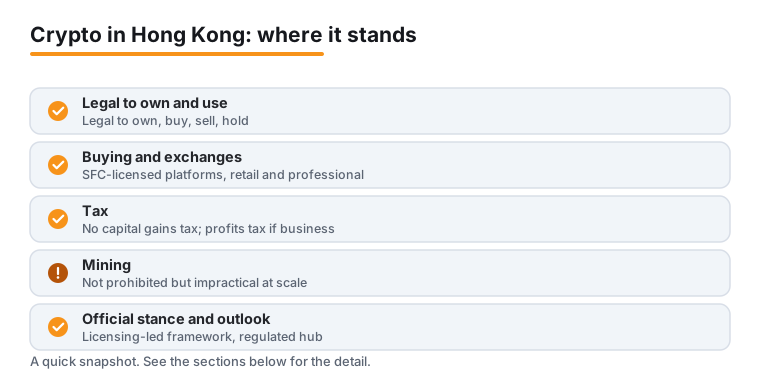
Yes, Bitcoin and other virtual assets are legal to own, buy, sell and hold in Hong Kong. The Special Administrative Region chose regulation over prohibition. In October 2022 the Financial Services and the Treasury Bureau (FSTB) issued a Policy Statement on the Development of Virtual Assets in Hong Kong, setting out an ambition to build a responsible and sustainable virtual-asset sector rather than to shut it down.
What is controlled is the business of providing crypto services. Any platform offering virtual-asset trading to people in Hong Kong, or actively marketing such services to the Hong Kong public, must be licensed and supervised. Operating an unlicensed virtual-asset business is an offence, and the regulators repeatedly warn the public against using unlicensed venues.
Crypto is not legal tender in Hong Kong. Only banknotes and coins issued under Hong Kong law are. The authorities, including the Investor and Financial Education Council, have consistently stated that cryptocurrencies are not legal tender and cannot be treated as money that anyone is obliged to accept. Virtual assets are instead treated as a form of property or commodity, subject to the regimes described below.
Who regulates crypto: the SFC and the HKMA
Hong Kong uses a dual-regulator model for virtual assets.
The Securities and Futures Commission (SFC) is the markets regulator. It licenses and supervises virtual-asset trading platforms (VATPs), approves virtual-asset funds and exchange-traded products, issues the binding rules and guidelines for these activities, and publishes public alerts about unlicensed or suspicious operators. The SFC also maintains the official lists of licensed platforms and applicants.
The Hong Kong Monetary Authority (HKMA) is the central banking authority. It supervises banks' involvement in virtual assets and, since 2025, licenses and supervises issuers of fiat-referenced stablecoins under the Stablecoins Ordinance. The HKMA also leads work on the digital Hong Kong dollar (e-HKD) and tokenisation.
Two further bodies matter. The Financial Services and the Treasury Bureau (FSTB) sets overall government policy and drives new legislation, and the Inland Revenue Department (IRD) handles tax. You can confirm current rules and check a platform's status on the official SFC website at sfc.hk and the official HKMA website at hkma.gov.hk.
Key laws and frameworks
Hong Kong's framework rests on a small number of ordinances and regulator-issued rules rather than a single all-in-one crypto code.
- Anti-Money Laundering and Counter-Terrorist Financing Ordinance (Cap. 615), the AMLO: amended to create a licensing regime for virtual-asset service providers. From 1 June 2023 anyone operating a virtual-asset exchange in Hong Kong, or marketing such services to the Hong Kong public, must be licensed by the SFC and meet full AML and customer-due-diligence obligations.
- Securities and Futures Ordinance (Cap. 571), the SFO: where a token is a security or a futures contract, it can fall under the long-standing securities regime in addition to, or instead of, the VATP rules.
- Stablecoins Ordinance (Cap. 656): a dedicated law that commenced on 1 August 2025, bringing the issuance of fiat-referenced stablecoins under HKMA licensing. The first two issuer licences were granted on 10 April 2026.
- SFC rules and guidelines for VATPs: detailed terms and conditions, the Guidelines for Virtual Asset Trading Platform Operators, and circulars that set out custody, disclosure, token due-diligence and conduct standards.
Hong Kong is a separate jurisdiction from mainland China, where crypto trading and mining are banned, and it is not covered by the European Union's MiCA regulation. It runs its own regime. Because the precise obligations depend on the exact activity and the rules keep evolving, firms should take current legal advice and check the SFC and HKMA websites directly.
Licensing of virtual-asset trading platforms
Any exchange serving Hong Kong residents, or actively marketing to the Hong Kong public, must hold an SFC licence. The regime is sometimes called a dual-licensing model, because a platform that lists security tokens needs authorisation under the Securities and Futures Ordinance (Cap. 571), specifically licences for Type 1 (dealing in securities) and Type 7 (providing automated trading services) regulated activities, while a platform dealing in non-security virtual assets needs a licence under Part 5B of the AMLO. In practice the SFC expects platforms to hold both, so that the same investor-protection standards apply across all tokens.
The regime came into force on 1 June 2023, with a transitional window: pre-existing platforms had to apply by 29 February 2024 or wind down by 31 May 2024. Licensed platforms must meet demanding standards, including segregated custody of client assets through an associated entity, with the large majority of client virtual assets held in cold storage, strict token due-diligence before listing, financial-resource and insurance requirements, and external assessment reports submitted to the SFC.
Licensed platforms may serve retail investors as well as professional investors, subject to additional safeguards such as suitability and risk-awareness checks for retail clients. The SFC publishes and regularly updates an official list of licensed platforms, applicants, and closed or refused applications. Always confirm a platform's status there before depositing funds, using the SFC lists of virtual-asset trading platforms.
The stablecoin regime
Hong Kong introduced a dedicated regime for stablecoins. The Legislative Council passed the Stablecoins Ordinance (Cap. 656) in May 2025, and it commenced on 1 August 2025. From that date, issuing a fiat-referenced stablecoin in Hong Kong, or issuing a stablecoin referenced to the Hong Kong dollar from anywhere, is a regulated activity that requires a licence from the HKMA.
Licensed issuers must meet strict requirements. These include holding full, high-quality and liquid reserve assets that at least match the value of stablecoins in circulation, keeping those reserves segregated, honouring redemption at par, and meeting minimum capital requirements (reported as at least HK$25 million in paid-up share capital, with further financial-resource conditions). Robust AML, risk-management and disclosure obligations also apply, supervised by the HKMA.
The HKMA invited applications from interested parties in 2025 and indicated that only a small number of licences would be granted initially. On 10 April 2026 the HKMA granted the first two stablecoin issuer licences, to Anchorpoint Financial Limited (a joint venture involving Standard Chartered Bank (Hong Kong), HKT and Animoca Brands) and to The Hongkong and Shanghai Banking Corporation Limited (HSBC), with both licensees indicating they intend to launch Hong Kong dollar referenced stablecoins in the second half of 2026; as at 3 August 2026 neither coin had been confirmed as publicly live, although Anchorpoint completed test transfers of its HKDAP token on the Ethereum mainnet with OSL in May 2026 and was reported on 23 July 2026 to be preparing a phased issuance reaching users through partner platforms such as OSL and HashKey; as at 3 August 2026 neither coin had been confirmed as publicly live, although Anchorpoint completed test transfers of its HKDAP token on the Ethereum mainnet with OSL in May 2026 and was reported on 23 July 2026 to be preparing a phased issuance reaching users through partner platforms such as OSL and HashKey. The official details are on the HKMA's regulatory regime for stablecoin issuers page.
Crypto and Bitcoin tax in Hong Kong
Hong Kong is widely regarded as tax-friendly for crypto, but the picture is more nuanced than "tax-free" and depends on whether you are investing or running a business. For background see our guide to crypto taxes.
Hong Kong has no capital gains tax. Where you buy and hold a virtual asset as a long-term investment and later sell it at a profit, that gain is generally not taxed. There is also no general value-added or goods-and-services tax in Hong Kong.
The key tax is profits tax, which applies to profits arising in or derived from a trade, profession or business carried on in Hong Kong. If your crypto activity amounts to a business, for example frequent, systematic trading, or accepting crypto as business revenue, those profits can be taxable. The standard profits tax rates are 16.5% for corporations and 15% for unincorporated businesses. Under a two-tiered system, a lower rate applies to the first HK$2 million of assessable profits, charged at 8.25% for corporations and 7.5% for unincorporated businesses, with the standard rate applying above that. The Inland Revenue Department applies long-standing principles under the Inland Revenue Ordinance (Cap. 112) and has published guidance, including Departmental Interpretation and Practice Notes, on the taxation of digital assets. Crypto paid as employment income can also be taxable as salaries tax.
Whether a given activity is capital in nature or a taxable trade turns on the facts. The Inland Revenue Department's published position is set out in Departmental Interpretation and Practice Notes No. 39, Profits tax: Digital Economy, Electronic Commerce and Digital Assets, issued in March 2020, which classifies tokens as payment, security or utility tokens and taxes them according to type and use rather than by a separate crypto rule. The Inland Revenue Department's published position is set out in Departmental Interpretation and Practice Notes No. 39, Profits tax: Digital Economy, Electronic Commerce and Digital Assets, issued in March 2020, which classifies tokens as payment, security or utility tokens and taxes them according to type and use rather than by a separate crypto rule. This guide does not give personal tax advice. Keep thorough records of every transaction in Hong Kong dollar terms, and confirm your position on the official Inland Revenue Department website or with a tax professional.
AML, KYC and the FATF travel rule
Anti-money-laundering and know-your-customer rules sit at the centre of Hong Kong's approach. Licensed virtual-asset trading platforms are subject to the full requirements of the Anti-Money Laundering and Counter-Terrorist Financing Ordinance (Cap. 615). They must verify customer identity, conduct customer due diligence and enhanced due diligence for higher-risk clients, monitor transactions, keep records, and report suspicious activity to the Joint Financial Intelligence Unit.
Expect to provide identification, and sometimes proof of source of funds, when you open an account on a regulated platform. Hong Kong implements the standards of the Financial Action Task Force (FATF), including the travel rule, which requires platforms to collect, verify and pass on originator and beneficiary information for virtual-asset transfers. Stablecoin issuers licensed by the HKMA are subject to their own AML and counter-financing-of-terrorism guidelines.
The full text of the ordinance is published on the Government's e-Legislation portal as Cap. 615 Anti-Money Laundering and Counter-Terrorist Financing Ordinance.
Buying and using crypto in practice
Buying crypto in Hong Kong is legal and straightforward for individuals, but the platforms are heavily regulated. The mainstream route is an SFC-licensed virtual-asset trading platform. A typical process looks like this:
- Choose a licensed platform: confirm the provider appears on the SFC's official list of licensed virtual-asset trading platforms. Avoid unlicensed or offshore sites that solicit Hong Kong users.
- Open and verify your account: complete identity verification (KYC), which is mandatory. Retail users may also have to pass a risk-awareness assessment and a suitability check before they can trade.
- Fund the account: deposit Hong Kong dollars or another supported currency through the methods the platform offers.
- Buy and secure: place your order, review fees and spread, then decide whether to keep assets in the platform's regulated custody or move them to a personal wallet, and keep records for tax.
Retail investors can also gain regulated exposure through spot virtual-asset exchange-traded funds listed on the Hong Kong Stock Exchange, which trade through ordinary brokerage accounts. Crypto is not legal tender, so merchants are not obliged to accept it, and everyday payment acceptance remains limited.
Bitcoin ATMs and over-the-counter shops. Bitcoin ATMs (also called virtual-asset teller machines or crypto kiosks) have operated in Hong Kong and are not specifically banned, but the environment around physical crypto access points tightened significantly after 2023. Following the JPEX scandal, the SFC and the police scrutinised over-the-counter crypto shops and physical outlets that were promoting unlicensed services to the public. The Government has consulted on bringing over-the-counter virtual-asset services, which can include physical shops and kiosks that exchange cash for crypto, under a dedicated licensing regime, with the direction of travel toward requiring them to be licensed and to meet AML and customer-due-diligence standards. If you use a crypto ATM or over-the-counter shop, treat it with caution: fees and spreads can be high, identity checks may still apply, and you should confirm whether the operator is licensed for the service it offers. Where rules are tightening, an SFC-licensed online platform is generally the safer and more transparent on-ramp.
Bitcoin mining in Hong Kong
Bitcoin mining is not prohibited in Hong Kong, but it is impractical at scale and not a meaningful part of the local market. The city has very high electricity prices, a hot and humid climate that drives up cooling costs, extremely limited and expensive space, and a dense urban power grid with little spare capacity for energy-intensive computing. Those conditions make large proof-of-work mining hard to run profitably.
There is no special licence simply to mine for your own account, but a commercial mining operation would still sit within Hong Kong's wider rules, including business registration, profits tax and electricity and tenancy arrangements. This contrasts sharply with mainland China, where crypto mining has been banned. In short, Hong Kong matters far more as a regulatory, trading and corporate hub for digital assets than as a place to plug in mining rigs.
Recent developments in 2025 and 2026
The rules have moved quickly, with Hong Kong steadily expanding its regulated market while tightening oversight.
- Spot virtual-asset ETFs (April 2024): Hong Kong became the first market in Asia to launch spot Bitcoin and spot Ether exchange-traded funds, which began trading on 30 April 2024, giving retail and institutional investors regulated exposure.
- ASPIRe roadmap (2025): the SFC published a roadmap setting out its strategy to develop Hong Kong as a global virtual-asset centre, covering market access, products, infrastructure and investor protection.
- Stablecoins Ordinance (1 August 2025): the HKMA's licensing regime for fiat-referenced stablecoin issuers came into operation.
- Expanded VATP products (November 2025): the SFC issued circulars allowing licensed platforms to offer a wider range of products and services and to integrate their order books with global affiliate platforms for shared liquidity, with adjusted listing standards for tokens offered to professional investors.
- First stablecoin licences (10 April 2026): the HKMA granted Hong Kong's first two stablecoin issuer licences, to Anchorpoint Financial Limited and to HSBC, after assessing a much larger pool of applicants. Both said they planned to launch Hong Kong dollar referenced stablecoins in the second half of 2026.
- Dealers and custodians (targeted for 2026): on 24 December 2025 and again on 26 May 2026 the Financial Services and the Treasury Bureau and the SFC published consultation conclusions confirming a target of introducing an amending bill to the Anti-Money Laundering and Counter-Terrorist Financing Ordinance (Cap. 615) into the Legislative Council during 2026, for new licensing regimes covering virtual-asset dealers and custodians under the AMLO, expanding the perimeter beyond trading platforms.
- Advisers and managers (consultation): the FSTB and the SFC also consulted on licensing virtual-asset advisory service providers and virtual-asset management service providers, modelled on the existing regimes for advising on securities and asset management.
These are evolving; always check the official SFC and HKMA news and regulation pages for the latest position.
Consumer risks and protection
Hong Kong treats retail crypto as a high-risk activity, which is why licensed platforms must apply suitability, risk-awareness and disclosure measures. Even so, the protections are not a guarantee against loss.
The starkest warning is the JPEX case in 2023, when an unlicensed platform that had marketed itself aggressively to the public, including through influencers and physical shops, collapsed amid fraud allegations. Investors were unable to withdraw funds, and the amount involved ran to well over a billion Hong Kong dollars, making it one of the city's largest financial scandals. It is the clearest illustration of why using only licensed platforms matters.
The underlying risks remain the familiar ones. Crypto is highly volatile and can lose value quickly; platforms can be hacked or fail despite the rules; and scams promising guaranteed or high returns are widespread. Sensible practice: use an SFC-licensed platform, complete identity checks, never invest more than you can afford to lose, secure your holdings, understand the tax treatment of your activity, and verify claims against official sources rather than social-media hype. If a service is not on the SFC's licensed list, do not proceed until you have confirmed its status.
Official sources and how to verify
Because crypto rules in Hong Kong change frequently, always confirm the current position with primary, official sources rather than secondary summaries.
- Securities and Futures Commission (SFC) for platform licensing, the official lists of licensed platforms, guidelines and alerts: sfc.hk, including the lists of virtual-asset trading platforms.
- Hong Kong Monetary Authority (HKMA) for stablecoin licensing and banking-sector supervision: regulatory regime for stablecoin issuers.
- Inland Revenue Department (IRD) for tax: ird.gov.hk.
- e-Legislation for the law itself, including Cap. 615 (AMLO).
For broader context, see our crypto regulation overview and other country guides on the regulation hub. This article is general information current as of 2026 and is not legal, tax or financial advice; verify anything material with the SFC, the HKMA or a qualified professional before you act.
What is changing: the Hong Kong crypto bills in progress, August 2026
Hong Kong already has two crypto specific frameworks in force: the Stablecoins Ordinance (Cap. 656) since 1 August 2025, and the virtual asset trading platform regime inside the Anti-Money Laundering and Counter-Terrorist Financing Ordinance (Cap. 615) since 1 June 2023. Two further items are in the pipeline as at 3 August 2026, and only one of them has actually reached the Legislative Council.
| Measure | Stage on 3 August 2026 | What it does | Timing |
|---|---|---|---|
| Stablecoins Ordinance (Cap. 656) | In force | HKMA licensing of fiat referenced stablecoin issuers | Commenced 1 August 2025. First two licences granted 10 April 2026 |
| VATP regime under AMLO (Cap. 615) | In force | SFC licensing of virtual asset trading platforms | Commenced 1 June 2023. 13 platforms licensed, most recent 18 May 2026 |
| AMLO amendments for virtual asset dealing and custody | Consultation concluded, bill not yet introduced | New SFC licences for VA dealers and custodians | Conclusions 24 December 2025. Target: bill into LegCo during 2026 |
| AMLO amendments for virtual asset advisory and management | Consultation concluded, bill not yet introduced | New SFC licences for VA advisers and portfolio managers | Conclusions 26 May 2026. Target: bill into LegCo during 2026 |
| Inland Revenue (Amendment) (Preferential Tax Regimes for Funds, Family-owned Investment Holding Vehicles and Carried Interest) Bill 2026 | Before the Legislative Council | Adds digital assets to qualifying investments for the funds and family office profits tax exemption | Gazetted 12 June 2026, first reading 24 June 2026. Retrospective to 1 April 2025 if enacted |
The larger of the two pipeline items would extend SFC licensing beyond exchanges to four more activities. The Financial Services and the Treasury Bureau and the SFC published consultation conclusions on the dealing and custodian regimes on 24 December 2025, drawing 101 and 93 submissions respectively, and conclusions on the advisory and management regimes on 26 May 2026, drawing 51 submissions. Both documents commit to the same target: introducing the amending bill into the Legislative Council within 2026. The advisory and management licences are being aligned in scope with Type 4 (advising on securities) and Type 9 (asset management) regulated activities under the Securities and Futures Ordinance. For advisory providers the proposed capital floor is HK$100,000 in liquid capital where the firm does not hold client assets, or HK$5 million in paid up share capital plus HK$3 million in liquid capital in any other case, and the SFC does not intend to grant a deeming arrangement to existing providers, who would need a licence from the commencement date. The Legislative Council Panel on Financial Affairs took a background brief on the four proposed regimes at its meeting of 1 June 2026.
For a reader holding crypto personally, none of this changes what you may own. It changes who is allowed to sell to you, advise you and hold your coins. Over the counter shops, offshore brokers, crypto advisory services and discretionary crypto managers targeting Hong Kong would all need an SFC licence once the bill passes, and some are likely to exit rather than apply. As at 3 August 2026 no first reading of that bill could be traced and no commencement date has been published.
The tax bill is narrower and is already moving. The Inland Revenue (Amendment) (Preferential Tax Regimes for Funds, Family-owned Investment Holding Vehicles and Carried Interest) Bill 2026 was gazetted on 12 June 2026 and given its first reading on 24 June 2026. It expands the definition of fund and the scope of qualifying investments, and adds digital assets, meaning any virtual asset as defined under Cap. 615 subject to exclusions, to those qualifying investments. Subject to enactment it applies retrospectively from 1 April 2025, meaning the year of assessment 2025/26. It had not been enacted as at 3 August 2026. It is aimed at funds, single family offices and carried interest, and does not alter the position of an individual holding crypto in a personal wallet, who remains outside profits tax unless the activity amounts to a trade.
How to check a Hong Kong platform is licensed, and what happens if it is not
Thirteen virtual asset trading platforms held full SFC licences as at 3 August 2026, according to the SFC's published lists of virtual asset trading platforms. In licence date order they are OSL Exchange (15 December 2020), HashKey Exchange (9 November 2022), HKVAX (3 October 2024), HKbitEX, Accumulus, DFX Labs and EX.IO (all 18 December 2024), PantherTrade and YAX (both 27 January 2025), Bullish (18 February 2025), BGE (17 June 2025), VDX (13 February 2026) and Bixin.com, operated by NewBX Limited, licensed on 18 May 2026.
Two distinctions on that page matter in practice:
- A deemed to be licensed applicant is not licensed. The SFC states on the same page that such applicants are not formally licensed by the SFC.
- The SFC maintains a separate alert list of suspicious virtual asset trading platforms. It is updated as new names surface, with BiFinance added on 31 July 2026. The SFC warns that you may lose your entire investment held on an unlicensed platform if it ceases operation, collapses, is hacked or otherwise suffers misappropriation of assets.
Operating without the required licence is not a technicality. Providing a virtual asset service in Hong Kong without a licence is a criminal offence, punishable by a fine of HK$5 million and seven years imprisonment.
What the SFC changed for stablecoins, derivatives and funds in 2026
Three SFC moves in 2026 changed what a licensed platform in Hong Kong may actually offer, and none of them required new primary legislation.
- Relevant Stablecoins, 27 May 2026. SFC circular 26EC26 defines a Relevant Stablecoin as one that qualifies as a specified stablecoin under section 4 of the Stablecoins Ordinance and is issued by an entity licensed under that Ordinance. For those coins the usual VATP liquidity and index requirements do not apply, and licensed corporations may partner with platforms that carry a professional investor only licensing condition in order to serve retail clients through omnibus accounts.
- Perpetual contracts, 11 February 2026. The SFC published a framework allowing licensed platforms to offer virtual asset perpetual contracts and to engage affiliated market makers, under circular 26EC6. Perpetuals are limited to professional investors as defined in Schedule 1 to the Securities and Futures Ordinance (Cap. 571), and each product must be submitted to the SFC for approval. Retail investors in Hong Kong cannot access them.
- Authorised funds, 27 May 2026. The SFC tightened the rules for SFC authorised funds holding virtual assets: exposure above 10 per cent of net asset value requires SFC approval, fund level leveraged exposure to virtual assets is prohibited, staking is allowed only through SFC licensed platforms or eligible authorised institutions, and seeds and private keys must be stored securely in Hong Kong, with cold storage the default.
On the stablecoins themselves, the two licences granted on 10 April 2026 have not yet produced a coin in general public circulation. Anchorpoint completed test transfers of its HKDAP token on the Ethereum mainnet with OSL in May 2026 and was reported on 23 July 2026 to be preparing a phased issuance reaching retail users through partner platforms such as OSL and HashKey, rather than through direct retail issuance. Neither the HKMA nor either issuer had confirmed a live public launch as at 3 August 2026.
Frequently asked questions
Is cryptocurrency legal in Hong Kong?
Yes. Owning, buying, selling and holding virtual assets such as Bitcoin is legal in Hong Kong. Businesses that provide virtual-asset trading services to people in Hong Kong must be licensed and supervised by the Securities and Futures Commission. Crypto is not legal tender, however; only banknotes and coins issued under Hong Kong law are.
Who regulates crypto in Hong Kong?
Hong Kong uses a dual-regulator model. The Securities and Futures Commission (SFC) licenses and supervises virtual-asset trading platforms and approves virtual-asset funds and ETFs. The Hong Kong Monetary Authority (HKMA) supervises banks' crypto activities and, since August 2025, licenses issuers of fiat-referenced stablecoins. The Financial Services and the Treasury Bureau sets policy, and the Inland Revenue Department handles tax.
Do I pay tax on crypto in Hong Kong?
Hong Kong has no capital gains tax, so a long-term investor who sells crypto at a profit generally is not taxed on that gain. But where your activity amounts to a business, for example frequent, systematic trading, or crypto received as business revenue, profits can be subject to profits tax, generally 16.5% for corporations and 15% for unincorporated businesses. Crypto paid as salary can also be taxable. Keep detailed records and confirm your position with the Inland Revenue Department or a tax professional.
Do crypto exchanges need a licence in Hong Kong?
Yes. Any platform serving Hong Kong residents, or marketing to the Hong Kong public, must be licensed by the SFC. The regime took effect on 1 June 2023 under the Anti-Money Laundering and Counter-Terrorist Financing Ordinance, alongside the Securities and Futures Ordinance for security tokens. Licensed platforms must segregate client assets, hold most crypto in cold storage, conduct token due diligence and meet AML rules. Always check a platform against the SFC's official licensed list before depositing funds.
What is Hong Kong's stablecoin law?
The Stablecoins Ordinance commenced on 1 August 2025. It requires anyone issuing a fiat-referenced stablecoin in Hong Kong, or any stablecoin referenced to the Hong Kong dollar, to be licensed by the Hong Kong Monetary Authority. Licensed issuers must hold full, high-quality, segregated reserves that at least match the stablecoins in circulation, honour redemption at par, meet minimum capital requirements, and follow AML rules. The HKMA granted the first two issuer licences on 10 April 2026.
Can I buy Bitcoin ETFs in Hong Kong?
Yes. Hong Kong became the first market in Asia to launch spot Bitcoin and spot Ether exchange-traded funds, which began trading on the Hong Kong Stock Exchange on 30 April 2024. They are bought and sold through ordinary brokerage accounts and give retail and institutional investors regulated exposure to crypto prices without holding the tokens directly. As with any investment, they carry risk and crypto prices are volatile.
Who got Hong Kong's first stablecoin licences?
On 10 April 2026 the Hong Kong Monetary Authority granted the first two stablecoin issuer licences under the Stablecoins Ordinance. They went to Anchorpoint Financial Limited, a joint venture involving Standard Chartered Bank (Hong Kong), HKT and Animoca Brands, and to The Hongkong and Shanghai Banking Corporation Limited (HSBC). Both said they intended to launch Hong Kong dollar referenced stablecoins in the second half of 2026. Check the HKMA website for the current list of licensed issuers.
Do crypto dealers and custodians need a licence in Hong Kong?
Trading platforms already need an SFC licence. For other services the perimeter is still expanding. The Government and the SFC have signalled legislation, aimed at the Legislative Council in 2026, to license virtual-asset dealers and custodians under the Anti-Money Laundering and Counter-Terrorist Financing Ordinance, and have consulted on licensing virtual-asset advisers and managers. Because these rules are not all in force yet, confirm the current position on the SFC website before relying on it.
Is a new crypto law coming in Hong Kong, and when?
Yes. The Government and the SFC completed consultations on four new SFC licensing regimes covering virtual asset dealing and custody (conclusions published 24 December 2025) and virtual asset advisory and asset management (conclusions published 26 May 2026). They will be created by amending the Anti-Money Laundering and Counter-Terrorist Financing Ordinance, Cap. 615. The stated target is to introduce the bill into the Legislative Council during 2026. As at 3 August 2026 no first reading could be traced and no commencement date has been published. Separately, the Inland Revenue (Amendment) (Preferential Tax Regimes for Funds, Family-owned Investment Holding Vehicles and Carried Interest) Bill 2026 was gazetted on 12 June 2026 and received its first reading on 24 June 2026.
How do I check whether a Hong Kong crypto exchange is licensed?
Check the SFC's list of licensed virtual asset trading platforms. Thirteen platforms held full licences as at 3 August 2026, the most recent being Bixin.com, operated by NewBX Limited, on 18 May 2026. A firm shown as a deemed to be licensed applicant is not licensed. Also check the SFC's separate alert list of suspicious virtual asset trading platforms, which is updated as new names emerge; BiFinance was added on 31 July 2026. Providing a virtual asset service in Hong Kong without a licence is a criminal offence carrying a HK$5 million fine and seven years imprisonment.
Can I buy a licensed Hong Kong dollar stablecoin yet?
Not in general public circulation as at 3 August 2026. The HKMA granted the first two stablecoin issuer licences on 10 April 2026, to Anchorpoint Financial Limited and to The Hongkong and Shanghai Banking Corporation Limited, with the licensees saying they intended to complete preparation work and launch business in the coming few months. Anchorpoint completed test transfers of its HKDAP token on the Ethereum mainnet with OSL in May 2026 and was reported on 23 July 2026 to be preparing a phased issuance, reaching end users through partner platforms such as OSL and HashKey rather than being issued directly to retail. Neither the HKMA nor either issuer had confirmed a live public launch by early August 2026.
Do the new rules mean crypto advice and crypto fund management need a licence in Hong Kong?
Not yet, but that is the plan. The proposed regimes would align virtual asset advisory with Type 4 (advising on securities) and virtual asset management with Type 9 (asset management) under the Securities and Futures Ordinance, with the SFC as licensing authority. For advisory providers the proposed capital floor is HK$100,000 in liquid capital where the firm does not hold client assets, rising to HK$5 million in paid up share capital plus HK$3 million in liquid capital in any other case. The SFC does not intend to grant a deeming arrangement to existing providers, so a firm would need a licence from the commencement date of the regimes. Until the bill passes, crypto advice given in Hong Kong on non security tokens is not itself a licensed activity.
Facts reviewed: 5 August 2026. Page updated: 5 August 2026.
Related guides
More countries in the region
Practical guides