Home › Crypto Regulation › North Korea
Bitcoin & Cryptocurrency Regulation in North Korea
Quick answer — North Korea, 2026
- Legal: No consumer framework, effectively off-limits for residents, heavy sanctions apply
- Tax: No published crypto tax code, no verifiable rates
- Buying: No legitimate way for residents, exchanges block DPRK users
North Korea (the Democratic People's Republic of Korea, or DPRK) is one of the most unusual cases in the world for cryptocurrency. For ordinary residents, digital assets are effectively off-limits: there is no published legal framework for consumer crypto, no licensed exchange, no crypto taxation code, and almost no access to the global internet that crypto depends on. Yet at the state level the DPRK is one of the most active actors in crypto worldwide. International monitors and security firms attribute billions of dollars in stolen digital assets to DPRK-linked groups, used to raise revenue and evade sanctions.
This page explains what is publicly known about Bitcoin and cryptocurrency rules in North Korea as of 2026: the absence of a consumer regulatory framework, who controls money inside the country, the sanctions regime that governs anything DPRK-related from the outside, exchanges, mining, taxation, and consumer risk. Reliable primary information out of the DPRK is very limited, so this article is general information only and is not legal, tax, or financial advice. Anyone whose activity could touch North Korea should consult qualified counsel and official sources such as the U.S. Office of Foreign Assets Control (OFAC) and their own national regulator. For background see our crypto regulation guide.
On this page: Legal status · Who regulates it · Taxes · How to buy · Mining
Is Bitcoin and crypto legal in North Korea?
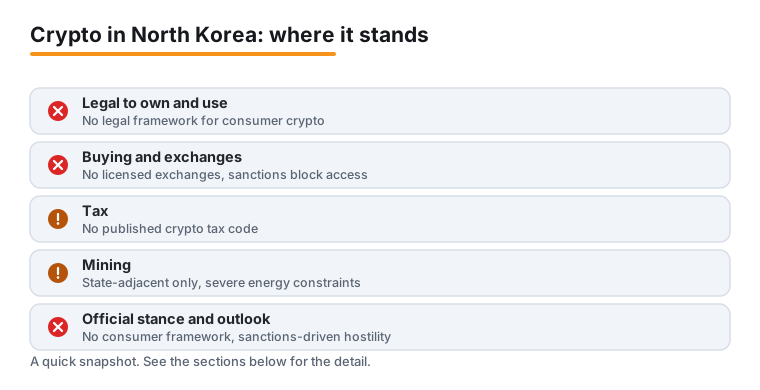
For the general public, the practical answer is no. North Korea has not published a legal framework that lets ordinary citizens own, trade, or spend Bitcoin and other cryptocurrencies, and the state tightly controls money, foreign currency, and communications. There are no licensed exchanges, no consumer wallets sanctioned by the state, and no open internet for the public, so a normal retail crypto market simply does not exist.
This creates a sharp split that is unique to the DPRK:
- For residents: no recognized right to hold or use crypto, no domestic exchanges, and no consumer infrastructure.
- For the state: cryptocurrency is reportedly used to raise revenue and move value outside the banking system that sanctions have cut the country off from.
North Korea also sits at the center of a global sanctions regime. For people and businesses outside the country, the relevant question is usually not whether crypto is legal in North Korea but whether your crypto activity exposes you to sanctions on the DPRK. Under U.S. and UN measures, transactions connected to North Korea or to designated DPRK-linked wallets and groups can be unlawful regardless of where you live. This is general information as of 2026 and not legal advice; verify the current position with OFAC and your national regulator.
The regulator: who controls money in North Korea
North Korea has no independent, transparent financial regulator that issues crypto guidance the public can rely on, and no equivalent of a securities or digital-asset authority. Money and banking inside the country are dominated by the state.
- Central Bank of the Democratic People's Republic of Korea: the DPRK's central bank, established in 1947, issues the North Korean won and is subordinated to the Cabinet. It acts as the sole bank of issue and supervises other state banks. It does not publish an accessible English-language website or any consumer cryptocurrency rules.
- No domestic crypto regulator: there is no published licensing body, consumer-protection authority, or registry for crypto businesses.
Because there is no domestic crypto regulator to consult, the bodies that effectively govern DPRK-related crypto are external: the U.S. Treasury's Office of Foreign Assets Control (OFAC) and the United Nations Security Council, supported since 2024 by the Multilateral Sanctions Monitoring Team (MSMT). See OFAC North Korea Sanctions for the primary U.S. program.
Key laws and frameworks
There is no publicly available body of North Korean cryptocurrency law comparable to the licensing regimes, consumer-protection rules, or anti-money-laundering frameworks found in most countries. What governs crypto in practice is strict internal state control over money and information, plus a dense web of international sanctions applied from outside.
The external frameworks are well documented:
- United States (OFAC): one of the most comprehensive sanctions programs in the world applies to North Korea, codified in the North Korea Sanctions Regulations at 31 CFR Part 510 and built on executive orders including E.O. 13551, 13687, 13722, and 13810. U.S. persons are broadly prohibited from dealings with the DPRK, and OFAC has placed North Korea-linked hacking groups and individuals on its Specially Designated Nationals (SDN) list. Interacting with a sanctioned wallet can itself be a violation. See the official text at 31 CFR Part 510 (eCFR).
- United Nations: multiple Security Council resolutions, beginning with Resolution 1718 (2006), restrict the DPRK's financial activity. After the UN Panel of Experts mandate was terminated in 2024 following a Russian veto, an 11-state Multilateral Sanctions Monitoring Team (MSMT) now reports on DPRK sanctions evasion, including crypto theft.
- Other jurisdictions: the EU, UK, South Korea, Japan, and others maintain their own North Korea measures and coordinate enforcement.
Because internal rules are opaque and external rules are strict and frequently updated, never assume a fixed legal position. Verify current designations before any activity that could be DPRK-connected.
Licensing and registration of exchanges (VASPs)
There are no licensed cryptocurrency exchanges or registered virtual asset service providers (VASPs) operating openly in North Korea, and no regulated on-ramps for residents to convert local currency into Bitcoin or stablecoins. Several structural barriers make a normal retail exchange sector effectively non-existent:
- No public global internet: ordinary residents are generally limited to a state-run domestic intranet (Kwangmyong) rather than the open internet that exchanges and wallets require. Global access is confined to a narrow set of elites and state functions.
- State control of money: the regime tightly manages currency, banking, and capital flows, leaving no room for an authorized retail exchange.
- Sanctions screening: reputable international exchanges block or screen out DPRK users and DPRK-linked addresses to comply with OFAC and UN rules.
The consumer protections that exchange licensing normally provides do not apply here. Any service claiming to offer a licensed crypto exchange to the North Korean public should be treated as unreliable or as a potential vector for fraud or sanctions exposure.
Crypto and Bitcoin taxation in North Korea
North Korea does not operate a transparent, market-style tax system, and there is no published crypto tax code, capital-gains regime, or reporting requirement for digital assets that residents or outsiders can consult. The country has historically presented itself as having minimal formal taxation, and in any case there is no legal consumer crypto market to tax.
Because no verified rates, thresholds, or filing rules exist in the public domain, this page states none and will not invent figures. If you are a non-resident whose crypto activity might intersect with North Korea, your tax and reporting obligations are set by your own country's rules and by sanctions law, not by any DPRK regime. Treat any claim of specific North Korean crypto tax rates with strong skepticism. For how crypto is taxed in functioning markets see our crypto taxes guide, and confirm your real obligations with a qualified professional. This section is informational only and not tax advice.
AML and KYC: how the world treats DPRK crypto
North Korea does not publish its own anti-money-laundering (AML) or know-your-customer (KYC) rules for crypto. Instead, the relevant AML and KYC obligations fall on everyone else, because the DPRK is treated as one of the highest-risk jurisdictions in global finance.
- FATF high-risk listing: the Financial Action Task Force lists North Korea on its public statement of jurisdictions subject to a call for countermeasures, urging all countries to apply enhanced due diligence and restrict financial relationships with the DPRK.
- Sanctions screening at exchanges: regulated VASPs are expected to screen customers and wallet addresses against the OFAC SDN list and freeze or reject transactions linked to designated DPRK entities and addresses.
- Designated addresses and mixers: OFAC has designated DPRK-linked hacking groups (including the Lazarus Group) and the mixing services used to launder stolen funds, making any DPRK-tagged address high-risk for compliant users.
North Korea sets no consumer AML rules of its own; the compliance burden sits with regulated firms worldwide that must keep DPRK-linked value out of the financial system.
Buying and using crypto in practice
There is no legitimate, publicly available way for residents of North Korea to buy or use Bitcoin, and this page does not describe workarounds. Unlike a typical country guide that compares licensed exchanges, payment methods, and wallets, the DPRK offers no compliant retail on-ramp:
- No licensed domestic exchange and no regulated payment rails for crypto.
- No open internet access for the general public, only the state intranet.
- Reputable global exchanges block DPRK users and DPRK-linked activity to comply with sanctions.
- No evidence of any public Bitcoin ATM network; crypto ATMs depend on open internet and regulated cash-handling businesses that do not exist there.
For readers outside North Korea who arrived here while researching the country, the practical takeaway is different but important: do not transact with anyone or any wallet connected to the DPRK, and use only properly regulated exchanges that perform sanctions screening. Sending value to North Korea or to DPRK-linked parties can violate UN and U.S. sanctions even if a recipient could somehow access it. If your situation is complex, such as a business with exposure to the region, get professional legal advice first. This section is informational only and not financial or legal advice.
Bitcoin mining in North Korea
Mining in North Korea is best understood as a state-adjacent activity rather than something available to ordinary residents, and reliable data on its scale is scarce. Researchers and sanctions monitors have pointed to DPRK-linked mining over the years, but precise figures on hash rate, hardware, or output are hard to verify because the country is so closed.
- Energy constraints: North Korea faces chronic electricity shortages, and large-scale proof-of-work mining is power-hungry, limiting how much the country can realistically sustain.
- Not a citizen activity: ordinary people lack the hardware, electricity, internet, and legal latitude to mine independently.
- Revenue context: to the extent state-linked mining occurs, analysts treat it as one way the regime generates value outside the sanctioned banking system. The large majority of documented DPRK crypto revenue, however, is attributed to theft and laundering rather than mining.
Claims about specific DPRK mining capacity should be read cautiously; the honest position is that verifiable numbers are limited.
How DPRK-linked crypto revenue actually moves
Alongside outright theft, sanctions monitors and blockchain analysts have documented a second stream of DPRK-linked crypto revenue: thousands of North Korean IT workers who use fake or stolen identities to get remote jobs at technology and crypto companies abroad, then send their pay back to the state. This matters for consumers because it shows how DPRK value enters mainstream crypto rails that ordinary users also touch.
- Payment in stablecoins: according to Chainalysis and other analysts, these workers often ask to be paid in stablecoins such as USDC and USDT, because the value is steady and over-the-counter traders can convert it to cash more easily than volatile tokens.
- Laundering pattern: proceeds are typically split across many wallets, routed through privacy tools or mixing services, and cashed out through OTC desks, which is why compliant exchanges screen so aggressively for DPRK-linked addresses.
- Scale: the United Nations has estimated the IT-worker scheme generates hundreds of millions of U.S. dollars a year, and OFAC put the 2024 figure at close to 800 million U.S. dollars.
The practical lesson for a regular user is that DPRK-linked funds do not stay in an isolated corner of the market. They move through the same stablecoins, exchanges, and OTC channels everyone else uses, which is exactly why sanctions screening and clean sourcing of funds matter.
Recent developments (2025-2026)
The story of North Korea and crypto in 2025 and 2026 is dominated by state-linked theft and the international response to it, not by any domestic reform:
- Record 2025 thefts: in February 2025, DPRK state-affiliated actors stole roughly 1.5 billion U.S. dollars in Ethereum from the exchange Bybit, the single largest crypto theft on record. According to Chainalysis, DPRK-linked actors stole about 2.02 billion U.S. dollars across 2025, a 51 percent increase over the prior year, and their all-time cumulative theft is estimated at over 6 billion U.S. dollars.
- MSMT report (January 2026): the Multilateral Sanctions Monitoring Team published its second report on DPRK violations and evasions of UN sanctions through cyber and IT-worker activities. The MSMT assessed that cryptocurrency theft may fund up to half of North Korea's weapons of mass destruction program, framing it as a national security risk rather than only a financial one.
- OFAC designations (March 2026): on 12 March 2026 the U.S. Treasury sanctioned six individuals and two entities tied to DPRK IT-worker fraud schemes, which OFAC said generated close to 800 million U.S. dollars in 2024, and designated multiple cryptocurrency addresses across networks such as Ethereum and Tron.
Expect continuity inside North Korea, with no transparent consumer crypto framework, alongside intensifying international efforts to track, freeze, and recover DPRK-linked funds and to tighten enforcement around mixers, bridges, and intermediaries. Specific figures evolve; check the MSMT report (U.S. State Department) and OFAC press releases for the latest.
Consumer risks and protection
North Korea sits at the extreme end of the crypto-risk spectrum, and the protections that exist in regulated markets are absent. The main risks to understand are:
- Sanctions exposure: dealings connected to the DPRK can breach UN and U.S. law and carry significant civil and criminal penalties. OFAC has repeatedly designated North Korea-linked groups and the people who launder for them.
- State-sponsored theft: the DPRK is widely described by governments and security firms as one of the most prolific state actors in crypto crime, with incidents attributed to groups such as the Lazarus Group. Any DPRK-tagged address is treated as high-risk and off-limits by compliant users.
- No consumer protection: there is no deposit insurance, no licensing, no complaints body, and no recourse for anyone dealing inside the DPRK.
- Opacity and misinformation: because the country is closed, much of what circulates online is speculative or outdated. Treat any service claiming to offer crypto access inside North Korea as a likely scam or sanctions trap.
For anyone outside the country, the safest posture is simple: stay well clear of DPRK-connected activity, use regulated exchanges that screen for sanctions, and rely on official guidance, which can change at any time.
Official sources and how to verify
Because there is no transparent domestic regulator to consult, verify any DPRK-related crypto question against the official external sources that actually govern it:
- OFAC North Korea Sanctions program for the primary U.S. sanctions framework and the latest designations.
- 31 CFR Part 510 (eCFR), the official text of the North Korea Sanctions Regulations.
- MSMT report on DPRK cyber and IT-worker activities for the most recent multilateral findings on crypto theft.
Always confirm current sanctions designations against the OFAC SDN list before any transaction that could be DPRK-connected, and check the rules of your own national regulator. For wider context, browse our global crypto regulation hub. This page is general information as of 2026 and is not legal, tax, or financial advice; verify the current position with the named official sources and a qualified professional before acting.
Frequently asked questions
Can ordinary North Koreans legally own Bitcoin?
In practical terms, no. North Korea has not published a legal framework allowing residents to own or trade cryptocurrency, there are no licensed exchanges, and the general public lacks access to the open internet that crypto requires. The state tightly controls money, foreign currency, and communications, so a normal retail crypto market does not exist.
Who regulates cryptocurrency in North Korea?
There is no independent or transparent domestic crypto regulator. The Central Bank of the Democratic People's Republic of Korea, subordinate to the Cabinet, controls money and banking but publishes no consumer crypto rules. In practice, DPRK-related crypto is governed from the outside by the U.S. Treasury's OFAC (under 31 CFR Part 510) and the UN Security Council, with monitoring by the Multilateral Sanctions Monitoring Team (MSMT).
Does North Korea tax cryptocurrency?
There is no publicly available crypto tax code, capital-gains regime, or reporting requirement in North Korea, and no verifiable rates exist in the public domain, so this page states none. If your crypto activity might intersect with the DPRK as a non-resident, your obligations are set by your own country's tax and sanctions laws, not by any North Korean regime. Confirm with a qualified tax professional.
Is it legal for me to send crypto to someone in North Korea?
It is very likely illegal and high-risk. Sending value to North Korea or to DPRK-linked parties can violate UN and U.S. sanctions, and authorities such as OFAC actively pursue those who facilitate DPRK fund flows. Recipients also generally have no normal way to access crypto. Do not attempt it without qualified legal advice; this is general information, not legal advice.
Why is North Korea so associated with crypto if its citizens cannot use it?
The association comes from the state, not the public. Governments and security firms widely attribute large-scale crypto theft and laundering to DPRK-linked groups such as the Lazarus Group, used to raise revenue and bypass the banking access that sanctions have cut off. The February 2025 Bybit hack of about 1.5 billion U.S. dollars is the largest crypto theft on record. So the country is simultaneously closed to ordinary crypto users and highly active at the state level.
Are there licensed exchanges or Bitcoin ATMs in North Korea?
No. There is no evidence of any licensed exchange or public Bitcoin ATM network operating openly in North Korea. These services need open internet, regulated cash-handling businesses, and a retail market that does not exist there. Reputable global exchanges also block DPRK users and DPRK-linked addresses to comply with sanctions. Treat any listing claiming otherwise as unreliable.
How much crypto did North Korea steal in 2025?
According to Chainalysis, DPRK-linked actors stole about 2.02 billion U.S. dollars in cryptocurrency in 2025, a roughly 51 percent increase over the prior year. The single largest event was the February 2025 Bybit hack of about 1.5 billion U.S. dollars, the largest crypto theft on record. Cumulative DPRK-linked theft since 2017 is estimated at over 6 billion U.S. dollars. Figures are estimates from blockchain analysts and can be revised.
How are North Korean IT workers paid in crypto?
Sanctions monitors describe North Korean IT workers using fake or stolen identities to get remote jobs at technology and crypto firms, often requesting payment in stablecoins such as USDC and USDT because their value is steady and they are easier to cash out through over-the-counter traders. The funds are then split across wallets, run through privacy tools, and sent back to the state. The United Nations estimates the scheme raises hundreds of millions of dollars a year. This is why regulated exchanges screen so heavily for DPRK-linked activity.
Facts reviewed: 30 June 2026. Page updated: 3 August 2026.
Related guides
More countries in the region
Practical guides