Home › Crypto Regulation › Japan
Bitcoin & Cryptocurrency Regulation in Japan
Quick answer — Japan, 2026
- Legal: Legal to own, trade and use, not legal tender
- Tax: Gains taxed as miscellaneous income, flat 20% reform proposed
- Buying: Via FSA-registered exchanges with KYC
Japan was one of the first major economies to give cryptocurrency a clear legal home, and it remains among the most actively regulated crypto markets in the world. Crypto assets such as Bitcoin are legal to own, trade, and use, and the businesses that connect users to the market, such as exchanges, must be registered and supervised. During 2025 and 2026 Japan tightened its rules further and began a fundamental shift that will treat crypto more like a regulated financial product rather than a payment tool. This guide explains the current state of crypto regulation in Japan: legal status, who oversees the market, the main laws, how exchanges are licensed, how crypto is taxed, the AML and KYC rules, and what buying, using, and mining crypto look like under Japanese law. For wider context, see our overview of crypto regulation.
This is general information current as of 2026 and is not legal, tax, or financial advice. Rules in Japan are changing quickly and the details depend on your situation. Verify the current position with the Financial Services Agency, the National Tax Agency, or a qualified professional before acting.
On this page: Legal status · Who regulates it · Taxes · How to buy · Mining
Is Bitcoin and crypto legal in Japan?
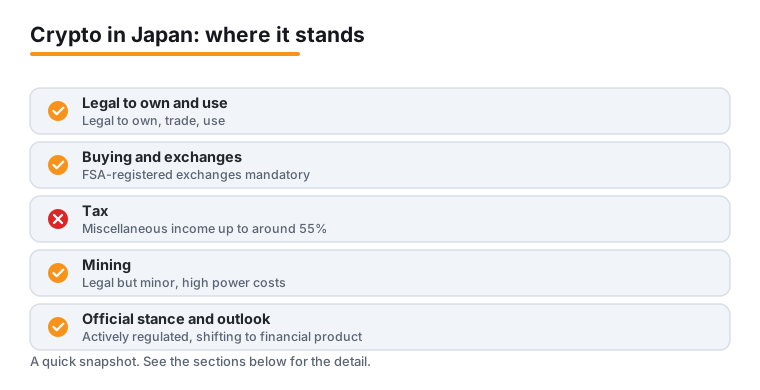
Yes. Bitcoin and other crypto assets are legal in Japan. The country formally recognised crypto in its Payment Services Act and built a registration and supervision regime around the businesses that serve users, rather than banning or ignoring the sector. Individuals may buy, hold, sell, and use crypto, and businesses may accept it, provided they comply with the relevant rules.
What is regulated is the activity of running an exchange, custody service, or similar intermediary. Any platform offering crypto buying, selling, custody, or related services to people in Japan must register with the regulator, and operating without that registration is a criminal offence. The Financial Services Agency has taken an increasingly assertive stance toward offshore platforms that target Japanese users without a licence, looking at factors such as Japanese-language interfaces, yen trading pairs, and advertising aimed at Japan.
Crypto is not legal tender in Japan. The yen remains the only legal tender. Bitcoin is treated as a transferable crypto asset, historically classed for payments purposes, that can be bought, sold, and exchanged, but it is not official money.
Who regulates crypto in Japan?
The primary regulator is the Financial Services Agency (FSA), the national body that licenses and supervises crypto-asset exchange service providers and other financial businesses. The FSA maintains the official register of approved providers and issues guidance, warnings, and enforcement actions.
Working alongside the FSA is the Japan Virtual and Crypto Assets Exchange Association (JVCEA), the industry self-regulatory body. The JVCEA is officially recognised under Japanese law and sets practical standards for member exchanges, such as rules on which tokens may be listed, conduct, and user protection. All licensed crypto exchanges are members.
For tax matters, the relevant authority is the National Tax Agency (NTA), which sets out how crypto transactions are taxed and oversees compliance. So three bodies matter in practice: the FSA for licensing and conduct, the JVCEA for industry self-regulation, and the NTA for tax. You can verify any provider against the FSA register and check tax guidance with the NTA, both linked at the end of this guide.
Key crypto laws and frameworks in Japan
Japan's framework rests on three main laws, with a major reform under way:
- Payment Services Act (PSA): the core law that has governed crypto-asset exchange service providers, setting registration, custody, and consumer-protection requirements. It is also where Japan's stablecoin rules sit.
- Financial Instruments and Exchange Act (FIEA): the securities-style law that already covers crypto derivatives and certain token offerings, and which Japan is moving to extend across crypto assets more broadly.
- Act on Prevention of Transfer of Criminal Proceeds: the anti-money-laundering and know-your-customer backbone, including the FATF travel rule for transfers between providers.
The rules have been moving fast. A 2025 amendment to the Payment Services Act, Act No. 66 of 2025, was enacted on 6 June 2025, promulgated on 13 June 2025 and brought into force on 1 June 2026 by a cabinet order decided on 19 May 2026. It broadened the businesses that must register, including a new lighter category for intermediaries that arrange transactions on behalf of a licensed exchange without holding user assets, and it codified detailed reserve, custody, and redemption requirements for stablecoins. Separately, the bill reclassifying crypto assets as financial instruments was received by the House of Representatives on 10 April 2026, passed that House on 11 June 2026 and the House of Councillors on 15 July 2026, and was promulgated on 23 July 2026 as Act No. 64 of 2026. Its securities-style disclosure, insider dealing and conduct rules commence on a date to be set by cabinet order within one year of promulgation, so no later than 23 July 2027, and that order has not yet been made. Reporting indicates the FSA plans to bring a defined set of around 105 crypto assets, including Bitcoin and Ethereum, into the new perimeter. Because the rulebook a given service must follow can depend on timing, always confirm the current legal position with the Financial Services Agency.
Licensing and registration of exchanges
Any business that provides crypto-asset exchange services to people in Japan must register with the FSA. The scope of these services covers the sale and purchase of crypto, exchange between crypto assets, intermediation and brokerage, and custody of crypto on behalf of users. Providing these services without registration is prohibited and carries criminal penalties.
Registered providers face substantial obligations: segregation of customer assets from company funds, strong custody and cybersecurity practices (Japan has emphasised cold-wallet storage for the bulk of customer crypto after past exchange hacks), internal controls, reporting to the FSA, and adherence to JVCEA self-regulatory rules. The 2025 PSA amendment added a lighter-touch registration for pure intermediaries that arrange transactions for a licensed exchange without holding customer assets themselves.
Penalties for operating without a licence rise under Act No. 64 of 2026. Unregistered crypto business is currently punished under Payment Services Act article 107 by up to 3 years imprisonment or a 3 million yen fine, and once crypto moves into the FIEA at commencement it will fall under FIEA article 197, paragraph 1, at up to 10 years or 10 million yen. A separate provision taking effect on 12 August 2026 already moves unregistered financial instruments business into that heavier article, from up to 5 years or 5 million yen, but it does not reach crypto until the main commencement. For users, the practical rule is simple: deal only with providers that appear on the FSA's official register, and treat unregistered offshore platforms soliciting Japanese users with caution.
How crypto is taxed in Japan
Crypto taxation in Japan is in a period of transition, so this is an area to verify before filing. For more general background, see our guide to crypto taxes.
Under the long-standing regime, profits from crypto for individuals are generally treated as miscellaneous income and taxed at progressive national income-tax rates, with local inhabitant tax and a reconstruction surtax layered on top. Combined, the top marginal burden on large gains has been reported at up to around 55 percent, much heavier than the flat treatment applied to listed shares. A taxable event typically occurs not only when you sell crypto for yen, but also when you swap one crypto for another or spend it, so record-keeping matters.
Japan's 2026 Tax Reform Outline, released on 19 December 2025, proposes moving qualifying crypto gains to a flat 20 percent separate self-assessment tax, more in line with how listed securities are taxed, and allowing losses on specified assets to be carried forward for up to three years against future crypto gains. The flat figure is reported as 20.315 percent in total, made up of 15 percent national income tax, 5 percent local inhabitant tax, and a 2.1 percent reconstruction surtax applied to the national portion. The favourable treatment is expected to apply only to specified crypto assets handled by registered providers, with reporting pointing to around 105 assets listed on FSA-approved platforms, while tokens on unregistered exchanges, NFTs, and DeFi yield are generally excluded and stay as miscellaneous income. The separate tax applies to disposals made on or after 1 January of the year following the year in which Act No. 64 of 2026 commences. Since that Act must commence by 23 July 2027, the start date can only be 1 January 2027 or 1 January 2028, and commentary expecting a 2027 commencement points to 1 January 2028. It is not available for the 2026 tax year. Activities such as staking rewards, lending yield, and NFTs are reported to remain miscellaneous income. The 20.315 percent rate and the 3 year loss carryforward are now fixed in statute, enacted and promulgated on 31 March 2026 as Act No. 12 of 2026. What remains open is the commencement date of Act No. 64 of 2026 and the Ministry of Finance ordinance that will settle which crypto assets qualify. Confirm your obligations with the National Tax Agency or a Japanese tax professional.
AML, KYC, and the travel rule
Anti-money-laundering and counter-terrorist-financing rules are central to Japan's crypto regime, built on the Act on Prevention of Transfer of Criminal Proceeds and the FSA's AML and CFT guidelines. Registered providers must verify customer identity (KYC), monitor transactions for suspicious activity, keep records, and file suspicious-transaction reports.
A key requirement is the travel rule: when crypto is transferred between registered service providers, identifying information about the sender and recipient must travel with the transaction. An amendment to the AML law implemented the travel rule for crypto-asset exchange service providers, taking effect on 1 June 2023, and it also covers electronic-payment-instrument (stablecoin) service providers. Japan keeps revising the jurisdiction list this rests on: the FSA and the Ministry of Finance promulgated an amended designation notice on 7 July 2026, applying from 3 August 2026, which Japanese reporting says adds Anguilla, Oman, Cuba, Dominica and Botswana and takes the designated list to 63 jurisdictions.
For everyday users, the practical effect is that opening an account requires full identity verification, large or unusual transfers may prompt additional checks, and using registered platforms on both ends of a transfer makes compliance smoother. These obligations sit on the providers, but they shape the user experience throughout.
Stablecoins and electronic payment instruments
Japan was an early mover in regulating stablecoins as a distinct category. Under the Payment Services Act framework, fiat-referenced stablecoins are treated as electronic payment instruments and may generally be issued to Japanese users only by regulated entities such as banks, trust companies, or licensed fund-transfer service providers. Issuers are required to back outstanding stablecoins with reserves and to meet custody and redemption obligations, with reporting on rules requiring reserves equal to the full value of coins in issue held in segregated, highly liquid assets.
The 2025 PSA amendment codified and refined these reserve, custody, and redemption requirements, including a reported change that lets issuers hold up to half of the backing reserve in low-risk assets such as short-term government bonds rather than solely in bank deposits. Japan has also been developing conditions under which certain qualifying foreign-issued stablecoins can be handled domestically as electronic payment instruments, with reporting that arrangements to distribute major dollar-referenced stablecoins to residents move forward from 2026. The intermediaries that distribute or broker stablecoins also fall within the registration perimeter.
For users, the takeaway is that stablecoins available through registered Japanese providers operate under defined backing and redemption rules, which is a meaningfully different position from holding an unregulated offshore token. Always confirm how a specific stablecoin is treated, as this is an evolving area.
Buying and using crypto in practice
For residents, the standard route is a domestic FSA-registered exchange. Well-known licensed names include bitFlyer, Coincheck, bitbank, GMO Coin, SBI VC Trade, Rakuten Wallet, and the locally licensed Binance Japan. A typical process looks like this:
- Choose a registered exchange: confirm the platform appears on the FSA's official register of crypto-asset exchange service providers, and avoid unregistered offshore sites soliciting Japanese users.
- Open and verify your account: complete KYC by submitting identity documents; verification is mandatory.
- Fund the account: deposit yen by bank transfer or another supported method.
- Buy crypto: place an order through the exchange app or website.
- Secure and record: decide whether to keep assets in regulated exchange custody (with fund-segregation rules) or move them to a personal wallet, and keep records of every transaction for tax.
Using crypto to pay merchants is allowed, but remember it is not legal tender, so acceptance is voluntary, and spending crypto can itself be a taxable disposal. Physical crypto ATMs have historically been rare in Japan because of the strict licensing and AML regime; any operator running them must register with the FSA and apply the same KYC and AML standards as online platforms, so check whether a machine is run by a registered operator before using it.
Bitcoin mining in Japan
Bitcoin mining is legal in Japan, but it is a relatively minor activity compared with countries that have cheaper power. Japan's high electricity prices and limited spare grid capacity make large-scale proof-of-work mining hard to run profitably, so the country matters more as a market and a regulatory model than as a mining hub.
There is no special licence simply to mine for your own account, but miners operate within Japan's wider legal environment: electricity contracts and grid rules, business registration and corporate tax for commercial operations, and tax on the value of mined coins as income. Operations that also handle other people's funds, or that run pooled or hosted services for customers, can stray into activities that trigger financial registration under the PSA framework, so the structure of a mining business matters.
The practical theme in Japan is efficiency: where mining or related data-centre activity happens, the emphasis is on efficient hardware, better cooling, and access to low-cost or renewable energy. Anyone considering a commercial operation should obtain tailored legal and tax advice and confirm the energy and environmental rules that apply to their site.
Recent developments in 2025 and 2026
Japan is in the middle of its biggest crypto-regulation overhaul in years. Three threads stand out:
- Payment Services Act amendment: Act No. 66 of 2025, promulgated on 13 June 2025 and in force since 1 June 2026, it broadens registration with a new electronic payment instruments and crypto-asset services intermediary category, adds a power to order providers to hold assets in Japan, and lets trust-type stablecoin reserves sit in certain government bonds and cancellable time deposits up to a capped share of the backing assets.
- Move to the Financial Instruments and Exchange Act: the amendment reclassifying crypto assets as financial instruments passed the Diet on 15 July 2026 and was promulgated on 23 July 2026 as Act No. 64 of 2026. It adds pre-offering, periodic and event-driven disclosure under new FIEA articles 27-39, 27-50 and 27-51, insider dealing offences under new articles 171-7 to 171-10 carrying up to 5 years imprisonment or a 5 million yen fine, a renamed crypto-asset trading business registration that also captures borrowing crypto from customers, and higher penalties for unregistered operators. Reporting indicates a defined set of around 105 crypto assets, including Bitcoin and Ethereum, would be brought into the new perimeter.
- Tax reform: the income tax reform act enacted and promulgated on 31 March 2026 as Act No. 12 of 2026 sets a 20.315 percent separate self-assessment tax on specified crypto assets, with a 3 year loss carryforward, applying from 1 January of the year after Act No. 64 of 2026 commences.
All three measures are now law. The Payment Services Act amendment has been in force since 1 June 2026. Act No. 64 of 2026 was promulgated on 23 July 2026, two of its non-crypto provisions bite on 12 August 2026, and its main crypto regime awaits a commencement order due within one year of promulgation. The tax change is law too, but does not apply until 1 January of the year after that commencement, so the rules that govern a disposal still depend on when you make it. Track changes through the FSA and NTA directly.
Consumer risks and protection
Japan's regime offers meaningful protections: customer assets must be segregated, exchanges must meet custody and cybersecurity standards (with emphasis on cold storage after past hacks), and the FSA and JVCEA supervise conduct. The planned FIEA reform would add disclosure and insider-trading rules and stronger penalties. These reduce some counterparty and conduct risk relative to unregulated venues.
The risks that remain are familiar ones: crypto's price volatility, the potential for loss through hacks, scams, or platform failure, and the tax complexity of an asset where many actions, including swaps and spending, can be taxable events. There is also regulatory-change risk: with Japan mid-transition, the exact rules and tax treatment can shift between the time you act and the time you report.
Sensible practices apply: use only FSA-registered providers, verify any platform against the official register, be wary of unregistered offshore sites and of guaranteed-return promises, never invest more than you can afford to lose, keep full records, and confirm current requirements with the FSA and NTA. This article is general information as of 2026 and is not legal, tax, or financial advice; verify anything material with the named official regulators or a qualified professional before you act.
Official sources and how to verify
Because Japan's rules are changing quickly, always check primary sources rather than relying on summaries. The authoritative starting points are:
- Financial Services Agency (FSA): licensing, the official register of crypto-asset exchange service providers, guidance, and warnings. fsa.go.jp/en
- National Tax Agency (NTA): how crypto is taxed and how to file. nta.go.jp/english
- Japan Virtual and Crypto Assets Exchange Association (JVCEA): the self-regulatory body and member exchanges. jvcea.or.jp/english
To verify a platform before using it, confirm it appears on the FSA register; to confirm a tax position, check NTA guidance or consult a Japanese tax professional. For more general background, see our hub on crypto regulation by country and our explainer on crypto regulation. Remember that this guide is general information current as of 2026 and is not legal advice; the official regulators above are the definitive source.
What is changing: Japan's crypto law pipeline as of August 2026
Japan's rulebook moved after this page was last reviewed on 30 June 2026. The headline reform is no longer a bill. The Diet passed it on 15 July 2026 and it was promulgated on 23 July 2026 as Act No. 64 of 2026. For scale, the FSA register of crypto-asset exchange service providers listed 26 registered firms as of 30 June 2026, 24 supervised by the Kanto Local Finance Bureau and 2 by the Kinki Local Finance Bureau. The table separates what already binds you from what is adopted but still waiting for a commencement date.
| Measure | Stage | Key dates | What it does |
|---|---|---|---|
| Payment Services Act amendment, Act No. 66 of 2025 | In force | Promulgated 13 June 2025; in force 1 June 2026 | New intermediary registration for firms that introduce users without holding assets; power to order providers to hold assets in Japan; trust-type stablecoin reserves may sit in certain government bonds and cancellable time deposits up to a capped share (FSA) |
| FIEA and Payment Services Act amendment, Act No. 64 of 2026 | Adopted; two non-crypto provisions in force from 12 August 2026 | Passed 15 July 2026; promulgated 23 July 2026; main crypto provisions by cabinet order within one year | Moves crypto from payments law to securities-style law, with disclosure duties, insider dealing offences and higher penalties (House of Representatives record) |
| Income Tax Act amendment, Act No. 12 of 2026 | Adopted, not yet in force for crypto | Enacted and promulgated 31 March 2026; applies from 1 January of the year after Act No. 64 commences | 20.315 percent separate self-assessment tax on specified crypto assets, with a 3 year loss carryforward (Nagashima Ohno and Tsunematsu) |
| Travel rule designation notice | In force | Promulgated 7 July 2026; applies from 3 August 2026 | Amends the designated jurisdiction list that governs sender and recipient information on cross-border transfers (FSA) |
| Spot crypto ETFs | Not adopted, nothing filed | No date set | Act No. 64 supplies the legal hook, but no Japanese spot crypto ETF has been filed, approved or listed (Cryptonews) |
Inside Act No. 64 of 2026, and what actually changes on 12 August 2026
Act No. 64 of 2026 was Cabinet bill 57 of the 221st Diet session. The House of Representatives record shows it was received on 10 April 2026, was referred to the Financial Affairs Committee on 28 May 2026, cleared that committee on 10 June 2026 and the plenary on 11 June 2026, cleared the House of Councillors committee on 14 July 2026 and the plenary on 15 July 2026, and was promulgated on 23 July 2026 as law number 64.
The Act is built in separate articles that commence at different times, and this is where most reporting goes wrong. Article 1 rewrites the securities side of the FIEA. Article 2 is the crypto rewrite. Only three amendments made by Article 1 take effect on 12 August 2026, and none of them mentions crypto.
- What changes on 12 August 2026: operating a financial instruments business without registration moves out of FIEA article 197-2, which carries up to 5 years imprisonment or a 5 million yen fine, and into article 197, paragraph 1, which carries up to 10 years or 10 million yen. Obtaining registration by fraud and lending your registration to someone else move with it. The Securities and Exchange Surveillance Commission's criminal investigation scope in article 210, paragraph 1 is also widened. The FSA confirmed the date on 29 July 2026 (FSA).
- What does not change on 12 August 2026: anything crypto. Running a crypto business in Japan without registration stays an offence under Payment Services Act article 107, at up to 3 years or 3 million yen, until crypto becomes financial instruments business at the main commencement. The crypto extension of the surveillance commission's investigation powers sits in Article 2 of the Act and waits for the same order.
- The licence is renamed and rescoped. Crypto-asset exchange business becomes crypto-asset trading business under new FIEA article 28, paragraph 5, and borrowing crypto from customers becomes a regulated activity under new article 2, paragraph 8, item 25, which captures most exchange lending products (Nagashima Ohno and Tsunematsu).
- Issuers and platforms must disclose. Information must be published before a public offering under new article 27-39, periodically under article 27-50 and on an event basis under article 27-51, with audit certification by a certified public accountant or audit corporation under article 27-59 unless the offering is small enough to meet a cabinet-order threshold (So and Sato).
- Insider dealing becomes a crime. New articles 171-7 to 171-10 cover people connected to a specified crypto asset issuer, to a crypto trading business, and to large trades, plus tipping and recommending. They are punished under article 197-2 by up to 5 years imprisonment or a 5 million yen fine, or both.
- Stablecoins stay outside. New article 2, paragraph 49 excludes electronic payment instruments from the crypto-asset definition, and So and Sato record that the position that NFTs do not in principle fall inside it is maintained.
- Existing operators get a runway of 6 months from commencement, extendable while a registration application is pending but capped at 2 years, and must notify the FSA within 2 weeks of commencement.
- The rest commences on a date set by cabinet order within one year of promulgation, so no later than 23 July 2027. That order has not been made. Two later tranches already have fixed dates: the rest of Article 1 on 1 April 2027, and the surcharge and forfeiture machinery for crypto in Article 2 on 1 October 2027.
Tax: 20.315 percent is now law, but you cannot file under it yet
The flat rate has stopped being a proposal. It was carried by the income tax reform act, Cabinet bill 3 of the 221st Diet, enacted and promulgated on 31 March 2026 as Act No. 12 of 2026. It does not switch on until Act No. 64 of 2026 commences, so a disposal made today is still miscellaneous income at progressive rates.
- Rate: new article 38-2 of the Act on Special Measures Concerning Taxation charges 15 percent national income tax on a separately computed crypto gain. Adding 5 percent local inhabitant tax and the reconstruction surtax, which runs at 2.1 percent of the national tax, gives 20.315 percent (Izumi Junya tax office).
- Scope: specified crypto assets only, defined as those whose names appear in the registration ledger kept under FIEA article 29-3, paragraph 1, less any excluded by Ministry of Finance ordinance. That ordinance has not been issued, so the qualifying list does not yet exist (Nagashima Ohno and Tsunematsu).
- Route: the relief only covers disposals made to, or on consignment to, a registered crypto-asset trading business operator.
- Losses: new article 38-3 carries them forward 3 years against gains of the same kind, provided a return is filed for the loss year and for every year in the chain.
- Staying on progressive miscellaneous income treatment: trades on overseas exchanges, decentralised exchange trades, peer to peer trades, and mining, staking and lending rewards (Takeda tax office).
- Start date: 1 January of the year following the year Act No. 64 commences. Because that Act must commence by 23 July 2027, the start date can only be 1 January 2027 or 1 January 2028. Commentary expects 2027 commencement, which points to 1 January 2028. A later start is not possible under the statute.
Travel rule: the designated jurisdiction list changed on 3 August 2026
The FSA and the Ministry of Finance promulgated an amendment to the travel rule designation notice on 7 July 2026, after a consultation that ran from 1 May to 31 May 2026 and drew 2 comments from 2 respondents. It applies from Monday 3 August 2026 (FSA).
The designation is made under articles 17-2 and 17-3 of the enforcement order of the Act on Prevention of Transfer of Criminal Proceeds, and it identifies jurisdictions whose own laws do not impose notification duties equivalent to articles 10-3 and 10-5 of that Act. Which side of the list a jurisdiction falls on determines how a registered Japanese provider must handle sender and recipient information when it transfers crypto assets or electronic payment instruments to a provider based there. Japanese reporting puts the amended list at 63 jurisdictions, up from 58, with Anguilla, Oman, Cuba, Dominica and Botswana added (BitTimes, CoinOtaku).
For an individual user this is invisible in the app, but it is the mechanism behind withdrawals to certain overseas platforms being delayed, questioned or blocked.
What has not been decided
Four things a reader should not assume are settled, because the reporting around Japan's reform often blurs them:
- The commencement date for the main crypto provisions of Act No. 64 of 2026 is not fixed. It must fall within one year of the 23 July 2026 promulgation, and professional commentary points to 2027 (So and Sato).
- There is no list of qualifying crypto assets. The Ministry of Finance ordinance that will exclude assets from the statutory definition has not been issued, and the binding scope will come from the FIEA registration ledger and that ordinance rather than from any published token count (Nagashima Ohno and Tsunematsu).
- No spot crypto ETF exists in Japan. Nothing has been filed, approved or listed, and investment trust rules, custody standards and product filings still have to be built before one can (Cryptonews).
- Japan's position on the Basel Committee's prudential standard for bank crypto exposures is unresolved. In November 2025 the FSA said it would not implement the standard by the Committee's January 2026 deadline and had no set timeframe, and no timetable has been published since (Central Banking, subscription required).
The policy basis for the whole reform is the Financial System Council's Working Group on Crypto-asset Systems report, chaired by Professor Morishita Tetsuo of Sophia University, published in Japanese on 10 December 2025 and in English on 16 February 2026 (FSA). Substantial secondary rulemaking still flows from it.
Frequently asked questions
Is cryptocurrency legal in Japan?
Yes. Owning, buying, selling, and using crypto such as Bitcoin is legal. Exchanges and other intermediaries that serve Japanese residents must register with and be supervised by the Financial Services Agency, and operating without registration is a criminal offence. Crypto is not legal tender, however; only the yen is.
Who regulates crypto in Japan?
The Financial Services Agency (FSA) is the primary regulator and licenses crypto exchanges, historically under the Payment Services Act. The Japan Virtual and Crypto Assets Exchange Association (JVCEA) is the industry self-regulatory body, and the National Tax Agency (NTA) handles tax. Japan is also moving to bring crypto more fully under the Financial Instruments and Exchange Act.
How is crypto taxed in Japan?
Individuals have generally been taxed on crypto profits as miscellaneous income at progressive rates, with local and surtax components added, reportedly reaching up to around 55 percent at the top, and many actions, including crypto-to-crypto swaps and spending, can be taxable events. Japan's tax-reform outline of 19 December 2025 proposes a flat separate tax reported at 20.315 percent (15 percent national income tax, 5 percent local inhabitant tax, and a 2.1 percent reconstruction surtax on the national portion) on qualifying crypto gains, with loss carryforward, phased in over the following years. It is expected to apply only to specified assets on registered platforms, not to NFTs or DeFi yield. Because rates, scope, and effective dates can change, confirm the current position with the National Tax Agency or a tax professional.
What is changing in Japan's crypto rules in 2025 and 2026?
Two big things. A Payment Services Act amendment enacted in June 2025, with full implementation in June 2026, broadens registration and tightens stablecoin rules. Separately, in April 2026 Japan's Cabinet approved an amendment to reclassify crypto assets as financial instruments under the Financial Instruments and Exchange Act, adding securities-style disclosure, insider-trading rules, and tougher penalties; if passed by the Diet it is expected to take effect around fiscal 2027. Tax reform toward a flat 20 percent rate is being phased in alongside.
Where can I buy Bitcoin in Japan?
Through an FSA-registered exchange. Licensed platforms include bitFlyer, Coincheck, bitbank, GMO Coin, SBI VC Trade, Rakuten Wallet, and Binance Japan, among others. Verify a platform appears on the FSA's official register, complete identity verification, fund your account in yen, and keep records for tax. Avoid unregistered offshore sites that solicit Japanese users.
How can I verify Japan's crypto rules and licensed exchanges?
Use the official sources. Check the Financial Services Agency at fsa.go.jp/en for licensing, the register of approved providers, and guidance; check the National Tax Agency at nta.go.jp/english for tax; and see the JVCEA at jvcea.or.jp/english for the self-regulatory body and its members. These primary sources are definitive, and this guide is general information as of 2026, not legal advice.
Which crypto assets qualify for Japan's proposed flat 20 percent tax?
The proposal from the December 2025 tax-reform outline is expected to apply only to specified crypto assets handled through FSA-registered providers, with reporting pointing to a defined set of around 105 assets, including Bitcoin and Ethereum, listed on approved Japanese platforms. Tokens on unregistered exchanges, NFTs, and DeFi lending or staking yield are generally reported to stay outside the flat rate and remain miscellaneous income at progressive rates. The scope and timing are still being finalised, so confirm the current position with the National Tax Agency before relying on any figure.
Are foreign stablecoins like USDC allowed in Japan?
Fiat-referenced stablecoins are regulated as electronic payment instruments under the Payment Services Act, and issuing them to residents is generally limited to banks, trust companies, or licensed fund-transfer providers. Japan has been developing conditions under which certain qualifying foreign-issued stablecoins can be distributed domestically through registered intermediaries, with reporting that arrangements for major dollar-referenced stablecoins move forward from 2026. Because this is an evolving area, confirm how any specific stablecoin is treated with the provider and against FSA guidance before using it.
Has Japan actually passed the law making crypto a financial instrument?
Yes. The Act Partially Amending the Financial Instruments and Exchange Act and the Payment Services Act was Cabinet bill 57 of the 221st Diet session. It passed the House of Representatives on 11 June 2026, passed the House of Councillors on 15 July 2026, and was promulgated on 23 July 2026 as Act No. 64 of 2026. It is law, but most of it is not yet in force: the main crypto provisions commence on a date to be set by cabinet order within one year of promulgation, so by 23 July 2027 at the latest, and that order has not been made.
What changes on 12 August 2026?
Two things, and neither is about crypto. Twenty days after promulgation, running a financial instruments business without registration moves from FIEA article 197-2, which carries up to 5 years imprisonment or a 5 million yen fine, into article 197, paragraph 1, which carries up to 10 years or 10 million yen, and the Securities and Exchange Surveillance Commission's criminal investigation scope is widened. Both amendments sit in Article 1 of the Act, which is the securities side. Unregistered crypto business stays an offence under Payment Services Act article 107, at up to 3 years or 3 million yen, until crypto moves into the FIEA at the main commencement. The FSA confirmed the 12 August date on 29 July 2026.
Can I file my crypto gains at 20 percent in Japan yet?
No. The 20.315 percent separate self-assessment tax was enacted and promulgated on 31 March 2026 as Act No. 12 of 2026, but it applies only to disposals made on or after 1 January of the year following the year in which Act No. 64 of 2026 commences. Since that Act must commence by 23 July 2027, the earliest possible start is 1 January 2027 and the latest is 1 January 2028, with commentary pointing to the later date. Gains realised in 2026 are still miscellaneous income taxed at progressive rates.
Which crypto will qualify for Japan's 20.315 percent rate?
Only specified crypto assets, meaning those whose names appear in the registration ledger kept under article 29-3, paragraph 1 of the Financial Instruments and Exchange Act, minus any the Ministry of Finance excludes by ordinance. That ordinance has not been issued, so no binding list exists yet, and any token count you see quoted is press estimate rather than law. The relief also only covers disposals made through a registered crypto-asset trading business operator, so trades on overseas exchanges, decentralised exchange trades, peer to peer trades and mining, staking and lending rewards stay outside the regime as miscellaneous income.
Is there a Bitcoin ETF in Japan?
No. No Japanese spot crypto ETF has been filed, approved or listed. Act No. 64 of 2026 reclassifies crypto as a financial instrument, which supplies the legal hook for one, but investment trust rules, custody standards, FSA secondary rulemaking and an actual product filing all still have to happen first.
How many crypto exchanges are registered in Japan?
The FSA register of crypto-asset exchange service providers listed 26 registered firms as of 30 June 2026, of which 24 are supervised by the Kanto Local Finance Bureau and 2 by the Kinki Local Finance Bureau. The register is published as a PDF and a spreadsheet on the FSA website and is the only definitive check on whether a platform is licensed.
Facts reviewed: 3 August 2026. Page updated: 3 August 2026.
Related guides
More countries in the region
Practical guides