DeFi Explained: Decentralized Finance
Decentralized finance, or DeFi, is a set of financial services built on public blockchains that let people lend, borrow, trade, save, and earn without relying on a bank, broker, or other central intermediary. Instead of a company holding your assets and processing your transactions, software called smart contracts executes the rules automatically, and anyone with a crypto wallet and an internet connection can use it.
The promise is open, programmable money: services that run 24/7, settle in minutes, and are accessible to people who are excluded from or underserved by traditional banking. The trade-off is that DeFi shifts responsibility onto the user. There is rarely a customer support line, transactions are usually irreversible, and the same openness that removes gatekeepers also removes safety nets. This guide explains how the main pieces work, where the real opportunities and risks are, and what to check before you put money in.
None of this is financial, legal, or tax advice. DeFi rules and tax treatment vary by country and change frequently, so verify anything important with official sources and, where appropriate, a qualified professional.
What is DeFi?
DeFi refers to financial applications that run on a blockchain rather than inside a bank or a brokerage. The core idea is to replace trusted middlemen with transparent code. A few building blocks make this possible:
- Public blockchains. Networks such as Ethereum and other smart-contract chains maintain a shared, tamper-resistant ledger that anyone can read and audit. There is no single company that can freeze the network or unilaterally rewrite balances.
- Smart contracts. These are programs deployed on-chain that hold funds and execute rules automatically: "if a borrower's collateral falls below this level, sell it," or "pay this interest rate to whoever deposits." Because the code is public, anyone can inspect how a protocol behaves before using it.
- Wallets. A self-custody wallet (a browser extension or mobile app) holds your private keys and lets you approve transactions. With DeFi you typically connect your own wallet rather than creating an account with a username and password.
- Stablecoins. Tokens designed to track a stable value, usually the US dollar, are the main unit of account in DeFi. They let users lend, borrow, and trade without constant exposure to crypto price swings.
Three properties distinguish DeFi from traditional finance. It is permissionless, meaning you generally do not need approval to use a protocol. It is composable, meaning applications plug into each other like building blocks, so a token you earn in one protocol can be used as collateral in another. And it is non-custodial by default, meaning you keep control of your assets instead of handing them to an institution. As of 2026, the total value locked across DeFi protocols is commonly measured in the tens of billions of US dollars and shifts constantly; trackers such as DefiLlama publish live figures if you want a current snapshot.
Lending & borrowing
Lending and borrowing are among the most established and widely used parts of DeFi. Protocols such as Aave, Compound, and MakerDAO let users deposit crypto assets into a shared pool and earn interest, while others borrow from that pool by posting collateral. Interest rates are set algorithmically based on supply and demand: when many people want to borrow a given asset, the rate to borrow it rises and the rate paid to lenders rises with it.
The defining feature of most DeFi loans is overcollateralization. Because the system cannot run a credit check or chase you for repayment, a borrower must lock up more value than they take out. For example, to borrow 1,000 dollars in stablecoins you might need to deposit 1,500 dollars or more of another asset. This is what lets people borrow without identity checks, and it is also why borrowing is mostly used to unlock liquidity without selling an asset, not to access credit you do not already back with collateral.
If the value of your collateral falls too far, the protocol automatically liquidates it: it sells part or all of your deposit to repay the loan, usually with a penalty. Liquidations are a normal, built-in mechanism, not an error, and they can happen quickly during sharp market moves. Borrowers manage this by keeping a comfortable buffer between their loan size and their collateral value.
A more advanced concept is the flash loan, an uncollateralized loan that must be borrowed and repaid within a single blockchain transaction. If it is not repaid in that same transaction, the whole thing reverts as if it never happened. Flash loans are used by developers and traders for arbitrage and refinancing, but they have also been used to amplify attacks on vulnerable protocols, so they are a double-edged tool.
Yield farming & DEXs
A decentralized exchange (DEX) lets you swap one token for another directly from your wallet, without an order book matched by a central company. Most DEXs, including Uniswap and Curve, use an automated market maker (AMM) model. Instead of matching buyers with sellers, an AMM holds two or more tokens in a liquidity pool and uses a formula to quote a price. Anyone can trade against the pool, and the price adjusts automatically as the balance of tokens shifts.
Those pools are funded by liquidity providers (LPs), users who deposit a pair of tokens and in return earn a share of the trading fees. Supplying liquidity is the foundation of yield farming: the practice of moving capital into pools, lending markets, or staking programs to earn returns, sometimes boosted by extra token rewards the protocol hands out to attract deposits. Related strategies include liquid staking, where you stake an asset to help secure a network and receive a tradable token (such as stETH from Lido) that represents your staked position and can be reused elsewhere in DeFi.
Yields can look high, but they deserve scrutiny. A few points to keep in mind:
- Advertised APYs are not guaranteed. Rates fluctuate with demand and can fall sharply, and headline numbers are often inflated by temporary token incentives that may lose value.
- Impermanent loss. When the prices of the two tokens in a pool diverge, an LP can end up with less value than if they had simply held the tokens. Fees may or may not offset this.
- Reward tokens carry their own risk. Being paid in a protocol's own token means your return depends on that token holding its value.
As a rough rule, unusually high yields usually signal unusually high risk. A return far above what established protocols offer is compensation for taking on more danger, not a free lunch.
Risks
DeFi removes intermediaries, but it does not remove risk; it redistributes it onto the user. Understanding the main categories is essential before committing funds.
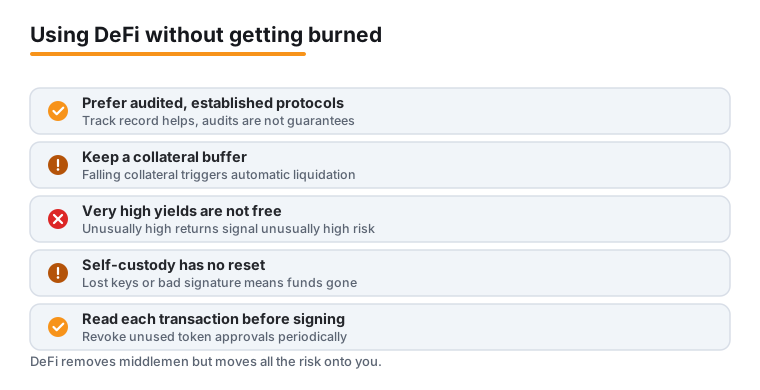
- Smart contract risk. DeFi runs on code, and code can contain bugs. Exploits and hacks have drained large sums from protocols. Favor protocols that have been audited by reputable firms and have a long track record, but treat audits as one signal, not a guarantee of safety.
- Market and liquidation risk. Crypto prices are volatile. If you have borrowed against collateral, a fast drop can trigger liquidation and real losses. Even without borrowing, the value of your deposits can fall significantly.
- Stablecoin risk. Stablecoins are central to DeFi, but they are not all equal. Some are fully backed by reserves, others rely on collateral or algorithms, and a stablecoin can lose its peg under stress. Understand what backs any stablecoin you hold.
- Custody and key risk. Self-custody means there is no password reset. If you lose your private keys or seed phrase, your funds are gone; if you are tricked into signing a malicious transaction, they can be stolen instantly. Phishing sites, fake apps, and wallet-draining scams are common.
- Counterparty and governance risk. "Decentralized" is a spectrum. Some protocols retain admin keys or upgrade controls that could be misused or compromised. Governance tokens and the teams behind them can also make decisions that affect your position.
- Regulatory and tax risk. The legal status of DeFi activities differs by jurisdiction and is still evolving in 2026. Lending, swapping, and earning yield can all have tax consequences. Do not assume any specific rule applies to you; check official sources and consider professional advice.
Practical habits reduce exposure: start small, use well-established protocols, never invest money you cannot afford to lose, double-check website addresses, and review exactly what each transaction is authorizing before you sign it. Revoking unused token approvals periodically is also good hygiene.
Frequently asked questions
How is DeFi different from a crypto exchange like Coinbase or Binance?
Centralized exchanges (CeFi) are companies that hold your assets, manage accounts, and process trades on your behalf, much like a traditional broker. DeFi protocols are software that runs on a blockchain; you keep custody of your own assets in your wallet and interact with the protocol directly. CeFi is generally easier for beginners and offers customer support, while DeFi offers self-custody and openness but puts full responsibility on the user.
Do I need Bitcoin or Ethereum to use DeFi?
Most DeFi activity happens on smart-contract networks such as Ethereum and similar chains, so you typically need that network's coin to pay transaction fees, plus whatever tokens or stablecoins you want to use. Bitcoin itself has limited native DeFi, but it can be brought into DeFi through wrapped versions (tokens on another chain that represent Bitcoin) and through bridges. Wrapping and bridging add extra steps and their own risks, so understand the mechanism before using it.
Can DeFi really help people without bank accounts?
In principle, yes. Because DeFi is permissionless and only requires a smartphone and internet, it can offer savings, payments, and credit to people who lack access to traditional banks or live with unstable local currencies. Stablecoins are particularly useful for cross-border payments and remittances. In practice, barriers remain: users need internet access, a way to convert between local money and crypto, enough technical knowledge to stay safe, and the resources to post collateral for borrowing. DeFi is a promising tool for financial inclusion, not a complete solution on its own.
Are DeFi yields safe, and why are some so high?
No yield in DeFi is risk-free. Returns come from real sources such as trading fees, borrowing demand, and staking rewards, but they fluctuate and are often boosted temporarily by a protocol handing out its own tokens. Very high advertised rates usually reflect higher risk, such as exposure to a volatile reward token, a new and unaudited protocol, or impermanent loss in a liquidity pool. Treat any rate far above what established protocols offer as a warning sign rather than an opportunity.
What is the safest way for a beginner to start with DeFi?
Learn before you commit money, then start with a small amount you can afford to lose. Use well-known, audited protocols rather than chasing the highest yields, secure your wallet's seed phrase offline, and verify every website address to avoid phishing. Read what each transaction is asking you to approve before signing it. Because rules and tax treatment vary by country and change over time, confirm anything important with official sources. This is general education, not financial, legal, or tax advice.
Last updated: 2026-06.