Liquid Staking and Restaking: Where the Extra Yield Comes From and What Can Go Wrong
If you have read our guide to how crypto staking works, you know the honest baseline: Ethereum staking pays roughly 3 percent a year, sometimes a bit less. So when a dashboard advertises 8, 12, or 15 percent on what looks like the same ETH, the correct first reaction is not excitement, it is a question: who is paying the difference, and for what? This article answers that question properly. We will walk through liquid staking tokens like stETH, restaking through EigenLayer style protocols, liquid restaking tokens like rsETH and eETH, the exploit that drained roughly 290 million dollars from Kelp DAO in April 2026, and a decision framework for whether any of this belongs in your portfolio at all.
The short answer: you are being paid to stack risks
Proof of stake yield has exactly two native sources: new coin issuance and a share of transaction fees. Everything above that baseline has to come from somewhere else. In liquid staking and restaking, the extra yield is assembled from four ingredients: payments from services that rent your staked collateral as security, token emissions from protocols buying growth, points programs that pay in airdrop speculation rather than cash, and borrowed positions that multiply all of the above. None of these are free money. Each one is compensation for a specific risk, and the risks stack on top of each other rather than replacing one another. Keep that framing: when advertised yield goes from 3 percent to 12, the risk did not quadruple in one place, it multiplied across several.
Liquid staking in plain terms: what stETH actually is
Normal staking locks your ETH with a validator. Liquid staking protocols like Lido take your ETH, stake it across their node operator set, and hand you a receipt token, stETH, that you can trade, spend, or use in DeFi while the underlying ETH keeps earning. stETH rebases daily, meaning your balance ticks up as rewards accrue, and Lido keeps 10 percent of the rewards as its fee, split between node operators and the DAO treasury. For DeFi use there is wstETH, a wrapped version whose balance stays fixed while its exchange rate rises.
The receipt is the key concept and the key risk. stETH is a claim on ETH held by someone else's smart contracts and validators. That claim introduces two things plain staking does not have: contract risk, because a bug in the protocol can impair everyone's claim at once, and market risk, because the price people will pay for stETH on an exchange can drift below the value of the ETH backing it. That drift is called a depeg, and it is not theoretical. In June 2022, during the Celsius and Three Arrows collapse, stETH traded around 0.93 to 0.95 ETH for weeks. Holders who could wait were fine. Holders who had to sell, or who had borrowed against stETH, took the loss in real money.
Restaking: renting out the same collateral twice
Restaking, popularized by EigenLayer, lets staked ETH or liquid staking tokens secure additional services on top of Ethereum. These services, called AVSs (actively validated services), include oracle networks, data availability layers, and bridges. They need economic security but do not have their own validator sets, so they rent yours. You delegate to an operator, the operator runs the AVS software, the AVS pays rewards, and in exchange your stake becomes slashable under that AVS's rules as well as Ethereum's.
This last part stopped being hypothetical on April 17, 2025, when EigenLayer's slashing went live on mainnet. Since then, each AVS defines its own slashing conditions, and there is no standard framework across them. One service might penalize downtime, another incorrect attestations, another missed cryptographic duties. Your operator's mundane mistakes, an outdated key, a buggy client, count too. Every additional AVS your operator opts into is an additional rulebook under which your ETH can be destroyed, run by a team you have probably never evaluated.
LRTs: the convenience layer that concentrates everything
Doing restaking manually means picking operators and AVSs yourself. Liquid restaking tokens, LRTs, do it for you. You deposit ETH or an LST into a protocol like Kelp (rsETH), ether.fi (eETH and weETH), or Renzo (ezETH), and receive a single token representing a managed basket of restaked positions. The protocol picks the operators, the AVSs, and the risk parameters. You inherit every one of those choices without making any of them.
That convenience is exactly what concentrates the risk. An LRT holder is exposed to the LRT protocol's contracts, the restaking layer's contracts, the LST's contracts underneath if the deposit route used one, the operator set's competence, and every AVS in the basket. Many LRTs are also bridged to other chains so they can be used in DeFi there, which adds a bridge to the stack. Remember that word, bridge. It matters in the next section but one.
Decomposing a 12 percent APY, line by line
Take a typical 2026 LRT dashboard number, say 10 to 12 percent, and pull it apart. The base Ethereum staking layer contributes roughly 3 percent. Actual AVS reward payments, real fees paid by real services, have generally added a few percent at most; analyses through 2025 and 2026 put the honest combined figure for staking plus restaking somewhere around 4 to 7 percent. Everything above that line is one of three things: incentive emissions in the protocol's own token, points programs whose value depends entirely on a future airdrop that may disappoint, or a looped position where the platform has borrowed against your deposit to buy more of the same exposure.
A useful discipline: for every percentage point of advertised yield, name the counterparty who pays it and their reason for paying. Issuance is paid by the network to secure it. AVS fees are paid by services to rent security. Points are paid by nobody yet. If you cannot complete the sentence for a chunk of the APY, that chunk is not yield, it is your own risk premium being marketed back to you.
The risk stack: slashing plus contracts plus depeg
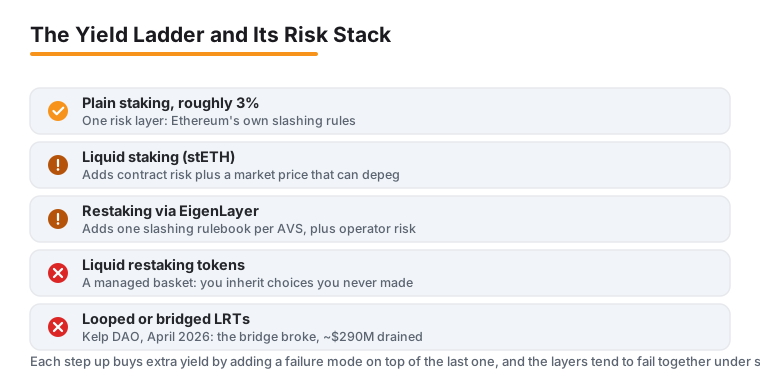
Lay the layers out and the picture is clear. Plain staking has one slashing regime and, if you self stake, no contract intermediary. Liquid staking adds a smart contract layer and a market price that can detach from backing. Restaking adds N more slashing regimes, one per AVS, plus operator risk. LRTs add another contract layer and delegate all the choices. Bridged LRTs add cross chain messaging on top.
The uncomfortable property of this stack is correlation. These risks do not fail independently on quiet days, they fail together under stress. A slashing event or exploit anywhere in the basket dents confidence in the token, the token depegs, the depeg triggers liquidations of looped positions, forced selling deepens the depeg, and lending markets freeze the collateral. Each layer's failure is the next layer's trigger. That is not a hypothetical chain of reasoning. It is a description of April 2026.
Case study: the Kelp DAO exploit, April 2026
On April 18, 2026, an attacker drained about 116,500 rsETH, worth roughly 290 million dollars, from Kelp DAO's cross chain bridge, the largest DeFi exploit of the year to that point. The failure was not in staking, not in restaking, and not in any AVS. It was the bridge. The LayerZero based setup relied on a 1 of 1 verifier configuration, a single node checking cross chain messages. Attackers, later attributed to North Korea's Lazarus Group, compromised infrastructure nodes, knocked the honest data sources offline with a denial of service attack, forced a failover to nodes they controlled, and injected fake messages that released funds across some 20 chains.
The aftermath is the real lesson. Aave froze rsETH markets within hours. The attacker deposited most of the stolen rsETH into Aave as collateral and borrowed roughly 190 million dollars in ETH and related assets against it, weaponizing the exact looping mechanics covered below. Holders of bridged rsETH on other chains found their tokens stranded or discounted through no action of their own. If you hold an LRT anywhere, you are exposed to its weakest deployment on any chain, and the weakest link is usually the plumbing nobody reads about, not the headline protocol.
The looping problem: how yield multiplies and then reverses
The recursive strategy behind many double digit APYs works like this: deposit an LST or LRT into a lending market as collateral, borrow ETH against it, use the borrowed ETH to mint more of the same token, deposit that, borrow again. Three or four loops can turn a 4 percent position into a 12 percent one. The catch is symmetry. The loop multiplies the depeg exposure by the same factor it multiplies the yield. A 5 percent depeg on a 3x looped position is a 15 percent hit to your equity, and lending markets do not wait politely, they liquidate at a penalty, and mass liquidations push the price down further, liquidating the next tier of borrowers.
Edge case worth knowing: some vault products loop on your behalf without saying so plainly. If a strategy's APY meaningfully exceeds the sum of its named yield sources, assume there is borrowing inside it and read the docs until you find it.
Getting out: exits, queues, and discounts
Exiting these positions has two doors. The primary door is protocol withdrawal: redeem the token for underlying ETH at full value, but wait through a queue. Liquid staking withdrawals typically clear in hours to days in normal conditions. LRT withdrawals also have to unwind through the restaking layer's withdrawal delay, which is measured in days by design, precisely so slashing can be applied before funds leave. The secondary door is instant: sell the token on the open market at whatever price it fetches. In calm markets the discount is negligible. In a crisis, when everyone wants the instant door, the discount is largest exactly when you most want out. If your plan assumes you can exit at par during stress, you do not have a plan.
A decision framework: is plain staking enough?
Work through these questions honestly. First, can you name the payer behind every percentage point of the advertised yield? If not, stop at plain staking. Second, if the token depegged 10 percent tomorrow, would anything in your setup force action, a loan, a loop, a margin position? If yes, you are carrying liquidation risk, not just yield risk. Third, is a meaningful share of the return points or emissions? Then you are farming a speculation, which is a legitimate activity but not passive income, size it like a speculation. Fourth, is this money you would mind losing entirely?
For most holders, the answer that falls out is boring: plain staking, done carefully, captures the reliable part of the yield with one risk layer instead of five. Our step by step staking guide covers that path. If you still want restaking exposure after all of the above, some damage limits: keep it under 10 percent of your ETH position, use one established protocol rather than chasing the top APY, hold the token on Ethereum mainnet rather than bridged versions, never loop it, and check which AVSs your deposit actually secures at least once a quarter, because the basket changes without asking you.
Frequently asked questions
Is stETH safe to hold long term?
Safer than most of what is built on top of it, but not risk free. You carry Lido's contract risk, its operator set's slashing risk, and the possibility of the market price trading below backing during stress, as it did in mid 2022. If you hold it unlevered and can wait out a depeg, the main scenarios that permanently hurt you are a serious protocol exploit or a mass slashing event, neither of which has happened to Lido at scale so far.
What exactly happens if an AVS slashes my restaked ETH?
The restaking protocol burns or confiscates a portion of the stake delegated to the offending operator, under conditions the AVS itself defined. If you hold an LRT, the loss is socialized across the token: the backing per token drops, and the market price usually drops faster. You do not get a vote, a warning, or an appeal. Your protection is choosing protocols that vet operators and cap AVS exposure, which is exactly the homework most LRT buyers skip.
Did Kelp DAO users get their money back?
The exploit was attributed to the Lazarus Group, which has an effectively zero voluntary return rate, and the funds were quickly moved into lending positions and laundering routes across many chains. Some of the attacker's downstream funds were frozen through fast action by DeFi teams and the Arbitrum Security Council, but historically, state attributed thefts of this size result in little direct recovery for holders. Treat any restaking deposit as exposed to exactly this outcome.
Why did stETH depeg in 2022 if it was always redeemable?
Because at the time it was not redeemable. Ethereum withdrawals only went live in April 2023, so before that stETH's peg was held purely by market confidence, and confidence broke when Celsius and Three Arrows were forced sellers. Today redemption arbitrage makes a deep, lasting stETH depeg harder, but short sharp dislocations are still possible whenever sellers outnumber the patient.
Are restaking points and airdrops worth farming?
They can pay off, and several 2024 to 2025 airdrops did, but you should account for them at zero until tokens hit your wallet. Points have no guaranteed conversion rate, allocations get diluted as deposits grow, and programs change rules retroactively. If removing the points from the math makes the position unattractive, the position is a speculation on an airdrop, so size it accordingly.
Is liquid staking through an exchange the same thing?
Functionally similar, structurally different. Exchange staking products and tokens like cbETH put a custodian between you and the stake, so you swap smart contract risk for counterparty and account freeze risk, and yields are usually lower after fees. For small amounts the convenience can be worth it. For meaningful size, self custodied liquid staking or plain staking gives you fewer parties who can say no when you want your ETH back.
Last updated: 2026-06-30.