Crypto Staking Explained: How It Works, What It Pays, and What Can Go Wrong
Staking is one of the few ways to earn a return on crypto that comes from the network itself, not from lending your coins to a stranger. But the word gets stretched to cover everything from running your own validator to tapping a button on an app that promises 20 percent a year, and those carry very different risks. This guide covers what staking actually is, a realistic payout in 2026, the ways it can cost you money, and a calm first-time path. It is written for a normal person, not a trader.
This is educational content, not financial advice. Nothing here is a recommendation to buy, sell, or stake any asset, and you should confirm current rules and rates yourself before acting.
What staking actually is, in plain words
Some blockchains decide who adds the next block of transactions by lottery, and your odds go up if you lock some of your own coins as a deposit. That deposit is your stake. Behave honestly and the network pays you a small reward for helping keep its records correct. Cheat, or let your equipment fail badly, and part of your deposit can be taken away. That is the whole idea: skin in the game, paid out as yield.
This system is called proof of stake. It replaced the older proof of work model on Ethereum in 2022, and most newer networks use it. The coins you can stake are the network's own token, for example ETH on Ethereum or ADA on Cardano. You cannot stake Bitcoin this way, because Bitcoin uses proof of work and has no native staking. If a product offers a yield on Bitcoin, it is doing something else, usually lending, with separate risks.
One thing staking is not: it is not free money, and it is not interest from a bank. The reward is new coins the network creates plus transaction fees, paid in the same asset whose price you are exposed to. Staking pays you in the same asset whose price you are exposed to, so the yield and the price risk are bound together.
What a realistic reward looks like in 2026
Real network staking yields are modest. As of mid 2026, Ethereum's base reward sits around 2.6 percent a year, according to ethereum.org, with roughly 41 million ETH staked, about a third of the supply. Cardano delegators typically see low single digits, often quoted between about 2.7 and 4.5 percent depending on the pool. These rates drift down as more coins get staked, since the same reward pool is shared among more people.
Here is the rule worth remembering: the network sets a ceiling on what honest staking can pay, and right now that ceiling is low single digits for the big chains. So when an app advertises a flat 15 or 20 percent on a major coin, that extra yield is not coming from staking. It is coming from lending your coins to borrowers, from a token the platform prints, or from new deposits paying old ones. A guaranteed 20 percent is a red flag, not a deal.
The clearest warning is Anchor Protocol, which paid a fixed 20 percent on the UST stablecoin in 2021 and 2022. Commentators flagged for months that the rate was unsustainable, the reserves needed repeated bailouts, and in May 2022 the system collapsed and wiped out tens of billions of dollars. If you cannot explain in one sentence where a return comes from, treat it as gone.
Lockups, queues, and getting your coins back
Staked coins are not always instantly available. Two delays matter. First, on some networks there is a waiting line to start or stop being a validator. On Ethereum, joining runs through an activation queue and leaving runs through a separate exit queue, and both swing sharply with demand. The exit queue hit a record of more than 46 days in September 2025 after one large operator withdrew about 1.6 million ETH at once, and as of August 2026 the exit queue is empty while the entry queue is backed up at over 40 days. Second, some staking products add their own lockup on top, where your coins are frozen for a fixed term.
Networks differ a lot. Cardano is on the easy end: when you delegate ADA to a stake pool, the coins stay in your wallet, stay spendable, and there is no unbonding wait if you stop. Ethereum sits in the middle, with a queue but no fixed term. Some chains lock coins for a set number of days after you ask to withdraw, and you earn nothing during that window.
Why this matters: if the price drops and you are stuck in a multi-day exit queue, you cannot sell until your coins come out. Before you stake, get an exact answer to two questions. How long to get my coins back, and do I earn rewards during that exit, or nothing? If the platform will not say plainly, that is your answer.
Three ways to stake, and who each suits
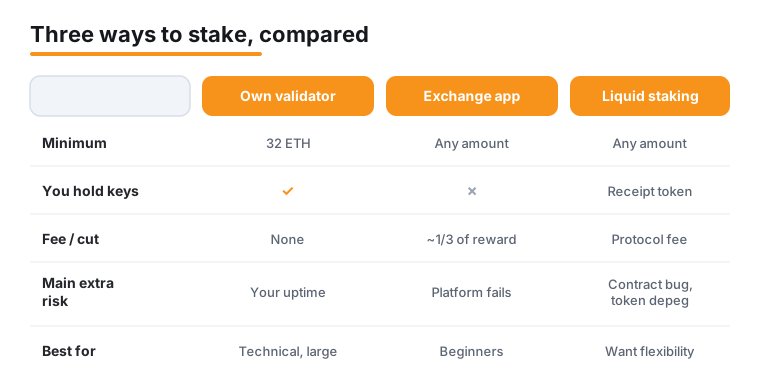
Run your own validator. On Ethereum this means depositing 32 ETH and running validator software on a computer that stays online, as the official ethereum.org staking page describes. You keep your own keys, take no middleman cut, and earn the full reward. You also carry full responsibility: downtime costs small penalties, and mistakes can cost more. This suits technically confident people with a meaningful amount to stake.
After the Pectra upgrade in 2025, a single validator can hold any balance between 32 and 2,048 ETH and compound rewards automatically, instead of forcing large holders to run dozens of separate validators. The 32 ETH floor to start has not changed.
Stake through an exchange or app. Platforms like Coinbase and Kraken let you stake with no minimum, even a fraction of a coin, by pooling deposits and running validators for you. The trade-off is a commission. Coinbase, for example, takes a sizable cut of the reward, recently around a third on a standard account and less for premium tiers, so a roughly 4 percent gross rate can land closer to 3 percent in your account. It is the simplest option and suits beginners, but you are trusting the platform to hold your coins safely.
Liquid staking. You deposit a coin and get a tradeable receipt token back, for example stETH from Lido or cbETH from Coinbase, that keeps earning while you hold it. You can move or use that token elsewhere instead of having your funds frozen. It adds smart-contract risk and the chance the receipt token trades below the real coin during a panic. As covered below, US regulators have now addressed plain staking and, in a separate August 2025 staff statement, certain liquid staking arrangements too, though restaking is still unaddressed and all of it is staff guidance rather than binding law.
Slashing and the other ways you can lose money
Slashing is the penalty for a validator doing something the network treats as an attack, such as signing two conflicting versions of a block. Per the official Ethereum proof-of-stake docs, a slashed Ethereum validator faces an immediate burn of about 0.0078 ETH per 32 ETH staked, then a gradual drain over roughly 36 days, plus a larger correlation penalty if many validators are slashed at once. The everyday risk for a careful validator is small.
Two things to keep straight. Simply going offline is not slashing. The same docs note there is no slashing for missing a block proposal; you just forgo the reward and pay tiny inactivity penalties. Slashing is reserved for provable misbehavior. And if you stake through an exchange or liquid staking service, you usually are not slashed directly; you bear it only if the operator is penalized and passes the loss along.
The losses that actually empty wallets are usually not slashing at all. They are: the coin's price falling while you are locked up; a smart-contract bug draining a staking protocol; a receipt token like stETH depegging when you need to sell during a crisis; and the platform itself failing. The crypto lender Celsius froze withdrawals and went bankrupt in 2022, and the US Federal Trade Commission settled with the company and charged its co-founders with duping customers while billions in deposits were squandered. Earn program customers were treated as unsecured creditors, near the back of the line. The point behind "not your keys, not your coins" is that when a custodian collapses, your deposit can be gone.
Are the rewards taxable? In the US, yes
In the United States, staking rewards are taxable income. The IRS settled this in Revenue Ruling 2023-14, which says a cash-method taxpayer must include the fair market value of staking rewards in gross income in the year they gain "dominion and control" over them, meaning the moment you can actually sell or move them. This applies whether you stake directly or receive rewards through an exchange.
A small worked example. Say you receive a reward worth 50 dollars on the day it becomes yours to control. You report 50 dollars of ordinary income that year, even if you do not sell, and that 50 dollars becomes your cost basis. If you later sell those coins for 80 dollars, you have a 30 dollar capital gain on top; sell for 30 dollars and you have a 20 dollar loss. Keep a record of the date, amount, and dollar value of every reward, because the value at receipt is what you are taxed on.
Tax treatment differs by country and changes over time, and this is a genuinely tricky area, so treat the above as background and check current rules for where you live. Our overview of crypto taxes goes deeper, and a qualified tax professional is worth it once real money is involved.
Where the rules stand in 2026
The regulatory picture has gotten clearer for plain staking. In May 2025 the SEC's Division of Corporation Finance issued a statement on protocol staking concluding that several common forms, solo staking, delegating while keeping custody, and basic custodial staking, are not securities transactions, because the reward comes from helping run the network rather than a manager's efforts. That removed a legal cloud over US staking services.
Two cautions. The statement is staff guidance, not binding law, and it did not itself cover liquid staking or restaking. The staff addressed liquid staking separately in an August 2025 statement, reaching the same conclusion, but restaking is still unaddressed and remains the least settled area. State regulators have not all fallen in line. So the simple forms have a clearer footing in the US; the fancier products are still a question mark. Rules elsewhere vary widely; our crypto regulation overview and the country pages, such as the United States, are a starting point for where you live.
A safe first-time walkthrough
If you want to try staking without taking outsized risk, here is a measured path. None of this is a recommendation to stake; it just reduces avoidable mistakes if you have already decided to.
1. Decide an amount you can ignore for months. Stake only coins you already own and would hold anyway. Never borrow to stake.
2. Pick a major network with well-documented mechanics, and read its official staking page so you understand the lockup and reward before you commit.
3. Start on a reputable, regulated exchange. In the Coinbase app, open the asset under your portfolio, tap Stake, enter a small amount, read the risk acknowledgment, and confirm. On Kraken the flow is similar under its earn or staking section.
4. Note three numbers before confirming: the advertised rate, the platform's commission, and the time to unstake. If any is missing or vague, stop.
5. Record the date and dollar value of each reward as it arrives, for taxes.
6. After a few weeks, practice unstaking a small portion so you learn how long it really takes and that the money comes back. Only then consider doing more.
7. As you grow more comfortable, read about holding coins yourself. Our guides on crypto wallets and cold storage cover self-custody options that reduce platform risk, and the crypto basics page fills in surrounding concepts.
Common mistakes to avoid
Chasing the highest advertised number is the big one. A 15 percent rate on a major coin is not a better version of a 3 percent rate; it is a different, riskier product wearing the same word.
Confusing the receipt token with the real coin is another. A liquid staking token can trade below the underlying asset during stress, so selling it in a panic may lock in a loss the native withdrawal queue would have avoided. Ignoring the unstaking delay trips people up too: assuming you can exit instantly, then finding a multi-day queue exactly when you want out. Forgetting that rewards are taxed when received, not when sold, leaves people with a tax bill and no records. And parking large balances on an exchange just to earn a small yield concentrates platform risk for a thin payout.
Frequently asked questions
Can I lose my original coins by staking?
Yes, in a few ways. The coin's price can fall while you are staked, which is the most common loss. A validator that misbehaves can be slashed and lose part of its deposit. A staking platform can fail or be hacked. And a liquid staking receipt token can trade below the real coin if you sell during a crisis. Honest staking on a major network with a reputable provider rarely triggers slashing, but price risk and platform risk are always present.
Why is a 20 percent staking yield a red flag?
Because honest network staking on big coins pays low single digits in 2026, and that is the ceiling the protocol sets. Any return far above it is coming from somewhere riskier, usually lending your coins out, a token the platform prints, or new deposits paying old ones. Anchor Protocol's fixed 20 percent looked great until the system collapsed in 2022 and erased tens of billions. If you cannot explain where the extra yield comes from, assume it is borrowed time.
Is staking the same as a savings account?
No. A bank savings account pays interest in dollars and, in many countries, your deposit is insured up to a limit. Staking pays you in the same crypto whose price you are exposed to, the reward is not guaranteed, there is no deposit insurance, and on some networks your coins are locked for days. The two can look similar in an app, but the protections are not comparable.
How long does it take to get staked coins back?
It depends entirely on the network and product. Cardano lets you stop delegating with no waiting period, and the coins never leave your wallet. Ethereum routes withdrawals through an exit queue whose length swings with demand. It hit a record of more than 46 days in September 2025 when one large operator exited at once, and it was empty in August 2026. Some platforms add their own fixed lockup. Always confirm the exact unstaking time before you commit, and whether you keep earning during the exit.
Do I owe tax on staking rewards if I never sell?
In the United States, yes. IRS Revenue Ruling 2023-14 treats the fair market value of rewards as income in the year you gain control over them, regardless of whether you sell. That value also becomes your cost basis for a later sale. Rules differ by country and change, so verify your local treatment and keep dated records of every reward, ideally with help from a tax professional.
Is staking on an exchange legal in the US in 2026?
For plain staking, it has a clearer footing. In May 2025 the SEC staff stated that solo staking, custody-keeping delegation, and basic custodial staking are not securities transactions. But that is staff guidance rather than binding law, the May 2025 statement did not itself cover liquid staking or restaking, though a separate August 2025 staff statement reached a similar conclusion for certain liquid staking arrangements, restaking is still unaddressed, and some states may take their own view. The simple forms are on firmer ground than the more complex products.