How to Stake Crypto: A Step-by-Step Beginner's Guide
Staking means locking up a coin that runs on a proof-of-stake network so it can help validate transactions, and in return you earn rewards paid in that same coin. Networks like Ethereum, Solana, and Cardano use this design instead of mining: rather than burning electricity to secure the chain, they rely on participants who put their own coins on the line. When you stake, your coins are part of that security, and the network shares some of its newly issued or fee-based rewards with you.
This guide explains what staking is, then compares the three common ways to do it, honestly, by effort, control, and risk. It walks through the basic steps using the simplest route as an example, and it is clear about what can go wrong. This is educational information, not financial or tax advice; the goal is to help you understand the choices, not push you toward staking.
What staking is, in plain terms
On a proof-of-stake network, the right to validate the next block of transactions is given to participants who have locked up coins as a deposit. That deposit is the stake. By committing coins, a validator is promising to follow the rules; if it does its job honestly and stays online, it earns rewards, and if it misbehaves it can lose part of the stake. This is how the network reaches agreement without miners.
You do not have to run a validator yourself to take part. Staking applies to proof-of-stake networks such as Ethereum, Solana, and Cardano, and there are several ways for an ordinary holder to contribute coins and share in the rewards without operating any equipment. The trade-off between those ways is the heart of this guide. For a deeper conceptual treatment, see crypto staking explained.
The three common routes, compared honestly
There are three routes most people use, and they differ mainly in how much effort they take, how much control you keep, and what risks you accept. None is best in the abstract; the right choice depends on how much you hold, how technical you are, and how much you trust a third party. The table summarizes the trade-offs, and the sections below add detail.
| Route | Effort | Control | Main risks |
|---|---|---|---|
| Centralized exchange | Lowest | Custodial; exchange holds the coins | Counterparty risk; exchange takes a fee |
| Pooled / liquid staking | Moderate | You hold a tradeable staking token | Smart-contract bugs; token can trade below the underlying |
| Solo staking | Highest | Full; you run the validator | Slashing; downtime; technical setup |
Notice that effort and control tend to move together. The easiest route gives you the least control, and the route with the most control asks the most of you. There is no option that is simultaneously effortless, fully self-controlled, and risk-free.
Route A: staking through a centralized exchange
This is the simplest route. You hold a stakeable coin on an exchange, choose to stake it through the platform's interface, and the exchange stakes on your behalf for a fee. You do not run anything, manage keys for a validator, or think about uptime. For many beginners this is the first staking they try, simply because it is a few taps inside an app they already use.
The cost is control. Exchange staking is custodial: the exchange holds the coins, so you depend on the platform's solvency and security. If the exchange fails, is hacked, or freezes withdrawals, your staked coins are caught up in that. This is the same counterparty risk that applies to leaving any funds on an exchange, and it does not disappear because the funds are staked. The exchange also keeps a cut of the rewards as its fee. If you are weighing whether to keep coins on a platform at all, the broader picture in our Ethereum overview is a useful companion.
Route B: pooled and liquid staking
Pooled and liquid staking protocols, for example Lido, let any amount of a coin take part by combining many people's deposits. There is no large minimum, and in the liquid version you receive a tradeable token that represents your stake and its accruing rewards. You can hold, move, or use that token while the underlying coins stay staked, which is why it is called liquid.
The risks here are different in kind. These protocols run on smart contracts, so a smart-contract bug could put deposits at risk. The staking token can also trade below the value of the underlying coins it represents, a gap sometimes called a depeg, especially during stressed markets. Liquid-staking protocols commonly charge around 10% of the rewards as a fee. This route sits between the other two: more control and self-custody than an exchange, but more moving parts than simply holding a coin, and it leans on the kind of on-chain infrastructure covered in our DeFi explainer.
Route C: solo staking
Solo staking gives you the most control and the full reward, because you run the validator yourself with no middleman taking a cut. On Ethereum this means depositing 32 ETH to run your own validator. The all-in reward for staking ETH is typically around 3% to 4% as of 2026, and a solo staker keeps all of it rather than sharing it with a pool or exchange.
The demands are real. Solo staking needs technical setup and reliable uptime: your validator should be online and behaving correctly. Solo validators can be penalized through slashing for misbehavior, and can lose small amounts for being offline. Importantly, this slashing risk falls on the validator operator. Someone using a reputable pooled or exchange service in the normal way is not personally slashed; that operational risk is the operator's. If you want to understand the official requirements before considering this route, the canonical reference is ethereum.org.
How to start: the basic steps
The steps below use the exchange route as the simple example, since it involves the fewest moving parts, but the thinking behind each step applies to all three routes. Read the whole list before committing any coins, because the most important work, understanding the terms and the risks, happens before you click stake.
- Pick a stakeable coin you already hold. Staking only works on proof-of-stake networks, so check that the coin you have, such as ETH, SOL, or ADA, actually supports staking rather than buying something new just to chase a reward.
- Understand the reward rate, fees, and any lock-up before committing. Find out the advertised reward rate, what fee the platform or protocol keeps, and whether there is a lock-up or unbonding period during which you cannot freely move the coins. These terms vary a lot between networks and routes.
- Choose the route that matches your skill and trust level. Decide honestly whether you want the simplicity and counterparty risk of an exchange, the flexibility and smart-contract risk of liquid staking, or the control and responsibility of solo staking.
- Start with a small amount. Stake a modest amount first so you can see how rewards appear, how the interface works, and how unstaking behaves before committing more.
- Keep records, because rewards are usually taxable. Note what you received and when, since in many countries staking rewards are taxed as income when you receive them.
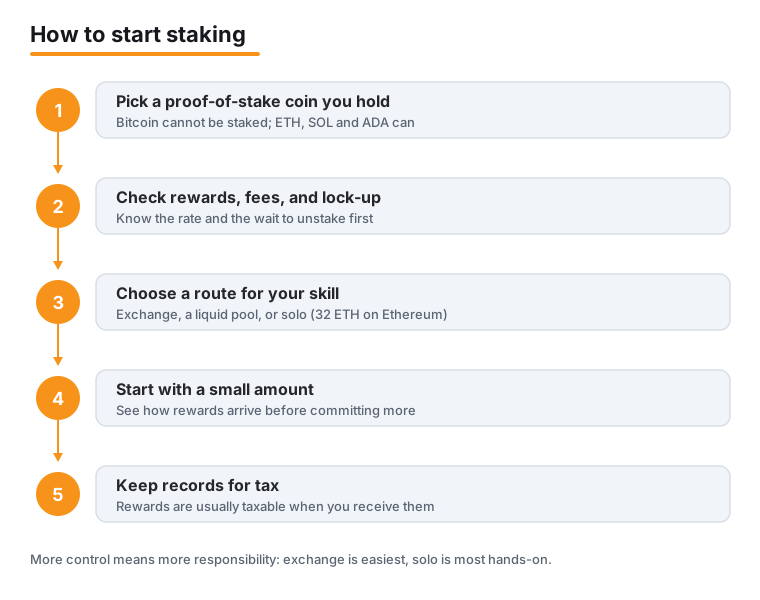
That is the whole core procedure. The pattern to notice is that the technical act of staking is usually quick; the parts that protect you are choosing the right route and understanding the terms beforehand. For the related skill of moving between coins, see how to swap one crypto for another.
Lock-up, unbonding, and getting your coins back
Staked coins are not always instantly available. Different networks have different lock-up or unbonding periods, the wait between asking to unstake and actually being able to move the coins. This can range from none at all to many days, so it is worth checking before you commit rather than discovering it when you want out.
Ethereum is a useful concrete example. Withdrawals of staked ETH have been possible since the Shanghai upgrade in April 2023. There is an exit, or unbonding, queue, and as of early 2026 that queue is very short, often just minutes. It can lengthen, though, when many validators try to exit at once, so the wait is not fixed. The general lesson holds across networks: confirm how quickly you can unstake before you assume your coins are liquid.
The risks, and the tax side
Staking is not free money, and being clear-eyed about the downsides matters more than the headline reward rate. Lock-up and unbonding delays mean you may not be able to sell quickly when you want to. Slashing can penalize a validator for misbehavior or downtime, though that risk sits with the operator, not with an ordinary user of a reputable pooled or exchange service. Smart-contract risk applies to liquid staking, where a bug could affect deposits. Counterparty risk applies to exchanges, where you depend on the platform staying solvent and secure. Above all, rewards are not guaranteed, and the coin's price can fall, sometimes by far more than any reward; staking does not remove the basic market risk of holding the coin.
There is also a paperwork side. In many countries, staking rewards are taxable as income when you receive them, valued at the time they arrive, with possible further tax consequences if you sell. Rewards often arrive frequently, so it helps to note amounts and dates as you go. Rules differ by country and change over time, so consider speaking with a qualified tax professional about your situation. For a general orientation, see our crypto taxes guide. This remains educational information, not financial or tax advice.
Frequently asked questions
What is the difference between staking and just holding a coin?
Holding a coin means it sits in your wallet or on an exchange doing nothing in particular. Staking means locking that coin into a proof-of-stake network so it helps validate transactions, and in return you earn rewards paid in the same coin. The trade-off is that staked coins are committed: depending on the network and route, you may face a lock-up or unbonding period before you can move them again. Staking also adds risks, such as smart-contract or counterparty risk, that simple holding does not.
Do I need 32 ETH to stake Ethereum?
Only if you want to run your own validator through solo staking, which requires depositing 32 ETH and keeping it online with reliable uptime. If you do not have that amount or do not want the technical responsibility, pooled or liquid staking removes the minimum and lets any amount take part, and centralized exchanges also let you stake whatever you hold. Those routes are easier but come with their own trade-offs: a fee on your rewards, plus smart-contract risk for liquid staking or counterparty risk for an exchange.
How long until I can unstake and access my coins?
It depends on the network. Different chains have different lock-up or unbonding periods, ranging from none at all to many days, so you should check before committing. On Ethereum, withdrawals of staked ETH have been possible since the Shanghai upgrade in April 2023, and there is an exit queue that as of early 2026 is often just minutes, though it can lengthen when many validators exit at once. Do not assume staked coins are instantly available; confirm the wait for your specific coin and route first.
Is staking safe?
Staking carries real risks that vary by route. Exchange staking adds counterparty risk, since the platform holds your coins and you depend on its solvency and security. Liquid staking adds smart-contract risk and the chance that the staking token trades below the underlying coins. Solo staking adds slashing and downtime risk for the operator. Across all routes, rewards are not guaranteed and the coin's price can fall, sometimes by far more than any reward. Starting small and understanding the terms first are the most useful precautions.
Will I get slashed for staking?
Slashing is a penalty that can take part of a validator's stake for misbehavior, and there can be smaller penalties for being offline. This risk falls on whoever operates the validator. If you stake solo and run your own validator, the risk is yours. If you use a reputable pooled service or a centralized exchange in the normal way, you are not personally slashed; that operational risk sits with the operator. As with any service, choosing established and well-regarded providers reduces, though never fully removes, the chance of problems.
Are staking rewards taxable?
In many countries, staking rewards are taxed as income when you receive them, valued at the time they arrive, and selling later can have further tax effects. Rules differ by country and change over time, so this guide cannot tell you your exact obligations. The practical advice is to keep clear records of what you staked, what you received, and when, since rewards often arrive frequently and add up. Consider consulting a qualified tax professional about your situation. This is educational information, not financial or tax advice.
Last updated: 2026-06.
Related guides
- How to Swap One Crypto for Another Safely
- How to Accept Crypto Payments as a Business
- How to Choose the Right Network When Sending Crypto (ERC-20 vs TRC-20 vs BEP-20)
- Getting Paid in Crypto: How Stablecoin Salaries Actually Work
- How to Back Up Your Seed Phrase (and Test That It Works)
- How to Set Up a Self-Custody Wallet
- Crypto Scams and Fraud: How to Stay Safe