Cardano (ADA): Guide, Price & How to Buy
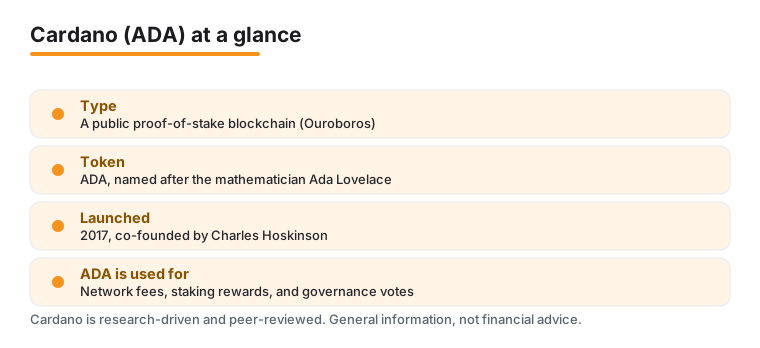
Cardano is a public proof-of-stake blockchain whose native token is ADA. It launched in 2017 and was co-founded by Charles Hoskinson, one of the original Ethereum co-founders. What sets the project apart is its development style: most major changes are grounded in peer-reviewed academic research and formal methods before they reach the live network. The stated goals are scalability, sustainability and security, with a long-term focus on financial services for regions that are underbanked.
This guide explains what Cardano is and how it works under the hood, walks through buying and staking ADA, compares Cardano with Ethereum, and looks at the factors that actually move ADA's price. The aim is to give you an accurate, jargon-light starting point. Nothing here is financial, legal or tax advice, and crypto markets are volatile; treat ADA as a high-risk asset and verify current details with official sources before acting.
What is Cardano (ADA)?
Cardano is a layer-1 blockchain, meaning it is a base network on which applications and tokens can be built, much like Ethereum or Solana. ADA is the coin used to pay transaction fees, participate in staking, and vote in on-chain governance. The token is named after Ada Lovelace, the 19th-century mathematician often regarded as the first computer programmer.
The network secures itself with a proof-of-stake consensus protocol called Ouroboros. Instead of miners competing with energy-hungry hardware, as on Bitcoin, the right to add blocks is awarded to stake pools roughly in proportion to the ADA delegated to them. This makes Cardano far less energy-intensive than proof-of-work chains and lets ordinary holders earn rewards by participating. Ouroboros was one of the first proof-of-stake protocols to be published with formal security proofs in peer-reviewed venues.
How the network is built
Cardano's roadmap has historically been organised into named eras, each adding a capability:
- Byron established the foundation and the ability to move ADA.
- Shelley decentralised the network and introduced staking and stake pools.
- Goguen brought smart contracts via the Plutus platform, enabling decentralised applications (dApps).
- Basho focuses on scaling, including the Hydra layer-2 system.
- Voltaire introduces on-chain governance so that ADA holders, rather than founding entities, decide the protocol's future and control the treasury.
A practical design choice worth knowing is the Extended Unspent Transaction Output (eUTXO) accounting model, an extension of the model Bitcoin uses. Rather than one global, constantly changing balance sheet, the ledger is a set of discrete outputs that transactions consume and recreate. This allows fees and the success or failure of a transaction to be calculated before it is submitted, and lets independent transactions be validated in parallel.
ADA has a fixed maximum supply of 45 billion tokens, of which a large majority is already in circulation. Because no more than 45 billion can ever exist, ADA is often described as having a capped, disinflationary supply, with staking rewards drawn from a reserve and from transaction fees. Always check a live data source such as a major exchange or block explorer for the current circulating figure.
How to buy & stake ADA
There are two common routes to acquiring ADA: a centralised exchange that takes traditional money, or a decentralised exchange (DEX) where you swap other crypto directly from your own wallet. Below is a general walkthrough. Exact steps, fees and availability differ by provider and country, so confirm details on the platform itself.
Buying ADA with fiat on a centralised exchange
Centralised exchanges such as Binance, Coinbase, Kraken and others let you convert currencies like USD, EUR or GBP into ADA. The typical flow is:
- Open and verify an account. You will normally complete identity verification (KYC), uploading ID and sometimes proof of address. This is a legal requirement on most regulated platforms.
- Deposit funds. Common methods include bank transfer, debit or credit card, and sometimes regional payment services. Card purchases are fast but usually carry higher fees than bank transfers.
- Place the order. Search for ADA or a pair such as ADA/USD, choose a market order (buy immediately at the current price) or a limit order (set the price you are willing to pay), enter the amount, and confirm.
- Decide where to keep it. You can leave ADA on the exchange for convenience, or withdraw it to a personal wallet for greater control.
Buying ADA on a decentralised exchange
A DEX lets you trade peer-to-peer through smart contracts, without handing custody to a company, and usually without an account sign-up. To use one you first need a self-custody wallet that supports Cardano, then connect it to a DEX built on the network and swap one token for ADA (or vice versa). When choosing a DEX, look at its liquidity and trading volume for the pair you want, the swap fees, and the project's track record. Because you control the wallet, you are fully responsible for security and for double-checking token contract addresses before approving a swap. Self-custody also means there is no support desk to recover funds if you lose your recovery phrase.
Wallets and security
A Cardano wallet stores the private keys that control your ADA. Popular options include software wallets such as Lace, Eternl, Yoroi and the Daedalus full-node wallet, and hardware wallets like Ledger and Trezor that keep keys offline. Whatever you choose: write down your recovery phrase on paper, store it offline, never type it into a website, and enable two-factor authentication on any exchange account. A hardware wallet is the strongest practical option for larger holdings.
Staking ADA
Staking is one of Cardano's most user-friendly features. You delegate your ADA to a stake pool to help secure the network and earn rewards, and several details make it low-friction:
- No lock-up. Your ADA never leaves your wallet and stays fully liquid. There is no unbonding or freeze period, so you can spend, move or re-delegate at any time.
- Rewards by epoch. An epoch lasts about five days. After you first delegate, it typically takes two to three epochs before your initial rewards appear, after which they are paid each epoch and compound automatically.
- Pool choice matters. Avoid pools that are saturated (over the network's per-pool stake cap), as rewards per delegator fall once a pool is too large. Look at fees, reliability and how consistently a pool produces blocks.
- Typical yields. Annual returns have generally sat in the low single digits in 2026. Yields vary with network parameters and pool performance, so treat any figure as an estimate, not a guarantee. Many centralised exchanges also offer staking, usually for a cut of the rewards and sometimes with their own conditions.
Note that staking rewards can be taxable income in many jurisdictions. Keep records and consult a qualified tax professional about your local rules.
Cardano vs Ethereum
Cardano and Ethereum are often compared because Charles Hoskinson helped start both, and because both are general-purpose smart-contract platforms. They have since taken different technical paths. Neither is simply better; they reflect different priorities.
| Aspect | Cardano | Ethereum |
|---|---|---|
| Consensus | Proof-of-stake (Ouroboros) since launch | Proof-of-stake since the 2022 Merge (previously proof-of-work) |
| Accounting model | Extended UTXO (eUTXO) | Account-based |
| Smart-contract languages | Plutus (Haskell-based), Aiken, Marlowe for finance | Solidity, Vyper |
| Development style | Research-led, formal verification, peer review | Faster iteration, very large existing ecosystem |
| Scaling approach | Hydra and other layer-2 work; on-chain throughput upgrades | Large rollup (layer-2) ecosystem |
What the differences mean in practice
The accounting models lead to different developer experiences. Ethereum's account model gives smart contracts access to a shared global state, which is flexible and familiar but can make outcomes and gas costs harder to predict and has historically been a source of certain bug classes. Cardano's eUTXO model makes a transaction's validity and fee knowable before submission and supports parallel processing, but it requires a different way of structuring applications, which can be a learning curve for teams arriving from Ethereum.
Ethereum's biggest advantage today is maturity: a far larger base of developers, tools, liquidity and deployed applications, especially in decentralised finance and NFTs. Cardano's pitch is methodical engineering, predictable fees, low energy use and an increasingly formal, community-run governance system. The two are not mutually exclusive, and a growing amount of work across the industry aims at interoperability so assets and data can move between chains. If you want a wider primer on how these networks differ, our crypto comparisons hub and the Ethereum (ETH) guide go into more depth.
ADA price & outlook
ADA's price, like that of most cryptocurrencies, is volatile and driven by a mix of factors rather than any single cause. Understanding what tends to influence it is more useful than chasing forecasts. This section explains the dynamics; it deliberately avoids price predictions.
What tends to move ADA
- Broad crypto market cycles. ADA is strongly correlated with the wider market. When Bitcoin and the overall market rally or sell off, ADA usually moves in the same direction.
- Macroeconomic conditions. Interest rates, inflation and general risk appetite affect speculative assets. Tighter financial conditions tend to weigh on crypto; looser conditions tend to support it.
- Technology and adoption. Delivery of scaling and governance upgrades, growth in the number of dApps, total value locked in Cardano DeFi, and real-world or institutional usage can all influence demand for ADA.
- Network developments and governance. Protocol upgrades and the maturing on-chain governance process can shift sentiment, positively or negatively, depending on how they land.
- Sentiment and liquidity. News, social-media discussion, exchange listings and overall trading volume can amplify moves in both directions over the short term.
Where the project is heading in 2026
Cardano's recent direction centres on scaling and decentralised governance. On scaling, the Hydra layer-2 system processes transactions off-chain in parallel "heads" to raise throughput and lower costs, and longer-term consensus research (publicly discussed under the name Ouroboros Leios) aims to increase base-layer capacity substantially. On user experience, the Mithril protocol speeds up wallet synchronisation so lightweight and mobile users can interact with the chain more easily.
On governance, the network has moved into community-led, on-chain decision-making in which ADA holders vote on protocol changes and treasury spending, building on the framework set out in CIP-1694. Protocol upgrades are delivered through hard forks, and the timing of any given upgrade can change as it goes through testnet validation and community review. Because these schedules and outcomes shift, confirm the current status on official Cardano channels and reputable trackers rather than relying on a fixed date.
The practical takeaway: ADA is a speculative, higher-risk asset whose value depends on adoption that has not yet fully materialised. Do your own research, size any position so you could absorb a large loss, and remember that none of this is investment advice.
What changed in 2025-2026
The last year or so has been one of the busier periods in Cardano's history, with several long-promised pieces actually shipping. Here is a plain-language rundown of what is new, with links so you can check the primary sources yourself. None of this is a recommendation to buy or sell; it is context.
Governance went fully live
The big structural change is that Cardano's on-chain governance is now operating day to day rather than sitting on paper. The community ratified a formal Cardano Constitution, first enacted on-chain in February 2025 after the Plomin hard fork, and an updated version took effect on 24 January 2026 with about 79% support from Delegated Representatives (DReps). The update tightened the rules: treasury withdrawal proposals must now be fully self-contained, and off-chain documents attached to proposals need permanent, tamper-evident links. Founding entities such as Input Output no longer have special control over the treasury; ADA holders, the stake pool operators and an elected Constitutional Committee do. You can read the official note on the updated Constitution at cardano.org. In practice this means real votes are now being held on things like ecosystem budgets and event funding, and they do not always go the way the founding teams might prefer.
Stablecoins finally arrived in size
For years a common criticism was that Cardano lacked deep stablecoin liquidity, which made its DeFi feel thin. That changed in early 2026 when USDCx, a version of Circle's USDC backed 1:1 and brought across through Circle's xReserve and Cross-Chain Transfer Protocol, went live on the Cardano mainnet on 27 February 2026. Within weeks it became the network's largest stablecoin, sitting alongside existing options like USDM, USDA and the older DJED. Circle's own write-up is here: USDCx on Cardano via Circle xReserve. More dollar liquidity on-chain is what lending markets and exchanges need to function, so this is a meaningful piece of plumbing rather than just a headline. If you are new to how dollar-pegged tokens work and why rules around them matter, see our explainer on stablecoins and the GENIUS Act and the broader DeFi guide.
A clearer regulatory picture in the US
Cardano's regulatory standing in the United States improved over 2025 and 2026. The SEC dropped its enforcement cases against Coinbase and Binance in 2025, easing the climate for tokens like ADA. Then in March 2026, reporting indicated US regulators moved toward treating ADA as a digital commodity rather than a security, in line with proposed market-structure legislation that would put assets like it under CFTC oversight. Treat the exact legal status as still settling rather than fully final, and remember rules differ by country. Our general crypto regulation overview and the deeper piece on crypto and securities law explain why the security-versus-commodity question matters so much for which products, like ETFs, can launch.
Scaling work kept moving
On the technical side, Hydra moved from demos into more real use, including non-custodial trading venues that use its near-instant finality, and an early alpha of an updated Hydra was shown. The headline scaling project, Ouroboros Leios, which reworks how blocks are produced to lift base-layer throughput, entered its public rollout plan during 2026 with a testnet phase targeted for mid-year. These are works in progress, not finished products, and timelines have slipped before, so check current status before assuming any date.
Where ADA stands versus competitors
It helps to be honest about Cardano's competitive position rather than cheerlead. ADA is still a large and well-known cryptocurrency, but its standing relative to rival smart-contract platforms has slipped from its peak, and the conversation among developers and traders in 2026 tends to centre on Ethereum and Solana more than on Cardano.
Market size and ranking
By mid-2026 ADA generally sat outside the very top tier of cryptocurrencies by market value, ranking lower than it did in the 2021 cycle. Solana in particular has a market capitalisation several times larger than Cardano's, and newer entrants have at times pushed past ADA in the rankings. Exact positions move constantly, so check a live tracker such as CoinMarketCap's Cardano page for current figures rather than trusting any number quoted here.
The honest comparison
- Versus Ethereum: Ethereum has far more developers, applications, liquidity and tooling. Cardano counters with predictable fees, very low energy use and a research-first culture, but it has not matched Ethereum's ecosystem depth. See the ETH guide for more.
- Versus Solana: Solana built a reputation for raw speed and low fees and attracted a lot of activity in trading, payments and consumer apps. Cardano's throughput upgrades (Hydra, Leios) are partly aimed at closing that gap, but much of that work is still maturing.
- Versus Bitcoin: This is less a direct rivalry, since Bitcoin is mainly used as a store of value rather than an applications platform, but ADA competes with Bitcoin for the same speculative capital during market cycles.
The fair summary: Cardano has strong engineering and a now-functioning governance system, but it is playing catch-up on adoption. Whether its methodical approach pays off over a long horizon is exactly the open question, and it is why ADA remains a higher-risk bet rather than a sure thing. You can compare several major coins side by side in our crypto comparisons hub.
Roadmap and outlook
Cardano's roadmap in 2026 is less about adding brand-new eras and more about delivering and refining what the Voltaire (governance) and Basho (scaling) phases set in motion. Here is what the project is working toward, kept deliberately free of price targets.
What to watch
- Leios on testnet, then mainnet. The main scaling effort reworks block production to raise base-layer capacity. A public testnet phase was targeted for mid-2026, with mainnet later; treat any date as provisional until a hard fork is actually scheduled. Input Output's blog (iohk.io) is the place to track engineering updates.
- Hydra adoption. Beyond throughput claims, the test is whether real applications, such as exchanges and games, actually run on Hydra channels and people use them.
- Midnight, the privacy sidechain. Midnight is a separate, privacy-focused network linked to Cardano, with its own NIGHT token distributed through a community "Glacier Drop" that began releasing tokens in late 2025. It aims to add data-protection features without forcing everything onto a public ledger. It is early, and how much it adds to ADA's usefulness is still unproven.
- A possible US spot ETF. CME launched regulated ADA futures in February 2026, which starts a clock toward a potential spot exchange-traded fund. Issuers including Grayscale have filings under review, and reporting pointed to possible decisions in the second half of 2026 under faster listing rules. An approval is not guaranteed, and a launch would not by itself make ADA a good investment. Reuters and other established outlets are reasonable places to follow this; for background on why institutions care, see institutional crypto adoption.
- Governance maturity. The interesting long-term story is whether on-chain, community-run governance can fund development and steer the protocol without the founding entities. Early votes suggest it works but is messy, which is normal for new democratic systems.
A realistic outlook
Cardano enters the second half of 2026 with more boxes ticked than at almost any prior point: live governance, real stablecoin liquidity, a clearer US regulatory footing and scaling work in flight. The open question is adoption. Plenty of capable chains exist, attention is finite, and Cardano is competing for users and developers against faster-moving rivals. If the scaling upgrades land and the new stablecoin liquidity pulls in real DeFi activity, the case strengthens; if not, ADA risks staying a well-engineered network that fewer people actually use. Either way, this is a volatile, speculative asset. Only commit money you can afford to lose, verify everything against primary sources, and remember that this guide is educational and not financial, legal or tax advice.
Frequently asked questions
Is Cardano (ADA) a good investment?
No one can answer that for you, and anyone promising guaranteed returns should be treated with suspicion. ADA is a volatile, high-risk asset whose long-term value depends on adoption that is still developing. Consider your own goals, time horizon and risk tolerance, only invest money you can afford to lose, and speak with a licensed financial adviser if you are unsure. This guide is educational and not financial advice.
How do I stake ADA, and is it safe?
You stake by delegating ADA from a compatible wallet to a stake pool, or by using a staking service on a centralised exchange. With native Cardano staking your coins never leave your wallet, stay fully liquid, and there is no lock-up period, which keeps custody risk low. The main risks are choosing an unreliable or saturated pool (lower rewards), and, if you use an exchange, trusting that platform with your coins. Rewards are not guaranteed and may be taxable where you live.
What is the difference between Cardano and Ethereum?
Both are proof-of-stake smart-contract platforms, but they differ in design. Cardano uses the eUTXO accounting model and a research-led development process, while Ethereum uses an account-based model and has a much larger, more mature ecosystem of applications, tools and liquidity. Cardano emphasises predictable fees, formal verification and low energy use; Ethereum emphasises ecosystem size and rapid iteration. Many in the industry are working toward interoperability between such chains.
Where can I buy ADA?
ADA is widely listed. You can buy it with traditional money on regulated centralised exchanges such as Binance, Coinbase and Kraken, typically after completing identity verification, or swap other crypto for ADA on a Cardano decentralised exchange using a self-custody wallet. Availability, supported payment methods and fees vary by country and platform, so check the provider directly. After buying, consider moving larger amounts to a hardware wallet for safekeeping.
How many ADA coins are there?
Cardano has a fixed maximum supply of 45 billion ADA, and a large majority is already circulating. Because the cap can never be exceeded, ADA is described as having a capped, disinflationary supply, with staking rewards funded from a reserve and from transaction fees. For the exact current circulating supply, check a live source such as a major exchange or a Cardano block explorer.
Is there a Cardano (ADA) ETF, and is ADA a security?
As of mid-2026 there is no fully launched US spot ADA exchange-traded fund, but the path is open: CME began offering regulated ADA futures in February 2026, and issuers including Grayscale have spot filings under SEC review, with reporting pointing to possible decisions later in 2026. On the security question, US regulators moved during 2025 and 2026 toward treating ADA as a digital commodity rather than a security, helped by the SEC dropping cases against major exchanges. The exact legal status is still settling, can differ by country, and an ETF approval would not make ADA a safe or guaranteed investment. This is educational information, not financial or legal advice.
What changed for Cardano governance and stablecoins recently?
Two big things. First, Cardano's on-chain governance is now live and operating: ADA holders, stake pool operators and an elected Constitutional Committee vote on protocol changes and treasury spending under a community-ratified Constitution, an updated version of which took effect in January 2026 with about 79% support. Founding entities no longer control the treasury. Second, dollar liquidity grew: USDCx, a version of Circle's USDC, launched on the Cardano mainnet in February 2026 and quickly became the network's largest stablecoin, joining options like USDM, USDA and DJED. More stablecoin liquidity is useful groundwork for lending and trading apps, though Cardano's DeFi is still small compared with larger chains.
Last updated: 2026-06.