Crypto Comparisons: Bitcoin vs the Rest
Crypto comparisons are how most people actually learn this space. You rarely understand an asset in isolation; you understand it by holding it up against something familiar and asking how it differs. Is Bitcoin more like gold or more like a tech stock? Is Ethereum a competitor to Bitcoin or a different kind of thing entirely? Is a token the same as a coin? Does proof of work or proof of stake matter to you as a holder?
This guide works through the comparisons that come up most often, in plain language. The goal is not to crown a winner in each matchup. Most of these assets and designs exist to do different jobs, and the honest answer is usually "it depends on what you want." What follows is meant to give you the vocabulary and the trade-offs so you can reason about them yourself.
Nothing here is financial, legal, or tax advice. Figures in crypto and commodities move constantly and rules vary by country, so treat the numbers below as illustrative and confirm anything that matters with official sources before you act on it.
Bitcoin vs Ethereum
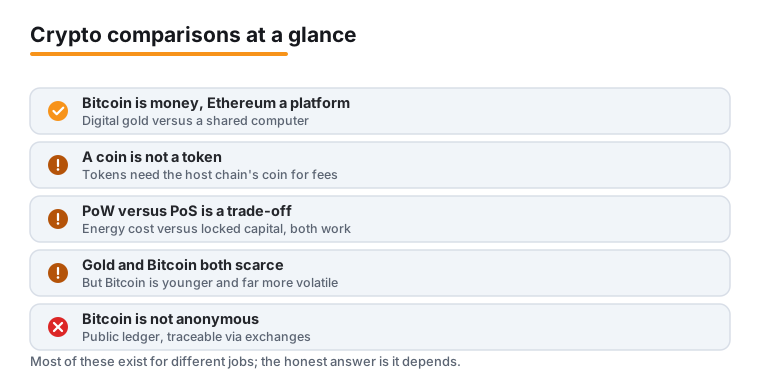
Bitcoin and Ethereum are the two largest crypto networks, and they are routinely lumped together. They are built for genuinely different purposes, and that single fact explains most of the differences people notice.
Bitcoin was designed to be money and a store of value: a fixed-supply, censorship-resistant digital asset that no central party controls. Its scripting capabilities are deliberately limited. The network does one thing extremely well, which is to securely move and hold a scarce asset. Its monetary policy is famous for being simple and predictable, capped at 21 million coins.
Ethereum was designed as a programmable platform. On top of moving its native asset (ether, or ETH), it runs smart contracts: self-executing code that powers decentralized finance, stablecoins, NFTs, and thousands of other applications. Think of Bitcoin as digital gold and Ethereum as a global, shared computer that also has its own currency.
A few practical differences flow from that:
- Supply. Bitcoin has a hard 21 million cap and a fixed, knowable issuance schedule. Ethereum has no fixed cap; its net supply changes over time because new issuance is offset by a fee-burning mechanism, so ETH supply can drift slightly up or down depending on network activity.
- Consensus. Bitcoin uses proof of work (mining). Ethereum switched to proof of stake in 2022. That distinction gets its own section below.
- Use case. People gravitate to Bitcoin for a long-term scarce asset, and to Ethereum for exposure to on-chain applications and the activity that runs on them.
They are not strictly rivals. Many holders own both, treating Bitcoin as a savings asset and Ethereum as a bet on the broader smart-contract economy.
Coins vs tokens
People use "coin" and "token" interchangeably, but they mean different things, and the difference is useful when you are evaluating a project.
A coin is the native asset of its own blockchain. Bitcoin (BTC) runs on the Bitcoin blockchain; ether (ETH) runs on Ethereum. Coins typically pay the network's transaction fees and secure the chain. If a project has its own independent blockchain, its native unit is a coin.
A token is created on top of an existing blockchain using a smart contract; it does not have a chain of its own. Most tokens you will encounter live on Ethereum or other smart-contract platforms and follow shared standards (on Ethereum, ERC-20 for fungible tokens and ERC-721 for non-fungible tokens). Stablecoins, governance tokens, and most newly launched assets are tokens.
| Coin | Token | |
|---|---|---|
| Runs on | Its own blockchain | Another chain's smart contracts |
| Examples | BTC, ETH | Stablecoins, governance and utility tokens |
| Pays network fees | Usually yes | No; you pay fees in the host chain's coin |
| How it's created | By running/launching a blockchain | By deploying a contract |
One practical consequence trips up newcomers: to move a token, you need the host chain's coin to pay the fee. To send a token that lives on Ethereum, for example, you need some ETH in the same wallet to cover the transaction. Tokens are also generally cheaper and faster to launch, which is why there are so many of them, and why the bar for scrutiny should be higher.
PoW vs PoS
Every blockchain needs a way for strangers to agree on which transactions are valid without a central authority. The two dominant methods are proof of work (PoW) and proof of stake (PoS). This is one of the more consequential crypto comparisons because it touches energy use, security, and how new coins are issued.
Proof of work, used by Bitcoin, has computers (miners) compete to solve a hard mathematical puzzle. The winner adds the next block and earns a reward. Solving the puzzle requires enormous computing power and electricity, and that real-world cost is precisely what makes attacking the network expensive. The trade-off is significant energy consumption.
Proof of stake, used by Ethereum since its 2022 transition ("the Merge"), replaces miners with validators who lock up, or stake, the network's coin as collateral. The protocol selects validators to propose and confirm blocks; misbehavior can cost them part of their stake. PoS dramatically reduces energy use. Ethereum's switch cut the network's energy consumption by roughly 99.9% according to widely cited estimates.
Neither is universally "better." The trade-offs:
- Energy and hardware. PoW is energy-intensive and needs specialized hardware. PoS needs almost none by comparison.
- Security model. PoW security comes from external cost (electricity and machines). PoS security comes from capital locked inside the system. Both are battle-tested at scale, and supporters of each argue their model is more robust over the long run.
- Participation. PoS lets holders earn staking rewards for helping secure the chain, either by running a validator or via staking services. PoW rewards go to miners.
For most holders, the practical takeaways are simple: PoW networks like Bitcoin lean on energy and miners; PoS networks like Ethereum let you potentially earn yield by staking, with its own risks such as lock-up periods and penalties.
Bitcoin vs gold
Bitcoin is frequently called "digital gold," so this comparison gets a lot of attention. The label captures something real, but the two assets diverge in important ways.
The case for the analogy rests on scarcity. Gold is scarce because it is hard to find and mine. Bitcoin is scarce by design: its supply is capped at 21 million coins, and the rate of new issuance is cut roughly every four years in an event called the halving. As of 2026, more than 95% of all bitcoin that will ever exist has already been mined, with the remainder released slowly over the coming decades. Gold's above-ground supply, by contrast, grows by only a small amount each year through mining, on the order of low single-digit percentages, so both are genuinely scarce relative to most assets.
Where they differ:
- Physical vs digital. Gold is a tangible metal with thousands of years of history as a store of value, industrial uses, and broad cultural acceptance. Bitcoin is purely digital, just over fifteen years old, and far less universally accepted, though adoption continues to widen.
- Portability and settlement. Bitcoin can be sent across the world in minutes and stored as a string of keys. Moving meaningful quantities of physical gold is slow, costly, and requires secure storage and transport.
- Volatility. Gold's price is relatively steady. Bitcoin has historically been far more volatile, with large swings in both directions. That is the main reason cautious investors still favor gold for stability.
- Custody risk. Gold can be stolen physically and needs a vault. Bitcoin can be lost or stolen if private keys are mishandled, and on-chain theft is often irreversible. Different risks, both real.
- Verification. Verifying gold's purity and weight requires expertise. Verifying bitcoin is trivial and instantaneous on the network.
A reasonable framing: gold is the older, slower, physically grounded store of value, and Bitcoin is the newer, faster, more volatile digital contender that borrows gold's scarcity logic. Whether Bitcoin earns a lasting place alongside gold is an open question, and not one to settle with price predictions.
Bonus comparisons: forks, custody, privacy, and fiat
A few other comparisons come up constantly. Here they are in brief.
Bitcoin vs fiat currency
Fiat is government-issued money such as the US dollar or euro. Its value rests on trust and legal status rather than commodity backing, and central banks can adjust its supply. Bitcoin is decentralized, has a fixed supply schedule, and is not controlled by any government. Fiat wins on stability, universal acceptance, and consumer protections; Bitcoin offers borderless transfers, a public ledger, and a supply no authority can inflate. In practice the two increasingly coexist rather than one replacing the other.
Hardware vs software wallets
A software wallet (a desktop, mobile, or browser app) is convenient and internet-connected, which makes it handy for frequent use but more exposed to malware and phishing. A hardware wallet is a physical device that keeps your private keys offline, far safer for long-term holdings but less convenient day to day. A common approach: a software "hot" wallet for small spending amounts and a hardware "cold" wallet for savings. Whichever you use, protect it with strong unique passwords, two-factor authentication where available, and a securely stored backup of your recovery phrase.
Hard forks vs soft forks
A fork is a change to a blockchain's rules. A soft fork is backward-compatible: nodes that do not upgrade can still participate, like a minor app update. A hard fork is not backward-compatible and can split the chain in two, sometimes creating a brand-new coin that existing holders receive. Bitcoin Cash and Bitcoin Gold, both from 2017, are well-known examples.
Anonymity vs pseudonymity
Bitcoin is pseudonymous, not anonymous. Transactions are tied to wallet addresses rather than legal names, but every transaction is recorded permanently on a public ledger. With enough analysis, especially when an address connects to a regulated exchange that knows your identity, activity can often be traced back to a person. Tools exist to obscure trails, but their effectiveness varies and their use can carry legal and compliance implications. Treat Bitcoin as transparent by default, not private, and check local rules, which differ sharply by jurisdiction.
Frequently asked questions
Is Bitcoin or Ethereum a better choice?
They are built for different jobs, so "better" depends on your goal. Bitcoin is designed as a scarce, fixed-supply store of value. Ethereum is a programmable platform that powers smart contracts and on-chain applications, and its native asset benefits from that activity. Many people hold both for different reasons. This is not investment advice, and you should do your own research before buying either.
What is the difference between a coin and a token?
A coin is the native asset of its own blockchain, such as BTC on Bitcoin or ETH on Ethereum, and it usually pays that network's fees. A token is created with a smart contract on top of an existing blockchain and does not have a chain of its own. To send a token, you generally need some of the host chain's coin to cover the transaction fee.
Does proof of stake make a coin safer or just greener?
Both claims have merit, but they are separate. Proof of stake is dramatically more energy-efficient than proof of work; Ethereum's 2022 switch cut its energy use by roughly 99.9% per widely cited estimates. Whether it is more secure is debated: proof of work derives security from real-world energy cost, while proof of stake derives it from capital locked as collateral. Both models are used by large, long-running networks.
Is Bitcoin really like digital gold?
The comparison holds for scarcity. Bitcoin is capped at 21 million coins and gold's supply grows only slowly, so both are genuinely scarce. But Bitcoin is digital, far younger, more volatile, and far more easily transferred than physical gold, which has thousands of years of history and broad acceptance. The analogy is useful shorthand, not a guarantee that the two will behave the same way.
Is Bitcoin anonymous?
No. Bitcoin is pseudonymous. Transactions are linked to wallet addresses rather than names, but everything is recorded on a permanent public ledger and can often be traced, especially once an address interacts with a regulated exchange that has verified your identity. Treat it as transparent by default rather than private.
Last updated: 2026-06.